Whiteout (Book 4): The City of Light, page 1
part #4 of Whiteout Series


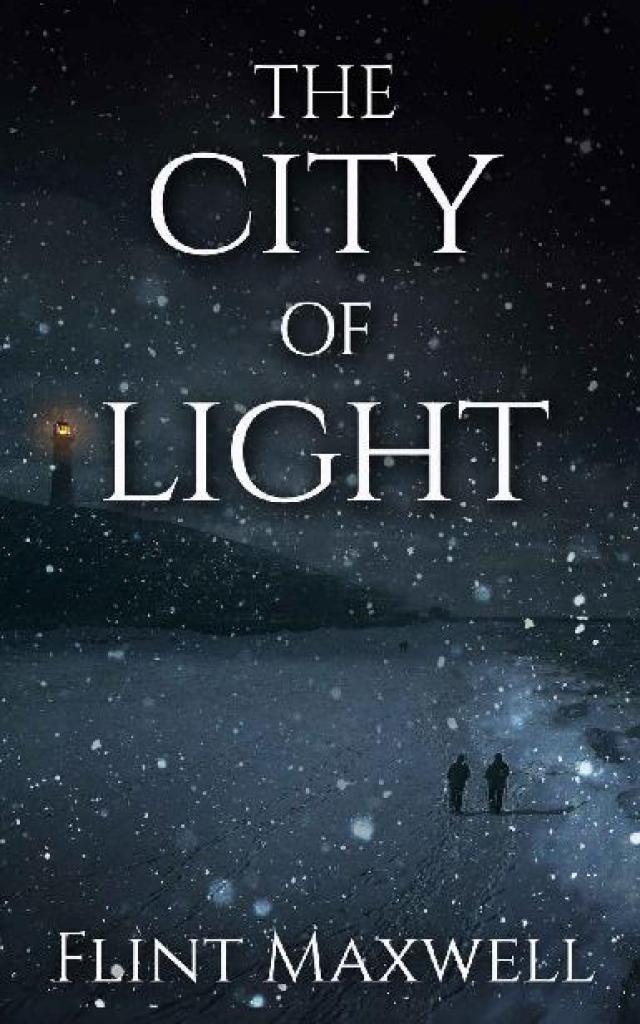
The City of Light
Whiteout #4
Flint Maxwell
Copyright © 2020 by Flint Maxwell
Cover Design © 2020 by Carmen DeVeau
Edited by Sonya Bateman
Special thanks to Sabrina Roote
All rights reserved. No portion of this book may be reproduced in any form without permission from the publisher, except as permitted by U.S. copyright law. For permissions email: fm@flintmaxwell.com
This is a work of fiction. Names, characters, places, and incidents either are the products of the author’s imagination or are used fictitiously. Any resemblance to actual persons, living or dead, businesses, companies, events, or locales is entirely coincidental.
The author greatly appreciates you taking the time to read his work.
For Jake Clarkston,
who’s always been apart of the family
Join the Flint-Stones, my rarely used newsletter, and receive a free book of horror stories called The Bitter Cold.
Get Your FREE Book Right Here!
Visit my WEBSITE for news, info, and more free stories!
Too much mystery is merely an annoyance. Too much adventure is exhausting. And a little terror goes a long way.
― Dean Koontz, Odd Thomas
1
Grief
The moon was dead.
So were the stars.
I hadn’t seen a hint of either since the blizzards began. And I missed them, but I especially missed them during the cold, dark hours of the night, when the sky became a solid black wall of nothingness and the monsters called our names.
I missed them the way I missed Jonas, that rambunctious family man who had lived at the gym, and who would stay on his feet after downing enough booze to knock an elephant on its ass. I missed them the way I missed Helga, the kind woman who had taken us in after we fled our rented house on the opposite side of Prism Lake (even after I busted one of her windows). I missed them the way I missed Mikey Hark, Ell’s little brother, who had proven himself to be a fun, loving, and hilarious young man, and who was brutally murdered at the hands of the insane human monster of Woodhaven, Ohio.
Speaking of Woodhaven, we left that dreaded town the first chance we got. As soon as a sliver of light burned through the clouds, we packed up and drove our snowmobiles through the fresh powder, pushing their engines to the limit and putting Woodhaven far behind us. I kept thinking how if I turned around, I’d see a dark figure standing in the snow. That figure would be Bob Ballard. I’d see how his head was only attached to his neck by a few red strands, how his mouth was full of blood, and how his eyes were full of murder.
I don’t know if you remember, but I mentioned my vision going dark when I did what I did to Ballard, and how I only recalled the aftermath. But as miles and more time separated us from the events at that house in Woodhaven, my mind decided to start filling in the blanks, showing me snippets of what happened. Most of these snippets came in the form of nightmares. In them, I saw myself thrusting the shovel’s blade through his throat. I saw the blood, so much of it. I saw how it pooled in the curves and indents of the metal. I saw the flashes of white that were his spine, the glistening cords that were his tendons, and the life slowly fading from his eyes.
But instead of dying in these dreams, Bob rips the shovel from his throat and laughs. The wheezy cackle escapes from the gash in his neck more so than from his mouth. A red mist sprays over my face, and then he turns the shovel and thrusts it through my throat. I feel my head detach, and as it rolls from my severed neck and hits the basement floor, a cloud of dust blooms, blinding me. Somehow, I’m still cognizant, conscious, alive. The dust clears. Bob shambles like a zombie and, smiling, his own head barely attached and bobbling, he yells, “You should’ve cooperated, Grady, my pal! Should’ve let me do what I had to do, and maybe it wouldn’t be this bad!”
His boot rises and comes down like a falling anvil—and then I wake up screaming.
Yes, these images had become a nightly occurrence after what we went through. I couldn’t shake them, and although they’ve lessened in frequency, I don’t think I ever will.
For three days we stayed in Woodhaven, and like I said, we moved on at first light, traveling for the better part of a day before seeking shelter in another small town called Tallmadge Falls. Unlike Woodhaven, though, this place was deserted—as far as we knew, at least. No survivors, no crazies, and no wraiths. Just snow, a sea of white as far as the eye could see, broken up by trees whose trunks were mostly buried.
We wouldn’t have stopped there if not for Ell.
I was driving the snowmobile. She was riding passenger next to our measly possessions—lots of Off! bug spray, lighters, and a few flashlights—and Mikey’s body lay on her lap. He was still wrapped in the sheet. Ell held him, clutching her little brother to her chest. She spoke no words for the duration of our journey, but sobbed softly to herself every so often.
Stone drove the other snowmobile, following closely behind Ell and I. Mia and Chewy were his passengers, along with the rest of our possessions—these consisted of spare coats, blankets, socks, shoes, and what was left of the food we took from the gas station near Avery’s Mills.
We were coming upon a town when Ell whispered. I barely heard her over the sled’s droning engine and the constant battering of the wind. I glanced her way, saw she was pointing out of the cracked windshield to the right, and turned my eyes in that direction. Here I noticed something besides the distant treetops. Flashes of brilliant white stood out between the woods, and above, a towering spire stretched into the sky, a beacon against the backdrop of gray and black.
“What is it?” I asked.
“A church,” Eleanor answered. “I think.”
“It’s pretty.”
“It’s more than that. It’s the place, I can feel that there’s—I don’t know—there’s something about it.”
I had no clue of what Ell was talking about. Yeah, the idea of pulling over and making sure she was okay crossed my mind, but I didn’t. After what we'd experienced in Bob’s basement combined with the loss of her brother, you had to think she was close to losing her sanity entirely. I know I was. But, like I’ve said before, Ell’s stronger than most.
“We have to go there,” she said. Her eyes burned with a seriousness I hadn’t seen since before Woodhaven. “That’s the place I want to leave Mikey. The place I want him to rest.”
I asked no more questions, and I steered through the sea of white toward the spire. And as we gained on the church, I knew Ell was right.
There was something about it.
Tallmadge Falls reminded me of Woodhaven in a lot of ways—small, surrounded by empty farmland and forest, and deserted. In the heart of the city there was a town circle instead of a square. The circle was a large roundabout with eight exits branching off in every direction, but in the middle was a park. Tall trees were planted around the outside, a way of deterring drunk drivers from jumping the curb and plowing through the grass. Of course, snow covered most everything around here, another thing the two towns had in common, so I allowed my imagination to fill in the blanks of what was under the layers of white. Park benches, walkways leading to the few buildings in the circle, trash cans, and maybe some memorial plaques dedicated to the town’s bigwig donors. Fast food places, gas stations, and drug stores surrounded the outskirts of the roundabout, but they were pristine in comparison to the shabby businesses and the creepy motel we saw around the town square in Woodhaven.
Even if there was a creepy motel, I don’t think it would’ve brought down the circle’s centerpiece. That church. As we got closer to it, I realized how dated it was. In fact, some may have called it beyond dated. Ancient was a better descriptor. The politer term, I believe, is historical. Still, despite its age and various points of disrepair, the church was beautiful. Maybe even more beautiful surrounded by all that snow, where it shined bright like a star in the night sky.
I drove our sled up to the steps leading to the church’s door and killed the engine. I felt like I was looking at an old painting, the kind you see housed in protective cases meant to prevent the endless stream of camera flashes from wearing the portraits down to blank canvas.
Four pillars rose high in front of the building, and large chunks of paint were missing from them, showing the wood beneath. Above the pillars was a large stained glass window showing a distorted depiction of Christ on the cross. Black holes peppered the torso. It was as if someone had thrown rocks at it, but that nor the sheeted ice could dampen the dazzling brilliance of the art. At the top of a stone staircase all but buried by the snow, a tall door rose between the second and third pillar. I craned my head and took in the tower, the belfry, and the spire, the latter ending with a cross at its apex, which pierced the heavens above.
A blanket of warmth invaded the snowmobile’s cab. I don’t think I imagined it or that it was some sort of mental sensation. I honestly believe the air grew a few degrees warmer. Not much, but in those conditions, a few degrees went a long way.
The idea this place might’ve been protected wasn’t a crazy one. I think—as I’m sure the others did as well—that there was magic there, but it was the type of magic one wasn’t meant to keep. It was like finding a ladybug, and with it, good luck. But you couldn’t lock the poor insect away in a jar and keep it forever, milking it of its power. No, you had to let it go. You had to open the window or your front door, and help it back into the wi
In our time there, less than a day if memory serves me correctly, nothing bothered us. When I say nothing, I mean nothing. The wraiths steered clear of the circle and perhaps the town in general; no beasts wailed or screamed save for the wind, and even that was tame compared to what we’d been used to. Nothing called our names; nothing taunted us; I thought no bad thoughts; and, for the hour or two of sleep I got while inside, my nightmares of a murderous Bob Ballard were nonexistent.
We lived almost in a state of wonderful bliss.
“Yeah,” Ell said, voice shaky but not from the cold. “Yeah, this is it.”
Stone and Mia pulled up next to us. They were both staring at the building with dreamy smiles on their faces. Between them, Chewy stood on his hind legs, his forepaws planted on the narrow dashboard, and looked out through the foggy windshield. Even the dog seemed happier, and I was glad for that after what he’d gone through.
“I’ll see if it’s open,” I told Ell and got out. Her voice followed, which I heard loud and clear thanks to the slowing wind.
“It’ll be open,” she said with one hundred percent certainty, and she was right.
The door swung inward silently almost as soon as I touched it, almost as if someone, some unseen host, had opened it for me. Come in, come in, Grady. Sit for a bit, warm your bones, rest your soul.
Goosebumps prickled my flesh and a shiver went down my spine, but like Ell’s shaky voice, I reckoned this wasn’t a result of the blistering cold.
I paused before crossing the threshold, and my eye caught a sign at the edge of my vision. The top of it jutted out of the snow, cutting the letters of the first line in half. I sidestepped over to it, cleared it off, and read these words:
Tallmadge Falls Historical Church
Built between 1822 & 1825, and
designed by Franklin Cantor
This historic landmark is the oldest
church building in Ohio still in
continuous use as a place of worship.
I found the sign slightly sad now that the church was no longer a place of continuous worship, but that didn’t make it any less welcoming. I turned and waved the others toward me. They came, and I went back and helped them up the steps one by one.
Ell was last, having been studying the edifice for as long as it took Stone and Mia to get to the door. She still held Mikey’s body in her arms. I took him from her, and together, we entered.
Darkness hung around the pulpit and up in the eaves, but it was not a malicious darkness, the kind which frightened us. It was just a regular darkness, if that makes sense—the result of an absence of light and not the result of supernatural beings. Still, malicious or not, hating the dark is built into our DNA, and when we spied the rows and rows of unlit candles lining the aisle and behind the stage, we wasted no time igniting them.
Stone limped to the pulpit with the help of his two-by-four, and sat heavily on the step. He shook his head, making the hood of his coat fall backward. “Man, for a place as old as shit, it’s not bad.
“Stone!” Mia snapped. She was sitting in the first row of pews closest to the stage. “You can’t say ‘shit’ in church!”
“You just did.”
Mia faked a laugh—har-har-har! “That doesn’t count, you ass—”
Stone raised a finger and pointed at her. “Ah!”
“—assin. You assassin! I said ’assassin’!”
Stone grinned. “Not that it makes any sense…but nice save.”
Their exchange made me crack a smile, but I didn’t join in their laughter. Though I felt safe and somewhat warm here, I was too concerned about Ell. She hadn’t moved from her spot at the back of the church, where I had laid Mikey on one of the pews. She was standing behind it, leaning over and staring down at her little brother with tears in her eyes. Every few seconds, one would drop and the sheet wrapped around his body would absorb it.
I cleared my throat. The others looked my way, and I nodded sideways toward Ell. They came as I put a hand on Ell’s back. Knobs of spine and ridges of ribs poked through the many layers she wore, and I wondered when it was she last ate—or slept, for that matter.
“What do you wanna do?” I asked.
“I wanna bring him back,” Ell answered, smiling somberly. “But I can’t, so I guess I have to let him go.” She stroked the end where Mikey’s head was. “And we can’t bury him. The ground is too frozen for that, plus we don’t have any shovels.”
“Even if the ground wasn’t,” Stone said, pinching my bicep, “Grady wouldn’t be much help.”
“I’d try my damndest, though. Know that,” I said. “If you want me to go outside right now and start digging with my bare hands, I will.”
Ell’s smile transformed from somber to something slightly warmer. “I know you would, Grady.”
Stone wrangled my neck and rubbed my head with his knuckles. “You’re a good guy, dude. Sometimes too good.”
Standing on tiptoe, Ell kissed me on the cheek, and pleasant chills rippled along my shoulders. “Don’t worry, you don’t have to do any digging, Grady.”
“Then what should we do?” I asked.
Ell shrugged. “I just want to give him a good send-off.”
“And leave him?” Mia asked.
Ell nodded. “Yeah. He’ll be safe here.”
So that’s what we did. I helped Ell clean Mikey up. Wiped the blood away, combed his hair, changed him into clothes that weren’t soaked red. Ell, God bless her, stayed strong throughout the entire process, and when we were done, Mikey looked close to the way I remembered him.
His body lay on a dais, surrounded by lit candles and with a large cross towering over him. Nice words were said, tears were shed, and Chewy howled.
Finally, in a beautiful church in a beautiful town, Mikey could rest.
The sun shined through the clouds a handful of hours later, letting us know it was time to move on. So we continued south, and when the sun’s already dim light dimmed more, we found shelter, waited out the dark, and then left again.
Rinse. Repeat.
It was maybe a week and a half after we had left Woodhaven when the light disappeared for the longest stretch in recent memory. We might have tried waiting out this darkness, but I knew we couldn’t with Mia so close to having her daughter. Although usually cool and collected, Mia had become increasingly worried—for good reason—and after much deliberation, a decision was made while we stayed in a bakery full of stale and frozen pastries and bread. The decision was that we would press on, because we had no other choice.
As long as the snowmobile’s headlights worked and the storms remained mild, not dumping another half-dozen feet on us, we’d be okay.
And so far, we were.
The monsters left us alone, but they stayed close. That, I know for sure.
Not long after we’d left the bakery, our sled needed to be refueled and I got out to fill the tank. Ell was fast asleep, and I didn’t want to wake her, so I signaled Stone and Mia, stopped, and began the process as they shined a circle of light on me. It kept the monsters at bay, but it didn’t stop them from taunting us. I knew this because when I poured gas into the tank, a soft voice drifted my way.
It was Mikey’s.
“You let me die, Grady. You weren’t fast enough… Why, man? Why couldn’t you have saved me? Are you gonna let my sister die too? What about Mia? Is her baby gonna freeze to death?”
I had no answer for these questions, and I ignored the voice as best as I could. But I will admit this: my hands were shaking so badly when I dumped the gas, I spilled a good amount down the front of my coat.