

Space War: An Empire Divided, page 1
part #1 of Black Death Series


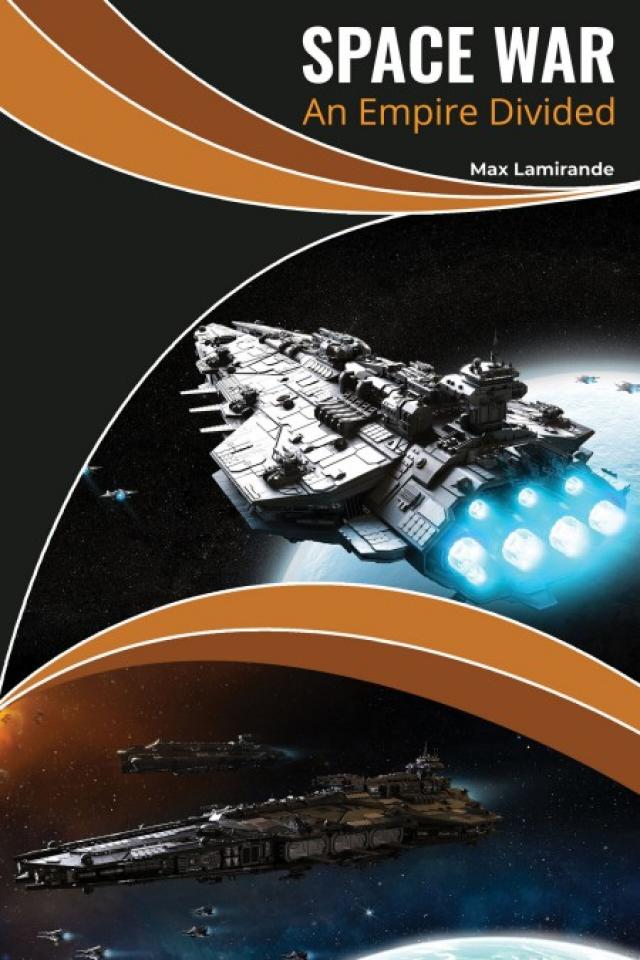
(c) Max Lamirande, 2023
Published by Max Lamirande
Proof read Stephen Sokol
(c) 2023 Saguenay, Quebec, Canada
All rights reserved. No part of this book may be reproduced or modified in any form, including photocopying, recording, or by any information storage and retrieval system, without permission in writing from the publisher.
FOREWORD
Dear readers,
Welcome to the Black Death Series. Thank you very much to the new people who just bought their first book from me; I will try to entertain you as much as possible. Welcome back to those that crossed over from my alternate history book series!
This book is my first try in the science-fiction and military space genre, so I hope you guys will find it enjoyable. Not the easiest to write, that's for sure. I lacked the familiar World War Two timeline but appreciated the no-limit writing with my imagination.
I have tried to make a future world enticing to you guys and enough action for those military space novel enthusiasts to revel in the story. Enough battles, enough mystery, enough characters, and intrigue. It should be a nice ride, with at least three books, and we'll see how popular this series gets once it takes off the ground and is published.
Special thanks to my friend Stephen Sokol for the editing help and proofreading. I hope you are enjoying your Macallan, wherever you are now!
About to board a place for a real-life trip to Europe for a real-life job. Next stop, Southern Germany and the Eagle's Nest. I will start writing Siege Pacific (Book 7 of the Pacific Alternate Series) there and should post more about it in the next foreword on the next book.
In the meantime, take care and enjoy the story.
PROLOGUE
A thousand years ago
Worms for wormholes
He was dreaming again; he was certain of it. He was floating in darkness. He was dressed in his imperial robes, with boots and his crown, but he could breathe, so it meant that he was not really in space. He looked at the palms of his hands but could barely see them. There was darkness all around him. Nothing was there; no sound could be heard. Nothing moved, no lights. A long time elapsed, then a small light appeared far, very far away in the nothingness.
The light grew in intensity as he seemed to approach it slowly. Then more lights started to show themselves. A few dozen at first, then hundreds. Then thousands. Suddenly he was somewhere in deep space, looking at the immensity of the magnificent galaxy before him. Space was full of bright white and yellow stars, red and blue nebulas, and hazy white cloud-like areas.
He closed his eyes for a moment as if extremely tired. When he reopened them, he was elsewhere. Still in space, but now in some unknown star system. It appeared that he was not even in the Milky Way Galaxy. The star system he was looking at had a sun that shone with a bright red and orange glow, like the sun in Earth's Solar System. It harbored several blue and red gas giants and a few rocky planets close in the inner system towards the star. Right in the habitable zone rested a blue and white planet like any other human-habitable world. Haakon felt that it was not inhabited by humans, but he could still see the bright lights of civilization on it as he faced the planet's night side. Millions of lights shone on its surface. In space, he saw large objects floating around the planet. Some moved, and some stayed in geo-synchronized orbits. Ships and space stations, he decided.
He closed his eyes again, and when he reopened them, he saw that he was right above the planet. He was startled by a large ship passing just by him, its rear engines flaring bright. He looked at it closely. It was a warship bristling with guns and looked powerful, even ominous. Its shape was quite strange, almost bulbous in form, with flowing curves, like some deep-sea creature.
Closing his eyes seemed to change his perspective. Feeling that his dream wasn't so discomforting after all, he decided to close his eyes for a third time. When he reopened them, he was somewhere else but couldn't really understand what he was looking at. The area he was in seemed filled with a reddish glowing liquid. Strands of colors swirled about everywhere in towering columns stretching for millions of kilometers. As far as he could see (and he could see as far as eternity, it seemed), he was in some alternate space or reality differing from the one that humans and the Milky Way Galaxy came from.
And then he perceived something, a presence winking to prominence in the dizzy, dreaming parts of his dreaming mind. He was in jump space but didn't think he'd ever seen it like it was at that moment. Humans could see and look through a Durasteel window at jump space with their own eyes but had not done so for a long time. Nothing exterior to the hull worked while ships were in jump space. No radar, no weapons, and no telemetry, so outside visuals from man-made devices couldn't show anything.
During the Age of Discovery, back in the 2600s and the 2700s, ships still came equipped with outside windows and viewports giving way to space, so ship crews could see and feel their way around space. As technology evolved, outside visual access was abandoned in favor of ship armor and efficiency. The only place where it could have been useful for humans to rely on their own eyesight would have been in jump space, but nothing mechanical, electronic, or energy-based worked outside the cocoon or bubble that was the ship itself. So over time, humans had simply abandoned the attempt to try to understand what lay in the so-called jump space between two wormholes. The emperor realized this might have been a mistake and decided to do something about it when he woke up.
But then why had his normally very vivid and useful vision-dream showed him this? He shook his head and again wondered what he was doing in jump space when a beautiful yellow strand of light twirled just past him, ending its course in an explosion of blue and red colors, like a rainbow imploding on itself.
Just as he was about to close his eyes because he felt nothing else could be attained in this bizarre region of space or reality, something caught his attention. Something moved in a straight line toward his general direction. It was immediately obvious it was not one of the colorful swirls or one of the towering columns of colors because it was on a level trajectory, just like a ship would be on a vector. And it was big. Very big.
It eventually approached close to him, and what Haakon saw baffled his mind. It was some kind of space beast or at least something alive. It opened and closed its mouth like it was eating the yellow and red twirls of colors. The gigantic thing was at least twenty kilometers long and easily three kilometers wide.
Yes! It was feeding. He decided that the thing looked like a giant worm. He also perceived some sounds and decided it wasn't that peculiar, for jump space was known to be noisy. In jump space, countless reports told of strange noises and other eccentric tales. What he saw was the source of the noise. He also thought this beast might explain why ships sometimes disappeared while transiting from one wormhole to another, although he could not find any malicious intent from the large beast. Modern science could not explain why this happened, nor the frequency. Years could go by without incidents, and then dozens could be reported in a month. The best explanation was always mechanical or some unknown malfunction, but now the emperor knew better. Jump space harbored life. He wondered if the beasts were sentient.
The giant worm came forward as if swimming in the fluid-like state around it. Nothing happened momentarily, the worm feeding or absorbing the colorful strands. Then it seemed to get agitated, and Haakon clearly heard it roar. The beast started to emit a bright light from its large mouth, and red and blue circles appeared out of nowhere, twirling in color and shape like a wormhole. "No, that can't be," he said out loud. But then it seemed like it! The worm started to go through the large swirling circle of colors. Wanting to see and understand where the worm was going, he closed his eyes again, hoping to be transported again.
And he was. He was back in normal space, momentarily experiencing a bright white light completely clouding his vision. It was like looking at a nuclear explosion without protective goggles. When he could see again, he realized he was facing the opening exit of a wormhole, but it was not acting like the ones he'd seen in his long life. It was as if the very fabric of space was being ripped open by some unknown, powerful force on the other side. Having been on the other side, Haakon knew that it was.
Then, the giant worm he'd seen a moment ago burst out into normal space going through the wormhole. He was baffled for a moment but then felt that something was happening behind him. The world he'd seen before was there but encircled by the dreadful and ominous black swirls he'd seen in so many of his past dreams. The swirls were busy completely absorbing the ships and orbital structures while its large black tentacle-like strands gripped the planet. He thought he saw some bright laser bolts from the ships, trying to defend themselves, but the vessels were clearly losing the battle. But then, something seemed to happen. The black swirls twitched in a few giant moves, seemingly imploding and exploding on themselves like a swarm of bees. Haakon decided that it reacted to the giant worm's appearance.
The beast moved in the blink of an eye (he didn't know how it could move so fast, but it did), and within a moment, it was plunging into the black swirl. What the emperor saw next baffled his mind, the black swirl tried to flee the giant worm, and the beast was devouring the blackness whole into its mouth. The two battled each other for a while, the beast pursuing the swirl, and they raced away in a deathly dance away from the planet.
Haakon then noticed something curious. The position of the newly created wormhole was exactly where.... Where?
Elysian Star Cluster
Cassiopeia system, near and around planet Gides-3, year 4124
A large explosion rocked the ground in front of one of the giant war mechas trying to hold the hill dominating the fiery and burning nightmarish landscape. The enemy fire attempting to hit the battle armor came from across the field, over the river. The mecha moved sideways at an impossible speed and crouched behind a large rock outcropping. The rock was blasted with several explosions a second later, each explosion missing its intended target.
The scene of battle was utterly chaotic. Lasers saturated the air everywhere, missiles flying on both sides. Giant robot-like beings were firing at one another. Here, one mecha was hit by a missile and tumbled backward, its protective energy screen flaring brightly as it absorbed the energy of the blast. There, another one fired its missiles from a pod on its back. The ten small weapons streaked above him momentarily and then thundered toward the mecha's opponents on the other side of the river, followed by white lines of smoke that soon scattered in the air. The target's energy shield flared as it reeled from the multiple explosions.
Another giant robot leveled his arm and fired its energy cannon at one of his enemies, penetrating the energy screen. After all, it was point-blank range, which always meant damage for the mecha that was hit. The powerful focused laser hit the central part of the battle armor, blasting it open, instantly killing the pilot inside, a trained combat soldier just trying to survive.
And if the battle and explosions weren't enough already, a rain of kinetic rounds suddenly fell from the sky. They soon impacted on the ground, creating huge mounds of earth and rubble, smashing the troops defending the ground beyond the large river. Large blasts soon followed, flooding the area with expanding balls of energy. The mechas on the hill streaked up in the air using their back and feet reactors, racing across the field to exploit the planetary bombardment their ships had just executed from space. They soon flew over the debris-filled river.
(...)
Above the dark sky, another battle was being fought. On a different battlefield, but a fierce fight nonetheless. Large ships approached one another at what could be considered point-blank distance in space. Only a few thousand kilometers apart, the two groups of ships fired lasers broadsides at the other. Streaks of energy and projectiles crossed the distance between the two warring fleets. Focused laser beams, plasma torpedoes, kinetic rounds, and ion cannons were fired by ships of similar designs. Some small, some large, and some very large ones. The ship's defensive screens from both sides flared white as they released the energy that had been trying to take them down.
The largest of them were just over a kilometer long and triangular in shape. The largest volume of fire came from those ships, as they had an incredible number of weapons on their hulls. It was also obvious that they fired nuclear weapons at each other from the large balls of white and carmine energy exploding on both sides of the battle.
Once in a while, a ship screen was taken down in a flash of dying energy, and the streak of plasma torpedoes, missiles, and solid kinetic rounds pounded its hull. From this short distance, the result was almost always the same. The vessel started to disintegrate under the strain of so many hits and then exploded outward in a catastrophic blast swirl of gray, red, and white colors, followed by expanding debris.
American Admiral Kurt Kimmel was strapped on his commander's chair aboard the Battleship Genesis as he watched the death of one of his own in silent, horrified awe. He never got used to his ships being destroyed. The battle he was directing was fierce. It was hard for him to take in all at the same time. Large fleet battles had been a thing of the past, things he'd learned at the Imperial Academy during his officer training course. War had been a thing for history books except for occasional engagements against pirates or small meaningless rebel worlds. This sort of fighting was new for him and his colleagues of the old Imperial Fleet. The last fleet battles were dated two hundred years ago, so no one alive had ever seen them. This didn't mean that the men and women commanding the warring fleets couldn't command them efficiently. They were well-trained and knew how to fight, except they were not all on the same side anymore.
Kimmel was the commander of the 2nd New American Fleet, which had just arrived in the Cassiopea Star System to try and help repulse the attack from the Ptolemy Star Navy attempting to invade the planet Gides-3, an earth-like colony of the Elysian Star Cluster. The Elysian were New America's allies and were being invaded by the Ptolemyans.
"Continue to concentrate on a big enemy battleship," said Kimmel to his weapons officer, Lieutenant Stravis. The ship rocked hard right after he'd given his order. Alarms blared across the command bridge. "Report, Commander Potemkin," yelled Kurt to his executive officer. Clara Potemkin was a very attractive younger woman. She was new on the ship, and Kurt had immediately noticed her good looks and competence. She had transferred from another battleship following the retirement of the XO of the Genesis. So far, he'd been quite satisfied with her work and skills. She ran a tight operation and was already feared by the rest of the bridge officers. Currently, Kurt was not interested in her looks but in her competence and how she processed his orders.
"Admiral, that last blast was a combination of three ten-kiloton explosions from enemy missiles. The Phalanx-10 defense system was not able to intercept the large volley sent at us." She paused to type some more on her control console. "The screen is holding at sixty-four percent," she finished. The XO's console was beside Kurt's command chair, so they could talk and see each other's screens and information, helping command the ship in battle.
"Mmmmm," mumbled Kimmel. The Admiral looked at his holographic tactical display, depicting the battle before him. The Ptolemyan task force was being pressed from two sides, as the New American fleet had arrived in the system while the battle was already underway between Elysium and Ptolemy. Just as he was about to formulate his next set of orders, one of the Ptolemyan battleships near Genesis exploded spectacularly in a bright expanding white ball of energy. Its screen had been overloaded a minute before, so a barrage of kinetic rounds and an atomic explosion followed, proving too much for the ship's reactive, energy-absorbing armor. "The Stalwart's Fury is gone, Admiral," said Potemkin, flashing him a feral smile. The Fury had been a ship from the Ptolemy Star Navy, formerly of the Imperial Fleet, explaining why the New American computers could identify it. All former imperial vessels had identification markers that the rest of the fleet could recognize. "Excellent, Potemkin. Please assist Battleship Aurora on grid 230-98. The data shows that the enemy ship facing it has its screen about to fail." "Indeed, Admiral," answered Clara, surprised that her commander had spotted the info amid all the cacophony of sounds and images.
It was impossible to see the battle with the naked eye. It was just too complicated for the human brain to compute a three-dimensional space battle. Distance, height, direction, and the void of space were not things that evolution had prepared humans for. Ships in space used sophisticated computers and AIs (artificial intelligence) to analyze and collect the data necessary for Kimmel to direct his battle. Without them, he would not have been able to comprehend or lead anything but his own ship.
After looking at the rest of the data pouring in on his holographic display, he surmised that the Ptolemyan admiral's fleet was doomed. His force was hemmed in between the New Americans (Kurt's) and Elysians (New America's allies), who were superior in number. And since the technological levels were similar in all of the human enclaves (former empire), numbers would do the trick in this battle.
There was no way out. He could see that the enemy ships were trying to extricate themselves from the battle, but they could not escape. Their sub-light drives flashed bright, but Kimmel and his Elysian ally only had to match the speed and continue to fire.


