Paris Red: A Novel, page 10


Once I start thinking of that, I think of every flower I can: lilacs, hyacinths, oeillets, honeysuckle, alyssum, coquelicots, nasturtiums, bluets, violets, pansies, lily of the valley, morning glories, roses and peonies—peonies which sometimes smell more like roses than roses do. But that still is not enough, so I go through the alphabet and try to think of flowers for different letters, and that way I pick up acacia, anemone, aster, camellia, chamomile, chicory, cinquefoil, clematis, clover, columbine, daffodil, daisy, dogsbane, flax, foxglove, gentian, gillyflower, goldenrod, heliotrope, jasmine, jonquil, lavender, lily, linden, lobelia, love-in-a-mist, love-lies-bleeding, lupine, madder, marigold, mignonette, nightshade, orchid, primrose, soapwort, sweetpea, tansy, valerian, veronica, viola, and wisteria. It takes a long time to come up with the list, and to come up with a picture of each of the flowers in my mind, and where I was the last time I saw it, and in that way hours go by. And when I get all the way through the alphabet, I think about the Marché aux Fleurs on the Île, and how tomorrow is Sunday and the bird sellers and rabbit sellers will be there with their wooden cages—
“Ça y est,” he says, breaking me out of my thoughts. And when I hear his voice I close my eyes and keep them closed a long time, and what I see is not his studio or him but the marché with its small cages and flowers, all of it there on the quai, there in my mind’s eye.
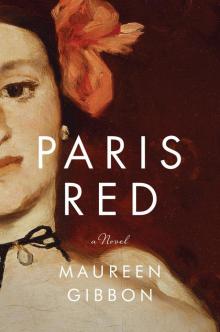
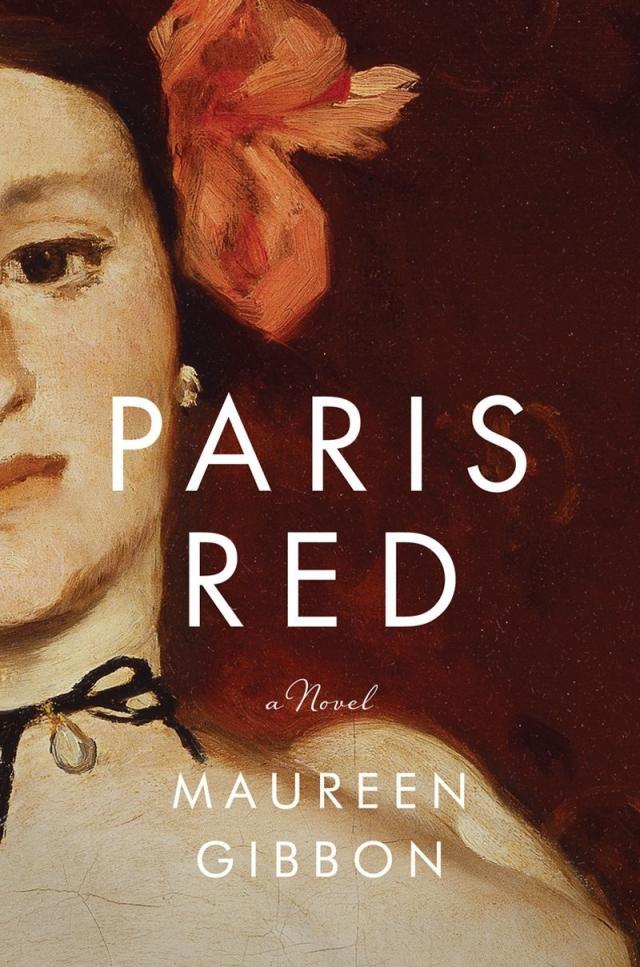
When I look at the painting—when he brings me around to see what he has done of it so far—I know everything I was thinking about is there in my eyes. The strongman is there, and Nise, and flowers, and the flower market, but also the quietness of the studio and the air between us.
It is all in the paint. It is all in the expression on my face.
“I like my eyes the best,” I say, and he nods.
The blue bow in my hair, the fancy blouse, the black ribbon around my neck—all that gets added in after I sit for a while, resting, after we both eat bread and cheese back by the cupboard at the rear of the studio and drink one glass of wine. A blue bow because my hair is reddish orange. A black ribbon around the neck to contrast with the cream of my skin.
Still, when I am putting those things on, even though I partway know the answer, I say, “Why didn’t you just have me wear this from the start?”
“Because you would have been different.”
I understand, I do—the frippery would have made me feel different, or stand differently, and if he had told me he wanted me to wear a bow, I might have washed my hair and fussed with it.
But now that I understand, it isn’t necessary. Now I understand that what matters is honesty. What matters is where I go in my head.
So in a little while I say, “Just ask for what you want. I’ll give it to you.”
He looks at me for a long while after I say that, and I think he will say something. But he does not. He just goes back to placing paint.
When the painting is done, we look at it together the way we did with the pastel drawing. This time I can see the focus is not my breasts or a blue stocking but my face.
Just my face.
I look plain. Not ugly, but not pretty, either. My lips are pale, my eyelashes light, and I can even make out the faint dimple in my chin. I look at all those things, I do, but I keep going back to my eyes. He has made them gray-green, and as I go on looking at them, I think I have never seen that color. And I think that must be why he made the rest of the painting so simple. Why he would not let me do my hair, why he kept my face naked. Yes, I am wearing a bow in my hair and a ribbon on my neck, but for some reason I hardly notice those things.
There is nowhere to look in the painting except my eyes.
And this time I know it is really how I look, not because I have seen my face that way but because I know what it feels like to look that way.
When my mother would not speak to me. When my grandmother died. When my heart was broken.
So this time it is a different question I ask. This time I ask, “Is that how you see me?”
He says, “When you let me.”
It is after that painting that I start wearing the black ribbon. Not just when I sit for him—all the time.
I do not know if it belonged to someone else or not—it was in his studio the day he painted my portrait. It does not matter. It belongs to me now.
Sometimes I tie it in front, the way it was in the painting, and other times I turn it into a choker with the ends trailing down my back. Sometimes I wear it in my hair. I wear it for days, until it smells of my skin and hair, and then I wash it out in my basin. Borrow an iron to iron it.
Of course he notices it. And of course he knows I took it.
“It suits you,” he tells me. That is all he ever says about it.
This time the photos he shows me are not from Moulin. There is no art to it, no pretend poses of awkward girls with their skirts pulled up or side views of breasts. There is one focus only: the cocks of the men rising up into the women.
I know he shows the photos to me to shock, and they do. Even when I tell myself not to let it show on my face, I know it does. And after the first couple, I only half look.
It is not just the naked bodies that disturb me. The faces disturb me. A flat-faced woman who looks stupid or half-witted, and all the men with dark mustaches. It all repulses me. And I know that is part of it too: he wants to see my reaction.
After five or six photos I want to tell him to put them away, that whatever it is he wanted, he got. But then the photos change and for some reason I do not look away.
It is not the woman, who is prettier than the others, with flowers in her hair and some kind of necklace. It is the man. He is the reason I do not look away.
In the first photo he is in profile, and I can see his collarbone, the way the muscles in his neck lead down to it like cords. His hair is longish and brushed back, and he is handsome. Clean-shaven. Young. And his face. His eyes are downcast or facing the woman in all the photos, but you can still sense what his eyes are like. There is a calmness there.
In one photo he leans back in a chair, head propped up on one fist. He gazes down at the woman, who sits below him, sucking him. The look on his face is one of—not love, I would not claim that—but seriousness. Patience. Some kind of devotion.
“These aren’t like the rest,” I say. “The rest are fake.”
“You don’t think these are fake?”
“These two are lovers. Real lovers. Not just for the pictures.”
“Why?”
“Look at his face,” I say.
He watches me for a little while and then he says, “They could be lovers. Or you might just like him. Like the look of him.”
“I like his face.”
“Not his body? He’s got quite a cock.”
But I think the photos cannot show what is not there.
I think the sweetness and patience in the man’s expression come from whatever he feels for the woman and the body of the woman. It is not something a photographer paid for. But what he says is also true: I like the body of the man in the photograph. I like his bare chest and his thighs. His sex. But without the expression on his face I would feel nothing.
So I say, “Yes. I like him. None of the others compare.”
I face him when I say it and let his eyes read mine. And I can tell that I passed some kind of test. Because I told the truth. Because I was bold enough to tell the truth.
He does not know that I will think of the photos for a long time, or that I will picture the man’s face and neck and cock in my mind, over and over. I’ll think of it the same way I did when he said, The redhead can take it.
At first I could not believe the lewdness of his words, but in the days that followed, it was all I could think of. The way he looked at me and the way his voice sounded. It took me a while to understand my feelings, but then I did. As shocked as I was, his words also excited me. It is part of what drew me to him—that he would dare to say something like that. That he would say it to me and then watch my face.
What he said was crude. Raw. Yet once I heard it, I craved it.
Now when I walk down the street I notice different things. Because of him.
How can it be that someone changes your eyes? The way you see?
Today it is a sign on a narrow strip of building that extends just beyond its neighbor, the brick only wide enough for single words:
CHEVALETS
TOILES
PALETTES
ET
COULEURS
FINES
I am changing out of a gold cloak at the end of one day when he says, “You can take a break tomorrow. I don’t need you. I have some other things I have to take care of.”
He says it as ordinarily as he would say any words, so I make my voice ordinary, too, and say, “A day off. That will be nice.”
I do not let anything show on my face.
When he kisses me goodbye and walks me to the door of the studio the way he always does, I can see he is already gone. Already absent.
I do not know how I feel anyway. Something about hearing him say I don’t need you upsets me, but I tell myself it is about work only. That when I had the day off from Baudon I was happy.
So the next morning after I go to Raynal’s for breakfast, I set out walking. I tell myself I have the day to myself to do as I please. At first it is fine because I think about everything that has happened with him, and how I feel closer to him than I ever thought I would, that it gets easier to talk each time we see each other. I like the days spent in the studio, the quietness but also the intensity.
A place could not be more different from Baudon than his studio, and my days could not be more different than they were.
But all I have to do is flash upon Baudon, and I begin to think about Nise, too. I think about the lie I told her, I think about money, and I think about how all the money I now have comes directly from him. He makes a point never to count coins into my hand—the francs are always waiting on the table, stacked neatly. I do not know if he does that for me, so I can take the money freely from the table and not directly from his hand, or if he does it for himself so he does not have to put the coins into my hand.
Probably he does it for both reasons.
It all begins to run together, the lie and Nise and the money he leaves counted out for me, and even though I am walking down streets, it seems like I am walking inside my own thoughts. I know it will not help if I sit down or turn around and go back to La Bruyère, though, so I keep on. In a little while I decide to go by Baudon to see if I can catch Nise, and once I decide that, some of the swirling inside me stops.
By the time I get to Rue Pastourelle it is almost lunchtime, and this time it is me hanging about in the street, waiting, the way he used to. I stand on the corner opposite the side of the street that Baudon is on, and I stand halfway down the block past where the soup seller has set up. I feel odd about being there, but I think about what I want to tell Nise and what I want to ask. Mostly, I just want to catch sight of her. See for myself that she is all right.
When a group of women comes walking down the street from the side entrance, it takes me only a second to spot her. She is with a couple of the apprentices and Toinette, who worked at the table beside her. The four of them walk together to buy lunch, and it is Toinette she talks to. A few feet away from the soup seller, she and Toinette play-fight, jockeying to see who gets in line first, elbowing each other, talking and laughing.
I see all of that and I hear her laughing with Toinette before I turn away, before I move quickly on down the street, before anyone sees me from across the way. And something in me stings for the second time since he told me I don’t need you, though I do not know why I should feel that way. What did I expect? That she would be walking by herself? Nise and I were always friends with Toinette. Always.
When I am safely away, I wonder if I really meant to talk to Nise anyway.
I thought I had something planned, but now I do not know what I would have said. Would I have shown her my new dress, bought because I wanted something that didn’t have the armpits rotting out from so much washing? Told her about the sketches he did yesterday of me holding a guitar, as if I were some kind of singer?
It all seems so foolish I can barely stand it. I seem so foolish I can barely stand it. But I do not let myself think anything more until I get farther away.
I do not know how long that swirling feeling goes on. I do not even know it has stopped until I am walking down one street and realize that the conversation I have been having in my mind all morning has stopped repeating. When I hear the silence in my head, I slow down.
I wanted to go to Baudon to see her and speak with her. I thought I would know what to say. But something about seeing her with Toinette and the other girls—something about seeing them all together, and me being on the other side of the street, standing alone in the middle of the day with nothing to do—it took the courage from me. She would have teased me about my new dress, or what I was doing alone if I was now with him, or she might have been angry with me, and that might have been good. Maybe if she teased me or been angry it would have righted things, would have paid me back a little for my lie. And if I had picked any other day maybe that would have been fine, I would have gone up to her and let her tease me.
But just now I could not. Not with Toinette there. Not on a day when I feel so odd and out of place.
And I tell myself, At least you saw her, and now that you know she is all right you can let go, you can. But before I let go I know there is one more thing I need to think of. About her and about me.
Right after I moved into the room on Maître-Albert with Nise, something happened that I could not explain. I did not understand at the time, but Nise knew. And then I knew, too.
At first I thought it was just a regular period, but my head and whole body ached, and I bled so much it ran down my legs and into my boots. When I told Nise what was happening, she told me to lie down and press on my belly. So I did. She got me some rags and tucked them under me, and I lay on the bed and pressed with my fists, right above my mound.
In a little while the worst of the bleeding stopped, but not before I passed a blood clot the size of my fist. It came out onto the rag I had wedged under my hips on the bed. I saw it and it was the size of my palm.
Nise wrapped up the clot and carried it out in our slop bucket. I do not know if she took it to the trash or to the toilet in the hall, and she did not say.
“Je pense que tu fais une fausse couche,” she told me when she came back.
I nodded when she said it, but it still did not make sense. I had been sleeping with someone, but I had not even missed a period. Had not seen anything except the clot.
When I said that to her, she said, “Maybe that’s all it is when it’s early. Just blood.”
Then it did make sense. I did not have other words for what poured out of me except the ones she gave me, and I did not have another person to help me. And I do not just mean a person to help me understand. She got me a basin of clean water so I could wash, and she helped me scrub the blood from my skirt and wipe the blood out of my boots.
I said we were like sisters, but we were closer than that because sisters often fight, and she and I never did. We just loved each other and helped each other. We did not fight until the end, about him.
I walk and walk. More slowly now that my mind is not swirling, but I know enough not to stop altogether. As long as I keep walking, the streets keep me company. And I go on walking until I get to the Rue de L’Essai, there by the Marché aux Chevaux.
I remember the place from coming here with my father, and I look for the strange trees that grow just past the wall, there in the aisle of the marché. They look different now because they have leaves on them, but I still recognize them: branches on one side only, growing away from the building, with knobs of twigs reaching upward. When I was little and saw the trees in winter, I thought the branches looked like knuckles with fingers.
I walk up and down l’Essai and Poliveau, Duméril and Cendrier. Find the building that has the crane and the rooster on it. When I find that I feel better, and part of me wishes I had my carnet de poche along. I would not be able to draw the building or the plaque with the crane or the trees the way I really see them, but a drawing would be a record of the day. No matter what the drawing looked like, it would mean something.
But I have nothing with me, so all I can do is stand and look. I do that for a long time.
And when I finally walk away to begin to make my way home, something inside me does not ache so much. So it must be enough just to see things sometimes. Just to look and see.
When I go back to the studio the next day, he is done with sketches and wants to begin working on the painting where I have a guitar over my shoulder and eat from a paper cone of cherries. Except there is a problem. For the sketches we made do with a crumpled piece of paper, but now he really wants fruit, and that is where things become complicated. Cherry season is over.
“We’ll have to improvise,” he says.
So he sends me out to buy grapes instead. And when I come back, that is what he has me stand and hold and pretend to eat. A bunch of grapes.
“What did you do yesterday?” he asks after he has been working for a little while.
“I walked.”
“Where to?”
I do not tell him I went to Baudon or that I saw Nise. “The Marché aux Chevaux,” I say.
“All the way there?”
“Once I started I kept going.”
“No wonder you look tired today,” he says. “I think you wore yourself out.”
“Well, once I got there I had to come home.”
He laughs when I say that. It is a relief to hear him. To be standing in front of him, there in the quiet room.