Chills, page 8



So that was it, then. It could likely sense sound or movement, and maybe even smell the presence of something, but it couldn’t see her, at least not in the way she thought of seeing.
Still . . . how fast could it move? What were the odds she could outrun it to her car or, having accomplished that, outdrive it?
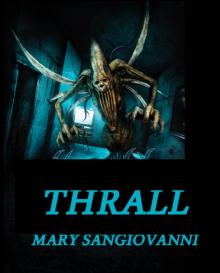
It was then that she heard laughter. Immediately, the thing on the side of the building twittered and spidered its way a few feet along the wall toward the ground. The moonlight rippled over the plates of its back.
Oh God, no, nonono, she thought.
She turned slowly, aware that the feelers, reaching for the source of the voices, were waving right over her head now. Across the street, a twenty-something with a blond bun and a conservative blue dress was walking arm in arm with a young man who looked to Kathy like a member of the Young Republicans.
Kathy made a move in their direction, and immediately the feelers snapped back toward her. She stopped, holding her breath and then letting it out slowly. She had a .45 in her car; even though she was no longer with the Bureau, she had kept up her firearms license. But her car was a good sprint away, and the snow would slow her down. And a gun was no guarantee anyway; those back plates looked pretty thick. Maybe its underside was a vulnerability, but—
While Kathy was considering her options, the thing on the hospital wall skittered around to the front of the building.
“Shit!” she whispered, and loped over the snow drifts after it. When it came into view, she froze again, glancing slowly across the street to the couple. The man held out his key fob as they were walking, and the boop-boop of the unlocking mechanism was followed by the flashing of headlights from a car about two hundred feet away.
The creature let out an ear-piercing whine and jumped down onto the snow. Its feet, Kathy noticed, didn’t sink as she would have expected with the obvious weight of the thing. Instead, it skittered across the ice and snow as easily as it had scaled the side of the hospital building. Fixated as it was on the couple, the thing paid no attention to Kathy, and so she detoured toward her car, grasping for the driver-side door handle just as the thing reached the middle of the street. The couple had reached theirs as well, and it was when the woman opened the passenger-side door that she saw the creature bearing down on them. Her scream echoed down the empty street.
Kathy dove across the driver’s seat to the glove compartment and grabbed her gun as the man’s screams joined the woman’s. She opened the passenger door, aimed as best she could at what she thought was the underside of the thing, and fired. It wailed, a bloom of white opening up where she hit it, and the feelers lashed out wildly in multiple directions.
The wound didn’t slow the creature down, though. It climbed partially onto the hood of the car and shattered the windshield with a leg, spearing the man through the chest as he cowered behind the wheel. Kathy fired again, but the creature moved and the shot glanced off its back plates. Another bullet tore into its leg, and for a moment, Kathy had hope as the thing wobbled and slid along the car hood. Then it regained its balance. The woman cried out as the creature’s tail dove straight for her. When it rose again, Kathy could see the woman dangling from the spiked end of the tail like a limp rag doll, the blood surrounding the hole in her gut soaking her top, raining down, and staining the snow beneath her.
Kathy yanked the passenger door shut and sat up, then slammed the driver’s door closed as well. She started the car just as the creature down the street managed to shake the woman free of its tail. It withdrew its leg and turned toward her.
“Let’s go, bitch,” she muttered, half to herself and half to the thing as she threw the car in drive and peeled out of the lot. She tore down the street, fishtailing at the corner as she made a left, but she barely let off the gas. Behind her, the thing screeched, and that screeching kept up with her, though she could make out no crunching of snow. It had to be practically flying over the drifts, closing the gap between them. She glanced in the rearview mirror and saw it leap into the air. She slammed the gas pedal to the floor, and the car jerked just out of reach as the thing landed behind her. The tail came down, breaking the ice-crusted layer of snow along the curb behind her. Kathy fixed her gaze on the road ahead. She turned off on one of the country roads, a back way to get to Colby, along which she felt fairly certain she could keep the thing away from anyone else. The creature followed. The road, flanked by thick woods on both sides, was a strip of darker white amidst growing mounds of glistening snow. Occasionally, the thing behind her grabbed hold of trunks or branches and swung from one to another, closing the distance between them. She couldn’t see the center line or even a good portion of the pavement. There were no streetlights on the road, either, so only her headlight beams, twin arms of amber-white glow, reached into the darkness ahead of her. Occasionally, the overhanging tree branches pulled back and the moon reminded her that she had not fallen off into an endless void. That, and the metallic squeal of the thing gaining on her.
A tail or leg—Kathy had not seen which—shaved the side of her car, furrowing through paint and metal and jerking her to the left. She nearly lost control of the wheel but compensated quickly, swerving toward the left to put space between her car and the creature.
Then she hit a patch of ice. The tires slid, tractionless, toward a snow bank ahead and to the right. Panic welled up into her throat, threatening to choke her, but she swallowed it down. She pumped the brakes, cut the wheel into the skid, and regained control, pulling the car back onto the road just seconds before it would have buried its front end into the snow drift.
The creature behind her wailed into the wind and dove forward.
A half-obscured sign that swam up in her headlights told her the center of town and the police station were seven miles away. Almost there . . .
A terrible rending sound, followed by the sudden descent of a leg into her back seat, sent her on another skid. The creature was above her now, on the roof of the car. She could hear the groaning of metal and the scraping sounds of its other legs as it sought a way to hold on. Feelers smacked against the windshield; one took hold of a wiper blade and wrenched it free. Kathy screamed, as much out of anger as fear. She hit the brakes, hoping the sudden stop would throw the thing, but this sent the car spinning in circles. The feelers clamped down on the frame of the car; against her windshield, she could see small suckers like tiny, hungry mouths slurping at the glass.
She cut the wheel again, trying to stop the spin—hoping, even praying a little, that she could get the car moving forward again.
The back end of the car hit the post of a sign that said the police station was now only three miles out of reach, and miraculously, the car righted itself, nose pointing in the direction of the town center. Thank the universe, she thought, for small favors. Within seconds, she was moving again, but the thing was still latched on to the roof of her car like a barnacle
The car was coming up on a bridge over a small pond, not terribly high but high enough to warrant care when crossing. The county had never gotten around to replacing the wooden guardrail with a metal one. It was a lonely bridge on a county back road hardly anyone ever took; that it had even been kept up with as well as it had was enough to let county officials sleep at night.
It was pitch black over the side of that bridge, and the water cold enough, Kathy imagined, to stop a heart. A glance down at her steering wheel, though, and a scream from above her as another leg tried to puncture the roof made the decision for her. She clicked on her seat belt.
With its leg firmly embedded into the back seat of her car, Kathy floored it and cut the wheel. The wooden guardrail splintered on impact with her bumper, and as the car sailed off the bridge, it hit a patch of moonlight in midair and then slammed through the first layer of ice on the pond.
Chapter Six
When Teagan found him, Jack was standing stone still amid the bustling of uniformed officers cordoning off Chandler Park, white puffs of breath making tight little clouds in front of his face. Beneath a canvas tent, half-frozen bodies, minimally clothed and illuminated by park street lamps on old-fashioned iron poles, were laid out atop the rows of picnic tables, attended to by Cordwell and Brenner and CSIs who were taking pictures and measurements and poking and prodding. There were a lot of bodies—eight or nine—and Jack stood in the center of them, amid the rows of tables, staring up into the snow-smeared night. Occasionally, flashlight beams arced through the tight circumference of the scene’s darkness, followed by mumbled comments carried on frosted breaths. So far as Teagan could tell, Morris and Kathy weren’t anywhere on the scene.
“This is one of three,” Jack said without looking at him.
“One of three what?” Teagan asked, joining him among the bodies. He took an unlit Camel from his flannel shirt pocket and popped it between his lips. He’d quit three years ago, but the presence and taste of the little stick, even just hanging there unlit, was both a comfortable affectation and personal challenge, a reminder of a vice he’d conquered. He blew on his hands to warm them up, then shoved them into the pockets of his jeans.
“Three crime scenes just like this. Ormann Park, the Colby Public Library parking lot, a baseball diamond behind the high school on Fremont Ave. Information’s still trickling in, but estimates quote twenty-seven dead. Nine each at the three crimes scenes, which I’m sure Kathy will tell you is of occult numerological significance. All Colby townspeople. Business owners, bums, teachers, hairdressers, landscapers, cooks, carpenters, bus drivers, factory workers, retired folks, even cops. Kids, Teagan. Little kids. Third body from the left, that little one there, is a kindergartner. Gracie Anderson. She was five fucking years old.” Jack’s voice never rose above a tight, strained monotone.
Teagan knew the man well enough to understand the incredible restraint it must be taking for Jack not to break, especially regarding the child. He felt much the same way at the moment. “Jaysus,” he said. “What the fuck is going on in this town?”
“Well,” Jack replied, “Cordwell says at least three people at each scene were murdered by other people—our Hand of the Black Stars cultists, I’d say. And on those nine vics, Cordwell found evidence of manual strangulation, use of bladed implements—knives, straight razors, that sort of thing—and gunshot wounds. But the rest he swears are some kind of animal attacks, like our first John Doe.”
“Chris Oxer,” Teagan said.
“You ID’d him?”
“Aye. He used an ATM card at that convenience store, and the bank gave us a name. Family confirmed the identity. And here’s a biteen of news. They say the lad had taken up with some new friends—no one the family had ever met. They said Chris was almost superstitious in not talking about them.”
Finally, Jack looked at him, then nodded. “Well, it looks like Oxer’s new friends had a field day this afternoon. And turning on him wasn’t enough, apparently. Most of these vics went the way of Oxer. Ripped apart, half-eaten, bones gnawed and snapped . . . and those damned symbols carved all over them still. But the killers made it easier to sort things out this time. Wallets and cell phones were all left behind. Like covering up the murders doesn’t matter anymore.”
“Well, that was a sound bit a help, that.”
“Yeah. And the uh . . . jars . . . are over there,” Jack added, nodding in the direction of a cordoned-off park bench with a row of mason jars on it.
“Jars?”
“Eyes. Mostly eyes. Some tongues. A couple of fingers and an ear.”
“Fuck,” Teagan said.
“I think the sigils bother me the most. Every one of these bodies has that same symbol as Oxer’s carved into it, or one like it. Damned if I can tell the difference, but they look pretty much the same to me. And apparently it’s the same deal at the other scenes. It’s like they’re being tagged, marked somehow as belonging to the cultists. That gets under my skin, ya know? They’re flaunting their sickness all over this town—bodies, jars. But no footprints, Reece. For all this fucking snow, not a single damned footprint, no animal droppings or animal prints, despite all the animal attacks that supposedly happened, and no evidence of snow brushed aside or out of the way. No weapons. No hairs or fibers. It’s like ghosts killed them all.”
“What do Morris and Kathy think?”
“Don’t know. Morris was supposed to be at the high school, but he texted that he was detained, whatever that’s supposed to mean. Don’t know the details yet. And I have no idea where Kathy is. But you know . . . that’s Kathy. She can handle herself.”
The two men stood in silence for a few moments. Teagan frankly wasn’t sure what to say, and sensed that Jack hadn’t quite found a way to look objectively at the crime scene all around him. It was a struggle sometimes to do that. Teagan knew the feeling of having to fight the personal and professional fear and insecurity in one’s soul to regain composure and do his job. Rapists, child molesters, murderers, torturers, terrorists, the sad, the lost, the widowed, the orphaned, the insane . . . Sometimes it was a heavy, monstrous job, and it could get inside of a person, if one wasn’t careful. The various everyday evils and their aftereffects could find a way inside the less tangible substances, the “cells” of the heart, mind, and soul, injecting its icy blackness and sucking out the life and light. It could make a person feel weighed down and even monstrous, too. Take this case, for example.... What was wrong with these cultists? He had seen hate before—had, in fact, been in the thick of hate that had hardened and grown stronger over hundreds of years. But what kind of hate could drive someone to jar up the parts of other human beings? To carve them up like hams and feed them to wild animals? And was it even hate? The thought turned his stomach that it could be simple indifference to other people’s suffering . . . old people and children. . . . Sometimes the scope of evil, plain and simple human evil, was overwhelming.
But the catch-22 of it was in the alternative. Teaching yourself to feel nothing or next to nothing was too easy—too damaging, Teagan had found—to allow it to become the quick and convenient defense mechanism against all of life’s pain.
However, standing there waiting for the old habit of swathing oneself in indifference to kick in might not be the best option in this case. Maybe a little outrage was needed to match the senseless indifference of the crimes surrounding them and spur them to action. Furthermore, it was cold out, and Teagan’s fingertips were getting numb. So finally he spoke.
“Jack . . . what’s the plan?”
“Well, I think the first thing to do is—” Jack stopped abruptly, mid-sentence.
Teagan followed his gaze to a dark spot at the corner of the park, where the hiking trails began. “What is it, Jack?”
“I . . . I don’t know yet. Come on.” He started off toward a far dark corner across the field that was devoid of all police action. If Teagan remembered correctly, the beginnings of the hiking trails were over there. It was an odd move, to be sure—Jack was not usually the type to walk away from the heart of a crime scene. But then again, maybe diversion was what he needed to get his head right again.
Or maybe Jack’s gut was telling him something connected to the scene—or worse—was out there in those woods.
“Jack, wait up, mate.” Teagan dropped the Camel back into his shirt pocket and did his best to sprint in the snow drifts after the senior detective, his hand on his gun’s safety.
Jack had made his way nearly to the tree line, his .45 drawn, when he stopped. The snow coming down around him in the moonlight formed a kind of halo of shimmering movement and shadows.
“For the love-a God, mate, what’re we chasin’?”
On the hiking trail, a pale blue shadow—a shadow of blue light, despite the contradiction of terms, was exactly what Teagan thought it was—passed from a bank of charcoal night behind one tree to another. It was human-shaped but missing any discernible detail, a semi-transparent thing moving through the surreal shade of unbroken, wooded stillness. He drew his .45.
Jack motioned silently for them to flank the grouping of trees behind which the phantom had disappeared. They crept to the tree line, parted, and submerged themselves in the gloom. Teagan tried to breathe shallowly, afraid that even the puffs of his breath would put him somehow at a disadvantage to the stealthy thing in the woods.
Once Teagan stepped into the forest, all sounds from the crime scene were suddenly muffled, as if he’d closed a door or window. But he felt something, all right—not quite a sound or smell, far less than a physical touch, but something that stirred the hairs on his arms and brushed cool non-fingers across the back of his neck. He’d spent time camping one college weekend with friends at Seafield House in County Sligo, the allegedly haunted ruins of an old Irish mansion overgrown with trees and ivy, and the feeling on the grounds had been similar—the feeling that energy was moving around him, anxious, even hostile, crowding and closing in.
His gut told him to step out of the area, to back away from it and not turn his back on it, to go back to the crime scene. That’s what his gut said, but his brain told him he was being a right savage tool. There wasn’t anything in here, in the snow and dark, that hadn’t been here any of the countless times he’d come through before, running or hiking or bringing a bird on a romantic nature walk. He set his jaw, narrowed his eyes against the rising wind, and began searching for the figure. If it was a cult member, it better hope that Teagan found it before Jack did; Jack was bulled enough to lamp whoever it was but good.
As he crept slowly over the underbrush toward the hiking trail, he listened. It made sense that the figure (he couldn’t quite conclude to himself, for reasons unknown, that it was anything quite as tangible as a person just then) must have hit upon the hiking trail. There was no crunch of shoes breaking branches or rustle of trudging through foliage, and no visual evidence of it, either. Not that Teagan was a tracker of any kind, but he didn’t hear or see much of any sign of life, human, animal, or otherwise. The cold was seeping into him. His toes felt like hard, painful little rocks in his boots, his fingers stiff and raw around his gun. He wished Jack would emerge from behind some tree or other and call off the search. Maybe what he had thought was a figure had been a strange effect of the moon glancing off of an icy tree trunk, or maybe some animal with its winter coat, bounding away back to the cover of the woods.