I'le Dor, page 31


“I’ll miss you, Libby,” Lucien said.
A fat woman with false teeth sat in a chair next to where they stood, puffing furiously on a cigarette. “If they delay that flight again!” she said to a small man who wore a matching wedding band, wagging her finger menacingly at the end of his nose.
“There’s nothing we can do,” the man said.
“Me, too, Lucien,” Libby said. Moi, aussi. She put her arm through his and he hugged her. As she stepped back, she could see tears in his eyes and knew there were some in hers also.
“I have a clearer sense of where my roots are,” she said. “Of being connected to this place.” Of another trip she wanted to take, to explore the French part of her heritage. Her sense of comfort came from hearing French around her, but something more, too. Her mother’s French grandmother, even though she never knew her.
“What next?” he asked.
“We’ll see,” she replied. “I don’t know. I’ve wanted to go to France and spend some time there for years. I think I’ll regret it later if I don’t. I’m not sure I can finish the paintings I’ve started until I go.” She was not sure why that was, but she sensed it.
“What about Dan?”
“I don’t know for sure. The letter was from him. He’s done a lot of thinking. I look forward to seeing him. What about you?”
“I feel better.”
“And Susan?”
“It hurts. I still love her. Mon Dieu. The Anglo in her, too, I think. Comprends-tu?” Do you understand?
Libby nodded. “Are you going to Montreal?” she asked.
“I guess so. Maybe it will all just feel worse, like you said, missing arms and legs or something. But what else can I do? I have to go.”
Libby smiled at him. “Would she have called and left that message for me if she didn’t still love you? I think it means something.”
“I don’t know any more,” he said. “Anyway she’s so proud, you know.”
“I remember.”
“So,” he shrugged. “I’ll find out, I guess. One way or the other.”
When a voice came over the loudspeaker to announce Libby’s flight, she reached out to touch the sleeve of his jacket.
“Bon voyage,” he said. “A bientôt.”
“A bientôt,” Libby said so quietly he might not even have heard her. She turned toward the door that opened onto the tarmac. His eyes would probably follow her although for all she knew he would turn away so as not to have to watch. When she looked around once, he raised his hand.
As she waved, she imagined the sounds of French stretching back to the early settlers on the St. Lawrence, to small villages in France. These were the voices of her ancestors, too, no longer all in English, no longer only the men and women with gravestones in the countryside of England.
When she stepped inside the plane, Libby could feel the passengers who were already seated watch her as she moved down the aisle. As she sat down, she saw that the horse was no longer stuck in quicksand. It was racing down a road somewhere with wind blowing through its mane. Under a blue sky, birds sang and there were bees buzzing by raspberry bushes. And in the white house near the bush, the house on rue Champlain, she saw the oak table in the dining room as clearly as if she were ready to sit down at her place across from Sheila and Wally.
“Everybody happy?” her mother asks.
“Benedictus. Benedicat,” her father says.
As Libby fastened her seat belt, the pilot’s voice came over the intercom, first in French and then in English.
“We expect a little chop on our way up to cruising altitude,” he said.
66.
PULLING HER SWEATER around her, Michelle caught her image in the mirror on the outside door of the change room. Enough time had passed since Nick drove off through a snowfall toward the highway and Libby caught her plane that having seen them felt almost like a dream. It was quiet and outside snow was falling. Customers were unlikely to wander in until noon. They would have to shovel first, but she knew the weather itself wouldn’t stop them. She thought about Nick’s invitation. She would have gone to Toronto for a few days in the spring and taken Marcel Blouin with her, but Marcel had refused the invitation. Nick had written once to thank her and said he’d returned to work without too much difficulty, even with new insights. He’d asked about the boy and she thought now she would suggest Nick come up to Ile d’Or in the spring to see Marcel again. Maybe the fund could afford a camera for Marcel and Nick could teach him how to use it. Suddenly ideas emerged spontaneously. She’d let Nick know she’d be glad to see him herself. And his photographs.
Smiling slightly at her reflection, she recalled Nick’s penetrating gaze when she found him looking at her. Often surreptitiously, with glances that lingered and that made her more aware of her femininity again. She hadn’t tried to convince him, or anyone for that matter, that her father hadn’t done anything illegal. She was relieved to have preserved the details of that bit of history for herself. That Maurice Dufresne might not have been honest about the gold no longer troubled her. It was not her doing. No one ever knew where the gold was hidden, so they could go on guessing about whether he had actually taken the high-grade. Except for Libby, whom Michelle had as much as told, albeit without any details.
It had taken her a long time to figure out that scenes she’d witnessed as a very young child were connected. A knock on the door her father answered. Frightened at the sight of two men waiting outside on the stoop, she began to cry.
“So what have you been up to?” loud voices said to Maurice in French. “Let us in.” They pushed past him. “Where is it?” they demanded, looking around as if trying to decide where to start to look.
“There’s nothing here,” her father said.
Michelle’s eyes followed them in wordless horror. Francine must have been sleeping as she wasn’t saying anything either. Or maybe she’d been there, also frightened. The noise would have awakened her as they went through the house, searching through cupboards and drawers, leaving lingerie hanging from her mother’s bureau, nylon stockings with the black lines down the back strewn across the floor. Coming into the living room again, they shifted the cushions on the sofa and left them upside down. One of them went down the basement stairs where he could be seen from the kitchen door, looking into the wringer washing machine. He turned away, holding his nose, appearing disgusted.
“But there’s something here,” he said when he came upstairs again. Mais, il y a quelque chose ici. “I’m certain of that.”
They would return, they said.
Afterwards, her father went to the basement and moved the wringer to take something out from beneath the dirty diapers. He left the house with a package and when he came back his arms were empty. Michelle heard her mother ask if he’d been drinking.
“Just a pint,” he said, starting to sing.
That was in the days before The Flamingo. Her father could drink with the best of them, but when the nightclub opened, he stayed sober for the customers and the fights and high jinks that might happen. He might have liquor on his breath when he came home, but he didn’t stagger. If anything, he began to swagger.
Yes, that was her father, Michelle thought. King of the world. It was too late to tell him. She wished he hadn’t died before she even thought of it. Before his granddaughters had a chance to grow into women with lives of their own to share with him. How relieved she was that Dawn had called to say she’d been hired as a translator by a large company. Soon she’d move into her own apartment not too far from where Elise lived. Michelle felt as if her family circle had been restored and she looked forward to being a grandmother. She would remember her father as someone with gumption. A gutsy guy, she might one day say about him to her daughters. Or even her grandchild. Je me souviens, she thought. What did it matter that she couldn’t possibly have remembered the washing machine because she was just a small baby at the time? And it was her diapers that were in there. Maybe she heard her father talking to her mother later. He probably hid it in the coal chute by the time she was old enough to remember anything. And she had no idea of how he was talked into taking it. Unlike the men who didn’t get drawn in at all. Like Roman Petranovich. They managed to put up with the dirty work and didn’t crumble under veiled threats toward their children. Nick could be proud of that and she wouldn’t hold it against him. It was Libby’s lack of understanding of the dynamics that had existed in the mine that still irritated her. But she was glad they’d moved beyond whatever their fathers had been. Perhaps she would visit Libby, especially if Nick suggested it. Michelle dusted off the glass counter under the cash machine, looking down at the jewelry displayed there. There was a pale blue necklace she thought Charmaine might wear with her new dress, something that would sparkle around her neck at the New Year’s dance. If she didn’t happen to come into the store, Michelle would call her. Dealing with people came as naturally to her as choosing fashions, that ease something that probably came from her father.
You never knew who would be remembered and for what reason, she thought as she reached in and took out the necklace, dropping it carefully into a box with slightly crumpled tissue paper underneath it.
In the end, the Anglos who came in and built the mine were forgotten. There was a fleur-de-lys over the head frame Walter Muir designed and when that head frame was torn down, the flag flew over the gate in the chain link fence that surrounded the property. Even Father Chicoine, who seemed to run the town for such a long time, was almost lost from memory. There was a headstone for him in the Catholic cemetery, but no special dedication ceremonies were ever held. Or for anyone else Michelle remembered. The mayor didn’t speak when that first priest died. And the only one who ever had a street named after him was her father.
Epilogue
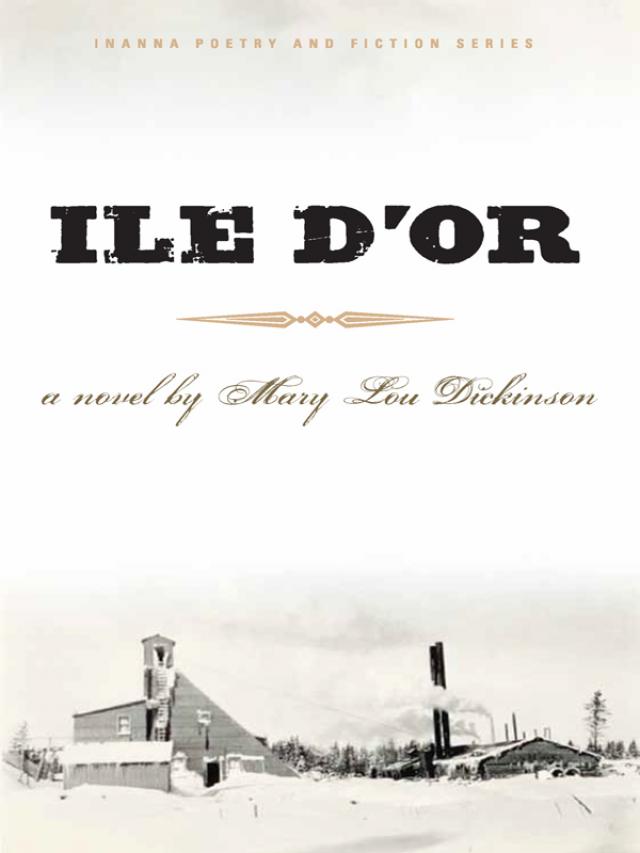
EVENTUALLY THE MINE was sold, the buyer a company that began to destroy buildings, and an open pit began to encroach on the edge of town. What was left after the bulldozers and trucks were finished looked like the landscape of the moon, the buildings and houses of earliest memory gradually disappearing.
One month the manager’s house was still there and the next, except for a grove of birch trees that had run around the perimeter, you could scarcely tell where it had been. Not only was that house destroyed, but the highway was also lifted up and moved to the other side of the pit. The Catholic and Protestant cemeteries, a bit further out on the highway, were left intact for the time being. Eventually the plan was to move both of them and that had everyone fuming. Although they agreed that to put the two cemeteries together would be a good idea and Michelle thought that way her mother could be reunited with her family.
Sometimes a stray rock dislodged by the blasting landed on someone’s roof or lawn. The story always was that the operation was proceeding according to regulations. A pile of earth and rocks was erected as a buffer between the devastation and noise of the pit and the part of town where The Flamingo still stood. It did not do anything but create an ugly line of demarcation, but after a while you could see a few blades of grass and yellow wild flowers emerging through the soil at the top of the pile.
Acknowledgments
With thanks to the Canada Council and the Banff Centre for the Arts, which at different times gave support. With extra special thanks to Adele Wiseman and William Kilbourn who always believed a book would emerge, but without whose ongoing affection and encouragement it might well not have. I am fortunate to have worked with Edna Alford, Marilyn Bowering and Colin Bernhardt at the Banff Centre for the Arts to find the soul of my material, to reclaim my voice. Thanks to Lee Davis Creal and Janis Rapaport who encouraged me to go to Banff. To James Polk and Susan Walker who supported early grant applications. To Alistair McLeod who was mentor of a workshop at the Humber School for Writers where I most recently workshopped a chapter of this novel. As well, I am fortunate that two incomparable women, my agent, Margaret Hart, and my editor, Luciana Ricciutelli, wanted to see this book published.
My family has been there to share tears and laughter and the belief that dreams matter. I am especially grateful to my daughter Andrea, her husband Mark, and their son Max, and to my son Phil. As well as to my sister Stephanie and her husband Michael, and their children, Gillian (Stacey) and Geoff (Rita) and their daughter Skye. I am lucky also to have the interest and affection of my brother John and his wife Diane and their large family.
My friends who are inspired by dance and yoga provide grounding to enjoy the dance of life. As did S. G. in giving special support during the early days of the book, the roughest times.
I am grateful to Anne Redpath, Nelson and Catherine Priske, Marcel Lefebvre, Margaret Arthur, Jay Huckle, Helen Filion, Roman Hawryluk, and all the others who patiently answered my questions. And to Brydon Gombay, Douglas Poff, Paula de Ronde, Joy Kogawa, Deb and Ian Wallace, Elizabeth Greene, Carol Findlay, Dianne Mesh, Lee Gold, Michèle Chicoine, Ray Bennett, Ruby Trostin and Larry Crackower, Maryka Sule, Claire Croisat, Ray and Shirley Spaxman, Ila Rutledge, Barb and Bill Wehrspann, Huong Pham, Ray Thompson and Pat Louden, Myrna Friend, John Wilkinson, Gene Simon and David Florkow, Joan Burrell, Richard Bishop, Austin Clarke, Liisa Tienhaara and Gerry LaMarsh, Don Heald, Bas van Fraassen, Rosa Shand and the many other friends who, at various stages, read and criticized my work and/or provided company for the journey.
Thanks to all my colleagues in the Moosemeat Writers’ Group, especially Heather Wood who manages the herd and Mike Matisko who used to, also to Edward Brown, Myna Wallin and Heather Wood who now also have books published and share that journey. And to everyone in the herd for honest, perceptive, tough critiques that as well as pointing out deficiencies, offer useful suggestions for going forward. At the risk of forgetting someone, as well as the aforementioned, this includes Katharine King, David Chilton, Beth Jones, Bill Zaget, Cecily Carver, Ben Gleisser, Sylwia Przezdziecki, Niko Troubetzky, Brian Robertson, Tessa Derksen, Max Arambulo and more, too, Joanna, Lana, Michelle, Craig, Ivaylo, Stephanie, Miriam, Kris, Ken. I have been around long enough (since 2005) that some folks have left the group and others have joined, offering new and fresh perspectives on an ongoing basis.
Also, courtesy credit with thanks to the estate of Robert W. Service. Roch Carrier’s word are from his book, The Hockey Sweater.
Photo: Dieter Hessel
Mary Lou Dickinson graduated with a Bachelor of Arts from McGill University and a Master in Library Science from the University of Toronto. She worked for many years as a crisis counsellor. One Day It Happens, her book of short stories, was published by Inanna Publications in 2007. Her fiction has been published in the University of Windsor Review, Descant, Waves, Grain, The Fiddlehead, Canadian Woman Studies, Northern Journey, Impulse, Writ and broadcast on CBC Radio. Her writing was also included in the anthology, We Who Can Fly: Poems, Essays and Memories in Honour of Adele Wiseman. Mary Lou Dickinson grew up in northern Quebec and has lived for many years in Toronto.
Mary Lou Dickinson, I'le Dor