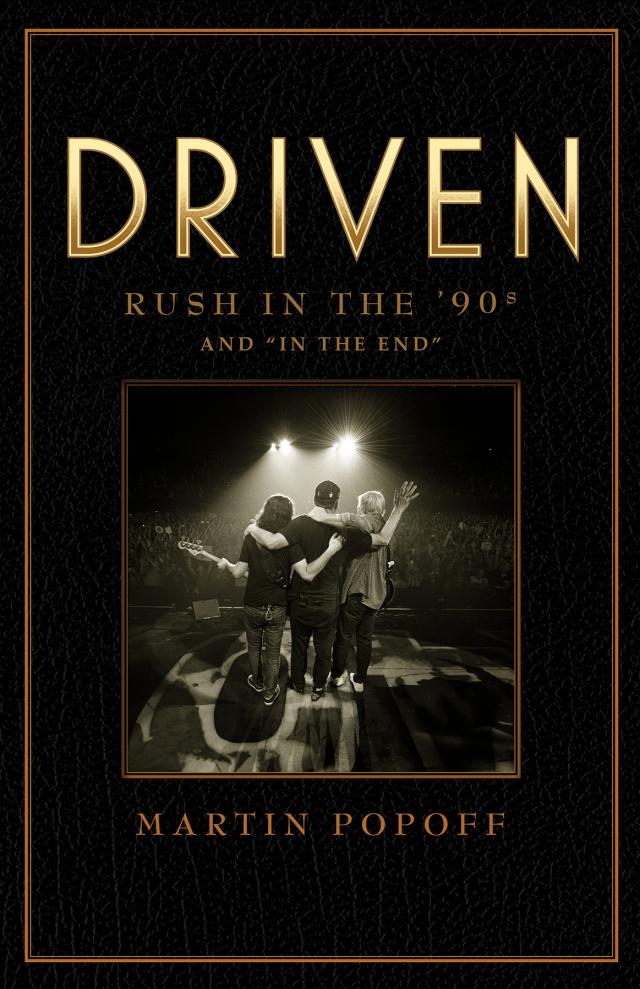
Driven: Rush in the '90s and In the End , page 24


Peart’s “Vapor Trail” lyric feels sharply autobiographical. Heartbreaking is the line “All the stars fade away from the night / The oceans drain away.” It’s a tribute to W.H. Auden’s poem “Funeral Blues,” read by Neil’s brother Danny at Selena’s service.
“That was definitely Paul Northfield,” says Alex, on the subject of the record’s big drum sound, almost dominant on “Vapor Trail.” “Paul came into the project about six months after we began. We had a couple of songs we still weren’t too sure about in terms of arrangement, and Paul really had an objective ear. He helped out a lot in fine-tuning some areas of the songs we were a little unsure of, having lived with them for so long. We went to Reaction Studio, which is not known for its live room, as a drum room. It’s actually quite a dead room. It’s a jazzy room, very dry. Paul came in and just built it up to his specs — drywall everywhere. Every open space he could find was re-drywalled. He really brought a lot of life to the room, and I think he did a great job on the kit. The kit sounds to me very immediate. It sounds like you’re there in the room, which is not an easy thing to do.”
Alex addresses the topic of Neil’s intense yet eerily spare lyrics. “Obviously, having gone through what Neil went through, and what we all went through, it was definitely going to impact where this record was going to go. To me the record is very optimistic. It’s all about recovery and about hope, about a future, rebirth and moving forward. There are some dark moments, some sad moments, but generally, it’s really about those things I just mentioned. And the course the lyrics it takes to get that message across covers a lot of ground, from a very personal experience to a more universal representation of it. Geddy and Neil worked very, very closely on getting that idea across. Neil has always been, I think, a writer who has written from an observer’s point of view. He doesn’t dictate one way or another, but he lets his feelings out and they are taken in a universal manner. With this record, it was a very personal experience, and they worked closely together so the idea that Neil was trying to get across could be presented by someone else, in this case by Geddy — he has to sing the lyrics with conviction. So they worked very closely and it was very professionally done. There was no question of a personal thing in it. It was more about what the best way was to get this across.”
In this author’s opinion, the most artistic, magical, emotional moment on any Rush record past Signals occurs at 3:44 of “Vapor Trail.” At the tail end of an impressive and fresh sort of ’80s new wave passage — Waterboys meets Big Country meets Midnight Oil — there’s a massive drum-propelled crescendo. Once the tension lifts, the band collapse into a sad and almost Sabbatharian groove, over which Geddy repeats the “in a vapor trail” refrain. Quickly it’s normalized by Alex adding REM-like picked electrics, but for a brief moment, at the outset, from 3:44 until about 3:53, it’s just epic sobbing notes from Alex atop Neil swinging for the fences. Not even sure there’s a bass track in there, and if there is, it’s just supporting these awful “Working Man” chords that emerge from Alex, considerably blackening what is already a bleak combination of music and words.
It’s hard to believe that “Secret Touch” was picked to be the album’s second single. Peaking at #25 on the U.S. Mainstream Rock chart, this one’s a bit more challenging for the listener. There’s bass chords to open, there’s a dissonant wall of sound for the verse, and there’s shocking bursts of almost Voivod-like heaviness.
But no real guitar solo. “I don’t solo nearly as much as I used to,” explains Alex, speaking with me at the time. “I think I used to have a solo on just about every song on every record we’ve made, but I’ve gotten out of that for some reason. I love soloing and I think relatively and objectively I’m a good soloist when it comes to composition of solos. But for some reason on this record, it just wasn’t in my heart. There are a few, but I just didn’t find it as important. I thought it would be great if those quote-unquote solo sections were more a band solo section where we just get into an instrumental thing and we’re all grooving and playing off each other; that was far more satisfying.”
Indeed, “Secret Touch” has one of those, where each of the players stays respectful to the root but can step off briefly or offer a variant. Here a crazy sound collage gives way to a sinister metal riff from Alex and distorted bass from Geddy on what can only be called a casual or spontaneous break, before the band brings back one of the song’s already established melodic themes.
“This was a great platform for exploration for me,” continues Alex. “The guitars are loud on this record, for sure. Everything is. The bass is loud, the drums are loud, the guitar is loud. We managed to capture that, and that’s really what our goal was from the beginning. I tried to create guitar parts that were simple yet sounded more complicated or complex than they really were. I really got into this idea of guitar dissonance and playing across keys and using keys that are usually against the wall and creating tension that way. Geddy’s playing a lot of bass chords lately, and on this record, they become a little more dominant with all this other guitar noise in the background. It created a sense of depth and greater dimension by doing that.”
“This is a bit of an extravaganza,” explained Geddy, again to Karl Coryat. “We built the song around these repeating bass chords that I thought sounded like French horns. The tune has a hypnotic feel, and because we weren’t happy just enjoying that feel, we had to smack it up with some power. When we get to the middle section and all hell breaks loose, there are these stuttering bass punctuations. I double tracked them, but on one of the tracks, I went in and digitally truncated the notes to make them sound really abrupt and punchy. There’s another point where I’m playing straight 16th notes, and when we were jamming originally, we could hear the sound of my fingers slapping against the string, but when we played it back it didn’t have the same ‘smack.’ So we put up a mic and recorded the sound of my fingers while we were laying down the parts, and we used it subtly in the mix. I don’t know how much of it survived under all the guitars, but it’s there.”
“Earthshine” is another tense rocker, Geddy singing high, Alex most clearly stomping a distortion pedal in comparison to elsewhere on the record. Geddy’s bass has more of that old-school Rush articulation to it here, old school meaning back to Moving Pictures and earlier and not so much the hyperarticulation of the late ’80s/early ’90s. The dark heaviness lets up for one of the band’s slightly Celtic choruses, Celtic also somewhat of an apt descriptive for Alex’s seagull-scream of an ersatz guitar solo late in the track and then the returning high atmospherics even later, which almost sound like Mellotron.
“‘Earthshine,’ which was the first song we wrote, was completely rewritten,” notes Alex. “Even the lyrics were changed around. Musically it was a completely different song from what it was, and it was a complete song in the beginning. We had all the parts, the lyrics; we worked it out, it was there. But there was something about it that just didn’t knock us out.”
In a sense, this was a revelation to the band: that with no deadline — and really no predictable outcome or future — they had the luxury of discarding ideas generated over the first long writing period, five or six months. In Geddy’s view, the original music didn’t live up to Neil’s majestic lyric. Not really a weather phenomenon but in the wheelhouse of Neil’s nature musings then, “earthshine” is an effect that occurs about once a month, where the night side of the moon is illuminated by “earthlight,” which is, in reality, sunlight bouncing off the earth.
“Sweet Miracle” is a comparatively conventional song on the record, melodic hard rock, somewhat singer/songwriter-ish. It’s one that came very early, with Geddy particularly touched by Neil’s almost spiritual lyrics. Geddy sings it in his comfortable lower range, although he adds some higher background harmonies. Once more, Neil is just hammering away at his cymbal array, making casual and bar-room rocking a song that is sort of ballad-esque.
Geddy says that “Nocturne” came from tail-end writing sessions that resulted in five or six songs coming rapidly, arising from jams between him and Alex that he thought were some of the best they ever had. To characterize it, it’s quite raw and wildly bass guitar–centric — the verse is built of two or even three very distinct bass tracks, no guitar, with Neil essentially playing hi-hat. But as the drama unfolds, there’s some intrusive and vicious guitaring from Alex, and then a break that is almost punk rock. Supporting Neil’s lyric — a fearful exploration of the dream state, essentially — the musical backtrack is both murky and agitated. Interestingly, the threat of the narrative isn’t so much of nightmares, but of dreams being too powerful, a night-mining threat to waking sanity.
“Freeze” gets a subtitle indicating it is Part IV of the “Fear” trilogy, Rush smashing the rules of trilogy-making in the process. Of the four songs, it’s the most about fear, literally being frozen by fright, nominally in some sort of early morning confrontation downtown. To recap: Part I of the trilogy is Grace Under Pressure’s “The Enemy Within;” Part II is “The Weapon” from one record previous, Signals; and Part III is “Witch Hunt,” from the record previous to Signals, namely Moving Pictures.
At the musical end, this is Rush at their most experimental. What we get is pretty much Primus without the sailor smoking a corncob pipe, although a modern-day King Crimson is also evoked. All told, it’s a gem hidden way at the back of an album that is almost seventy minutes long. Do bass chords make for good music? Debatable — in all cases across this record the songs might have been stronger without them. But “Freeze” is a full-on noise-prog workout, all the white-knuckle circumstances of the album coming to bear, almost as if the guys are executing a final flameout ignited by fumes.
As Geddy told Bass Player magazine, “We were dying to work in some screwed-up time signature because we hadn’t done that in a while, so we came up with a jam that was in seven. But then I got the idea to digitally form the jam around the song’s lyrics. The more I played with it on the computer, the weirder the time got. I decided the bass and guitar should be repetitive and hypnotic, but I threw out any rules for the time signature; I shaped the time of each verse section to the number of beats I needed to fit in the vocal properly. That’s why it’s hard to count that song. There aren’t any rules as to when a beat is dropped or added. The middle section is a bass-and-guitar jam, which we left virtually as is.”
Last track on Vapor Trails is “Out of the Cradle” and back come the bass chords, although Geddy says some of the intention was to use bass to create what a traditional piano part would sound like. Neil holds down a song breaking to get free, through the device of replacing expected snare whacks with tom-tom, and then a typical non-beat for a bit. But of course, as often is the case, this is to set up following verses and choruses where the beat is back. The music is on the happy side for the album, and so is the lyric, with Neil celebrating the miracle that is life, endlessly rocking (until the end) from the cradle forward. Peart was inspired by a Walt Whitman poem called “Out of the Cradle Endlessly Rocking,” which is much longer and covers a lot more ground. However long gone are the days when Neil would essentially summarize Coleridge — this is much more of an abstraction that takes the initial idea and explodes it. In interviews, Peart has likened riding a motorcycle to being rocked and soothed, and so it’s a fitting summary of events. Of course there are ties between the concept and actual music, ties that Whitman also regularly made.
Alex ends “Out of the Cradle” with a squall of guitar noise, but that isn’t the end of Vapor Trails. As alluded to, the album would get a full remix, the guys spurred on by favorable reviews of remixes of two tracks, “One Little Victory” and “Earthshine,” executed by Richard Chycki for the Retrospective III compilation.
“Right up to the point where we got to mixing, everything was going well,” explains Paul Northfield. “The difficulties — the big difficulties — with Vapor Trails, came in the mixing. We mixed it at Metalworks. I started the mixing, and before Christmas we’d gone into their big studio, which is a very, very large control room, with a new console in it, and initially everything was very smooth. Before Christmas, I’d mixed about two-thirds of the record, and everybody was really happy. It was like, ‘Wow, this is the easiest mixing session we had ever done.’
“And after Christmas I came back and I got a call from Geddy, ‘Oh, we need to talk.’ He said, ‘We’ve been listening to stuff, outside the studio here; the mixes sound very compressed — it doesn’t sound right.’ He wanted to play me a bunch of records he liked, and we played them in the control room, and it was like, well, it sounds a lot different outside. The differences between the records he played in the control room and what we were doing were not as noticeable, and so we started to sort of question the control room itself, or the room we were mixing in, which was frustrating, to say the least.
“So then we decided — or I decided — to move into one of the other rooms in Metalworks, which I did have good experience in mixing in, and we started from scratch again. Essentially it was going pretty well, but it was difficult. Alex was interested in a more intense and aggressive approach to mixing than maybe . . . I wouldn’t say it was between Geddy and Alex, because it wasn’t like that. Even me, I wasn’t necessarily comfortable with being quite as aggressive, from a guitar point of view, as Alex was looking for. But I guess that was his frustration to some degree. So mixing became difficult, and the decision was made that they would get somebody else in to do mixing, someone who hadn’t been involved. That was a decision taken, and I can’t disagree with them. I mean, that’s just what happened.
“And so Dave Leonard was brought in to mix it, somebody Geddy had worked with. I thought he brought some interesting musicality to some of the mixing, but ironically at the end of it all, the very criticisms we had at my mixing in the beginning, which was too compressed, ended up the problem with the album overall. Whether it was mixing or predominantly the mastering, it was a problem. At that point, I was not involved in the record. I was busy making another record at the time, with Porcupine Tree. So in the final month of the mixing and the mastering of the record, I was mostly at home in England and subsequently working on another project.
“It had been such a long journey making that record, that by the time it was all done, I think everybody was so worn out with it, they weren’t ready to sort of sit and be critical again. Consequently, the overly aggressive mastering, in retrospect, is plain for all to see. I think everybody would agree with that at this point. By the time it became clear that was going on, I think it was too late. All the guys in the band were pretty much exhausted with the whole process.
“And at the same time, there was a lot of enthusiasm for the record,” continues Paul. “For every person who was concerned about the sonic quality, there was a whole bunch of other people who were very excited about the energy of the record, the fact that it was a powerful record. Musically and songwriting-wise, there’s some really excellent stuff on there. But I’m glad it got remixed. It really does benefit from somebody from the outside going through what is there. Because there are some great performances and some great musicality on that record. It was a time and place — a very difficult time emotionally — making that record, and that comes through.”
As Neil explained in the Vapor Trails tourbook, “In the self-contained universe of our work, everything had been going very smoothly, and it was only when we moved into the final mixing stage that we got bogged down. It seemed that all of us, Paul included, had become too deeply immersed in the material, and we could no longer step back and hear the songs whole. After a few unsatisfying attempts, we called in a specialist, David Leonard, and he was able to sift through the parts and make them bright and new again, to find the hidden dynamics and textures and bring out the subtleties of the music and the performances. And so it was that we suddenly found we had been working on this project for over a year.
“While putting so much time and care into every detail of the content and performance of the songs,” continued Peart, “we hadn’t paid any attention to their length, and now we began to worry if all thirteen songs would even fit on a CD, which can only hold seventy-four minutes. There was some talk of saving a couple of songs for a compilation or something, but Rush has never left any ‘previously unreleased tracks’ for anybody to capitalize on, and we weren’t about to start now. All of these songs had taken a lot of time and effort, and we simply couldn’t imagine leaving any of them behind. Fortunately, they added up to just under sixty-seven minutes, so we were spared any painful choices.
“The last big challenge we faced, as always, was the running order of the songs, and we fiddled with that right up until the last minute. However, we never doubted which song would open the album, for ‘One Little Victory’ made such an uncompromising announcement, ‘They’re ba-a-a-ack!’ Knowing our music is nothing if not idiosyncratic, and doesn’t really cater to popular ‘taste,’ we also envisioned advertising slogans along the lines of, ‘If you hated them before, you’ll really hate them now!’ or ‘And now more of everything you always hated about Rush!’”
Alex’s complaints with the Vapor Trails mix were that certain guitar nuances, especially the acoustic playing, got lost, but also that there was distortion, crackling sounds, and compression. The most salient changes in the remix are that Neil’s bass drum and snare drum get more attack and whack, also something applied to Geddy’s bass playing. It adds to the tightness and energy and vitality of the songs. Most thankfully and impressively, none of the power was lost — the new version simply sounds more stadium-rocking and expensive, less muddy, but Bottrill didn’t turn off the bass and make Vapor Trails into Presto.