

Searching for Augusta: The Forgotten Angel of Bastogne, page 1


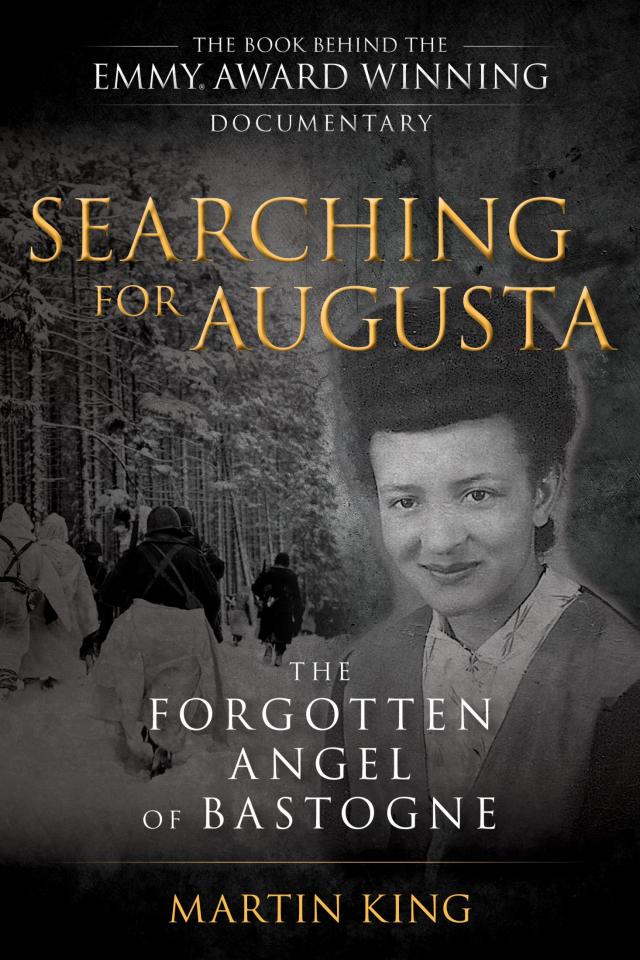
Searching for Augusta
The Forgotten Angel of Bastogne
Martin King
An imprint of Globe Pequot
Distributed by NATIONAL BOOK NETWORK
Copyright © 2017 Martin King
Maps: Melissa Baker © Rowman & Littlefield
Jacket photo credits: Portrait of Augusta on front and street scene on front flap by unknown photographer (author’s personal archive); soldier photos on front and back by unknown photographer (public domain); author photo on back flap by Ashley Rae King
All rights reserved. No part of this book may be reproduced in any form or by any electronic or mechanical means, including information storage and retrieval systems, without written permission from the publisher, except by a reviewer who may quote passages in a review.
British Library Cataloguing in Publication Information available
Library of Congress Cataloging-in-Publication Data available
ISBN 978-1-4930-2907-5 (hardcover)
ISBN 978-1-4930-2908-2 (e-book)
The paper used in this publication meets the minimum requirements of American National Standard for Information Sciences—Permanence of Paper for Printed Library Materials, ANSI/NISO Z39.48-1992.
Printed in the United States of America
To Ambassador Denise Campbell Bauer, for her wonderful support and encouragement
Contents
Contents
Acknowledgments
Preface: The Setting
Introduction: The Spark
Chapter 1: Who Were These People?
Chapter 2: Going Home for Christmas
Chapter 3: All Quiet in Bastogne
Chapter 4: The Fog Was So Thick
Chapter 5: Cafes and Cellars
Chapter 6: No Way Out
Chapter 7: Welcome to Hell
Chapter 8: Whose Nuts?
Chapter 9: Blue Skies Smiling at Me
Chapter 10: What’s Merry About All This?
Chapter 11: The Ghost Town
Chapter 12: The African Angel
Chapter 13: Speechless
Chapter 14: A Great Leveler
Chapter 15: The Last Dying Gasps
Chapter 16: Broken Town, Broken Heart
Chapter 17: Searching for Augusta
Epilogue
Excerpts from Interviews, Diaries, Letters, and Reports
About the Author
Acknowledgments
Many thanks to my wife Freya for her continued support for this work. Posthumous thanks to my late grandfather, Private 4829 Joseph Henry Pumford, who fought at Passchendaele in World War I and provided invaluable inspiration for all of my early interest in military history. He was promoted to corporal but then demoted for punching out a sergeant. He was unique in managing to terrify both sides in that particular conflict. Also, not forgetting offspring Allycia and Ashley Rae, brother Graham, sisters Sandra and Debbie, brother-in-law Mark, nephews Ben and Jake, and niece Rachel.
Special thanks to my dear friends, Mike Edwards, Lt. Col. Jason Nulton (retired), Comm. Jeffrey Barta (retired), Dan and Judy Goo, Gen. Graham Hollands, Elizabeth Thienpont-Dugaillez (Augusta’s best friend, who assisted with translation), for their wonderful support and encouragement. Grateful thanks to my friend Roland Gaul at the National Museum of Military History, Diekirch, and Helen Patton.
Thank you also to Mrs. Carol Fish and the staff at the United States Military Academy at West Point, and to Rudy Beckers and Greg Hanlon at Fort Dix for their ongoing support.
Thank you also to Eric Lemoine, Bruno, Serge, Michel, Olivier, and Joel, the fantastic team at the Heintz Barracks “Nuts Cave” in Bastogne, for allowing me unique access to everything I needed there.
Many thanks to my dear friend Mike Collins, who organized the photographs, Rick Rinehart, Lynn Zelem, Evan Helmlinger, Sara Givens, and everyone who worked on this, including my agent Roger S Williams, and not forgetting Brian Dick.
—Martin King, 2017
Preface: The Setting
You embody what is best and most kind in all of us.
—Col. J. P. McGee, former commander, Bastogne Brigade, 101st Airborne Division
This story is set in the small Ardennes town of Bastogne, Belgium. The first mention of Bastogne dates to 634 CE, and, like the rest of what is now Belgium, it changed hands many times over the centuries. It had been part of the Roman Empire and would later fall under Spanish and French rule. When Belgium gained its independence from the Netherlands in the nineteenth century, Bastogne became a prosperous market town known for its cattle and farm produce.
Today Bastogne is a town of around fifteen thousand. One can walk from one end to the other in about fifteen minutes. It heaves with visitors most summer weekends, during which the parking lot on McAuliffe Square quickly fills and the cafes and snack bars in the vicinity do a roaring trade. In a corner of the square there’s a Sherman tank that was taken out by a German 88mm gun during the Battle of the Bulge. Everywhere there are reminders of what occurred during the fateful winter of 1944–1945.
About forty-nine yards from the main square on rue de Neufchâteau stands a Chinese restaurant with a series of pillars at its front. On one of the pillars is a plaque that bears an inscription in both French and English that can give a reader pause.
The plaque identifies this as the site of a World War II military aid station of the US 20th Armored Infantry Battalion. The building was struck by a German bomb on Christmas Eve 1944. More than thirty wounded US soldiers being cared for inside were killed. One civilian also died: Belgian nurse Renée Lemaire, remembered today as “The Angel of Bastogne.” What the plaque doesn’t say is that the bomb that scored a direct hit on the aid station was dropped by the German Luftwaffe early in one of the bloodiest and most decisive clashes of World War II. The plaque also fails to mention a second nurse who could have just as easily been killed in the bombing. That nurse was Augusta Chiwy.
Bastogne before the war. Credit: Unknown
The Stars and Stripes hanging outside the town hall (the hôtel de ville) and various other establishments serve as a reminder of the debt of gratitude felt by local residents. Most of Bastogne’s visitors aren’t on a nostalgic World War II pilgrimage. They’re there to do a bit of shopping and enjoy some Ardennes specialties washed down with a glass of good beer. There are enough monuments and memorabilia to keep the discerning war tourist occupied, though, and it’s worth going off the beaten track to find them.
There’s an unambiguous atmosphere of real history pervading the streets and buildings, and one doesn’t need to be a historian to absorb Bastogne’s unique ambience. Some of the town’s elderly remember the days and long nights when Americans lived with them through a terrible struggle, but they’re in no hurry to talk about it. Soon, like the veterans who were there, they will all be gone.
Although decades have passed since the last world war, visible scars remain. Near McAuliffe Square there’s a dilapidated house on the rue du Docteur Chiwy. Paint is peeling off the door and graffiti covers the triplex-boarded windows. On closer inspection it’s possible to see exposed, scorched bricks and timbers awaiting refurbishment or replacement, silent testaments to another time. There’s no plaque, but in any other country this house would be a national monument. This is the house where nurse Augusta Chiwy lived.
Introduction: The Spark
One night some years ago I was watching the “Bastogne” episode of Band of Brothers, the series based on the best-selling book by Stephen Ambrose. The character of nurse Renée Lemaire was featured in this episode. I knew her story well—or at least I thought I did. In one shot, a black nurse is working on a wounded soldier behind Renée. The character playing 101st Airborne medic “Doc” Roe asks Renée, “Who’s the black nurse?” “Oh that’s Anna, from the Congo,” replies Renée dismissively. That is it. That is all we see. Where did Ambrose get that, I wondered?
I hunted frantically for the remote and eventually found it under the grumpy dog. Remote extricated, all fingers fortunately preserved, I pressed rewind, then pause, and shouted for my Belgian wife to come take a look. She doesn’t normally watch this kind of thing, but there have been exceptions. These have often involved coercion and duress, but that’s the price we pay for marrying nurses.
“Look at the nurse behind Renée,” I said, pointing.
“Yes, what about her?” my Belgian wife retorted.
“Well, she isn’t mentioned in any history book in my collection. Who was she, and what was she doing there?”
“Why don’t you get off your backside and find out?”
While those weren’t her exact words, over the years she’s developed a remarkable capacity for using my vernacular, and you get the gist.
When I first began asking around about this black nurse, absolutely nobody knew who she was. Moreover, Stephen Ambrose had taken some serious liberties with the story of Renée Lemaire. Renée was in the same town, but she never worked for the famed 101st Airborne. She was on the other side of town, working for the 20th Armored Infantry Battalion, attached to the 10th Armored Division of Patton’s Third Army. There were one or two vague references, but nobody could provide any concrete a
My mother was a nurse, and my wife and sister are both nurses. At the time of this writing, my daughter is also training to be a nurse. I’ve been around nurses all my life. I think if there’s any group of people in public service who deserve our respect and admiration, it’s nurses. So when I learned about a nurse who’d basically been ignored by history, of course I was going to zero in on her. I wanted—needed—to know more about this woman. I had no idea what I was getting myself into, or the story I was about to uncover.
Here was a person who deserved credit and had gotten none for what she’d done in 1944–1945. I would discover the circuitous route that led this woman from her birth in 1921, in what was then the Belgian Congo, to Bastogne and the Battle of the Bulge twenty-three years later. I discovered sometime later that the nurse’s name wasn’t “Anna.” It was Augusta Chiwy.
Who was this African nurse?
In December 1944 she was visiting her father and adoptive mother in Bastogne. She had come home for Christmas from Louvain, where she worked as a nurse, unaware that Bastogne would soon become a city under siege. In a last-ditch effort to win the war he knew he was losing, Adolf Hitler had ordered his armies to launch a massive assault on the Allies’ front line in Belgium. Bastogne was right in the crosshairs. It was defended by poorly equipped and badly outnumbered American troops who would soon be tested in one of the bloodiest confrontations in US military history. Augusta Chiwy would selflessly volunteer to help US medic Dr. Jack Prior for nearly a month of sleepless nights, numbing cold, and relentless bombing in a place of abject terror, where anyone could be killed at any time.
This story is not only one of remarkable courage and compassion in the face of appalling inhumanity. It’s also the story of a black Belgian nurse, a white army doctor, and the circumstances that drew them together and pulled them apart. It takes a lot to melt the heart of an irascible historian, but mine melted when I discovered their histories. I needed to know more. What had happened to Augusta?
It wasn’t easy to uncover the stories of two “ordinary” individuals during the Battle of Bastogne; that’s the writer’s tale, and you can read it at the end. But everything described here happened. I interviewed dozens of people and read hundreds of pages of primary source material, including letters and diaries. While the characters in this story may not have said every word as recorded here, where I have filled in dialogue, it is psychologically and historically true to the record.
I’ll confess that a sort of ménage à trois evolved. I’m much more comfortable talking about military events than emotional ones, but I fell in love with these people. I’m very protective of Augusta in particular, but she deserves to have you know her story. It starts in the Belgian Congo in 1921.
Chapter One
Who Were These People?
The Nurse
Augusta Chiwy’s life was not destined to be easy. She came into the world on June 4, 1921, in Mubavu, a village near the Rwandan border in an area known then as the Belgian Congo. Her father, Henri Chiwy, was a corpulent, mustachioed veterinarian employed there under a standard renewable three-year contract. Her mother was a Congolese woman about whom virtually nothing is known. Augusta was named after an uncle she never met, Dr. Auguste Chiwy, who lived in the Congo during World War I. After that war he lived and worked in Bastogne, where he died in 1924, three years after Augusta was born. She was named for him, and Bastogne’s rue du Docteur Chiwy commemorates him.
“The Belgian Congo” was the term for Belgian-colonized central Africa from 1908 to 1960, although it had its roots in King Leopold II’s annexation of the area in the 1880s. Despite the great wealth the Congo generated, the relationship between its indigenous people and their Belgian colonizers was never happy. When Joseph Conrad wrote Heart of Darkness, many believed he exaggerated, but in fact the novel barely scratched the horrific truth: An estimated ten million or more deaths have been attributed to Leopold II’s despotic regime. When he turned over the administration of the Congo to the Belgian people in 1908, he said, “I will give them my Congo, but they do not have the right to know what I’ve done.” As a result, Belgium’s turbulent colonial past is rarely taught in Belgian schools.
Belgium’s Congo administration was regarded by other Europeans as a drowsy, unsupervised, coercive machine that ruled by intimidation and corruption. Official records state there were so many illegitimate children born during the Belgian occupation that the government had to devise a plan to deal with the situation. The ubiquitous practice of (often nonconsensual, sometimes economically driven) sexual intimacy between Belgians and the ethnic population forced the colonial administration and the Belgian Parliament to formally debate what they termed the problème des métis. Métis, or mulatto, was the term used for biracial children. The father was usually white, the mother black, but there were a few rare exceptions.
The most pressing issue at the time was whether the partly Caucasian biracial children should have the same status as other Congolese, or should be considered an intermediate group—superior to the indigenous people, but inferior to white Europeans. Numerous attempts to resolve the predicament produced a series of contradictory policies, resulting in considerable ambiguity. This equivocality heavily impacted the lives of biracial children like Augusta. Children’s status depended largely on the degree of recognition and acknowledgment of parenthood by their fathers. Many abandoned children ended up living in Catholic and Protestant missionary boarding schools created for this purpose.
Ostracized by the indigenous community because of her light skin, at the age of three Augusta was placed in a government-funded mission school in what is now Burundi. Due to her father’s status, Augusta would have been an almost-permanent resident at the school, which was run by zealous Belgian missionaries advocating God’s love, but rarely applying it. Augusta would eventually become part of an active government-sponsored program for mulatto children that forcefully transferred hundreds of them to Belgium. The stated purpose was to relocate as many of these children as possible on the premise of offering them a new life in a civilized country, but often they became subject to even greater discrimination and exclusion.
In 1931 nine-year-old Augusta was brought to Belgium by her father along with her younger brother, Charles, who was born on September 9, 1922, at Mugomera, Ngozi, in Burundi. Since no mother is named on either birth certificate, Charles and Augusta likely had different biological mothers.
Augusta’s wedding day photo. Credit: Author’s personal archive
It was a misty April morning in Matadi when Henri bundled his two children on board the SS Léopoldville and prepared to bring them to his hometown of Bastogne. The journey usually took three to four weeks depending on weather conditions. Thirteen years later the same ship that brought Augusta and Charles to Belgium was hastily loaded with 2,223 soldiers of the US 66th Infantry Division en route to take part in the Battle of the Bulge, the same battle that would someday touch Augusta.
The SS Léopoldville was roughly five miles off of the coast of Cherbourg when one of two torpedoes fired from a German U-boat struck the starboard side aft and exploded immediately, killing three hundred men. American soldiers didn’t understand the Captain’s “abandon ship” orders.
Flemish speaking Belgian Captain Charles Limbor, who had assumed command of the vessel in 1942, didn’t speak a word of English. Chaos ensued as American soldiers and the ship’s Belgian crew, which included ninety-three Africans from the Congo, scrambled to the deck. The British destroyer HMS Brilliant drew up on the port side of the Léopoldville and attempted to rescue survivors, some of whom were making for the scrambling nets, but it was an extremely difficult job having to negotiate the eight- to twenty-one foot channel swells. Consequently, in their haste some soldiers and crew took their lives in their hands and jumped from the deck rails located about forty feet above sea level. Some were crushed to death between the two ships while others broke limbs as their bodies impacted the tumultuous sea. Captain Limbor and 515 US soldiers went down with the ship. Another 248 died from injuries, drowning, or hypothermia. GI’s were ordered not to mention the sinking to the press and official documents about it remained classified until 1996.


