

The Case of the Forgotten Fragonard, page 1


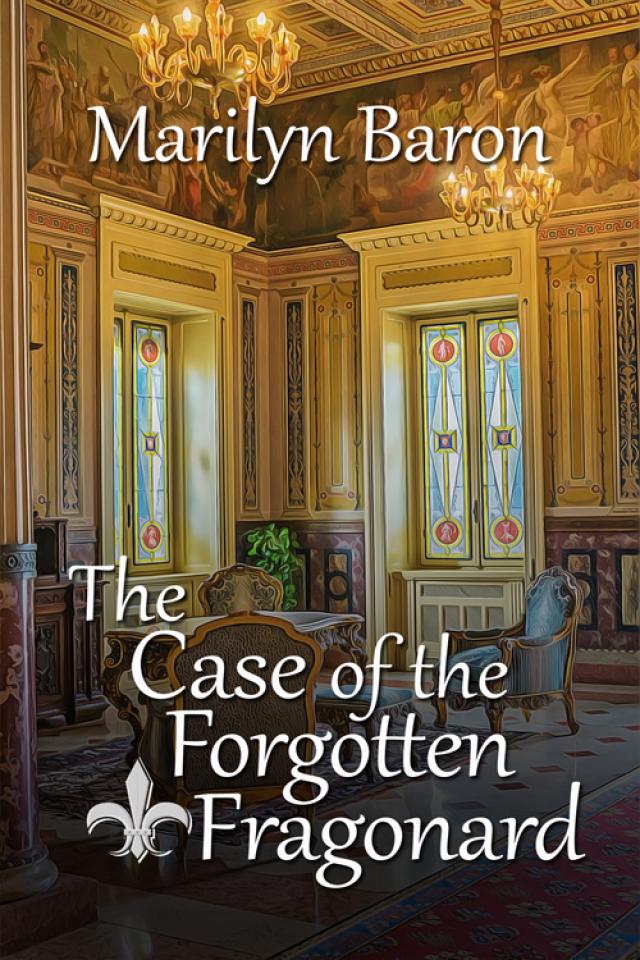
Table of Contents
Excerpt
Praise for Marilyn Baron
The Case of the Forgotten Fragonard
Copyright
Dedication
Quote
Chapter One
Chapter Two
Chapter Three
Chapter Four
Chapter Five
Chapter Six
Chapter Seven
Chapter Eight
Chapter Nine
Chapter Ten
Chapter Eleven
Chapter Twelve
Chapter Thirteen
Chapter Fourteen
Chapter Fifteen
Chapter Sixteen
Chapter Seventeen
Epilogue
A word about the author…
Thank you for purchasing
“How do you know me?”
“Who in Italy doesn’t know the famous and beautiful Signora Ferrari of Massimo Domingo Art Detective Agency?”
“I wasn’t aware anyone knew my name. My boss is the premier art expert.”
“Signora, you’re too modest. Your reputation precedes you, as does the highly questionable and fading reputation of your boss. And your particular expertise will be put to very good use here, I assure you. It’s a special job that requires your particular skills.”
“What exactly are we doing here?” Hadley demanded, acting more courageous than she felt.
“Okay, let’s dispense with the niceties, if we must. I have inherited a number of paintings, and I’m in need of your talent in authenticating and tracking the provenance of what I believe are masterworks.”
“You mean stolen Nazi art.”
The man straightened. “Certainly not. I have the records that maintain these paintings were legally sold to the buyers and that I now own Palazzo Allegretti and all of its contents.”
“But I understood that Herr Muller had purchased the palazzo.”
“Herr Muller works for us. He’s what you could call an anonymous third party. We’ve been waiting a long time to release these paintings onto the open market. I simply need your assistance in verifying their authenticity, perhaps giving us an idea of their current value, which has undoubtedly risen since they were…”
“Confiscated?” Hadley posed. “Is that the word you were looking for?”
Praise for Marilyn Baron
and THE CASE OF THE MISSING BOTTICELLI
“If you would like to travel to Italy without leaving home, you love art, intrigue and romance, I highly recommend THE CASE OF THE MISSING BOTTICELLI.”
~Cynthia B.
~*~
“Love Italy? How about cozies about missing Renaissance paintings? If so, this book is for you!”
~L. Kraft
~*~
“THE CASE OF THE MISSING BOTTICELLI by Marilyn Baron is an escape to Florence, Italy. The story was surrounded with lavish Italian flavor which swept me away and kept me turning pages.”
~Redi44Crew
~*~
“This cozy mystery will appeal to readers on many levels. The pace is non-stop; the characters are well-drawn and intriguing. A winner all around.”
~Kat Henry Doran, Wild Women Reviews
The Case
of the
Forgotten Fragonard
by
Marilyn Baron
A Massimo Domingo Mystery
Book 3
This is a work of fiction. Names, characters, places, and incidents are either the product of the author’s imagination or are used fictitiously, and any resemblance to actual persons living or dead, business establishments, events, or locales, is entirely coincidental.
The Case of the Forgotten Fragonard
COPYRIGHT © 2022 by Marilyn Baron
All rights reserved. No part of this book may be used or reproduced in any manner whatsoever without written permission of the author or The Wild Rose Press, Inc. except in the case of brief quotations embodied in critical articles or reviews.
Contact Information: info@thewildrosepress.com
Cover Art by The Wild Rose Press, Inc.
The Wild Rose Press, Inc.
PO Box 708
Adams Basin, NY 14410-0708
Visit us at www.thewildrosepress.com
Publishing History
First Edition, 2022
Trade Paperback ISBN 978-1-5092-4865-0
Digital ISBN 978-1-5092-4866-7
A Massimo Domingo Mystery, Book 3
Published in the United States of America
Dedication
This book is dedicated to my husband, Steve,
to my two daughters—Marissa and Amanda,
and to my two granddaughters—Aviva and Amelia.
“I was in awe of Michelangelo’s energy. I felt things that I could not express. When I saw the beauty of the Raphaels, I was moved to tears, and I could scarcely hold my pencil. For several months I remained in a state of apathy that I was unable to overcome, until I resolved to study the painters who I felt I had a chance of rivaling: and so I turned my attention to Barocci, Pietro da Cortona, Solimena, and Tiepolo.”
~ Jean-Honoré Fragonard
Chapter One
Firenze, Italy
When she arrived at the office, Hadley Evans, now Mrs. Luca Ferrari (she had to keep reminding herself), she had no idea her life was about to change in such a dramatic way. As an art detective she’d had the opportunity to see great masterpieces up close. But there was a definite difference between appreciating a painting mounted in its gilded, vintage frame, hanging in an antiseptic, untouchable, but well-lit space in a museum, surrounded by hundreds of art afficionados carrying cameras with selfie sticks, versus breathing on and touching the same canvas that was lovingly painted by the artist centuries before.
It started out as any other ordinary day, although Hadley’s days in Florence were hardly ordinary compared to her mundane life previously in Tallahassee, Florida. It began with a brief, but pleasant, walk over the Ponte Vecchio to the center of town where the Massimo Domingo Art Detective Agency was located. She greeted Gerda, Massimo Domingo’s office manager, and settled herself in her new space, tastefully and generously decorated by Massimo’s long-suffering wife, Francesca.
She rifled through the first few telephone messages. Again, nothing out of the ordinary. The Uffizi curator wanted to talk to her about an upcoming exhibit and offer her a job, again. Her gynecologist called to confirm that she wanted to reschedule an appointment she’d made to get fitted with a diaphragm. That would put off the serious confrontation with her new husband, Luca, whose sole mission in life, other than to rescue all the helpless people (especially women) in Florence who needed protecting, seemed to be getting her pregnant.
But there was one message, hastily scribbled in Gerda’s undecipherable handwriting, something about a forgotten Fragonard, painted after 1771. Had this painting been commissioned by the capricious patron of the arts Madame du Barry? Yes, that Madame du Barry, official royal mistress to Louis XV, his last mistress, who was unceremoniously and noisily beheaded during the Reign of Terror in 1793. Perhaps this would be an outlandish claim of another large panel painting in the cycle known since the nineteenth century as The Progress of Love. Undoubtedly a fake. All the other panel paintings in the cycle were accounted for.
Gerda must have gotten it wrong. To Hadley’s knowledge, there were only four main panels in that cycle, considered Fragonard’s masterpiece, large-scale decorative works of art, originally hung in the music pavilion of du Barry’s country retreat at the Château de Louveciennes, west of Paris. They were currently on display at The Frick Collection in New York City, actually at the Frick Madison, the museum’s temporary home. Hadley had visited the Fragonard Room at the Frick a number of times and, most recently, at the Frick Madison, before she flew to Florence, and she was enamored of—really mesmerized by—Fragonard’s Progress of Love series. She was by no means an expert on Fragonard. Her time in college had mostly been occupied studying Italian Renaissance painters. Admittedly, she didn’t know everything she should about the artist. She’d have to get up to speed on the French painter and printmaker.
Hadley strolled over to Gerda’s office with the telephone slip, still musing on what the painting could be.
“Gerda, there’s no name on this note, no number.”
“The note about the Fragonard?”
Hadley nodded.
“The poor Rachmanus,” said Gerda, shaking her head. “I looked him up after I got the message. At one time, he received all kinds of decorative commissions from royal and private patrons. He painted small cabinet-sized paintings for French private collectors, but most of his paintings were created for the aristocracy, so his career was put on hold and his major client base wiped out by the French revolution. After the revolution, he ultimately returned to Paris to work with the new government to help administer the national museum at the Louvre. He stopped painting for the last fifteen years of his life. By then, his work had fallen out of favor and he died in relative poverty and obscurity, all but forgotten. His most famous series was rediscovered with renewed interest in the late nineteenth century. He once said, ‘If necessary, I would even paint with my bottom.’ He’d definitely hit bottom.”
Hadley smothered a laugh. She had seen the portrait of Fragonard painted by his sister-in-law Marguerite Gérard and thought he had the look of a portly and jovial George Washington. It was hard to think of Fra gonard, who was considered among the most important and innovative French painters of the second half of the eighteenth century, as a “poor Rachmanus.” But Gerda pitied almost everyone as a “poor Rachmanus” at some stage in their lives. And Hadley certainly didn’t want to imagine him painting with his bottom.
Had he really said that? And she had not known that the French Rococo Master had come to such a bad end. Fragonard’s work was certainly highly valued and coveted today. “So how can I get in touch with her?”
“She wouldn’t leave her name or her number. She was calling from Rome and said she’d be calling back later today.”
“Are you sure she didn’t ask for Massimo?”
“No, she specifically asked for you.”
Hadley scratched her head. “But there are only four main canvases in that cycle.”
“She was adamant about that. She claims there’s another unknown painting related to the series.”
Hadley’s pulse raced as she recalled the playful, erotic works of the eighteenth-century artist. The four paintings at The Frick, his largest, had made such an impression on her she’d never forgotten them. The exquisite paintings captured a couple in four different moments in their love affair, from pursuit and meeting to commitment and friendship—the climax of love—and were set in lush romantic landscapes…gardens bursting with flowers and full of mythological sculptures.
Hadley tilted her head. The caller was probably a prankster. There was no fifth canvas from that series, was there? And from the little she knew of Fragonard, the prolific artist produced more than 550 paintings, several thousand drawings (although hundreds are known to be lost) and thirty-five etchings, but who, according to Gerda, nevertheless fell from favor at the end of his life. Besides, what would one of the French painter’s works be doing in Italy?
All she could do was wait. But before the woman called back, Hadley was going to brush up on her Fragonard. Never mind that her calendar was full. If there was even a remote possibility that some lost Fragonard had been discovered, Hadley would shoot that to the top of her to-do list. Massimo would be proud of her if she managed to pull off that coup. Of course, he’d also be jealous, but, par for the course, he would receive all the accolades anyway. She didn’t mind playing second fiddle to the maestro. She was young and comparably inexperienced and still had a lot to learn. She was indebted to Massimo for giving her a chance to work at such a prestigious agency at such a young age. An agency that, itself, had fallen out of favor, but had been revitalized by her discovery of a cache of stolen Nazi art in a Venetian villa and a Vermeer in Lake Como. She was lucky to have the job at all. She would have her opportunity to shine in the years to come.
She hurried over to Massimo’s office. Generally, Gerda kept it neat when he was away, but there were telltale signs of her boss’s untidy habits evident all over the room. Unfinished sweets in a crumpled bag from the pasticceria down the street. Hadley threw it in the trash basket. Unopened letters were scattered across his desk. Hadley swept them up into a neat pile. Gerda must be preoccupied. Probably by her new boyfriend, the doctor.
Hadley examined the art history books in the room, until she settled on an English edition of Fragonard by Pierre Rosenberg, a French art historian, curator and former President-Director of the Louvre, a catalogue of the artist’s major paintings. Pulling it from the shelf, she wandered back to her office to find out all she could about the moody nature painter from Provence. She also pulled Fragonard’s Progress of Love at the Frick Collection by Colin B. Bailey, a specialist of eighteenth-century French painting who had joined The Frick Collection in 2000.
She knew Fragonard’s work was more than just what some people dismissed as superficial, immoral, intimate bedroom scenes, natural landscapes, gardens, green leaves, flowers, sculptures, and chubby cupids and cherubs. The Rococo style of art had originated in Paris during the reign of Louis XV. Although the market for the Rococo Master’s work had fallen out of fashion during the French revolution, to which he lost his patrons when they lost their heads, and he was all but forgotten when he died, Fragonard’s use of color and fluid style influenced the work of many renowned Impressionists, including Monet, Renoir, and Berthe Morisot (his grandniece). Fragonard was a favorite of Renoir for his painting of pretty women.
He was one of Hadley’s favorite artists too, which is why she frequented The Frick every chance she got when visiting New York. Fragonard evoked deep feelings with his spontaneous brushstrokes and sentimental subjects.
And she had visited Parfumerie Fragonard on the French Riviera, opened in 1926 and named after the famous Grasse-born painter. She had come away with long-lasting memories of the beauty of the scenery and a fondness for the place.
Hadley hadn’t thought seriously about Fragonard for a long time, but the hairs on the back of her neck stood up and her mind flooded with emotion as she flipped through the illustrations. Surprisingly, she came across some Italian drawings. What was Fragonard’s Italian connection?
Hadley put the books aside and began surfing the Internet, where she discovered that, indeed, the painter had taken two trips to Italy. Born in Grasse in southern France in 1732, he and his family moved to Paris where he studied in the studios of Jean Siméon Chardin, François Boucher, and Carle Van Loo. In August 1752, he entered the Prix de Rome competition given by the French Academy and won first prize. He left Paris for Italy in October 1756 and spent five years studying landscape painting and drawing in Rome with the support of the French Academy, sketching the Roman scenery. In 1760, he toured Italy, traveling to Rome, Naples, and Venice with patron and avid collector Abbé de Saint-Non. While in Italy, he produced a series of red chalk drawings before returning to Paris. From a quote she stumbled upon by Fragonard himself, she discovered he had been inspired by Italian artists:
“I was in awe of Michelangelo’s energy. I felt things that I could not express. When I saw the beauty of the Raphaels, I was moved to tears, and I could scarcely hold my pencil. For several months I remained in a state of apathy that I was unable to overcome, until I resolved to study the painters who I felt I had a chance of rivaling: and so I turned my attention to Barocci, Pietro da Cortona, Solimena, and Tiepolo.”
~Jean-Honoré Fragonard
Not much documentation and critical commentary about Fragonard’s art survived today. Hadley had seen his brilliant easel paintings in London and the Louvre, as well as The See-Saw, one of his earlier works, in Madrid at the Thyssen-Bornemisza Museum. And most recently, on a trip to Lisbon, she’d seen Fragonard’s “The Island of Love” at the Museu Calouste Gulbenkian, an oil on canvas, a view of a fictional garden, painted in France in 1770 and first sold in public in 1784 and later in various collections in Paris.
She paused at the computer and drew a long breath. Aha. Fragonard and his wife made a second trip to Italy in 1773-1774 with one of his major patrons, which sparked the artist’s fascination with landscapes and images of gardens, leading to some of his most famous masterpieces.
Hadley ran her finger across her lower lip. There was something familiar about that date…1773. She clicked on different sites until she found what she was looking for. It was by 1773 that Madame du Barry rejected the four paintings she had commissioned from Fragonard—The Pursuit, The Meeting, The Lover Crowned, and Love Letters, which were returned to the artist’s studio. In their place, she installed a series commissioned from Joseph-Marie Vien. Why? No one knew for sure. It was still a topic of discussion among art historians.
Were Fragonard’s canvases too old-fashioned? No longer to his patron’s taste? Was the artist’s French Rococo style incompatible with the neoclassical style of the house? Some accounts claimed the series was “too decent.” Was the subject of the paintings too close to home, alluding to his patron’s private affairs? Or were the pictures simply the wrong size? Or the wrong colors? Or was there some other dispute with the demanding patron? Were they unable to reach an agreement on price? Records show Fragonard was paid for his preliminary sketches, which must have been approved, but there was no proof he was ever compensated for his finished work. Fragonard was notorious for abandoning projects, revising estimates upward, pushing back deadlines, and alienating his clients.


