

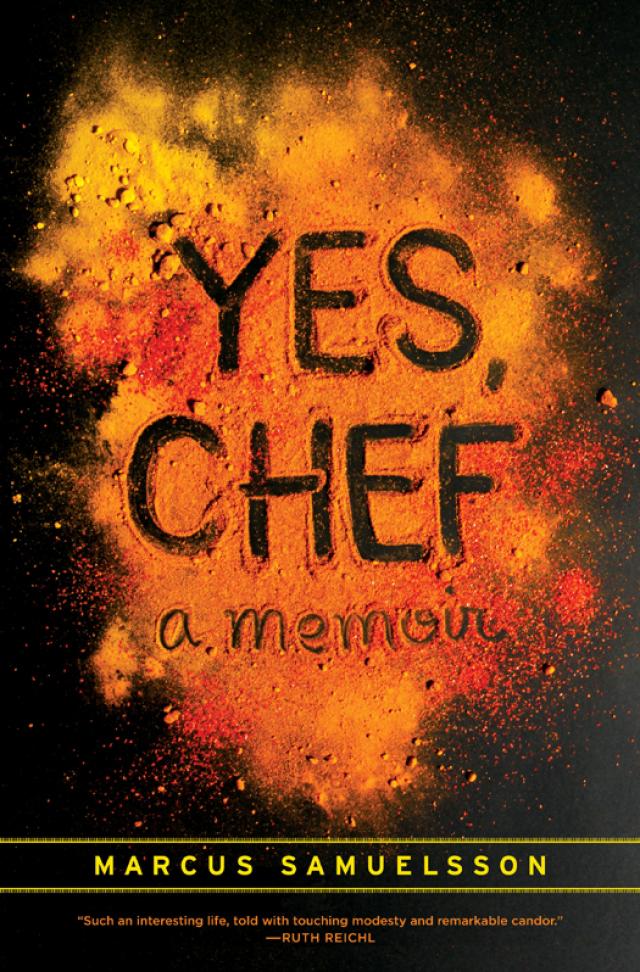
Yes, Chef, page 15


None of us talked about it—we were guys, after all—but we all felt freer in New York than we had at home; we were no longer such oddballs. We all had other black friends and other people of color as friends and everybody did his thing. Everything we moved to New York for was happening for us: diversity, music, excitement, creativity.
Not everything went my way in New York, of course, and some of those disappointments were greater than others. On the lighter side of failure, my attempts at love, American style, flopped. I had this idea, when I arrived, that I wanted to date a typical American girl. (Whatever that was.) I wasn’t more specific than that in my desire; I was just ready to change up from the Swedish au pairs I’d met through Svenne buddies at work. Casey hooked me up, of course—I’d have had no other way into that world.
The deck was stacked against me from the start, since I knew almost nothing about dating, much less American dating. In Sweden, we hung out in groups, and whoever ended up as couples still traveled as part of the group. Whoever had money paid; there were no expectations, and no one kept track. Once I got to America, my Garden City buddy Anthony filled me in on the high school prom rituals of the boy asking the girl, the corsage, the limo, the bow tie having to match the dress.
“For a high school dance?” I kept asking him.
When I met up with my first proper American date, an African American woman a couple of years younger than me, she seemed ready for adventure.
“Let’s go places,” she said. Cool, I thought, and headed for the nearest subway.
“No, I can’t,” she said, looking down at her high heels. “Not in these.”
So we cabbed down to the Village to have a drink and some food at a skanky place on Bleecker Street. Then she wanted to go uptown to the Shark Bar, so we cabbed up to the Upper West Side and had another drink. Then she wanted to go back downtown to listen to late-night music, and when we stepped out onto Seventh Avenue, I counted out the fare for our third taxi of the night and I realized I had only eight dollars left. I panicked, then I got mad. Screw this, I thought.
“This has been nice,” I lied. “But I have to get up early tomorrow.”
It’s not in my nature to give up easily. I met another girl and came up with what I figured was a surefire plan. One of Aquavit’s Brazilian waiters had gone back to Rio for vacation, and I was apartment-sitting for him. He had a nice place, so I figured, OK, rather than go on a date to some bad restaurant, I should invite the girl over so I can cook for her. I get to show off what I’m good at, and we’d eat better and cheaper than any restaurant I could afford. I called and proposed the dinner.
“What are you talking about?” she said, as if I were crazy. For me that wasn’t a weird thing, just to invite someone over and cook a big meal. She finally agreed to come—as long as she could bring a girlfriend/bodyguard.
“No problem,” I said.
I did a four-course meal, with appetizer and soup and a potato-wrapped salmon.
The girls oohed and aahed at every course. I figured I’d put the girl I liked at ease, but as soon as dinner ended, and I asked if she wanted to hang out, she and her friend announced they had to go. I guess they’d figured they’d eat with me and then go hang out with the guys who were serious prospects, guys with enough loot to wine and dine them.
That wasn’t me. My salary wasn’t going to increase anytime soon, so I had to figure out how to have fun on the cheap, and find girls who would go along with that. By the end of my nine-month stint, I’d tracked down the best hot dog stand in the city, and that’s where I’d take my dates. Afterward, if a girl hadn’t given up on me yet, I’d invite her to take a walk with me through Central Park. You’d be surprised how many New Yorkers have never really been to Central Park—or if they have, haven’t visited it in years.
I love Central Park like only an immigrant could. It’s an American masterpiece. I explored every corner of it: I’d skate up to 100th and Fifth to sit in the rose garden or hang out at the east-side plaza where roller skaters of every shape and size danced all day long. People were making out, picnicking, jogging. There was every color and ethnicity. Back then, you’d see lots of Vietnam vets, too, guys who’d checked out of society and made their home there. On the soccer field, I’d play one day against some of the best soccer players I’ve ever competed against in my life, and the next day, I’d be playing against some bum who would drop out to go smoke weed and then come back in. No one cared. No one was there to judge.
Being broke and living in a city like New York was no problem, once I realized you could still find plenty of stuff to do if you knew where to look. If I was going out and had fifty dollars to spend, I’d grab the Village Voice events calendar, scoping out whatever was cheap or free—concerts in the park, clubs with no cover, off-off-Broadway shows that needed butts in the seats. I got it down to an art form: how to have a good time for forty-nine dollars or less.
The best place to start was Chinatown, which was busy and energetic, with a sidewalk scene that provided plenty of visuals and smells and a totally exotic soundtrack. I found spots where my date and I could get a tasting menu for five dollars each, if you ordered right, and since I was the cook, I always ordered. We would share noodles, dumplings, steamed buns, barbecue ribs, hot and sour soup, and one noodle dish for the grand sum of ten dollars. Add in some really bad plum wine and a tip: sixteen dollars and you were good to go. For me, the best dish of all was the sweet pork buns, which were such a new combination of textures and flavors. The big white buns were light and airy with a slightly toothy skin caused by the steaming process. I watched as the cooks loaded up bamboo steamer baskets with buns, put on their lids, and then set them over heats much higher than we ever used at Aquavit. At the center of the bun was a filling of roasted pork and a sweet sauce.
It came with a side dish of soy sauce, and into this I’d mix every condiment on the table: mustard, chili sauce, and a bit of chili vinegar. We’d dip the buns in the sauce and get through the obligatory first bite—all dough—to get to the mind-blowing second bite, which combined dough and filling. It’s still one of my favorite dishes to eat. I always wondered who created this dish, how it came about.
The whole experience of the Chinese restaurant was so intriguing to me that I never minded being treated rudely or made to wait. And yes, the lighting was usually operating room fluorescent and the floor was linoleum and the service would have gotten you kicked out of restaurant school, but if you were lucky enough to be able to see into the kitchen, even glimpses through swinging doors, you saw a fury of activity, cooks working at top speed putting out tremendous volume and quality. That work ethic, along with a price I could afford, kept me coming back.
Chinatown was just one of a hundred food destinations I’d discovered, and almost day by day, my desire to stay in New York grew stronger. I was intrigued by what I was seeing in the American approach to food. It clearly started with the traditions of Europe but was not bound by them. Europeans I’d worked with scoffed at American cuisine, claiming it was nothing more than burgers. I knew that was bullshit. I was having one unbelievable food adventure after another, and I didn’t want that to stop.
———
IN NEW YORK, I was surrounded by people who were on their way somewhere. I wanted to be on my way, too, but it turned out that the rest of the New York cooking world wasn’t quite as easy to crack as Aquavit had been. While I was still waiting to hear from places I’d written to in France, it seemed silly not to explore some American options while I was in the country. I aimed high. Jean-Georges Vongerichten was at Lafayette and Daniel Boulud was at Le Cirque, and while they were clearly geniuses, they were not at center stage. Center stage, at that moment, belonged to David Bouley, a chef from Connecticut who had made his mark in the city when he ran the kitchen at Montrachet, a TriBeCa restaurant owned by the then fledgling restaurateur Drew Nieporent. Bouley won raves for stuffing cabbage rolls with foie gras one night and pairing red snapper with a tomato-and-coriander pasta the next. Both Bouley and Nieporent were about to build food dynasties, but due to mismatched temperaments, not together. In 1987, Bouley opened his own restaurant—Bouley—on West Broadway and Duane, practically around the corner from Montrachet. He knocked it out of the park, too, earning four stars from The New York Times, repeatedly coming in at number one in the reader-driven Zagat Survey, and winning awards from the industry’s benchmark-setting James Beard Foundation. Customers reserved months in advance to taste Bouley’s locally sourced fingerling potatoes or his roasted wild salmon with sesame seeds in tomato water.
I wanted to work for David Bouley.
I took the subway down to Canal Street one afternoon to see if I could secure a stage with him. I was fairly sure Christer Larsson would let me off for a couple of weeks; it was a kind of gentlemen’s agreement among chefs to let your hard workers train with someone else when the opportunity arose.
The first thing I noticed about the restaurant was a crate of fresh apples sitting out on the sidewalk, waiting to be taken inside. I made my way back to the kitchen and recognized in every detail—the decor of the dining room, the freshness of the herbs that an intensely focused commis was chopping, the quiet seriousness of the staff—the same level of commitment I had known at Victoria Jungfrau. I found the sous-chef, a German guy who would go on to have his own successful restaurant in the West Village some years later. I told him my history and asked if they’d let me stage.
“No,” he said, and I realized that his gaze had stopped short of actually focusing on me, that he wasn’t putting any effort into seeing beyond an instantaneous judgment he’d made that I was not worth his time. It was the look. I’d seen it everywhere from Gburg to Nice. “I don’t think so.”
“You could let me do a tryout before you decide,” I suggested, feeling emboldened by my recent successes at Aquavit. I was offering a couple of weeks of free, skilled labor. If they let me work just one shift, they’d see what I could do.
“I don’t think so,” he repeated, and turned his back.
Had they ever had a black cook in that kitchen? Would they ever?
It was becoming clearer and clearer to me that black people were almost by design not part of the conversation about fine dining. In New York, I’d only heard of one black man to pull a chair up to that table, and that was Patrick Clark, a second-generation chef from Canarsie, Brooklyn. In 1980, when he was only twenty-five, Clark brought nouvelle cuisine to TriBeCa via the Odeon, and The New York Times gave him two stars in its very first review of the place. Clark would go on to do stints in LA and DC, he’d turn down an invitation to become the White House chef for the Clinton administration, and he’d eventually be named executive chef for Central Park’s iconic Tavern on the Green restaurant.
Sometimes, when Christer Larsson took me along to swanky cooking events, I would see Clark there. He seemed like a nice guy with a big personality, built like a boxer. A well-fed boxer. He was always, without fail, the only black man among his peers, but he seemed at ease in any environment, confident that he deserved to be in the room, on equal footing with other food-world luminaries who left me starstruck, like Park Avenue Café’s David Burke and Aureole’s Charlie Palmer. Clark always seemed to be accompanied by people of color, people who probably would never have gotten into the room without him.
Back then, as a black man in the world of fine dining, Patrick Clark was truly the exception to the rule. His food was solid and well-executed, his passion and personality were larger than life, and yet he would never get more than two stars. I wanted more. I wanted four stars. The upper echelon among chefs was still reserved for white men, but I knew, in my heart, that that could change. I was the Lion of Judah, as Ethiopians sometimes referred to themselves, born into one of the oldest, proudest civilizations on the planet. And I was raised with the truth of equality, by white parents who lived out their belief in racial equality through their love and protection and support. I believed in myself as a chef. I just needed to get through the door. The key, I knew, was to have the one credential that still mattered above and beyond anything else: France. If I could get to France, then even a jerk-off sous-chef couldn’t afford to ignore me.
FIFTEEN FRANCE
I HAD TO GET TO FRANCE. ANYONE WHO WANTED TO KNOW GREATNESS had to go to France. Yeah, I found French food too heavy and rigid and fussy sometimes, with technique overshadowing flavor, but there was no question that it embodied excellence, history, and craft—three qualities that appealed to me. Plus, I needed that pedigree in my pocket.
Starting at Belle Avenue and then whenever I went home between jobs, I’d go to the library to look up French restaurants. I didn’t even know enough French to write the letters, asking for work; I had to find someone to help me translate. Plenty of places didn’t bother to respond at all, many said no, and the first one that wrote back with possibilities was the Paris branch of a Swiss hotel chain, no doubt impressed by my time at Victoria Jungfrau.
“Take the job,” my father said, a firm believer in going with the bird in hand. I was holding out for a place that had earned top honors, which meant three stars in the Michelin guide.
“No way I’m taking that,” I said.
“Marcus,” he said, in a tone that meant he was trying to appeal to my sense of reason. “Even if it’s a one star or a zero star, just take the job. At least you’ll be in France.”
He had a point, but I wanted to hold out. If I kept working hard, there would be a payoff.
In the summer of 1993, two events conspired to catapult my cooking to a new level. First, after thirty polite rejections to the letters I’d sent to three-star restaurants in France, one finally said yes. The family-owned Georges Blanc restaurant in Vonnas, halfway between Dijon and Lyon, offered to take me as an intern the following May, and if everything worked out, I would be allowed to stay for nine months. They would cover room and board, but as was always the case in restaurant apprenticeships, the higher the level, the less you got paid. At Georges Blanc, I’d get squat. I’d have to save up for my transportation and living expenses, which might have been possible if I hadn’t had to make the monthly payments for my daughter.
The second event, which ended up being a kind of solution to the challenges of the first, happened on a hot August day during the break between lunch and dinner services, when Paul Giggs walked through the doors of Aquavit. My old boss from Victoria Jungfrau had left Switzerland and gone back to working for cruise ships, this time a highly rated Norwegian cruise line. His ship had docked in New York, and he decided to look me up. He was sitting at the bar when I came out of the kitchen, and I did a double take at seeing him perched on a barstool. He had come to visit, but he also happened to be looking for a cook. Was I interested?
“It’s hard work,” he warned. “There’s no such thing as a day off.”
Paul’s timing couldn’t have been better. My contract at Aquavit was almost up and cruise ship work paid incredibly well, many times over what I’d ever earned. I agreed to sign on for a four-month stint, a run that would take me from Fort Lauderdale to South America. This was the adventure Mannfred and I had talked about so many times back in Interlaken. Going through with it would be a kind of tribute to my lost friend.
I ended up doing two stints for Paul, back to back, filling the months between New York and France and wiring my earnings to my mother to bank for me. I made enough to finally pay off what I’d borrowed from my parents, salt away six months of child support payments for Zoe, and pile up a good chunk of change for France. I also got to see the world, albeit in four- and five-hour doses when we docked in ports from Venezuela to Saint Petersburg.
In a creative sense, work on the ship wasn’t that challenging or rewarding. Paul was giving customers what they wanted: nothing too complicated. We’d make crab cakes on a “haystack” of fried leeks, minute steaks, and lemon garlic roasted chicken, day in and day out. What mattered was consistency and service, pleasing the passengers who had paid a thousand dollars a day to be on that ship. It was a little like being an actor in a Broadway show, having to be on time and do your best six days a week, except we did it for seven. Every day, we had two hundred guests to feed and we cooked them breakfast, lunch, and dinner. I learned how to bang it out, and I remember thinking that if I ever had to do pre-theater dinners again, I’d be able to do them with my eyes closed.
Guests usually came aboard for one week, and they rated the food at the end of their trip: Paul went apeshit if we got anything less than top marks. Fortunately, we rarely did.
He was fair and he rewarded talent, but if you messed up, he was not nice. My worst moment on the ship was near Acapulco. I’d recently gotten Paul to hire my buddy Susan, a Swede I’d worked with at Aquavit.
“I don’t know about bringing women onto the boat,” he said, but I vouched for Susan and she worked so hard and was so talented that Paul accepted her instantly. Unfortunately, from swimming or eating something ashore, Susan fell horribly sick. Either we had to cover for her, or she had to go home.
“No problem, we’ll pick up her slack,” I promised, but taking over a second person’s station in an eight-person kitchen turned out to be too much. I was handling her fish station and the grill, and I started to lose track. Was that lamb order rare or medium rare? How many tenderloins was that again? It was too much. I was going down. Marcel, a Swiss cook who was in charge of the entremetier station, had to step in on fish while I dug myself out on the grill. I started screaming out orders, totally out of control, and when Paul saw how lost I was, he screamed louder, berating me all through service.


