

Enchantress: A Novel of Rav Hisda's Daughter, page 1


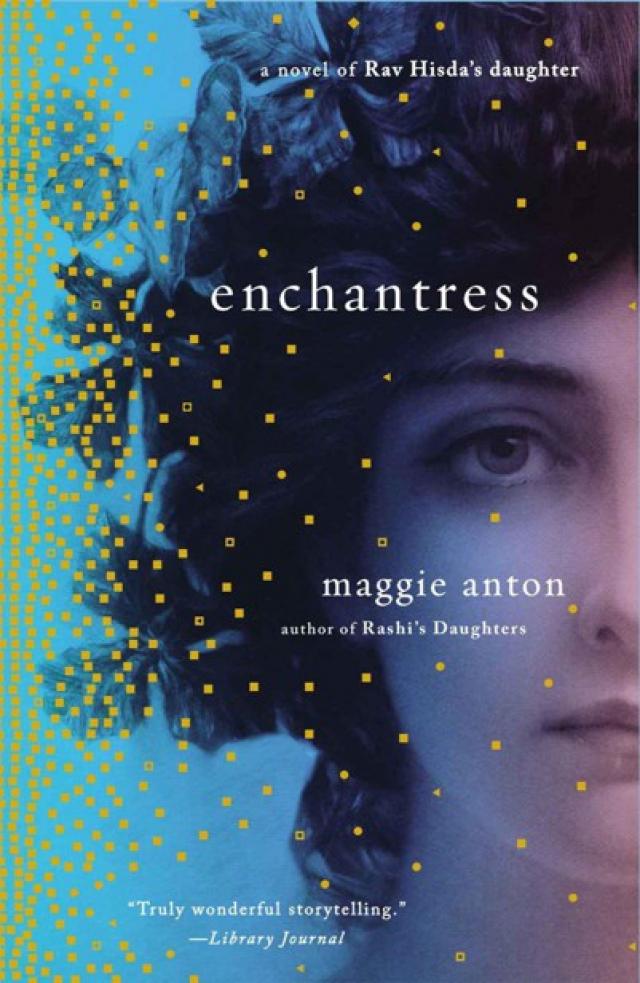
A PLUME BOOK
ENCHANTRESS
MAGGIE ANTON was born Margaret Antonofsky in Los Angeles, California, where she still resides. Raised in a secular, socialist household, she reached adulthood with little knowledge of her Jewish religion. All that changed when David Parkhurst, who was to become her husband, entered her life, and they both discovered Judaism as adults. That was the start of a lifetime of Jewish education, synagogue involvement, and ritual observance. This was in addition to raising their children, Emily and Ari, and working full-time as a clinical chemist for Kaiser Permanente for more than thirty years.
In 1992 Anton learned about a women’s Talmud class taught by Rachel Adler, now a professor at Hebrew Union College in Los Angeles. To her surprise, she fell in love with Talmud, a passion that has continued unabated for twenty years. Intrigued that the great Talmudic scholar Rashi had no sons, only daughters, Anton researched the family and decided to write novels about them. Thus the award-winning trilogy Rashi’s Daughters was born, to be followed by the National Jewish Book Award finalist Rav Hisda’s Daughter, Book I: Apprentice.
Still studying women and Talmud, Anton has lectured throughout North America and Israel about the history behind her novels. You can follow her blog and contact her at her website, www.maggieanton.com.
Praise for Enchantress
“Enchantress casts its own spell.”
—Nomi Eve, author of Henna House and The Family Orchard
“Perhaps the best occult author of our time, Anton’s scintillating language sweeps the reader quickly into the chills and thrills of Jewish life and love during the Babylonian Empire.”
—Rabbi Goldie Milgram
“Maggie Anton’s Enchantress displays vast learning and delicious romance in equal measure. With charming characters, bewitching prose, and a spellbinding plot, Anton’s Enchantress will beguile readers.”
—Rabbi Burt Visotzky, Professor of Midrash and Interreligious Studies at the Jewish Theological Seminary and author of Sage Tales: Wisdom and Wonder from the Rabbis of the Talmud
“Maggie Anton performs nothing less than a feat of literary legerdemain in her latest novel. Yet again, the beloved author of the Rashi’s Daughters trilogy has exposed the forbidden secrets of the ancient world while, at the same time, conjuring up the flesh-and-blood women and men who lived out their lives in distant antiquity. Enchantress is an enchantment in itself!”
—Jonathan Kirsch, author of The Short, Strange Life of Herschel Grynszpan
Praise for Rav Hisda’s Daughter, Book I: Apprentice
“The work of a master craftswoman set upon repairing a major gap in Jewish literature.”
—Philadelphia Jewish Voice
“This absorbing novel should be on everyone’s historical fiction reading list.”
—Library Journal (starred review)
“Rav Hisda’s Daughter provides a wealth of historical detail about Jewish life in Babylon and Israel in the third century CE. Its interest lies in its portrayal of the sorcery, incantations, and women’s customs in this exotic, faraway period of time and place, sometimes against the backdrop of war.”
—Historical Novel Society
Also by Maggie Anton
Rashi’s Daughters
Book I: Joheved
Rashi’s Daughters
Book II: Miriam
Rashi’s Daughters
Book III: Rachel
Rashi’s Daughter: Secret Scholar
( for YA readers)
Rav Hisda’s Daughter
Book I: Apprentice
PLUME
Published by the Penguin Group
Penguin Group (USA) LLC
375 Hudson Street
New York, New York 10014
USA | Canada | UK | Ireland | Australia | New Zealand | India | South Africa | China
penguin.com
A Penguin Random House Company
First published by Plume, a member of Penguin Group (USA) LLC, 2014
Copyright © 2014 by Maggie Anton
Map illustration by David Parkhurst
Penguin supports copyright. Copyright fuels creativity, encourages diverse voices, promotes free speech, and creates a vibrant culture. Thank you for buying an authorized edition of this book and for complying with copyright laws by not reproducing, scanning, or distributing any part of it in any form without permission. You are supporting writers and allowing Penguin to continue to publish books for every reader.
REGISTERED TRADEMARK—MARCA REGISTRADA
LIBRARY OF CONGRESS CATALOGING-IN-PUBLICATION DATA
Anton, Maggie, author.
Enchantress : a novel of Rav Hisda’s Daughter / Maggie Anton.
pages cm
eBook ISBN 978-0-698-15883-2
1. Jewish women—Fiction. 2. Magic—Fiction. 3. Good and evil—Fiction. 4. Jewish fiction. I. Title.
PS3601.N57E53 2014
813'.54—dc23 2014018774
This is a work of fiction. Names, characters, places, and incidents either are the product of the author’s imagination or are used fictitiously, and any resemblance to actual persons, living or dead, businesses, companies, events, or locales is entirely coincidental.
Cover design: Zoe Norvell
Cover image: Clematis, Sir Hubert von Herkomer (1849–1914) / Private Collection / Photo © The Mass Gallery, London / The Bridgeman Art Library
Version_1
CONTENTS
About the Author
Praise for Maggie Anton
Also by Maggie Anton
Title Page
Copyright
Dedication
Acknowledgments
Timeline
Map of Middle East ca. 300 CE
Cast of Characters
PART ONE: King Narseh’s Reign
ONE
TWO
THREE
FOUR
FIVE
SIX
SEVEN
EIGHT
NINE
TEN
ELEVEN
TWELVE
THIRTEEN
FOURTEEN
FIFTEEN
SIXTEEN
PART TWO: King Hormizd’s and King Shapur’s Reigns
SEVENTEEN
EIGHTEEN
NINETEEN
TWENTY
TWENTY-ONE
TWENTY-TWO
TWENTY-THREE
TWENTY-FOUR
TWENTY-FIVE
TWENTY-SIX
TWENTY-SEVEN
TWENTY-EIGHT
TWENTY-NINE
THIRTY
THIRTY-ONE
THIRTY-TWO
THIRTY-THREE
THIRTY-FOUR
THIRTY-FIVE
EPILOGUE
AFTERWORD
GLOSSARY
To my husband, Dave—
without your love, encouragement, and support, Rashi’s daughters and Rav Hisda’s daughter would still be merely figments of my imagination.
ACKNOWLEDGMENTS
I thank my outstanding editor at Plume, Denise Roy, who wielded her line edits with scalpel-like precision to cut extraneous and duplicate material so the flow improved and the reader was left eager to learn more. It was an education and a pleasure to work with such a consummate professional.
Kudos to Beth Lieberman for editing advice that never let me forget that the Talmud scenes should be about more than just Talmud, and that my heroine and hero must fulfill their characters’ arcs. Many thanks to my literary agent, Susanna Einstein, who has been negotiating for me since the early days of my career. My daughter, Emily, a voracious reader of historical fiction, spent hours critiquing my early drafts and never hesitated to lambast any scenes that didn’t measure up to her exacting standards.
I must also acknowledge the myriad of scholars who offered their assistance, with special appreciation to my Talmud study partners, Henry Wudl of HUC and Janet Sternfeld Davis of AJU.
Last, but not least, I offer love and gratitude to my husband, Dave. He had no idea that after thirty-five years of marriage to a chemist with regular working hours, he would abruptly be catapulted into living with an author who stayed up into the early hours writing, traveled all over the country (sometimes for weeks at a time), and whose income was erratic to say the least. He bore all this disruption with patience and a sense of humor, much better than I would have done if our situation had been reversed.
TIME LINE
450 BCE
Cyrus the Great allows Ezra and captured Jews to return to Zion from Babylonia, but many remain there.
332 BCE
Alexander the Great defeats Persian king Darius, Judea and Babylonia become Greek provinces.
167 BCE
Hasmonean/Maccabean revolt in Judea (basis of Hanukah). Judea again ruled by Jewish kings.
63 BCE
Pompey conquers Hasmonean state, Judea now ruled by Rome.
ca. 40 BCE
Hillel comes to Jerusalem from Babylonia and founds school to teach Torah.
37 BCE
Herod becomes client king of Judea, dies in 4 BCE.
6 CE
Judea becomes Roman province.
35
Jesus crucified.
66
Judean Jews rebel against Rome.
70
Judean rebellion fails. Temple in Jerusalem destroyed.
132
Bar Kokhba revolt against Rome, in Judea.
135
Bar Kokhba revolt is crushed. Judea renamed Palestina.
200
Mishna (Oral Law) redacted by patriarch, Rabbi Judah ha-Nasi.
220
Rav returns to Babylonia from Eretz Israel. He and Samuel establish Torah schools in Sura and Pumbedita, respectively.
226
Sasanian Persians conquer Parthia.
230
Hisda born in Babylonia.
241
Shapur 1 becomes king of Persia.
250
Jews agree to accept Persian law in Jewish courts. Jews receive autonomy within that limitation.
260
Shapur 1 defeats Rome, captures emperor Valerian.
270
Rava (Abba bar Joseph) born in Babylonia. Rav’s grandson Nehemiah becomes exilarch (through 313).
284
Diocletian becomes Roman emperor (through 305).
292
Narseh becomes king of Persia.
296
Narseh declares war on Rome.
298
Narseh defeated; Persia loses Armenia and upper Euphrates. Persian capital Ctesiphon sacked.
301
Narseh abdicates in favor of son Hormizd II.
307
Constantine, a Christian, becomes emperor of Rome.
309
Hormizd II dies. Persian crown placed on pregnant wife’s belly.
310
Shapur II born and declared king of Persia.
313
Mar Huna becomes exilarch (through 337). Constantine issues Edict of Milan and makes Christianity an official religion in Rome.
325
Roman Palestina administered by Christians. Last remaining Torah school in Tiberias is closed.
328
Shapur II crowned king of Persia and immediately attacks Arabs.
337
Constantine dies. Roman throne divided among his three sons.
350
Jerusalem Talmud complete.
359
Shapur II begins war with Rome.
361
Julian the Apostate becomes emperor of Rome, declares war against Persia and begins to rebuild Temple in Jerusalem.
363
An earthquake in Israel destroys Sepphoris and the partially rebuilt Temple in Jerusalem. Rome defeated at Samara. Death of Emperor Julian.
380
Christianity established as Rome’s only official religion.
400
Yazdgerd becomes king of Persia, marries a Jewish princess, and inaugurates golden age of Sasanian kingdom.
424
Rav Ashi dies, and redacting of the Babylonian Talmud begins.
425
Rome abolishes office of Nasi (patriarch) in Palestina.
500
Death of Ravina, head of Sura school and last sage named in the Babylonian Talmud.
570
Birth of Mohammed.
630
Rise of Islam.
638
Omar captures Jerusalem. Jews allowed to live there for the first time in nearly five hundred years.
642
Palestina, Syria, Egypt, and Babylonia fall to Muslim Arabs.
650/700
Stammaim (anonymous editors) produce the final form of the Babylonian Talmud
CAST OF CHARACTERS
Abba bar Joseph (b. 270)—a.k.a. Rava; Hisdadukh’s second husband, from Machoza
Abaye—Rava’s best friend and study partner in Pumbedita
Acha (b. 311)—Hisdadukh and Rava’s fourth son
Achti—Hisdadukh’s older sister, wife of Ukva bar Chama, in Sura
Adda—Rava’s student in Machoza
Adhur Narseh—Persian king (309), eldest son of Hormizd II
Adurbad—magus in Machoza, high priest under Shapur II
Ardeshir—Persian prince, younger son of Hormizd II and Cashmag
Ashmedai—king of the demons
Aspenaz—wife of Isaac the Butcher, in Pumbedita
Avimi bar Rechava—one of Homa’s twin sons
Rabbi Avahu—rabbi in Eretz Israel, heads school in Caesarea
Babata—Abaye’s second wife, in Pumbedita
Bahmandukh—sorceress in Machoza
Bar Hedaya—dream interpreter
Beloria—basket weaver and wife of Hisdadukh’s brother Pinchas
Bibi—Abaye’s son and oldest child
Cashmag—Persian queen, widow of Hormizd II, mother of Ardeshir
Chama bar Rami (b. 291)—son of Hisdadukh and Rami bar Chama
Chanina (b. 308)—Hisdadukh and Rava’s third son
Chatoi—young woman in Pumbedita, wife of Dakya
Choran—Rava’s first wife, in Machoza and Nehar Panya
Dakya—young man in Pumbedita, husband of Chatoi
Daru—Rav Nachman’s slave-manservant
Diya—sorceress in Machoza
Donag—daughter of Rav Nachman and Yalta, in Machoza
Dorti—Homa’s daughter with first husband, Rechava
Dostai—Rava and Hisdadukh’s household steward in Machoza
Efra—Rava and Hisdadukh’s land steward in Machoza
Eliezer—Yochani’s son, in Tiberias
Elisheva—daughter of Abaye and his first wife, in Pumbedita
Em—enchantress in Pumbedita, Hisdadukh’s teacher
Fulvius—circus animal supplier in Sepphoris
Gabrilus—Salaman’s son, in Sepphoris
Gerbita—Dakya’s mother, in Pumbedita
Gidel—Pazi’s father, Tachlifa’s father-in-law, Rava’s business partner in Machoza
Haifa bar Rechava—one of Homa’s twin sons
Hamnuna—Rav Hisda’s colleague on Sura beit din
Hanan—Hisdadukh’s brother, husband of Mariamme
Hannah—Mari and Rahel’s daughter, wife of Sama
Haviva—Hisdadukh’s mother, wife of Rav Hisda
Rav Hisda—Babylonian rabbi, judge on beit din in Sura
Hisdadukh (b. 275)—Rav Hisda’s daughter and youngest child, nicknamed Dada
Homa—Abaye’s third wife, a katlanit
Hormizd II—king of Persia (302–09)
Hormizd—Persian prince, son of Hormizd II
Hoyshar—Chaldean astrologer in Machoza
Huna—Hisdadukh’s nephew, son of her brother Tachlifa
Ifra—daughter of the exilarch Nehemiah, widow of Persian king Hormizd II, mother of Persian king Shapur II
Isaac the Butcher—Homa’s brother, in Pumbedita
Ispandoi—sorceress in Machoza
Issi—Homa’s nephew, son of her brother Isaac
Jacobus—Salaman’s son, in Sepphoris
Joseph (b. 301)—Hisdadukh and Rava’s eldest son
Judah Nesiah—patriarch, ruler of Israel’s Jewish community
Kahana—Rava’s student in Machoza
Kardar—Persian high priest under Hormizd II
Kiomta—Chatoi’s mother, in Pumbedita
Leuton—Hisdadukh’s slave-maidservant
Mahadukh—client of Hisdadukh in Pumbedita
Mar Huna—exilarch (313–37), ruler of Babylonia’s Jewish community, son of Nehemiah
Mar Zutra—son of Rav Nachman and Yalta
Mari (b. 259)—Hisda’s son and fourth oldest child, a flax dealer
Mariamme—family treasurer and wife of Hisdadukh’s brother Hanan
Matun—sorceress in Machoza
Mesharashay (b. 315)—Hisdadukh and Rava’s fifth and youngest son
Nachman (b. 251)—Hisda’s son and second oldest child, a judge
Rav Nachman bar Jacob—colleague of Rav Hisda, heads beit din in Machoza
Narseh—king of Persia (294–302)
Nebazak—widowed sorceress in Machoza


