

Death Comes to the Costa del Sol, page 1


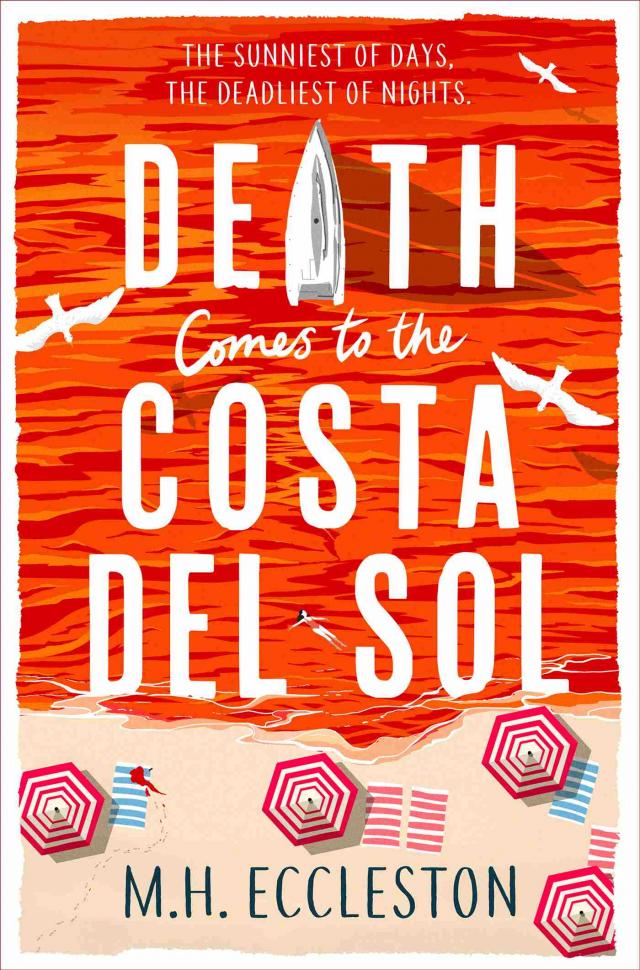
DEATH COMES TO
THE COSTA DEL SOL
ALSO BY M.H. ECCLESTON
The Trust
Death on the Isle
DEATH COMES TO
THE COSTA DEL SOL
M.H. ECCLESTON
www.headofzeus.com
First published in the UK in 2023 by Head of Zeus,
part of Bloomsbury Publishing Plc
Copyright © M.H. Eccleston, 2023
The moral right of M.H. Eccleston to be identified as the author of this work has been asserted in accordance with the Copyright, Designs and Patents Act of 1988.
All rights reserved. No part of this publication may be reproduced, stored in a retrieval system, or transmitted in any form or by any means, electronic, mechanical, photocopying, recording, or otherwise, without the prior permission of both the copyright owner and the above publisher of this book.
This is a work of fiction. All characters, organizations, and events portrayed in this novel are either products of the author’s imagination or are used fictitiously.
A catalogue record for this book is available from the British Library.
ISBN (HB): 9781803287218
ISBN (XTPB): 9781804548370
ISBN (E): 9781803280400
Cover design: Ben Prior
Head of Zeus
First Floor East
5–8 Hardwick Street
London EC1R 4RG
WWW.HEADOFZEUS.COM
For my family.
Contents
Also by M.H. Eccleston
Title Page
Copyright
Dedication
One
Two
Three
Four
Five
Six
Seven
Eight
Nine
Ten
Eleven
Twelve
Thirteen
Fourteen
Fifteen
Sixteen
Seventeen
Eighteen
Nineteen
Twenty
Twenty-one
Twenty-two
Twenty-three
Twenty-four
Twenty-five
Twenty-six
Twenty-seven
Twenty-eight
Twenty-nine
Thirty
Thirty-one
Thirty-two
Thirty-three
Thirty-four
Thirty-five
Thirty-six
Thirty-seven
Thirty-eight
Thirty-nine
Forty
Forty-one
Author’s Note
About the Author
An Invitation from the Publisher
One
The bar had seen better days. A crack, as wide as a pencil, wandered between the ceiling beams. There was a film of dust on the chrome coffee machine and the bottles of red wine in the rack by the wall. It was a cool place though – typically Spanish. A dozen tables, none of which matched, were set out on the black and white tiled floor. At the far end, double doors opened on to a courtyard with more tables, shaded by a large fig tree. A fountain gurgled in an alcove. There was nobody around.
She looked down the copper counter. Blinked. George Clooney was staring back at her. A picture of him, at least – propped up against a stack of white cups. It was an advert for a brand of coffee. He was wearing a tuxedo, with a black bow tie – the kind you tie yourself – dangling from his open collar, a tiny coffee cup raised halfway to his lips. There was an enigmatic expression on his face, as if he was just about to wink at her, or sneeze.
Astrid’s mind drifted while she waited for a bartender to appear. What if her father had moved to Italy rather than Spain, and she’d been sailing around Lake Como instead of the Costa del Sol? Perhaps she’d have some kind of emergency on the boat – a toaster fire, maybe? – and have to dock at Clooney’s waterside villa and ask for help.
He answers the door in the same unbuttoned shirt. ‘Are you alright?’ he says, ushering her inside.
Then he makes coffee for both of them, and while Astrid sips hers at the marble kitchen island, he starts fumbling with his bow tie.
‘Never could get the hang of these things.’
‘Another awards ceremony?’
‘I’m afraid so.’ He looks up with those liquid brown eyes. ‘All I want to do is crash on the sofa and watch some TV.’
‘Like Dogs Need Homes?’
He gasps, then steps forwards. ‘I love Dogs Need Homes – it’s my favourite show.’ He takes Astrid’s hand and slowly leads her to the TV room and—
‘Hola!’
Astrid snapped out of her daydream. Behind the bar stood a man who could, if she squinted, be George Clooney’s sadder, less successful brother. The stubble, and his light blue shirt, which was frayed at the collar, told the same story as the crack in the ceiling.
‘Sorry.’ She read his confusion. ‘I was miles away.’
He was still staring at her.
Astrid sat up, and in a low and steady voice said, ‘Lo siento, he estado—’
‘It’s okay,’ he interrupted. ‘This is the Costa del Sol. There is no need to speak Spanish.’
‘Got it.’ Really? Four weeks trying to learn Spanish on the sail over here – that was a waste.
He stared at her again.
‘You alright?’ Astrid asked.
‘I apologise. You remind me of someone.’ He clapped his hands. ‘Now – what can I get you?’
Astrid glanced at George Clooney. ‘Coffee?’
The man’s shoulders sagged. ‘Sorry, the machine is broken.’ He held up a finger and smiled. ‘I have something you’ll like.’
Without waiting for her to answer, he went down the bar and started preparing something out of sight. She heard the chopping of a knife on a board, and the rattle of ice cubes. Astrid studied the framed posters on the wall of Spanish movies and famous flamenco dancers, and the curled banknotes from around the world that were pinned to the beam above her head.
The bartender returned with a tin jug and a tumbler the colour of sea glass. The ice crackled as he poured out a pale-yellow liquid.
‘Rosemary lemonade.’ He pushed it across the counter.
She drank it slowly, the scent of the lemon and rosemary making her feel light-headed. She knew that if she’d ordered it back in England, it wouldn’t be the same. Here, in a lonely Spanish bar on a hot day, with the foothills of the Sierra Bermeja shimmering beyond the fig tree, it was perfect. ‘Delicious. Thank you.’ She pushed the glass back across the bar.
The bartender refilled the glass and introduced himself. His name was Eduardo. He’d owned this place – Bar Finca – for twenty years. He lived upstairs with his two children, a boy and a girl, both young teenagers. ‘They’re good kids,’ he said. ‘Not so good at school, maybe. They like swimming and riding their bikes too much.’ He laughed, then caught himself. ‘I’m sorry, I’ve talked too long. Tell me what brings you here?’
Astrid told him she’d sailed down from the Isle of Wight to spend some time with her father, who’d lived here for a while. ‘Peter Swift. He lives on this road. Peter and Jennifer?’
He shook his head a couple of times. Then slapped the counter. ‘Yes! That is who you remind me of. Red sports car.’ He mimed wrestling a steering wheel. ‘Very fast.’
‘Yep – that sounds like him.’
‘I know him now.’ He nodded over to the double doors. ‘Sometimes I see him walking on the hill trails.’
She took a draw on the lemonade, the sprigs of rosemary tingling on her lips. Then she checked her watch. It was time to go and see him – she couldn’t put it off any longer. This was what she wanted, more than anything. So why was she so nervous?
‘When was the last time you saw your father?’
‘Two years.’ Two years… how has so much time slipped away between us? But she knew the answer – it was Jennifer.
‘That’s a long time.’
‘It is.’ She opened her purse. ‘How much do I owe you?’
‘Two euros.’
She passed the coins across the bar. He took the money and put it in his pocket, instead of the till. ‘Good luck.’
‘Thanks.’ She slipped down from her bar stool.
‘Because—’ He paused, not wanting to interfere, but knowing it was worth saying. ‘Because family – that’s all there is. Without family, who are we?’
She tried to force a smile, but couldn’t – he was right, this was why she was nervous. Her father – he was the only family she really had. If this didn’t work out, then what? Where else would she go? ‘Yes – that’s very true, Eduardo.’ Then she thanked him and told him she’d come back, and he said he’d be pleased if she did.
*
Outside in the street, she checked the address on her father’s last letter – she was close. There were only a dozen houses before the road came to an end. They were big houses – two or three storeys. Each one was a different style, from whitewashed villas to rust-coloured forts that looked like Foreign Legion outposts.
Her father’s house was the second to last on the road. It was a peachy cake of a building. A terracotta tiled roof jutted out, throwing a slim blade of shadow down orangey walls. A purple bougainvillea rambled over a wooden front door pitted with black diamond studs. Impressive. It was good to see her father was doing well for himself, she thought. For both of them. Chances are, Jennifer was around. If so, she’d be polite. Keep it civil.
There was a convertible red Triumph sports car in the drive. Must be his car. A pair of tan driving gloves neatly folded on the dashboard. Definitely his car. She strode forward and rapped on the front door, straightened her dress… and waited. But nobody came.
She went over to the side of the house and carried on down an alleyway, past a green recycling bin that was full of empty wine bottles, round the corner and out into the bright sunshine again.
In front of her was a well-tended lawn with cactuses and agave plants lined up against white boundary walls. Below the lawn was a lower tier of paving. A pool was set in the middle, like a baguette-cut sapphire. Beyond the pool was the Sierra Bermeja. It was majestic. Few mountains were this big, this close to the coast. She’d used the peak as a marker to sail into the Mediterranean yesterday – watching it rise up to meet the sky, its lower ridges splayed out like the paws of a sphinx, guarding the town of Estepona huddled below it.
There was a scuttling noise from inside the house, and something shot out from the open patio doors. Astrid jumped back. What was it? A dog? It took some close inspection to be sure. It was like a small cloud of fluff propped off the ground by four spindly legs. Round and round it circled, its claws rattering and tattering on the stone path. Astrid knelt down. She could just make out some features hidden in the fluff – two gleaming black eyes and a black button nose. It stalked towards her, its jaw dropping to reveal a row of teeth like a tiny picket fence.
Astrid reached for her phone and bent down. ‘Hullo, Furball,’ she whispered, taking a close-up picture. She wasn’t sure why, exactly. Maybe just to have a record of it – in case someone asked her what was the strangest creature she’d ever seen. The dog made a few high, furious yaps. Then it wheeled round a couple of times, darted its eyes back to the house and started yapping again. Louder this time.
Jennifer appeared at the doorway. She flipped her sunglasses down from her forehead and shook her head in disbelief. ‘Is that you, Astrid?’
‘Sure is,’ Astrid called over.
Jennifer wrapped her leopard-print beach dress tight around her, knotting the silk belt at her waist. ‘I can’t believe it.’ She slipped her feet into a pair of flip-flops by the door and wandered down the steps. The little dog stood up on its back legs and did a couple of pirouettes, whimpering in short bursts. Jennifer leant down and bundled the dog up, bringing it close to her face. ‘Yuss, yuss, baby,’ she cooed. ‘You’re safe with Mummy now.’
The little dog began licking Jennifer’s face, its sharp tongue dabbing at the corner of her mouth, streaking her lipstick across her cheek.
‘That’s got to be unhygienic, don’t you think?’ Astrid realised she was that close to adding ‘for the poor dog’. That close. She held her breath. Steady, Astrid. Don’t ruin this. But there was something about Jennifer that made her bristle. No, not something – everything about her was annoying.
Jennifer gathered up the dog and whispered in her ear, ‘Ooo… don’t worry about this strange lady. You go and have a little nap, baby.’ She put the dog down between them. Viewed from above, it was almost spherical, like thistledown.
‘Come on… hop it, Furball,’ said Astrid. The dog peered up, curled its black gums at the corner of its mouth and trotted back into the house.
‘It’s Lulu… not Furball,’ said Jennifer.
‘I’ll try and remember.’
‘Sorry, I forgot. You’re not really a dog person, are you?’
‘Actually—’ Astrid squared up. ‘I really like dogs. I had a little dog for a while – Sheepdip.’ That felt sad. She realised it had been almost two months since she’d left him in Dorset.
‘A dog?’ Jennifer raised an eyebrow. ‘You?’
‘Yes, I like dogs. But it’s like people, isn’t it? You get some nice ones… and some annoying ones.’ She kept a straight face and sidestepped Jennifer on her way to a table on the patio which was shaded by a large parasol. She sat on the seat at the end, glad to be out of the searing heat.
Jennifer caught her up. ‘So, um… this is a nice surprise.’ She fixed a watery smile. ‘Did um… did Peter know you were coming? He never mentioned it.’
‘No, I finished a job on the Isle of Wight, and I thought I’d just sail over here. Spur of the moment kind of thing.’ Astrid glanced at the open patio doors. ‘Is he around?’
‘He’s in his office – day trading. It’s his new money-making scheme. Don’t ask me how it works though.’
‘Okay, I won’t.’
Jennifer looked at the gold bangle-style watch on her wrist. ‘He should be finished in a minute. Most of the European markets shut down about now, then he’ll switch off for the day.’
Astrid placed her bag by her feet. ‘That’s fine, I’ll wait.’
Jennifer smiled again – an even weaker smile this time – and headed into the house. Astrid waited for about five seconds. Then she tried out a few of the seats. Facing the house, facing the garden – imagining which was the best seat to get up from to greet her father. She’d thought about this moment for so long and she wanted it to be perfect. Dramatic, even. Just her and her father, who she was sure would be surprised and delighted. So far, it had been Jennifer, surprised and mildly appalled, plus her mutant dog.
Eventually, she heard footsteps in the gloom beyond the patio doors. There were whispered voices. Her father strode out into the sunshine, a large glass of red wine in one hand, the other tucked into the pocket of a pair of sharply creased khaki shorts. The outfit was rounded off with a white linen shirt and a cream Panama hat. Jennifer was close behind, carrying a tray on which was balanced a jug of iced water and some glasses.
Astrid stood up quickly, bumped her head on the crossbar of the parasol, shouted ‘Fugg…’ – and when she’d composed herself, her father was awkwardly drawing back his outstretched arms and settling into his seat. She’d missed the big father and daughter moment.
‘Are you alright, Astrid?’ Jennifer buzzed in, scooping a chunk of ice from the jug.
‘I’m good, thanks,’ said Astrid, rubbing her head.
Her father crossed his legs and rested his hands on his knee. ‘Astrid… what are you doing here?’
She wanted to say that she’d missed him. That when she’d nearly drowned at the Isle of Wight it was him, only him, she’d thought about. And that she’d thought about him across five hundred miles of fickle sea. But that moment had sailed too. So she just shrugged and before he could say anything, Jennifer said, ‘How long are you planning to stay?’
Lovely. She’d barely arrived, and Jennifer wanted to know when she was leaving. ‘I’ve booked into the harbour for a couple of weeks, so at least that long.’
Her father took off his hat, placing it carefully on the table. He always wore the same type of hat when the sun was out or the cricket was on the radio, even if he was still in his pyjamas.
Jennifer tipped her head to one side and looked mournful. ‘Can we say how sorry we are to hear about you and Simon splitting up?’
‘I’m fine.’ Astrid felt an acidy tickle low in her throat.
‘If you want to talk about it,’ added Jennifer, ‘I’m here to listen.’
Astrid thought that she was more than happy to talk about it – how Simon’s affair had imploded their marriage. Just not with Jennifer. It wasn’t the kind of advice she needed. ‘I’d rather not, thanks.’
‘I understand.’ Jennifer paused. ‘But for the record, we think it’s for the best.’
Astrid crossed her arms. There had been a lot of use of the word ‘we’ so far, although her father hadn’t offered an opinion on the subject. ‘I didn’t realise you’d both discussed it.’
‘Of course.’ Jennifer looked to Astrid’s father. ‘Peter and I discuss everything.’
Her father smiled benignly. He was looking well – tanned and lean. At least she didn’t have to worry about his health. ‘Yes, I read her your letters, Astrid. I was sure you wouldn’t mind.’
‘They were very entertaining,’ chipped in Jennifer.
‘Entertaining?’ coughed Astrid. ‘The collapse of my marriage was entertaining?’
‘Gosh, no,’ said Jennifer. ‘All those eccentric characters you met in the village.’


