Popular Clone, page 2


But now, finally, he was free.
The bus sat ahead, its open door gleaming in Fisher’s vision like a stairway to the stars. But his attention was quickly taken by something even more beautiful.
Veronica Greenwich.
Fisher glanced around carefully to make sure nobody saw how he was looking at her. He had never told a soul about his feelings for her, and he didn’t plan to admit it, ever. Her bright eyes radiated sweetness and intelligence. She was tall, towering over Fisher, with long, blond hair that she usually wore down and wrapped around her left shoulder. Although she didn’t share Fisher’s scientific mind, she was a gifted student of language and history.
Once, at the end of their fifth-grade year, she had touched his hand. At the annual academic awards, as she walked from the stage with her French prize and he was approaching to receive his science honors, her right hand had brushed his left. She probably hadn’t done it intentionally, but she hadn’t pulled away from him, either, which was a lot more than he had come to expect.
Just then, Veronica glanced up and made eye contact.
Fisher’s insides turned to grape jelly. He wanted to look away, but he couldn’t. He was frozen, paralyzed.
Veronica’s mouth spread into a small smile. She lifted a hand … and waved.
Fisher’s mind began to stutter like Willard. Veronica waved. Veronica waved at you. What is the normal social response when a person waves? Think, Fisher, think… .
Just when he remembered how to lift his hand in response, he saw the Vikings step out of the school’s front doors. His ability to move instantly came back as the fight-or-flight instinct kicked in—although Fisher’s instincts didn’t really include the “fight-or-” part.
A decorative shrub arrangement stood a few feet from Fisher and without thinking, he dove in. Spindly branches raked his clothes and left long red lines down his arms. He pushed his way as far in as he could, wedging himself among its thick leaves. He didn’t know if Veronica had seen him. But right now his survival was at stake.
He could see the Vikings through a gap in the leaves. They were looking for him. Willard was plodding his way along the sidewalk, his heavy-lidded eyes moving back and forth. Leroy paced along one side of the bus, then the other, looking up into the windows, like a shark circling a boat, hoping for it to capsize. And Brody stood on the steps of the school, overseeing the expedition.
Fisher knew there was nothing to do but stay put. The leaves were itchy, but they kept him well hidden. He almost wished he had a shrub he could lug around wherever he went. Mental note: research portable shrub concept.
After a few minutes, Brody walked to the bus, shouting something Fisher couldn’t hear, and Willard and Leroy followed him aboard.
Fisher pushed, twisted, and hopped his way out of the shrub just in time to watch the taillights of the school bus vanish around the far corner. Veronica was nowhere to be seen.
He took a deep breath, resigning himself to the long walk home.
It was a typical late September day in Palo Alto. The sun was beaming brightly, and palm trees swayed lazily on either side of the road. After about five minutes, a familiar hum and crackle filled the air. Fisher looked off to his right at the enormous concrete-and-steel complex that housed TechX Enterprises.
Somewhere inside those laboratories was the well known Dr. Xander, more commonly known in popular media by the nickname Dr. X™.
Dr. Xander had been a mysterious figure ever since he arrived on the scene back when Fisher was just learning to walk. He had brought all sorts of inventions to public light, some more successful than others. Fisher himself had used Dr. X’s Shakespearean-to-Modern English Instant Translator Earpiece. The Voice-Responsive Moving Propane Grill, by contrast, had rolled blazing into a few too many living rooms to catch on.
But these were only his little gizmos, the everyday products to keep his operation funded. Years earlier, he had successfully teleported a small car from one end of the city to the other. He claimed the technology was still a long way from being practical and widely useful, but no one had forgotten the moment that a green convertible had popped into being right before their eyes. Nor the day that a drill-headed machine the size of an office building had plunged beneath the ground at Dr. X’s command and literally stopped an earthquake. And his bid to enclose all of Palo Alto in an immense dome to “optimize the imperfect weather in the region,” had received sharply divided opinions.
What few announcements Dr. X had ever made to the public had all been made by video, with his face in complete darkness and his voice disguised. No one seemed to know what he looked like, or anything of his personal life.
People didn’t know what to think of Dr. X. They adored his inventions and hailed his genius, but the fact that he never showed his face made them wonder. Was he trying to hide something? Or was he just … shy?
Many people were scared of Dr. X, but Fisher wanted to be just like him. As he passed the impenetrable walls of the TechX compound, he imagined a possible future Fisher: a dark, shadowy figure silently stalking the halls of an immense laboratory complex. The people would react to his name with awe. No—with reverence! They would whisper and wonder about him, about his amazing machines and miraculous discoveries. And he’d gaze at the masses from a tall tower, above and apart from it all.
Fisher’s thoughts of future power and prestige distracted him so much that he almost walked right past his house without noticing. And not noticing Fisher’s house is like failing to notice a two-hundred-man bagpipe parade.
The Bas’s neighborhood was pleasant and well-groomed. The streets were lined with short trees, many with oranges or lemons hanging off them. Flowers of every color dotted the trim green lawns. No, the Bas house didn’t stand out because it was more beautiful than the other houses.
It stood out because Mr. and Mrs. Bas were geniuses who had no reservations about using their genius anywhere and everywhere they could.
Fisher’s parents had lent all of their scientific ingenuity to the construction of their home. Broad banks of solar panels extended out from all sides of the roof like an upside-down umbrella. Huge antennae bristled on the roof. One was for high-speed encoded transmissions between the house and the field labs where his parents worked. One was set up to communicate with the family’s personal satellite. Another was a fully featured radio telescope that Fisher’s father used for studying distant galaxies and celestial phenomena.
Above the roof hovered a cloud. Not a cloud hanging majestically in the stratosphere like good, polite clouds generally do, but a little cloud floating about twenty feet above the house, moving only very slightly in the wind. In the house there was a keypad with a series of controls and dials, like a thermostat. Fisher’s parents could adjust the cloud’s density with a slider, depending on how much shade was needed. A light drizzle was a button-press away, and a moderate downpour a quick knob-twist later.
Fisher walked through his front gate. This would not be so unusual except that he didn’t walk through his front gate by opening it, walking in, and then closing it behind him, but by actually walking through it. To the casual observer, the iron gate appeared perfectly normal, but it was in fact composed of Mr. Bas’s patented Liquid Door. When the gate detected a family member, it was programmed to drastically lower its density, allowing Fisher to walk right through it as if it were fog.
He passed his mother’s garden. At its center was a cantaloupe the size of a small car. There had been a cantaloupe the size of a large one, but its rind was so thick that a cutting torch had been needed to slice it. For the smaller ones they just used a buzz saw.
As he began to cross the front yard, stepping-stones skimmed across the grass to place themselves beneath his feet.
Situated in the midst of everything else, the front door seemed a bit out of place. It was about six and a half feet tall and three feet wide, made of wood, and set into hinges that allowed it to swing open and closed when unlatched by a brass knob.
In other words, it was just a door—which, for the Bas home, was the strangest thing of all.
Fisher sighed to himself as he shoved open the door. As useful as all of the gadgets and thingamajigs both inside and outside the house could be, he often wished that he lived in a house that didn’t have its own weather or throw newspapers back at the paperboy if they landed in the wrong spot. He was getting tired of other kids pointing and laughing at it when they passed by.
He wished, in fact, that his family could just be normal.
“Hey, I’m home,” he said as he walked into the front hall. After a few seconds, a tall figure wearing a fullface respirator, enormous goggles, and a pair of thick lab gloves walked over to meet him.
“Wrrcm hmmm, Fshuhh!” came the muffled reply. Then the gloved hands reached up to remove the mask, and Fisher’s mother smiled down at him. The mask had left red welts on her forehead and cheeks. “Good day?”
Fisher was about to launch into a multi-point lecture detailing all the ways in which it had not been a good day at all, but before he could say anything, a crash sounded from another part of the house, followed by a man’s voice saying “Ow, ow, ow, ow …”
“Oh dear.” Fisher’s mother sighed. “The hermit crabs must have staged another breakout.” She ran up the stairs.
Fisher set down his backpack, took off his coat, and flung it into the air. Just then, the hall closet spat out a coat hanger on an extendable boom, caught the coat, and retracted, storing his coat neatly inside.
His mother came downstairs a few minutes later followed by his father, who was holding an ice pack to his nose.
“I told you their aggression impulse was overengineered, but you didn’t believe me,” Fisher’s dad said.
“Well, if your little cage was up to par they wouldn’t be able to get out, now would they?” his mom replied, adjusting the ice pack.
“All right, next time you’re on maintenance duty. I’ll work on the enclosure if you try to make some crabs who don’t act like they’re James Bond.”
“Of course, sweetie,” said Mrs. Bas. They reached the bottom of the stairs. Mr. Bas glanced over his ice pack by tipping his head down, and noticed his son standing in the hallway for the first time.
“Hey, kiddo! Good day at school?”
“My day …” He looked from his mother to his father. Both were blinking at him expectantly: his mom with the mask slung around her neck, his father with the ice pack pressed to his nose. No. His parents wouldn’t understand. “Normal day. Y’know. I’m going to get started on my work. Let me know when it’s time for dinner.” Fisher headed up the stairs as his parents resumed their discussion of the rogue crustaceans.
Fisher headed straight for his room and, for the first time all day, allowed himself to relax. Fiber-optic cabling and hydraulic tubes snaked along every wall, connecting banks of computers, massive microscopes, and chemical apparatus that would shame most universities.
Here, Fisher truly felt he had a place in the world. He wished more than anything that he felt even half as comfortable in a crowd of other twelve-year-olds as he did when surrounded by test tubes and bubbling solutions. If telling a joke or talking to a girl were as effortless as splicing bacterial DNA, Fisher would be the most popular boy in school.
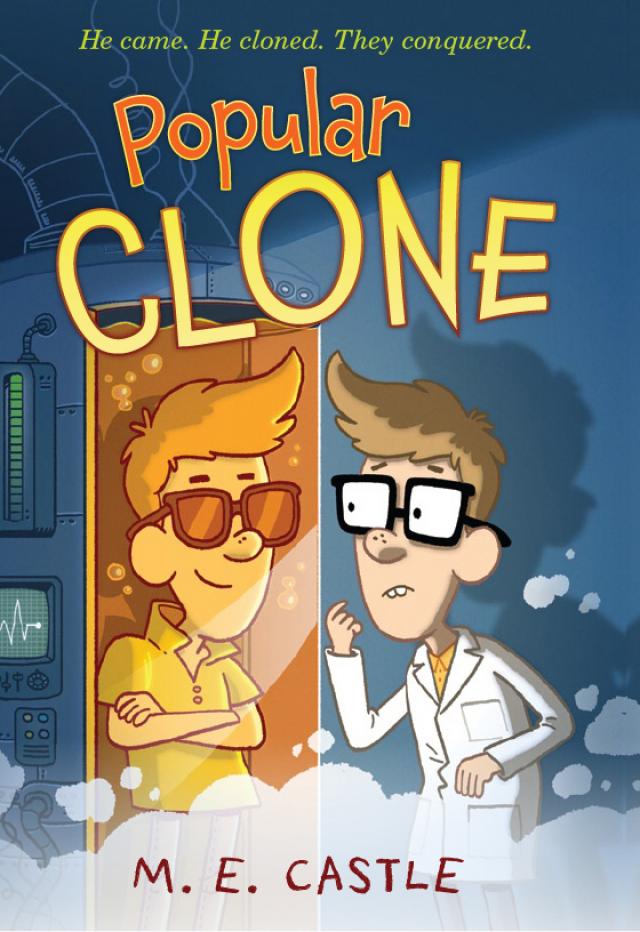
He turned to his closet door and waved a hand in the air. The door got brighter as its metal surface slowly resolved itself into a mirror. Fisher looked himself up and down. He raised his arms up above his head so his sleeves fell to his elbows, wishing he had big muscles instead of scarecrow arms. Then he tried to pat down his light brown hair, which never could decide on a single direction to go in. The three oblong freckles on his nose completed the picture.
Pathetic. He was doomed forever to be a geek. He waved his arms rapidly in the air, causing the motion-detecting closet door to shift into a crazy carnival mirror. Fisher’s image was distorted and warped, bending in all directions. Fisher walked toward it, striking funny poses and making faces. At least he didn’t have a forehead as large as an eggplant … or a body stretched out like taffy … or squashed up like a bowling ball… .
Too late, he felt a cool object under his foot. A moment later he was crashing to the ground as a steel test tube rolled away from him. “Oof,” he grunted. He had landed among a pile of dirty socks, and his flailing legs had made the mirror fade away.
As Fisher stood up, he heard a soft, snuffling sound and light footsteps approaching him. A few seconds later, a pinkish, lightly fuzzy object glided into the room and came to an unsteady landing at Fisher’s feet.
“Hiya, boy.” Fisher reached down to scratch his pet pig, FP, under the chin. FP was an unusual pig. In fact, he was a Flying Pig. His parents had once gotten into a debate about adding on additional lab space to their house. Fisher’s father had told his mother that he’d agree to expand the property “when pigs fly.” His mother had taken this as a challenge and won her new lab expansion by biologically engineering little FP.
FP looked like any other pig, except he had light bones and weblike tissue stretching between his front hooves and the middle of his back. This allowed him to glide as gracefully as his pig body permitted—in other words, not gracefully at all. But he was adorable nonetheless.
“Miss me?” Fisher asked, patting FP on the head.
FP squealed enthusiastically. Fisher sighed. At least someone cared about him, even if the Vikings were intent on making sure that he graduated from the school system without a single human friend.
Fisher walked over to a tightly sealed, clear plastic cube in which dozens of tiny mosquitoes swarmed, bouncing off the walls like compressed gas molecules. He had been working for months on mosquitoes, trying to modify their genes so that they would bite only certain chosen people. Certain meathead bullies, to be precise. If it worked, Fisher would be able to walk straight through a swarm of them and emerge on the other side without a single mosquito bite. The Vikings, on the other hand … Fisher smiled, picturing them covered in murderously itchy red spots.
“Let’s see how this batch came out, FP,” he said. “If I can get these to work, I bet I finally find a place among my own species. No offense, boy.”
He stuck his arm through a mesh-guarded port in the side of the tank, and left it there for thirty seconds. When he removed it, the smile on his face dropped away; his arm was covered in tiny red welts. “On second thought, maybe I should just go back to that dark, sinister tower idea.”
FP made a whining sound, bumping Fisher’s leg with his snout. Fisher sat down and set FP on his lap. “What do you think, little guy? Would I make a good villain?” A quick series of snuffles sounded like laughter. “What, not intimidating enough?” FP looked up at Fisher and dragged one hoof across Fisher’s stomach, as if petting him. “Oh, I’m too nice, is that it?” FP made a satisfied sounding snort and nuzzled back into Fisher’s lap. “Well, you just wait. Middle school is bound to turn me into an angry force of destruction. I’ll be an evil mastermind by the time I get to eighth grade. You’ll see.”
The soft sound of FP’s chuckling soothed him as he got back to work, determined to find a solution to the disaster his life had become.
CHAPTER 3
It is surely a sin for one man to covet another man’s wife. But it is a sin of far greater proportions (and fatal possibilities) to covet another man’s wife’s untested, artificial human growth hormone. Especially if we’re talking about my mom.
—Fisher Bas, Sientific Principles and Observations of the Natural World (unpublished)
“Down, boy,” Fisher said as he walked into the kitchen a few hours later. FP was doing his best to leap onto the counter, but kept landing with a thump back on the tiled floor.
The three freckles on Fisher’s nose scrunched closer together as he tensed his face in pain, and scratched his new insect bites. It felt like he’d dipped his arm in a tankful of needles and salt water.
His father didn’t even notice the boy—or the leaping pig—as he stood beside the oven and adjusted the controls on a screen with a full thermal map of the chicken roasting inside. His mother, meanwhile, was involved in an argument with the refrigerator over whether the white wine was chilled enough.
“Madam Bas,” said the refrigerator in a high, droning voice, “need I remind you that I can detect temperature variation to a precision of one two-hundredth of a degree kelvin?” If the refrigerator had had arms, it would have been crossing them in front of its chest. Or, rather, its ice drawer.
“I’m well aware of your thermometric abilities,” Fisher’s mom said to the fridge, beginning to get annoyed, “since I invented them. Now, can you tell me how the wine tastes? Or would you prefer to leave that to someone who has taste buds?”
The refrigerator stuttered slightly, relented, and opened its door with a puff of air that sounded a bit like a reluctant sigh.
“Dinner’s almost ready, Fisher,” said his dad, turning off the oven. “Could you set the table, please?”
“Sure thing,” said Fisher. He went to the touch screen on the table’s side and slid the plates to their proper spots, following up with forks, knives, napkins, and glasses. When he had finished configuring the layout on the screen, he pressed a button and a little hatch popped open on the kitchen countertop. The requested items began surfacing, one by one.
What appeared to be extra legs on the dining room table were, in fact, arms. So with multiple joints bending and sliding smoothly, it reached toward the counter, took hold of each plate, glass, and piece of silverware and placed it softly on its appointed spot as everyone sat down to eat.
Except that without anyone noticing, FP had finally made it onto the counter. So when the table’s arm stretched out to grab the third plate, it grabbed the flustered pig instead and placed him down in front of Mr. Bas. He looked startled for just a moment, but then nudged FP onto the floor with a shake of his head, and picked up his own plate.
“So really, Fisher, how was your day?” his mother pressed as she sliced herself a piece of chicken. Fisher shrugged.