STAGS 2, page 28


The three actors protested their satire was innocent, even in the face of torture, and in October of the same year walked free. Their defiance meant that many other Crown cases against London theatres and playwrights collapsed. Had the case against them prevailed, English theatre would have lost, not just Jonson’s work, but such plays as Macbeth, King Lear and Hamlet.
Jonson and Spenser might have formed a close comradeship in prison, but they were literally at daggers drawn by September 1598. Jonson killed Spenser in a duel in Hogsden Fields (modern day Hoxton) despite the fact that, according to Jonson, Spenser’s sword was ten inches longer than his. Jonson found himself in prison once more, but this time for murder. He was sentenced to death, but pleaded Benefit of the Clergy, speaking the ‘neck verse’ to avoid the noose. His possessions were confiscated, and his thumb branded, but he was freed and went on to write his greatest works, including The Alchemist and Volpone.
No one knows what the real Isle of Dogs was about. The imagery of dogs in Elizabethan times, with their fawning and licking ways, could easily be repurposed as a swipe at flattering courtiers like the Cecils. In the atmosphere of a mounting rivalry between the father and son team and Elizabeth’s great favourite, Robert Devereux, Earl of Essex, Ben Jonson may have used his play to support the young earl. But the closeness of the geographical Isle of Dogs to the queen’s palace at Greenwich, and the fact that the Crown reacted so harshly to the play, is highly suggestive of the theory that Jonson took aim at Elizabeth I herself.
Wherever the truth lies, I owe Ben Jonson an apology for my version of The Isle of Dogs. I did my best considering that the real play is lost forever.
Or is it?
Author's Note
Miserere by Gregorio Allegri was, and is, an important piece of music in my life.
When we’d just got just married my husband and I used to sit in our little kitchen in the after-dinner twilight listening to it, and it was like cold water going down your back. I don’t know how we discovered it – probably in some film or other – but it just spoke to us.
Now you’ve been Medieval enough to finish this book please allow yourself a Savage moment to go on YouTube and listen to Miserere. In true S.T.A.G.S. tradition it’s probably best to go for the choir of Kings College, Cambridge, one of the oldest choirs in England (plus they have a kick-ass chapel).
I never knew, all those years ago, that the words to Miserere were the ‘neck verse’, never realised that it would have such significance to me years later when I wrote this book. But if it has significance to me, that’s nothing to the significance it had to Ben Jonson when, hundreds of years ago, that short string of Latin words saved his life. He was literally saved by the book, and if that’s not an argument for reading, I don’t know what is. You know those bumper stickers that say: If you can read this you’re driving too close? Well, if you are reading this, then that means you got to the end of a book, and that means you’re a reader, and that means that, like Ben Jonson, you’ll be just fine.
M. A. Bennett
Acknowledgements
Firstly, I have to thank Jane Harris and Emma Matthewson at Hot Key Books for allowing me to carry on the S.T.A.G.S. story. Thank you to Emma also for her fantastic editing skills, to Holly Kyte for her thorough copy-edit and to Talya Baker for her meticulous editing and proofreading.
Thank you to my agent and friend Teresa Chris, who leads me through this wonderful world of books.
In that world I am grateful to a team of Medievals and a team of Savages in equal measure. The Medievals are the librarians who support my work so enthusiastically, especially in schools. And the Savages are the bloggers who champion my books on social media. Thank you all.
Family next. Thanks to Sacha for his knowledge of films, for room K9, and for the invaluable support he gives to me and my work. Thanks to Conrad who, although he is a full-on Savage, still helps me with references from his digital world. And even more thanks to Ruby, who is a bit more Medieval, and not only reads every word I write, but gives me advice along the way.
Two biographies of Ben Jonson helped me to understand his world. Ben Jonson, A Life by Ian Donaldson, and Ben Jonson, A Literary Life by W. David Kay.
I was also inspired by the Kingscote books by Antonia Forest, far and away my favourite school series. The twins, the theatre, the boarding school – she was there before me. If you haven’t read them, you must.
On the Savage front, two TV shows in particular influenced this book. Firstly, QI (BBC2) brought The Isle of Dogs back into my consciousness after many years of having forgotten about it. The exact clip which set me off on this journey is referenced in the book. I also gleaned a lot of information from the Channel 5 documentary Elizabeth I, which helped me to understand the later years of the queen’s life.
I’m lucky enough to visit lots of schools. Thank you to all the kids who couldn’t wait to find out what happened after S.T.A.G.S. – this book is for you.
Thanks to my sister, archaeologist Veronica Fiorato, for her knowledge of ancient manuscripts and their preservation.
Thanks to Morgan Headley for letting me borrow her name for Ty’s surname.
Lastly my thanks to actor Sebastian Armesto, who played Ben Jonson in the film Anonymous (2011), for his insights into the playwright’s character, and being the nearest thing I can imagine to meeting Ben Jonson in real life.
Hello!
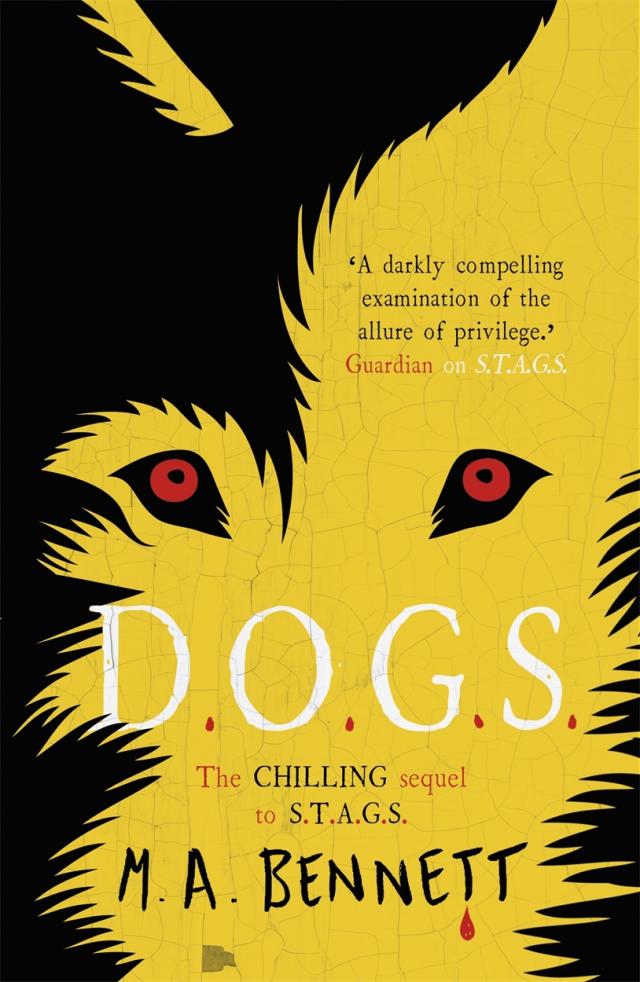
Thank you for picking up DOGS.
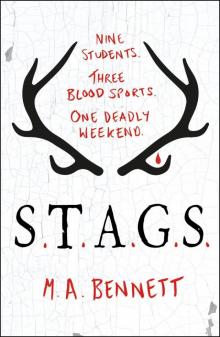
DOGS is the second book in my STAGS series, about St Aidan the Great School, an exclusive private school with a dark secret. STAGS was the story of Greer McDonald, an ordinary girl who wins a scholarship to an exclusive English boarding school, St Aidan the Great, and is then invited, by the richest clique in the school, on a country house weekend to Longcross Hall, where the promised traditional bloodsports – Huntin’ Shootin’ Fishin’ – take a dark turn.
The book was born out of the fact that I’ve had an interesting relationship with the upper classes myself. My grandmother, Ina Hoggarth, worked at Langcliffe Hall, a big stately home in the north of England. When I was born, my mother worked full-time, so I was raised by my grandmother in the housekeeper’s cottage. Living in the grounds of a great house I saw at first hand the upper classes at play. The Hall had a grouse moor and the family often hosted shooting parties during the season. My grandmother would work all weekend and come home on Sunday, dog-tired, with stories of the weekend’s sport. The gamekeeper, improbably named Perfect, would bring us a brace of pheasants for our Sunday dinner, still warm, floppy-necked and riddled with shot. Of course, while I was growing up in the housekeeper’s cottage, and attending the local comprehensive school, the sons of the big house were living a very different life. As a teenager, I would see them in the village pub during the holidays, but during term time they were at Ampleforth College, an exclusive boarding school in North Yorkshire run by Benedictine monks. Years later, I would write about another exclusive school run by Friars and an Abbot, but I would weave into that dark foundation everything I’d learned at my grandmother’s knee about huntin’ shootin’ and fishin’. It is at this school, St Aidan the Great, that the events of DOGS unfold, picking up exactly where the story of STAGS left off …
If you would like to find out more about my books, you can visit www.bit.ly/MABennett (case-sensitive) and become part of the M. A. Bennett Readers’ Club. It only takes a few moments to sign up, and there are no catches or costs.
Hot Key Books will keep your data private and confidential, and it will never be passed on to a third party. We won’t spam you with loads of emails, just get in touch now and again with news about my books, and you can unsubscribe any time you want.
And if you would like to get involved in a wider conversation about my books, please do review DOGS on Amazon, on Goodreads, on any other e-store, on your own blog and social media accounts, or talk about it with friends, family or reader groups! Sharing your thoughts helps other readers, and I always enjoy hearing about what people experience from my writing.
Thank you again for reading DOGS.
All the best,
M. A. Bennett
M. A. Bennett
M. A. Bennett is half Venetian and was born in Manchester, England, and raised in the Yorkshire Dales. She is a history graduate of Oxford University and the University of Venice, where she specialised in the study of Shakespeare’s plays as a historical source. After university she studied art and has since worked as an illustrator, an actress and a film reviewer. She also designed tour visuals for rock bands, including U2 and the Rolling Stones. She was married on the Grand Canal in Venice and lives in north London with her husband, son and daughter. Her first YA novel, S.T.A.G.S., was published in 2017 and was shortlisted for the YA BOOK PRIZE 2018, won the Warwickshire Secondary Book Award 2019 and Gold in the Sussex Coast Schools Amazing Book Award 2019, both voted by students, and won the Great Reads 'Most Read' 2018 Senior Award. D.O.G.S., the second in the world of STAGS, followed in 2019.
Follow her at @MABennettAuthor on Twitter and at @mabennettauthor on Instagram.
Thank you for choosing a Hot Key book.
If you want to know more about our authors and what we publish, you can find us online.
You can start at our website
www.hotkeybooks.com
And you can also find us on:
We hope to see you soon!
First published in Great Britain in 2019 by
HOT KEY BOOKS
80–81 Wimpole St, London W1G 9RE
www.hotkeybooks.com
Copyright © M. A. Bennett, 2019
All rights reserved.
No part of this publication may be reproduced, stored or transmitted in any form or by any means, electronic, mechanical, photocopying or otherwise, without the prior written permission of the publisher.
The right of M. A. Bennett to be identified as Author of this work has been asserted by them in accordance with the Copyright, Designs and Patents Act 1988
This is a work of fiction. Names, places, events and incidents are either the products of the author’s imagination or used fictitiously. Any resemblance to actual persons, living or dead, is purely coincidental.
A CIP catalogue record for this book is available from the British Library.
ISBN: 978-1-4714-0800-7
This eBook was produced using Atomik ePublisher
Hot Key Books is an imprint of Bonnier Books UK
www.bonnierbooks.co.uk
M A Bennett, STAGS 2