FOXES, page 27


The shutters came down again, and she pulled her hand away. ‘I can’t tell you.’
‘Can’t?’
‘All right, I won’t.’ It sounded pretty final.
I said carefully, choosing my words, ‘You won’t tell anyone? Or especially me?’
‘Especially you.’ There was no hostility; Ty just sounded matter of fact.
‘Why especially me?’
She said bluntly, ‘Because I don’t know which side you’re on.’ Now she looked at me very directly. ‘Do you know?’
I got up from the bed and walked to the window, looking down into the White Quad. It was peopled by students in blood-red stockings huddled down into their black Tudor coats against the mean January wind. I said, very softly, ‘He did save your life.’
‘And took how many others?’ She got up and pointedly opened her door for me. ‘You can’t run with the fox and hunt with the hounds, Greer.’
57
Of course I had to broach the subject of Henry with Shafeen too. I sought him out after I’d talked to Ty, and found him at the Paulinus well. He didn’t turn around at my approach, so I folded my arms around him from behind and rested my cheek on his back.
‘I feel like he’s here,’ he said. ‘I feel like he’s watching us.’
‘Welcome to my world,’ I mumbled into his shoulder. ‘I’ve been feeling like that for the last year.’
Shafeen put his hands on mine, clasping them to his heart, but didn’t turn. ‘How the hell did he manage it?’ he said bitterly. ‘Why didn’t he die?’
This should have been quite shocking, but I couldn’t blame Shafeen. ‘In the fire?’
‘No. At the waterfall.’
I spoke into the cloth of his coat. ‘In The Final Problem – the Sherlock Holmes story, I mean – Sherlock twists out of Moriarty’s grasp at the last minute by using a Japanese wrestling move. Moriarty goes over the falls, but Sherlock saves himself.’
I felt, rather than heard, Shafeen breathe out a bitter laugh. ‘I can’t see Henry in the WWA.’
I squeezed him a bit tighter. We must have looked weird, clasped together like that over the well.
‘And where is he now? He can’t be at Longcross.’
‘No.’ Now I turned him around. ‘But wherever he is, he’s not here. Not at this school.’ I put both my hands on his cheeks tenderly. ‘He can’t affect us.’
He held my hands at the wrists and gave me a piercing look. ‘Can’t he?’
58
I spent quite a lot of time with the police that term. Serious, sharp-eyed police from London. When the STAGS were attacked they clearly pulled in the very best, not the bumbling country plods they’d hired to cover up Henry’s death. These guys were from the Counter-Terrorism Unit at Scotland Yard, and they meant business. Of course, as I’d been the one to evacuate the house, they’d immediately wanted to talk to me. And, by extension, Shafeen and Nel.
They didn’t like, not one little bit, that we’d burned the Monteagle Letter in the library of Cumberland Place, leaving no evidence that it ever existed, and even to me that did sound massively dodgy. For a time it seemed like the eye of suspicion would fall on us. But I was always treated well, and eventually they let me go, and I wondered if that was the work of Henry – if I was being protected by the de Warlencourts, who now regarded me as their saviour. I told the police about Bates, and the champagne that wasn’t champagne, but some nameless instinct prevented me from telling them anything about the figure in the Guy Fawkes mask who had ambushed Rollo, or the fact that I knew only one man who was that tall.
Abbot Ridley, in fact, had been positively angelic since we’d come back to school. He’d given us time off lessons, he’d kept our parents in the loop and he’d arranged extra coaching for the bits of the syllabus we’d missed while helping the cops with their enquiries. When the CTU finally drove away from the school in their unmarked cars for the last time, I watched them go from the gatehouse. The Abbot appeared at my shoulder and watched with me, his hands tucked into the sleeves of his habit in a curiously monkish posture. ‘And so, they go,’ he said. ‘And now the real work begins.’
I turned to look up at him. ‘Real work?’
‘To forgive yourself.’ He smiled down at me. ‘You shouldn’t blame yourself for what happened in Acre Wood.’
‘I know,’ I began, ‘but –’ Then I stopped. ‘Acre Wood?’ I said. ‘I never mentioned Acre Wood.’
The charming smile faltered. ‘The police –’
‘No,’ I said forcefully. ‘I never told them either. I never said a word about Acre Wood.’
He was the picture of innocence as I looked up at him. In the winter light his handsome features could have been carved out of marble, his curls backlit by the low sun. He looked like some sort of Renaissance angel out of A Room with a View. But I wasn’t buying the good-guy act this time. ‘And don’t tell me I’m mad, or crazy, or I’ve been under a lot of strain, because I’ve got to tell you, I’m pretty sick of hearing that.’
‘I would never say that to you,’ he said, seemingly with complete sincerity. ‘Whatever you may think, I am on your side.’
‘Prove it,’ I said.
‘How?’
Very clearly, so he could not mistake me or twist my words, I said: ‘Show. Me. Your. Thumb.’
I had him. He was cornered, checked like a fox corralled by the hounds. The colour drained from his face, and his hands stayed clasped determinedly within his sleeves. His reply, when it came, was entirely unexpected. Mimicking my delivery, he said, ‘Check. Your. Post. First.’
‘What?’
‘Greer,’ he said in quite a different voice, ‘we will come back to this, I promise.’ He sounded more direct, more urgent than his usual amused and laidback self. ‘But I think you should check your letters.’ He turned on his heel and stalked away, and there was nothing for me to do but head to the sixth-form Common Room to check my mail.
59
I’d been watching the post like a hawk, praying for my acceptance letter to Oxford. If I didn’t get in, I didn’t know what I was going to do. I just wanted to get the hell away from STAGS, to be with Shafeen and Nel if they got in, in a world of sanity. I wondered if the Abbot knew something I didn’t, that my Oxford letter had finally come, but what did that have to do with Acre Wood?
This being STAGS, the sixth-form Common Room had a whole wall of these little pigeonholes for post, with small brass letters of the alphabet screwed onto them. I looked in M for MacDonald and, sure enough, there was a stiff cream envelope with my name handwritten on the front. As I slid it out there was no Oxford postmark to be seen, no University of Oxford franking stamp. In fact, there was no stamp of any kind.
I turned the envelope over and saw a wax seal. Memory made my heart begin to thud. Not because I recalled that long-ago invitation slipped under the door of my room. But because I remembered a letter at Cumberland Place, a letter that was so dangerous it had to be burned.
For this wax was not the blood red of the STAGS stockings and the Longcross dog rose. It was a more orangey, rusty red. And the imprint on the wax was not a pair of antlers, but a face.
A pointy animal face.
A face that belonged to a fox.
I broke the seal and this is what I read:
Greer,
We bear you no ill will, even though you foiled our own particular Gunpowder Plot. You should not blame yourself for not uncovering us sooner – you made a mistake, but you are in good company. That same mistake was first made by a king.
When James I heard about the first Gunpowder Plot he was actually out hunting. His response, when he heard his assassin’s name was Fawkes, was, ‘I have known a king to hunt a fox, but never a fox to hunt a king.’ So you see, he got the name wrong too.
Ever since then there has been an underground movement – the sons and daughters of those thirteen gunpowder plotters – who have been fighting against the Establishment. We have multiple branches, and myriad names. But mostly we have assumed the title James I gave us when he mistook the name of our leader. You see, it seemed to encapsulate the careless, cavalier way those with power treat those without. Did James ever bother to learn Guy Fawkes’s true name, even when he was hanged, drawn and quartered? Probably not. And because of this, that mistake became our name.
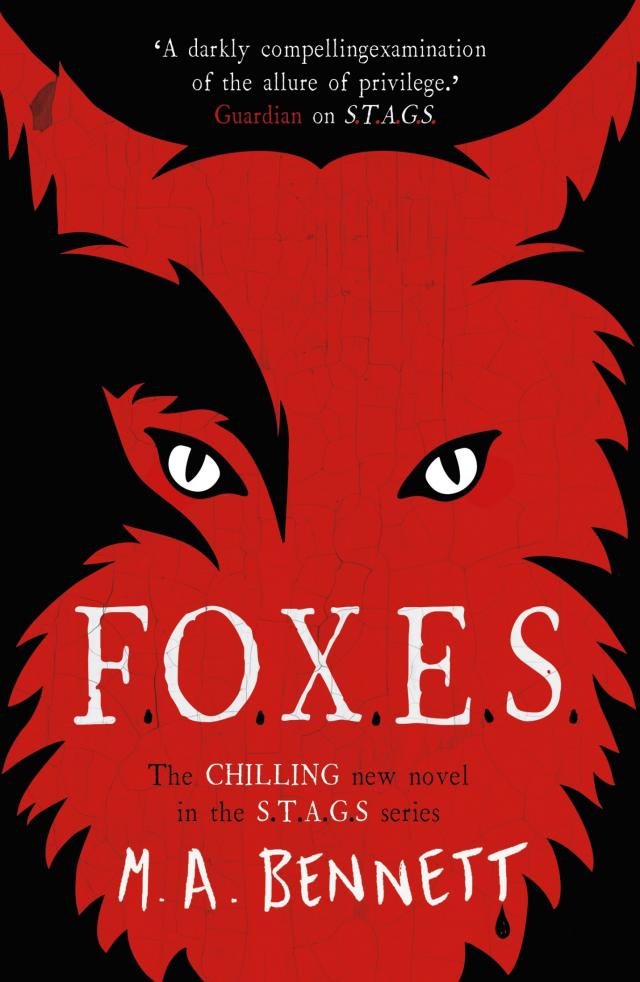
The FOXES.
If they don’t know who we are, Greer, they never see us coming.
The Order of the Stag has been our most ancient foe. This time you saved their hides, but we feel, most strongly, that in your heart you might be more of a Fox than a Stag. We have pledged to bring down the corrupt Establishment, to fight inequity, to smash the patriarchy. The fox is our emblem, a sigil of the fightback, the hunted turning to bite the hunter, the uneatable pursuing the unspeakable. Like the Order of the Stag, we have a leader, an opposite number to their Grand Stag. And, just the same, that title is passed from generation to generation. It is a name you know well, and it is the one with which I will sign this letter.
Yours, in the hope that you will join our struggle,
Reynard
Historical Note
In the autumn of 1605, a group of young Catholic men gathered for a supper party in a private house on the Strand. They included Robert Catesby, Francis Tresham and Ben Jonson, playwright and convicted manslayer.
The topic of conversation could hardly have been more dangerous. They discussed a daring plot to blow up the House of Lords when James I would be attending the State Opening of Parliament, at one stroke assassinating the king and most of the ruling class of England.
In the following days the plot was put into action. Jonson’s friend Guy Fawkes, a soldier he had fought alongside in the Netherlands, was recruited to help. Using the alias John Jonson, Fawkes rented a cellar beneath the House of Lords. He filled it with thirty-six barrels of gunpowder.
More and more conspirators were recruited, until there were thirteen plotters in all. But the number proved unlucky. On 26 October Lord Monteagle received a letter, thought to be from his cousin, the plotter Francis Tresham. Tresham warned his friend to stay away from the opening of Parliament. The letter contained the line ‘they shall receive a terrible blow this parliament; and yet they shall not see who hurts them.’
It was the king himself who interpreted the letter as an assassination attempt. His prime minister, Robert Cecil, ordered a search of Parliament.
On the night of 4 November 1605 Guy Fawkes was discovered in Parliament’s cellars. He held a lantern with which he planned to light the fuses the very next day, 5 November.
Hearing the news of Fawkes’s arrest, the plotters fled London. On 8 November they were traced to Holbeche House in Staffordshire. Catesby, the ringleader, was killed at once. Meanwhile Fawkes was imprisoned in the Tower of London, where he was tortured until he confessed, then put to death. The remaining plotters were tried and executed.
Only Ben Jonson was spared. He was arrested following the plot, but freed by Cecil on condition he use his Catholic networks to identify a priest who could implicate the plotters. Although Jonson protested that he’d done everything he could, no such priest was ever found.
Many historians now believe the Gunpowder Plot may have been a conspiracy by Cecil’s government. Before it, King James was disposed to be tolerant of Catholicism, the religion of his mother – Mary, Queen of Scots – and his wife. After it, his attitude hardened and England was once again a firmly Protestant country.
There are still many questions to be answered about the Gunpowder Plot. How did the plotters get hold of so much gunpowder, when its supply was in the gift of the government? Why did it take ten days for Cecil to act on the Monteagle letter? And was Catesby killed so quickly in order to silence him?
We don’t know all the facts, but a woodcut survives naming all of the plotters. One of the thirteen was Robert Catesby’s loyal servant.
He was known only as Bates.
S.T.A.G.S. was founded in the seventh century by St Aidan the Great. The name Aidan means ‘fire’ in Gaelic, and he is considered to be a protector against fire. He was dubbed ‘the Great’ in order to distinguish him from the lesser saint St Aidan of Ferns. Our St Aidan was born in Ireland, and became a monk on the Scottish island of Iona. He travelled to Northumbria, where he was made Bishop of Lindisfarne. Realising the value of education, he founded a school in the hope that he would train the next generation of Christian leaders. The school began with just twelve boys as pupils, but it grew into a centre of education and a jewelhouse of scholarly knowledge.
Aidan was canonised upon the performance of a miracle; he saved a stag from the hunt by turning him invisible. That stag gave the school an emblem, and a name. Today, after a thousand years of exceptional scholarship, S.T.A.G.S. has educated a dozen British prime ministers and countless members of both houses of parliament. St Aidan’s dream that he would train the future leaders of men has become a reality.
DE WARLENCOURT PLAYHOUSE – built in 1969, the theatre is an exact replica of the sixteenth-century Swan Theatre which used to stand on London’s bankside.
BEDE LIBRARY (incorporating the Scriptorium) – named after the Venerable Bede, the library has several notable architectural features, including the medieval Scriptorium, a remnant of the original monastery school, and the Tudor Reading Room.
GATEHOUSE – the gatehouse forms the entrance to the school, reached by crossing the medieval moat. In the days of the monastery school, the drawbridge was raised at night to keep marauding Scots away from the treasures of the chapel.
BEDE’S PIECE – STAGS boasts extensive playing fields, named for a piece of common land enclosed by the school during the eighteenth century.
CHAPEL – Founded in 683, the chapel is the oldest surviving building of the first monastery school. The stained-glass window of Aidan and the stag is original.
REFECTORY – This long building with vaulted ceilings was rebuilt at the time of the Civil War after a fire. The wooden benches and tables on which the students dine are the original ones from the monastery, on which the monks ate their breakfast of bread and beer.
ENGLISH SCHOOLS – In the reign of Edward VI, New Quad –a quadrangle of exquisite Tudor buildings – was built at STAGS to represent the four pillars of learning. The first of the schools (always referred to in the plural) is the English Schools, and the original sign still remains carved above the door.
HISTORY SCHOOLS – The second side of the quad, the History Schools houses the original copy of Bede’s work.
CLASSICS SCHOOLS – The third side of the quad, the Classics Schools still fulfills its function of teaching Latin, the language of law and learning.
SCIENCE LABS – Originally the Theology Schools, the fourth side of the quad, despite its Tudor appearance and theological sign carved in stone, now houses STAGS’ extensive science laboratories.
THE HUNDRED STEPS – this ancient stone stairway connects the upper and lower schools. Legend has it that in 1348 Edmund de Warlencourt rode up the hundred steps on his horse for a wager.
POOL – The STAGS swimming pool is Olympic-sized and fully compliant with the regulations of the Fédération Internationale de Natation. It is 164 feet long, 82 feet wide and 6 feet deep, with eight swimming lanes marked with rope and buoys.
FIVES AND REAL TENNIS COURTS – Both courts are fully enclosed, and constructed of their original timbers. The Real Tennis court is fashioned after Charles II’s court at Hampton Court Palace. The Fives court is designed to replicate one of the exterior bays of the chapel, where the game was first played after Mass.
HONORIUS
Honorius was Archbishop of Canterbury in the seventh century. His is the oldest and grandest house at STAGS. The White Quad, dating from the tweltfh century, features at its centre the Jerusalem Tree, a cedar tree grown from a seed brought home from the Crusades by Conrad de Warlencourt.
Honorius house colours: a white stag’s head on a ground of red and gold with a cedar tree as a charge.
BEDE
The Venerable Bede was an English Benedictine monk who wrote The Ecclesiastical History of the English People, a draft of which survives in the Scriptorium at STAGS. Bede house incorporates the extensive playing fields known as Bede’s Piece.
Bede house colours: a white stag’s head on a ground of red and blue, with a book as a charge.
OSWALD
Oswald was king of Northumbria from 634, uniting the kingdoms of Bernicia and Deira to become the most powerful ruler in Britain. Oswald did much to promote the spread of Christianity in the north, and fittingly the school chapel can be found in his house.
Oswald house colours: a white stag’s head on a ground of red and green with a crown as a charge.
PAULINUS
Paulinus was a Roman missionary and the first Bishop of York. The Paulinus Well, built during the bishop’s mission to Northumbria in the seventh century, stands in the middle of Paulinus quad. The waters at its depths were said, upon drinking, to turn a sinful man to God.
Paulinus house colours: a white stag’s head on a ground of red and purple with a well as a charge.
LIGHTFOOT
Lightfoot is the girls’ house at STAGS, and is the newest of all the houses, built originally as a dwelling for masters in 1550. It is a handsome Tudor building with its own Garden Quad, and it was first named Aidan’s House. The name was changed when Bishop Joseph Lightfoot of Durham successfully lobbied for the admission of girls in 1880. Since then, Lightfoot House has borne his name.
Lightfoot house colours: a white stag’s head on a ground of red and silver, with a bishop’s mitre as a charge.