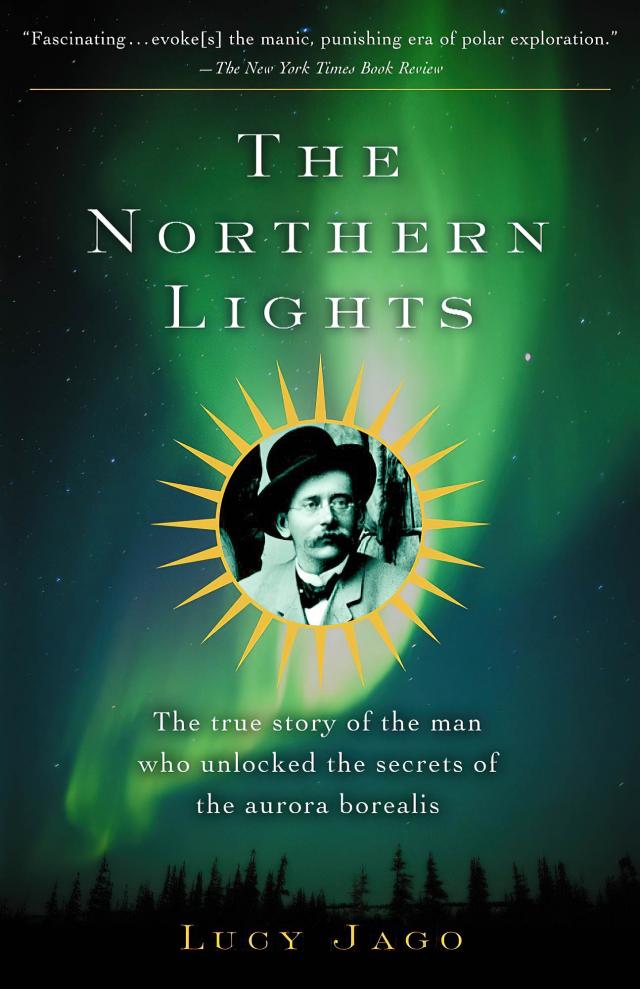
The Northern Lights, page 25


After a few weeks they found a rundown house in the perfect position; it belonged to a Greek merchant who sold it for 8,000 Egyptian pounds. Birkeland christened it “Villa Mea” and was proud to be founding his own research institute in Egypt. Although working at the observatory had been useful, Birkeland needed the freedom to study rather different phenomena from those that interested Knox-Shaw. He also wanted the intellectual freedom to work uninhibited by the doubts and disagreements that hampered his research at the Khedivial Observatory.
The alterations necessary to transform the villa into an observatory commenced slowly and with many problems for Birkeland, who had only Devik and the Eriksens to help him manage the Egyptian employees and ensure he was not paying too much for wages and building materials. Birkeland had asked the Norwegian consul, Hooker, for advice, but once again he found the man unhelpful and even deceitful. Despite these difficulties though, Birkeland was delighted to have his own house in such a beautiful spot.
Dear Helland,
I have just moved to a house on the edge of the desert. You couldn’t find a better place to observe the Zodiacal Light. One and a half kilometers away the Nile flows majestically fringed by a border of palm trees. On the other bank, I can count twelve pyramids, among them the five biggest in existence. Are you well? Please send me a few lines now and then. I have just finished a major treatise that I think will interest you.
Best regards, Kr. Birkeland
Birkeland did not give further details about the treatise he had written in this or other letters, nor did Devik know what it contained. In February 1916 Devik was recalled to Norway for military service and the professor was left entirely alone in Egypt. Devik did not see Birkeland alive again.
16
Letters from Home
Helwan, Egypt
1916
And on the pedestal these words appear: “My name is Ozymandias, king of kings: Look on my works, ye Mighty, and despair!” Nothing beside remains. Round the decay Of that colossal wreck, boundless and bare The lone and level sands stretch far away.
PERCY BYSSHE SHELLEY (1792–1822), “Ozymandias,” 1818
BIRKELAND had a postcard made at the beginning of 1916, showing him sitting on the steps of his new villa, in a white linen jacket and pith helmet, looking tenderly at a small menagerie of newly acquired pets. He sent the card to Helland for New Year and wrote on the back:
It’s me, with my newly born pig, my little kitten—very lively, the monkey—very serious and thinking about things, and my large tortoise.
Birkeland appeared to find comfort in his animals in the same way he had hoped Ida would when he had bought her a cat. He missed home and wrote frequent letters and telegrams to his friends, asking for news. To Devik he sent regular missives requesting information on how the laboratory was faring in the war, suggesting experiments he could carry out with the terrella concerning the Zodiacal Light, inquiring after both his health and the state of the capital. He also had some ambitious ideas about what he would do once he returned to Norway.
22 July, Hotel Nelson, Aboukir
Dear Helland,
Be sure, I am very glad to have letters from home. I am glad Miss Gleditsch got the assistant professor position. Thanks for the photograph, it is very good. I can see you before me as if you were alive. I have just arrived in Aboukir, I feel like I have come from hell to heaven in just five hours by train. In winter there is no place more lovely than Helwan but you can’t imagine how terrible it is for my health in summer. It’s worse than Christiania in winter. One gets stones in the kidneys and the liver and even in the heart maybe and rheumatism everywhere, because one cannot protect oneself from such heat. But here in Aboukir, everything vanishes in a couple of days and one feels more energetic. Today I have written five letters and in Helwan I haven’t written one in two weeks. Since Devik left I have been busy, going to Cairo ten times in fourteen days to find everything I will need for my new observatory.
And finally, I am going to tell you about a great idea I have had; it’s a bit premature but I think it will be realized. I am going to get some money from the state and from friends, to build a museum for the discovery of the Earth’s magnetism, magnetic storms, the nature of sunspots, of planets—their nature and creation. On a little hill I will build a dome of granite, the walls will be a meter thick, the floor will be formed of the mountain itself and the top of the dome, fourteen meters in diameter, will be a gilded copper sphere. Can you guess what the dome will cover? When I’m boasting I say to my friends here “next to God, I have the greatest vacuum chamber in the world.” I will make a vacuum chamber of 1,000 cubic meters and, every Sunday, people will have the opportunity to see a ring of Saturn ten meters in diameter, sunspots like no one else can do better, Zodiacal Light as evocative as the natural one and, finally, auroras around the poles of a terrella four meters in diameter. The same sphere will serve as Saturn, the sun, and Earth, and will be driven round by a motor. We could build the whole thing of steel, but then my phenomena would not be so beautiful.
Because of my health, I might go home for a while. There are all possible reasons to end this war.
Best wishes, Kr. Birkeland
Letters from home were a lifeline, but they were becoming less frequent and his replies often included complaints about the paucity of news he received. Birkeland did not realize that many letters were withheld by the censor or were lost with the ships that carried them in the North Sea and the Atlantic. A few did escape the torpedoes and the censor’s red crayon, including some from Hella.
Athens, Friday 4 April 1916
My dear friend,
I will throw such a party when I return home, because home is Helwan, but only when you are there. You cannot imagine how much I miss the communication of ideas and the daily meetings with a friend so sensitive and sincere as you. I go every week to the legation to see when I can travel back to Egypt. Now you have bought the Villa Mea I am firmly decided to buy my house too.
I am beginning to like physics more and more. Now I am occupying myself with Roentgen X-rays and I go nearly every day to a doctor who uses them. It’s truly a shame that I have become interested in such things so late, I would definitely have done something with it otherwise . . .
With fondest wishes,
Your Hella S.
As 1916 progressed, more and more mail was lost and Birkeland rarely received replies to his letters to Hella. He became convinced that she had forgotten him and sent her bitter letters of recrimination, some of which reached their target.
Dear Professor Birkeland,
I am really amazed by your telegram. I don’t understand why you reacted that way. I am unwell, even very unwell. Hopefully a letter from you will arrive soon and clear up the misunderstandings.
Yours, Hella S.
Birkeland became increasingly paranoiac and suspicious, not only concerning the lack of correspondence from his friends and from Hella but also regarding his own staff and the people around him. In particular, he became convinced that the plans for his cannon were vulnerable to espionage and that his own safety was compromised. During the course of the year he received occasional telephone calls and correspondence from both the French and British authorities inquiring further about his invention. Despite these hints of interest, no plans were discussed to purchase or develop the cannon and Birkeland worried that the British were trying to take his gun design without informing or paying him. He installed a safe in his bedroom, carefully locking away the copies of his patents, and bought two guard dogs and two more guns. Egypt’s strategic geographical position made it fertile ground for spies— British, French, and German—and Birkeland was determined not to let his invention be stolen from him. In the autumn of 1916 Birkeland decided he could no longer trust his servants and dismissed them all except the housekeeper. Nor did he feel comfortable with the builders altering the villa and they, too, were sent away.
In October the death of his old mathematics teacher, Elling Holst, depressed Birkeland further.
11 October 1916
Dear Mrs. Holst,
I have just read in the paper that Elling Holst is dead. The war prevented me hearing about it earlier. No other man ever touched me as deeply as Elling when I was young and I am thankful to have known him. He was such a special person, his loss will be felt by many. I send you my very deepest sympathies.
Kr. Birkeland
The month following the news of Holst’s death, Birkeland was cheered by a written request to demonstrate his gun:
Dear Sir,
I understand that you have drawings, specifications etc. of an invention which some time past you offered to both the British and French governments. I also understand that you are quite ready to explain the principle and the details of your invention to an officer with mechanical knowledge who may be delegated by General Headquarters.
If this is correct, will you kindly inform me what day and what time would be convenient to you for such an officer to call on you.
I am, Sir, Your obedient servant,
Francis Dalrymple, Secretary, Inventions Board
Birkeland was delighted that after thirteen years of trying to develop his cannon for widespread use, it might finally come to pass. He worked hard during the day, preparing the drawings for the inventions board and finding craftsmen who would be able to make a small prototype if necessary. At night, meanwhile, he worked on improving his photocell equipment, trying to isolate a range of rapid variations in the Zodiacal Light. He spent all his time in the silent, half-finished house, speaking to no one except the housekeeper and eating little. He increased his consumption of whisky, coffee, and veronal to compensate for his lack of nourishment, physical and emotional. On his birthday, 13 December 1916, no one called to see him, there were no letters or telegrams and no one in Egypt knew that Birkeland was forty-nine that day. He sent a telegram to Devik in the morning: ‘Birkeland desires Karl come to Tokyo.’ No further explanation was given, even though a rendezvous in the Far East had never been discussed before. If Birkeland had already decided to leave Egypt and travel to Japan, he had not asked the Norwegian consul for an exit visa, or informed anybody else of his plan.
Birkeland did not receive a reply from Devik, but far from forgetting his beloved professor, Karl had written numerous letters on returning home. Few survived the journey. Some arrived too late.
Christiania 13 March 1917
Dear Professor Birkeland,
I have received a letter from your bank manager in Cairo, Mr. Mustakki, where he mentions that you have heard nothing from me for a long time. The long letter I sent in December must have disappeared somehow. In this letter I told how the work at the laboratory was proceeding. My service with the King’s Guard has been so hard that it has been difficult to work at the same time. In these critical times all leave has been canceled, the military exercises have been very tiring and the new officer in charge is too strict in my opinion and does not understand that soldiers are human beings. We have been on watch for four days continuously without being allowed to take off our uniform for sleep. We often sleep in tents in temperatures of −32° Celsius, it’s the coldest January for eighty years and we have very little for heating.
When I have evening leave I have been working hard to restore the vacuum in the terrella, it is very hard because cracks appear due to the huge variations in temperature when the laboratory is not used. I shall have to strip the entire machine and start again—time-consuming and laborious but the only way to achieve a proper vacuum. The gas is shut off from 7 p.m. and so I have made an electrically heated lamp to seal the cracks—this device will be useful in Helwan too where there is no good gas. When I have finished my Guard Service I shall use my full power to restore the terrella and get results to you very soon.
Best wishes, yours sincerely, Karl Devik
Birkeland never received this letter. By the end of the year, he had become too ill to live alone and was taken to recuperate in Cairo by the Eriksens. Mrs. Eriksen later wrote to Karl Devik and related to him what had happened to the professor during his final months in Egypt.
Dear Devik,
So, eventually a letter has arrived in Egypt from you, it has been underway for a long time but now it is here. You asked my husband for news about Professor Birkeland but he has been terribly busy and has asked me to reply.
Last autumn I was several times out at the professor’s, he was very busy with some instruments for measuring light and with letters he had received from the British Admiralty. He was somewhat excited and told me he was drinking a great deal of coffee to work without feeling tired. He replied to our warnings about his health that his work was very interesting—this was the end of October 1916.
Around New Year Doctor Roeder, the physician for Scandinavians in Egypt, came here one evening and said he had been to Helwan to see a patient and had called in at the professor’s. He came to us very worried and asked whether we could go and visit the professor occasionally as he was in a very poor condition. Three people whom the professor trusted went to visit him the next day. They could tell that Birkeland was terribly thin and worn out, very paranoid and his eyes were flickering everywhere. He was convinced that the English were after him, he claimed that they were walking around the house, day and night, spying. He thought they had persuaded his housekeeper to spy as well and so he had sacked her at Christmas. He was not sleeping and the only remedy he had was half a beer glass of whisky and two grams of veronal. He had bought two dogs, a revolver and a shotgun, all ready in his bedroom. The trains move slowly around here and although Dr. Roeder went regularly to treat Birkeland he remained deeply paranoid and grew paler and paler. Birkeland said that his own consul, Mr. Hooker, and his associates were among the worst spies. He started to work again but he was like a child and could not be left alone and kept insisting that he could not stand another summer in Egypt.
Oh poor professor! He had a terrible time down there and I have blamed myself many times for not taking the trip out to see him. The reason he was so depressed, I think, was the abuse of coffee, too much work, whisky, and veronal. Other circumstances too—he was convinced people were watching him and we can’t say for sure that they weren’t, although his life was probably not in danger. He had been in touch with the British Military HQ who were helpful but he felt it was to give him a false sense of security.
What mattered most to the professor was that he didn’t get an answer from you, Karl, despite him and my husband sending lots of telegrams. He fabricated all sorts of explanations for your silence although the only correct one was the censorship.
The consul persuaded Birkeland to leave his house and found a good room in a pension close to the consulate. There Birkeland received medical treatment and proper food and began to recover so well that he thought whisky was disgusting and went for long walks with the consul. By February, Birkeland could amuse himself and laugh again like the old days. His feelings of being spied upon and followed were receding and he was thinking he should go back to Norway for his fiftieth birthday celebrations. To stay in Egypt was out of the question but to return via England was too dangerous and he could not travel alone and so the consul suggested that he return via Asia with him. Birkeland was delighted and he returned entirely to his old self. He amused all the people in the pension; they loved him and called him Monsieur Le Professeur!
They left on 10 March and Birkeland was radiating with happiness and promised to drown all English spies in the Red Sea. My husband said he kept his word and after Colombo said there was no sign of Birkeland’s paranoia and it was a lovely journey. They arrived in Japan on 3 April where they planned to stay for ten days but Birkeland suddenly changed his mind as he met some colleagues at the University of Tokyo and wanted to work with them for some months. My husband got in touch with the Norwegian General Consul, Mr. Anker, in Japan, who invited Birkeland to a Japanese resort. Mr. Eriksen informed Mr. Anker about Birkeland’s illness last winter and Anker promised to take good care of him.
It is very sad for all of us, particularly my husband who left him there, even though he advised him not to stay but the professor did not want to go back to the cold and dark of Norway. Birkeland prepared to start working with an old acquaintance of his and so my husband felt he was in good hands. What a shame it ended so sadly for Birkeland. Can you tell me how it happened? I will be very thankful. I’m glad your work is going well and let’s hope that when the war ends we will see you again in Egypt next winter.
With much love,
Gerda
17
Brittle Remains
Tokyo
April 1917
I am happy that among Kristian’s papers there is clear agreement from Eyde that Kristian is the inventor of the nitrogen method. Everything should be kept. One beautiful day it will be useful.
Letter from Richard Birkeland to Tønnes Birkeland,
November 1917
WHEN BIRKELAND arrived in Tokyo he went almost immediately to the Faculty of Science at the Imperial University. He was met by Professor Terada, who had traveled to Norway to meet Birkeland ten years previously and later wrote an account of Birkeland’s visit to Japan:
I will try to relate the events in the form of an objective memorandum while I still remember the facts. One morning, towards the end of the European War (World War I), when I happened to visit the central office of the Faculty of Science, I found an old European, rather short and bald, who was talking with the secretary. The secretary showed me the visitor’s card and asked me how to deal with his wish to see the library of the Physics Department. It was the famous physicist, Professor Birkeland from the University of Christiania. I remembered his face from the past because I had visited him once in his country and had seen his famous vacuum electric discharge experiment concerning aurora. Moreover, he had invited me to his home for tea. He did not remember me at once.