Motown, page 28


“You are drunk.”
“Spifflicated.”
“What?”
“My mother’s word. She used it when she chewed out my father so I wouldn’t understand. They sold the stuff out of cars in front of Dodge Main and he never got past them walking a straight line. Spifflicated, I just remembered. Haven’t thought of it in thirty years.”
“You’re celebrating, right? You got them.”
“Got what?”
“The letters! Dear Love-buggy, your Wendy-poo misses oo. How many you got? They really hot?”
“Oh, yeah, they’re hot.” The next sip cleared his fog. “Listen, Dan—”
“Anything we can quote in the papers? We can use what-chacallum, asterisks for the really hot parts. That always makes ’em seem worse. Bring them over. No, better stay there. Where are you, your place? I’ll be there in twenty.”
“I don’t have them, Dan. She burned them.”
“She what? Who’s she?”
“Enid. The Kohler woman. She burned them in her fireplace, every last one. Months ago.”
“Bullshit. Broads don’t destroy that kind of thing. My wife still has her wedding corsage and we ain’t talked to each other in a year. You toss the place?”
“They’re gone, Dan.”
During the pause on Sugar’s end, Rick leaned across the arm of his chair and slid the window up another few inches. The air in the room was getting hazy.
Sugar blew out. “Okay, we ain’t dead, just crippled a little. Make her a deal. She want to be famous? ‘Muckraker’s Mistress Tells All,’ we’ll get her on magazine covers, TV. It could lead to a movie deal like that Keeler cunt. Tell her there’s a couple of grand in it for her besides. No, shit, make it ten, we ain’t cheap. They do anything, you know, kinky? Don’t matter. We’ll take her picture with a schnauzer. No kidding, I’m getting into this.”
“I quit.”
“Stop clowning around. We got work to do.”
“I quit is what I said. Tell Fred Donner to stick it up his tailpipe. I’m hanging up my cloak and dagger. Don’t bother with severance pay or references.”
“Listen, we’ll talk about this when you’re not cockeyed. I had a nickel for every time I got a snootful and decided to tell the boss what I thought of him—”
“So long, Dan.”
“Wait! What you going to do to eat?”
“I’ve still got my wrenches.”
“You ain’t got shit. The title on that Camaro? It’s a fake. The car belongs to General Motors security. Answer the door, chump. That’s the repo man knocking.”
“He’ll find the keys in the ignition. I’ve got enough put away for a used Buick I saw advertised in the News.”
“That’d kill you.”
“It won’t, but the Camaro might have. A car’s just something to get you around, hopefully in one piece.”
“You motherfu—”
The flames in the metal wastebasket were dying down now. After Rick hung up on Sugar he got a long-handled cooking fork from the little kitchen and stirred the ashes until the unburned portion of the letters caught fire, then doused the sparks with water from the pitcher. Black smoke boiled out and found its way to the window.
A few minutes later the landlady from downstairs tapped at his door and asked him apologetically to use the ventilator fan when he cooked.
Chapter 40
SMOKE POURED IN A black column from the upholstery of an abandoned car someone had set fire to at the curb. The gasoline tank, like its tires and wheels and most of the engine, had been cannibalized weeks ago and none of the officers busy cordoning off that section of Kercheval was paying it any attention. Only Quincy was watching it when Krystal found him. On the other end of the block, glass broke with a long shivery tinkle. Most of the action had moved up the street.
“You okay, sugar? I heard shooting before but the police wouldn’t let me through.”
“You should of went home.”
“You got the keys. Besides, you know Krystal don’t like to sleep alone.” She slid an arm inside one of his. “You sound funny. You coming down with a cold?”
He touched the back of a hand to his nostrils and looked at it in the firelight. The bleeding had stopped. “I’m okay.”
“Radio says rain.”
It was still playing. He could hear it in a Doppler effect from the Corvette parked several blocks down, Barry McGuire singing about the eve of destruction.
“Mahomet’s dead.”
“Somebody told me.”
“I never did understand the crazy son of a bitch.”
“Wasn’t your fault, sugar. It was that white suit.”
“Man ought to be able to wear what he wants without getting shot.”
“Wasn’t nothing you could do.”
“I could of left him in jail.”
Sirens swooped and fell. Somebody said something unintelligible into a bullhorn. Krystal squeezed Quincy’s arm. “Riot’s over, Quincy. Let’s go home.”
He let her steer him toward the car. Then he stopped, turned back, and fished something out of his pants pocket that caught the firelight in a red glint. Lydell had given it to him to hold when he went to the hospital because it didn’t fit any more and he was afraid some intern might steal it. Quincy held up the ring, read the engraving: WORLD SERIES CHAMPIONS 1957. He threw it through the broken windshield into the burning car.
“The whole town next time, Lydell.”
A few minutes later he helped Krystal into the Corvette and they drove back toward Twelfth Street.
Postscript
THE SO-CALLED “KERCHEVAL incident” of August 9–10, 1966—sometimes referred to as a “miniriot” but downgraded by the media from a full-scale civil disturbance at the request of Mayor Jerome P. Cavanagh and the Detroit Police Department—began Tuesday at 8:25 p.m. when a routine arrest in front of a private residence aroused the wrath of bystanders, and ended twenty-four hours later when a cloudburst drenched the spirits of even the most stubborn protesters. Mother Nature’s intrusion was the last in a long line of fortunate coincidences—including the hour the trouble started, when the police force was at maximum strength, and the presence in the area of two squads of the Motor Traffic Bureau and both the first and second sections of the Tactical Mobile Unit—that enabled the police to restore order with a minimum of conflict.
The event has been called a dress rehearsal for the devastating riots that took place in the area of Twelfth Street during the week of July 23–29, 1967. A Sunday morning raid on a blind pig operated by the United Civil League for Community Action went wrong when customers attempted to prevent the police from leaving with their prisoners. Throughout the next seven days, the police engaged in running firefights with citizens on a street of flames. When local authorities proved incapable of containing the arsons, violence, and looting, Governor George Romney dispatched reinforcements from the Michigan National Guard and eventually requested emergency aid from President Lyndon Baines Johnson, who ordered tanks and paratroopers from the United States armed services into the area. When the insurrection had at last been put down, eighty million dollars in property had been destroyed and forty-three lives had been lost.
Mayor Cavanagh’s hopes for national office died soon after the riots. Defeated by former Governor G. Mennen Williams for the Democratic senatorial nomination, he announced his decision in June 1969 not to run for a third term as mayor. His death some years later received minimal attention in the national press. Similarly, George Romney’s dependency upon federal troops to quell a civil disturbance has been cited for his abysmal showing in the 1968 race for the Republican nomination for President. Detroit Police Commissioner Ray Girardin requested retirement in October 1967, explaining, “You’ve got to bleed some in a job like this, but, by God, I’ve been gushing.”
In 1973, the year the Arab oil embargo and the resulting energy crisis ended the brief reign of the gas-guzzling “muscle cars,” Detroit elected its first black mayor. Despite numerous federal and local investigations of alleged misconduct in his administration, Coleman A. Young remains in office as of this writing, the longest-serving mayor in Detroit’s history. Under his leadership the municipal government and its police agency have come to reflect the city’s predominately black population to a degree that would have been unthinkable in 1966.
Today, the biggest problem facing Detroit is not race but drugs, America’s most enduring legacy of the 1960s. The fight for supremacy in the numbers racket has been supplanted by drive-by shootings and crack-house massacres over millions of dollars in controlled and illegal substances. There have been other changes as well. The music of choice is Rap. Video arcades outnumber neighborhood movie houses, and those automobiles not manufactured in Japan are built with foreign steel and assembled in countries other than the United States. By law, they are all equipped with seat belts and other features designed exclusively for the safety of the people who ride in them.
And Twelfth Street is now known as Rosa Parks Boulevard.
A Biography of Loren D. Estleman
Loren D. Estleman (b. 1952) is the award-winning author of over sixty-five novels, including mysteries and westerns.
Raised in a Michigan farmhouse constructed in 1867, Estleman submitted his first story for publication at the age of fifteen and accumulated 160 rejection letters over the next eight years. Once The Oklahoma Punk was published in 1976, success came quickly, allowing him to quit his day job in 1980 and become a fulltime writer.
Estleman’s most enduring character, Amos Walker, made his first appearance in 1980’s Motor City Blue, and the hardboiled Detroit private eye has been featured in twenty novels since. The fifth Amos Walker novel, Sugartown, won the Private Eye Writers of America’s Shamus Award for best hardcover novel of 1985. Estleman’s most recent Walker novel is Infernal Angels.
Estleman has also won praise for his adventure novels set in the Old West. In 1980, The High Rocks was nominated for a National Book Award, and since then Estleman has featured its hero, Deputy U.S. Marshal Page Murdock, in seven more novels, most recently 2010’s The Book of Murdock. Estleman has received awards for many of his standalone westerns, receiving recognition for both his attention to historical detail and the elements of suspense that follow from his background as a mystery author. Journey of the Dead, a story of the man who murdered Billy the Kid, won a Spur Award from the Western Writers of America, and a Western Heritage Award from the National Cowboy Hall of Fame.
In 1993 Estleman married Deborah Morgan, a fellow mystery author. He lives and works in Ann Arbor, Michigan.
Loren D. Estleman in a Davy Crockett ensemble at age three aboard the Straits of Mackinac ferry with his brother, Charles, and father, Leauvett.
Estleman at age five in his kindergarten photograph. He grew up in Dexter, Michigan.
Estleman in his study in Whitmore Lake, Michigan, in the 1980s. The author wrote more than forty books on the manual typewriter he is working on in this image.
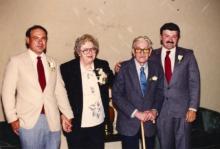
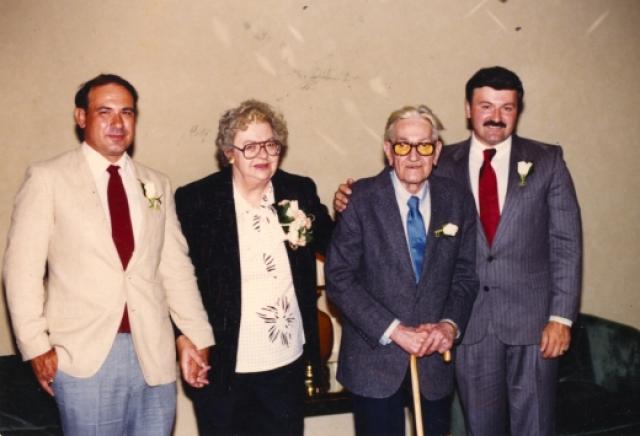
Estleman and his family. From left to right: older brother, Charles; mother, Louise; father, Leauvett; and Loren.
Estleman and Deborah Morgan at their wedding in Springdale, Arkansas, on June 19, 1993.
Estleman with actor Barry Corbin at the Western Heritage Awards in Oklahoma City in 1998. The author won Outstanding Western Novel for his book Journey of the Dead.
Loren signing books at Eyecon in St. Louis in 1999. He was the guest of honor.
Estleman and his fellow panelists at Bouchercon in 2000. From left to right: Harper Barnes, John Lutz, Loren D. Estleman, Max Allan Collins, and Stuart M. Kaminsky.
Estleman and his wife, Deborah, signing together while on a tour through Colorado in 2003.
Estleman with his grandson, Dylan Ray Brown, shown here writing an original story on “Papa’s” typewriter at Christmastime in 2005 in Springfield, Missouri.
Estleman with his granddaughter, Lydia Morgan Hopper, as he reads her a bedtime story on New Year’s Eve 2008. Books are among Lydia’s favorite things—and “Papa” is quick to encourage this.
Estleman and his wife, Deborah, with the late Elmer Kelton and his wife, Anne Kelton, in 2008. Estleman is holding his Elmer Kelton Award from the German Association for the Study of the Western.
Estleman in front of the Gas City water tower, which he passed by on many a road trip. After titling one of his novels after the town, Estleman was invited for a visit by the mayor, and in February 2008 he was presented the key to the city.
All rights reserved under International and Pan-American Copyright Conventions. By payment of the required fees, you have been granted the non-exclusive, non-transferable right to access and read the text of this ebook onscreen. No part of this text may be reproduced, transmitted, downloaded, decompiled, reverse engineered, or stored in or introduced into any information storage and retrieval system, in any form or by any means, whether electronic or mechanical, now known or hereinafter invented, without the express written permission of the publisher.
This is a work of fiction. Names, characters, places, and incidents either are the product of the author’s imagination or are used fictitiously. Any resemblance to actual persons, living or dead, businesses, companies, events, or locales is entirely coincidental.
copyright © 1991 by Loren D. Estleman
cover design by Mauricio Diaz
978-1-4532-4859-1
This edition published in 2012 by Open Road Integrated Media
180 Varick Street
New York, NY 10014
www.openroadmedia.com
EBOOKS BY LOREN D. ESTLEMAN
FROM OPEN ROAD MEDIA
Available wherever ebooks are sold
FIND OUT MORE AT WWW.OPENROADMEDIA.COM
follow us: @openroadmedia and Facebook.com/OpenRoadMedia
Videos, Archival Documents, and New Releases
Sign up for the Open Road Media newsletter and get news delivered straight to your inbox.
FOLLOW US:
@openroadmedia and
Facebook.com/OpenRoadMedia
SIGN UP NOW at
www.openroadmedia.com/newsletters
Table of Contents
Cover
Title Page
Dedication
Epigraph
Contents
Chapter 1
Chapter 2
Chapter 3
Chapter 4
Chapter 5
Chapter 6
Chapter 7
Chapter 8
Chapter 9
Chapter 10
Chapter 11
Chapter 12
Chapter 13
Chapter 14
Chapter 15
Chapter 16
Chapter 17
Chapter 18
Chapter 19
Chapter 20
Chapter 21
Chapter 22
Chapter 23
Chapter 24
Chapter 25
Chapter 26
Chapter 27
Chapter 28
Chapter 29
Chapter 30
Chapter 31
Chapter 32
Chapter 33
Chapter 34
Chapter 35
Chapter 36
Chapter 37
Chapter 38
Chapter 39
Chapter 40
Postscript
A Biography of Loren D. Estleman
Copyright
LOREN D. ESTLEMAN, Motown