

Priceless: The Case That Brought Down the Visa/MasterCard Bank Cartel, page 1


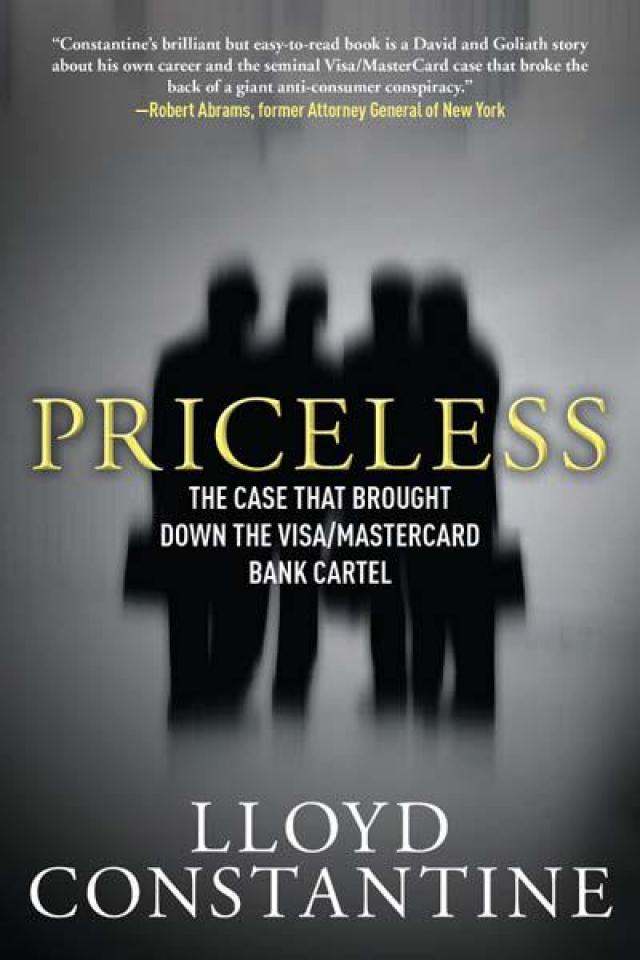
PRICELESS
The Case that Brought Down the
Visa/MasterCard Bank Cartel
by
Lloyd Constantine
Copyright © 2009, 2012 by Lloyd Constantine
All Rights Reserved. No part of this book may be reproduced in any manner without the express written consent of the publisher, except in the case of brief excerpts in critical reviews or articles. All inquiries should be addressed to Skyhorse Publishing, 307 West 36th Street, 11th Floor, New York, NY 10018.
Skyhorse Publishing books may be purchased in bulk at special discounts for sales promotion, corporate gifts, fund-raising, or educational purposes. Special editions can also be created to specifications. For details, contact the Special Sales Department, Skyhorse Publishing, 307 West 36th Street, 11th Floor, New York, NY 10018 or info@skyhorsepublishing.com.
Skyhorse® and Skyhorse Publishing® are registered trademarks of Skyhorse Publishing, Inc.®, a Delaware corporation.
www.skyhorsepublishing.com
10 9 8 7 6 5 4 3 2 1
Library of Congress Cataloging-in-Publication Data is available on file.
ISBN: 978-1-61608-375-5
eISBN: 978-1-62087-549-0
Printed in the United States of America.
This book and the work it chronicles are dedicated to
Jan, Isaac, Sarah, Elizabeth, “Connie,” and Edna.
They are the reason for my life.
TABLE OF CONTENTS
PROLOGUE: An Expensive Dinner for MasterCard
PART I: Origins
Opening Statement
The Cartel Revealed
Going Private
Wal-Mart, The Double-Edged Sword
The Teams Line Up
PART II: Six Battles
The Tide Turns
The United States Hitches a Ride
Five Merchants Become Five Million
Unsealing the Shark
Double Jeopardy
Visa/MasterCard’s Hail Marys
PART III: Endgame
Preparing for Trial
Breaking the Deadlock
Settlement
Payday
Closing Statement
2012: Motion to Reconsider
ADDENDUM
ACKNOWLEDGMENTS
INDEX
PROLOGUE
An Expensive Dinner
for MasterCard
THE NIGHT OF July 10, 1989, I hosted a buffet dinner at my Manhattan apartment for my fellow assistant attorneys general from fourteen states. Everyone assembled on West Sixty-Sixth Street for my mostly green banquet of chili, broccoli soup, salad, tabouleh, and pasta with pesto. Although the get-together at my place was intended to be social, allowing me to show off my wife and kids and our views of Central Park and the Chagall windows of the Metropolitan Opera House to colleagues from cities like Baton Rouge and Austin, the dinner conversation was dominated by a discussion of the credit card giants, Visa and MasterCard, whose combined market share was more than 95 percent. These companies had announced the merger of their separate debit card networks, forming a new joint network called “Entree.” The general opinion was that this debit card merger was designed to dominate that fledgling but inevitably huge business and destroy competing debit card networks like NYCE, MAC, STAR, and Shazam.
The fourteen states had responded to the announcement of the merger with a letter stating their intent to sue Visa and MasterCard. As head of the task force that coordinated antitrust enforcement for all fifty states, I was lead counsel of the team. The investigation that had led up to that day had taken sixteen months, and we were now ready to act. The lawsuit we would soon file against Visa and MasterCard was not merely the culmination of that sixteen-month probe: It was the tangible result of nearly a decade of work. That night, we talked about the progress that the states had made in our efforts to fill the void created by the Reagan administration’s virtual abdication of antitrust enforcement. Many of my dinner guests had participated in every step of this effort.
A full-day meeting with Visa had occurred that day, and a similar meeting with MasterCard was scheduled for the next day. Meetings like those we were holding with the bankcard associations are usually offered to target companies prior to civil suit or indictment. They rarely change anything but are used by both sides as an opportunity to learn something from the other side prior to formal hostilities. These particular meetings, however, wound up changing the entire course of dealings between me and the targets, and especially with MasterCard.
The meeting earlier that day with Visa had been polite, if inconsequential. Most of it had been consumed by Visa’s substantially and sadly accurate explanation of how the symbiotic relationship between Visa and MasterCard and the lack of real competition between them was the product of antitrust enforcement decisions made by our counterparts in the Federal Antitrust Division. By 1989, the antitrust laws had been sapped of much of their vitality. After eight years, in which Reagan administration antitrust officials had systematically dismantled the enforcement agencies and waged a campaign in Congress and the courts to trivialize the law, state attorney general (AG) enforcement, which I coordinated, was the last and only line of defense. Visa predicted that if the state AGs were to try to break up the Entree joint venture, we would fail—as the many previous antitrust suits against Visa and MasterCard had.
At 11:00 PM that night, after my dinner with the other Assistant AGs and hours before a scheduled meeting with MasterCard, Tim Cone, a young colleague, called to tell me about a conversation he had overheard at former baseball star Rusty Staub’s new restaurant on Fifth Avenue. Tim, his fiancee Diana, and his father Terry Cone, a senior partner at the Cleary Gottlieb law firm, heard three men discussing the meeting they were going to have with me the next day. The men said that an investigator would be hired to uncover something about me that I wouldn’t want revealed and that they would threaten to expose me unless I backed off MasterCard.
From Tim’s description, I was reasonably sure that one of the three men was Bob Norton, MasterCard’s general counsel, and that another was Stanley Robinson, a senior antitrust partner at the Kaye Scholer law firm. I told Tim that I didn’t take the conversation seriously and considered it macho dinner bluster, perhaps fueled by alcohol. Tim put Terry Cone on the phone, who related the same story and told me that the discussion about the investigator had come in the middle of a sober, serious, and straight-faced discussion of legal issues and tactics that would be used to defend MasterCard. He said he had practiced law for many years, knew what he had heard, and was positive that the men were serious about their plan to investigate and then threaten me.
I called my boss, New York Attorney General Bob Abrams, and we convened a midnight conference call with Mary Ellen Burns, the chief of the AG’s Public Advocacy Division, and Jack Ryan, our chief of criminal prosecutions, who had skillfully conducted the highly publicized Tawana Brawley grand jury investigation, involving sensationalized allegations of sexual abuse and mistreatment of a teenage African-American girl by white police and prosecutors in an upstate New York community. We agreed that I should call back the Cones and ask whether they would identify the three men prior to the meeting. I also asked them immediately to memorialize the conversation they had overheard, without further discussing it. They agreed to do this. The Cones also told me that the men had agreed to walk out of the meeting at exactly 12:30 PM and say that there was “nothing more to discuss.”
The next day, prior to the meeting, the three MasterCard lawyers were identified by Tim Cone, who was positioned behind a glass barrier where he could see, but not be seen from, inside the room where he was positioned. Then the meeting began. In contrast to the previous day’s meeting with Visa, the session with MasterCard was aimless. The three MasterCard lawyers talked and joked with each other and broke four times in just two and a half hours. At precisely 12:30 PM they got up, and Bob Norton said that the meeting was over because there was “nothing further to discuss.” I realized that the Cones were probably correct about what they had heard the night before.
According to a plan that we had established the previous night, I asked the MasterCard lawyers to speak with me privately and escorted them into Mary Ellen Burns’s office, where she and Jack Ryan were waiting. Turning to Norton, now identified as the lawyer who had said I would be investigated and threatened, I asked if they had dined at Rusty Staub’s restaurant the previous night.
“Yes,” Norton said.
I asked Norton if he were hiring an investigator to try to uncover illegal or embarrassing activities I had or was engaged in. Norton unraveled. He just started talking: “Oh my God, Oh my God. I know you’re not supposed to talk in bathrooms. I know you’re not supposed to talk in elevators. I said it. I said it. But I didn’t mean it! It was a joke. You’ve got to believe me, it was a joke! No matter what we found out about you, we wouldn’t use it. If you used drugs, we wouldn’t use it. If we found out about some weird sexual behavior, we wouldn’t use it. No matter what, we wouldn’t use it. Lloyd, you’ve got to believe me!”
Norton continued to rattle on about other illegal and embarrassing things they might uncover if they were to investigate me, which they wouldn’t have, but in any event would never reveal about me. This went on for a while in a panicked stream of consciousness reminisce
I turned to Robinson, a man then in his late sixties and one of the big names in antitrust at the Kaye Scholer law firm, which then had one of the premier antitrust practices in the United States. I told him that if he wanted to know something about me, he didn’t have to hire an investigator—he could just ask his law partner and my friend, Josh Greenberg, or Bob Kandel in his firm’s real estate department, who was my classmate at both Williams College and Columbia Law School.
Robinson said, “You have to believe me, Lloyd, that I didn’t think Bob was serious.” I asked him what he had done to make sure that “Bob” wasn’t serious. He did not answer.
I told Robinson I was distressed about where our profession was headed. “Stanley, ten years ago, if a client of yours had said something like this, you would have fired the client on the spot. And five years ago, you would have, at least, made sure that it was just talk. But now, you just assumed that it wasn’t serious, without doing anything to make sure.” I then said to all three of them, “Get out of our offices. I will figure out what I am going to do about you and about this.” They literally ran out of the office.
That day, I got calls from several acquaintances at Kaye Scholer. They begged me not to take action against Stanley Robinson or their firm. Josh Greenberg, the head of Kay Scholer’s antitrust department, told me that Robinson’s career had been distinguished, full of good and charitable works, and that Robinson had been his mentor. Besides that, Josh added that Robinson was about to retire. In fact, Stanley Robinson would continue to practice and represent MasterCard for several years.
I called Hal Lieberman, the chief counsel of the Departmental Disciplinary Committee for New York’s First Judicial Department in Manhattan. I told him about the incident, leaving out names. Realizing that I might be under some duty to report what had happened, I said the facts involved a friend of mine. Without directly saying so, Lieberman let me know that he understood that I was talking about myself. He said “my friend” was probably obliged under the disciplinary rules to report the incident to his office.
I thanked Hal for his advice and said I would pass it along to my friend. I did not, however, report Robert Norton, Stanley Robinson, or the incident. I believed that pressing an ethics complaint could make it difficult for me to litigate against MasterCard. This case was more important than putting some jerks in their place.
I was also just beginning to realize the magnitude of what would be involved in our attempts to break up the Entree joint venture. The MasterCard incident reminded me of the infamous effort by General Motors to discredit Ralph Nader during his early crusade against the “unsafe at any speed” Chevy Corvair. MasterCard’s discussion about discrediting me suggested that what we had discovered, in a relatively cursory investigation of Visa and MasterCard, was just the tip of an anticompetitive iceberg.
Moreover, the broader issues of what I considered to be the abandonment of antitrust enforcement by the Department of Justice and the abdication of the Federal Reserve’s stewardship of the U.S. payment system and its privatization by the Visa/MasterCard bank cartel, was a matter of great importance to the economy of the country. Like their colleagues at the federal antitrust agencies, the Reagan-Bush officials at the Fed were fanatical believers that the market would cure everything and always deliver optimal results. So, as electronic debit card transactions started to replace paper checks and cash, the Fed had begun to abandon its traditional role of regulating the nation’s payment system. The result was a great transfer of wealth from stores and consumers into the pockets of the banks and Visa/MasterCard.
I swallowed my private anger against MasterCard and proceeded in court with the Entree case. Visa and MasterCard quickly folded and abandoned their debit card merger, as described below. These events would eventually lead to the historic Merchants’ case against Visa and MasterCard seven years later. The inside story of that second case, which lasted seven more years, is the subject of this book.
THE LAWSUIT FILED on October 25, 1996, is officially called In re Visa Check/MasterMoney Antitrust Litigation. It is sometimes referred to as The Wal-Mart Case or The Merchants’ Case against Visa/MasterCard to distinguish it from a lawsuit brought by the United States against Visa and MasterCard two years later.
The Merchants’ case and this book are about an effort to stop certain business practices and alter the anticompetitive structure of an industry using the U.S. antitrust laws as the instrument of change. That is what the antitrust laws were designed to do, and, once in a generation, what they actually achieve. In the Merchants’ case, my law firm, Constantine & Partners, which had eight lawyers when the case began and seventeen when it ended, represented Wal-Mart, Sears Roebuck, Circuit City, The Limited, Safeway, and a class of five million stores against Visa and MasterCard. These bankcard associations were joint ventures owned by most of the country’s banks. Visa and MasterCard were represented by four of the largest law firms, including Clifford Chance, the biggest law firm in the world.
In Means of Ascent, Robert Caro quotes Lyndon Johnson as saying, “If you do everything you will win.” I thought of that quote constantly throughout the case, and it became a mantra for our litigation team. But unlike Johnson, we didn’t cheat. We did everything else and won.
The case was settled on April 30, 2003, after a jury had been impaneled for trial. Although the cash payment made by Visa and MasterCard to my clients was only the third most significant part of the settlement, that payment alone exceeded the combined total paid in the previous eight largest federal antitrust class action settlements. I began writing this book on November 23, 2003. It was important for me to begin writing then because the court’s award of attorneys’ fees had not yet been made. Although many people involved, as well as most observers of the case, consider our fee to be the most interesting event, I consider it incidental. It is a collateral benefit or damage of the case, depending on the point of view.
During my moment of celebrity following the settlement, I was profiled in the New York Times, which ran the headline, “He Won’t Discuss Money, But He Now Accepts Visa,” and the subheading, “Settlement $3 Billion, Taking on MasterCard, Priceless.” The money that I wouldn’t discuss was the amount of our attorneys’ fee, which had not yet been awarded, but was months later. It was important for me to begin writing about the Merchants’ case without that event intruding, although I could not escape its looming presence.
The court estimated that the settlement would save stores and shoppers upward of $87 billion in the first decade alone. However, the actual tally of just these quantifiable benefits will not be complete for many years, after many moves and countermoves are made by merchants, shoppers, Visa, MasterCard, banks, and competing payment networks such as American Express, Discover, STAR, PULSE, and NYCE. As these moves are made and the savings are tallied, and other unforeseen benefits accrue, more articles or books about this case may be written by others. This is mine.
PART I
Origins
Opening Statement
IT’S A FALLACY that lawyers who specialize in big-case business litigation are wannabe athletes. We are athletes, and to be successful we must have some of the physical attributes required in other great sports, including extraordinary stamina.
The training for my sport and epic contest in the Merchants’ case began under my father, Connie Constantine, a track star at Curtis High School on Staten Island, a boxer in Tuscaloosa, Alabama, and a football star at Syracuse University, who briefly played in the NFL. I was schooled and coached first in New York City, where I was born, and later at Herricks High School on Long Island, where I wrestled, played tennis, and was a football star but of a magnitude many notches below my father. Until he died, in May 1966, at the end of my freshman year at Williams College, my father—and mother—never missed any of my games or matches, not even a Friday afternoon freshman football game in Middlebury, Vermont—a fourteen-hour roundtrip from our home in Manhasset. After my father died, I lost interest in football but went through the motions for several more seasons.





