

Shameful Secrets on Coronation Close, page 1


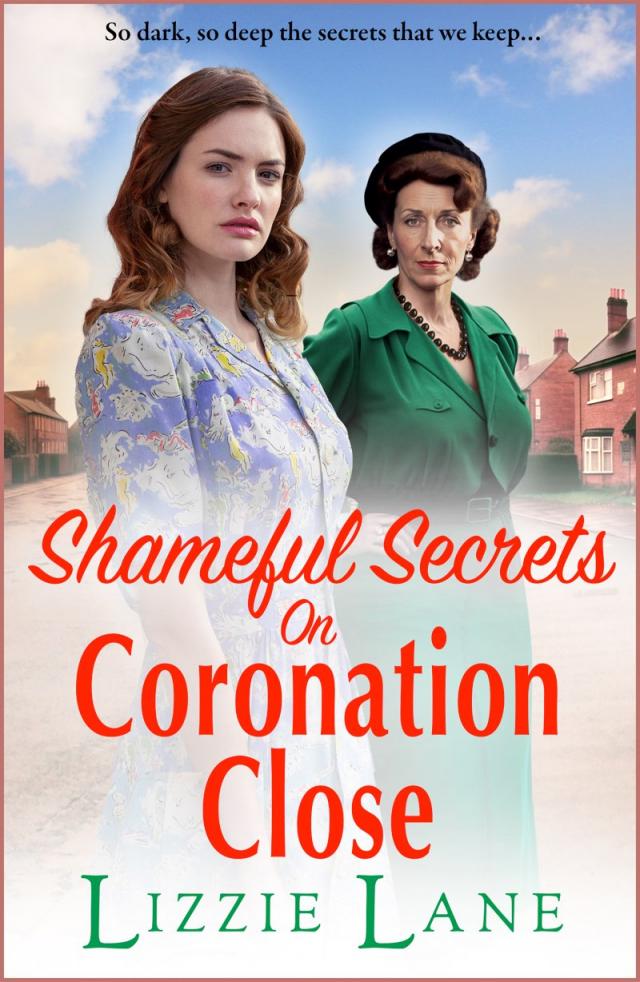
SHAMEFUL SECRETS ON CORONATION CLOSE
LIZZIE LANE
CONTENTS
Chapter 1
Chapter 2
Chapter 3
Chapter 4
Chapter 5
Chapter 6
Chapter 7
Chapter 8
Chapter 9
Chapter 10
Chapter 11
Chapter 12
Chapter 13
Chapter 14
Chapter 15
Chapter 16
Chapter 17
Chapter 18
Chapter 19
Chapter 20
Chapter 21
Chapter 22
Chapter 23
Chapter 24
Chapter 25
Chapter 26
Chapter 27
Chapter 28
Chapter 29
Chapter 30
Chapter 31
Chapter 32
Chapter 33
Chapter 34
More from Lizzie Lane
About the Author
Sixpence Stories
About Boldwood Books
1
JANUARY 1937
Thelma Dawson dashed from room to room of the house she shared with her daughters at number twelve, Coronation Close, a cul-de-sac of red-brick council houses on the Knowle West estate to the south of the city of Bristol.
Her daughters Mary and Alice, trotted along behind her with indignant expressions and frequent exclamations.
‘Ma, you’re going to be late for work. We can make sure everything’s ready for our George.’
‘I can’t help it. I so want everything to be perfect. My boy is coming home. I can barely believe it.’
For the third, or maybe even the fourth time, she flicked a duster at the spotlessly clean top of the pine chest of drawers. The item of furniture was newly acquired, sourced for her by neighbour and friend Jenny Crawford. Jenny in turn had found it at Robin Hubert’s second-hand furniture shop in Filwood Broadway. Robin was sweet on Jenny so she’d got it for a bargain price.
Thelma had made new curtains, laundered the bedding and bought a brand-new eiderdown from a shop in East Street, Bedminster, where a variety of shops nestled close to the dominating presence of the W. D. & H. O. Wills tobacco factory. It wasn’t often she could afford new, but it was for her boy, her eldest child, and she deemed him worth it.
George was the only one of her children to be born in wedlock, his father having died during the Great War. The fathers of her two daughters had passed like ships in the night, though she had hoped for more at the time. In the past, she’d fallen for men who had excited her, made her feel alive. Her current man friend Cuthbert Throgmorton – Bert as she called him – wasn’t exciting. He was safe and almost predictable and in a way she loved him. Even so, she couldn’t see marriage ever being on the cards, certainly not whilst his mother was still around. Still, Thelma lived in hope.
She continued to fizz with excitement. ‘I want it all nice, comfortable and clean for when our George comes.’
Mary exchanged a long-suffering glance with Alice, who promptly snatched the duster from her mother’s hands and tucked it behind her back when she attempted to snatch it back.
‘Ma, you could eat a pork chop off the floor in yer,’ Mary piped up.
In the absence of the duster, Thelma flicked at things with her bare hand.
Finally she stood in the doorway and surveyed the small but neat box room that her son, coming home from the sea and his profession as a Merchant seaman, would presently occupy.
Excitement at the prospect made her anxious. ‘Does it really look good? I mean everything. The curtains, the wallpaper, the furniture…’
The two sisters, totally unlike each other in colouring on account of having different fathers, exchanged a long-suffering look, shrugging their narrow shoulders and shaking their heads.
Alice breathed an exasperated sigh. ‘Everything’s lovely, Mum. There ain’t any dust. Me and Alice checked and so did you – about a dozen times.’ The two of them were used to cleaning and cooking. Thelma worked full-time at Bertrams, an up-market ladies’ dress shop doing a job that she loved. Little girls they might be – Mary eleven, Alice ten – but they liked taking responsibility for domestic chores. Other girls only played at being a housewife; Mary and Alice did it for real.
Thelma resisted any more fussing, but it was hard. ‘I want everything perfect for my boy.’
Her eyes glistened at the thought of him coming home. Only a few days now. He’d been away for almost a year – one in which so many changes had occurred. The country had lost a king and gained another and her new friend, Jenny Crawford, had moved into number two, Coronation Close next door to Mrs Partridge at number one. Her other friend, Cath Lockhart, lived at the far end of the cul-de-sac at number eight. Her house was number twelve from where she could glare across with undisguised dislike at Dorothy Partridge immediately opposite at number one.
Overall, they were a diverse lot. Some of her neighbours kept chickens. One of them kept goats who were sustained by kitchen scraps donated by anyone who had some to give. It saved bothering to put it in the pig bin – the small receptacle the council provided.
The residents of the council houses of Coronation Close were a good bunch – apart from Mrs Partridge at number one, the house right opposite her own at number twelve. That’s the way the numbers were in a cul-de-sac.
She had to admit that Dorothy’s sister, Harriet, seemed all right, but Dorothy Partridge herself was a troublemaker, the sort who wrote to the council if any of her neighbours put a foot wrong. Thelma was a frequent subject of her letters. So far, Dorothy had failed to bring Thelma down, but she kept trying. She couldn’t seem to help herself.
If the mantel clock downstairs hadn’t struck the hour, Thelma might have found another duster or got the carpet sweeper back out and pursued perfection for a bit longer. ‘Oh my God. Look at the time. Why didn’t you tell me?’
‘We did tell you.’
The three of them, mother and daughters, thudded off down the stairs.
Unlike most of her neighbours, Thelma made a point of looking smart no matter what time of day. Most of her clothes were handmade, cut down from decent-quality second-hand stuff she bought from Saturday-afternoon jumble sales. Never would she dream of leaving the house without lipstick, face powder or mascara. Never did she slop around in an old cardigan and slippers, hair in curlers like her friend Cath. The over-mantel mirror proclaimed that her hair was perfect, her lipstick unsmeared and her eyelashes were suitably slick with mascara, while the face powder gave her face a peachy glow.
She was bubbling with excitement. George was coming home. It had been almost a year since she’d last seen him and although she loved her daughters to distraction, George was her firstborn, her only son and the apple of her eye. In the meantime her job at Bertrams Modes awaited her.
‘Work,’ she murmured grabbing her handbag and checking its contents. ‘I must get to work.’
She shouted out to the kitchen, where her daughters were now preparing fried bread and tea for herself and for them.
‘Here you are, Ma,’ said Alice. She almost tripped over the hem of the adult-size apron she was wearing as she handed her mother a slice of fried bread and a cup of tea. ‘It’s cold out there. I reckon it’s going to snow, if not today, then very soon. You need something inside you,’ she pronounced in a manner belying her years. ‘Eat your fried bread.’
‘What would I do without you two,’ she said as she bit into the bread.
‘You’d be late for work all the time,’ said Mary in her matter-of-fact manner.
‘Get that down you and get going. You ain’t got all day,’ added Alice.
Thelma resisted rolling her eyes and laughing. Sometimes it seemed as though they were mothering her, not the other way round.
‘Right. I’m off.’
Goodbyes were said and then her heels were clattering up the garden path.
She bent her head into the bitter wind. The sky was grey and people standing at the bus stop were hunkered into their mufflers, slapping their gloved hands together to keep out the cold.
The bus was on time, but Thelma’s mind was so preoccupied imagining the homecoming that she almost forgot to get off at her stop.
‘Excuse me. Excuse me.’
After squeezing down the aisle between the seats, she made the rear platform of the bus and jumped off just as it began to move off. Her leap was slightly mistimed. She staggered between kerb and pavement; her fall was impeded by a steady pair of hands.
‘Steady on, love.’
She thanked whoever it was. The strong hands continued to grip as she mounted the pavement.
‘Thank you,’ she said again. ‘I can manage now.’
‘Do I get a kiss?’
She slapped him away. Cheeky bugger.
‘No you don’t. Let me go. I’ll be late for work.’
Once the grip was relinquished, she hurried off for Bertrams, the dress shop where she had risen from general sales assistant to leading sales assistant in a very short time. Right from the start, they’d recognised she had a flair for fashion, dressed well and flattered dithering customers into making a purchase. She had the gift of the gab and it went a long way to persuading people to buy what they didn’t think they needed.
Thelma tottered along on black suede court shoes. She’d never been late for work yet, but today she might be and Mr Bertram hated lateness. A shilling was docked from wages for each five minutes late. A shilling was a lot. She could buy a pair of stockings with that or two pounds of tea.
‘Serves me right for being distracted,’ she said to herself.
By the skin of her teeth, she made it outside the heavy mahogany doors of the shop, grabbed one of the pair of brass handles and pushed it open.
The smell of the interior of Bertrams Modes never failed to excite her. Silks, satins, wool, cotton and linen all had a smell of their own and she loved every one of them. She also loved the smell of kid gloves that Bertrams sold in several colours, though black, tan or cream were the bestsellers.
Women were Bertrams’ lifeblood and as such the place also smelled of them. Face powder and the lingering hint of expensive perfumes mixed with that of the sumptuous materials. Providing a firm and solid background to those smells was the beeswax polish used on the honey-coloured wooden walls, the counters and the chestnut brown lino.
Stiff, unseeing mannequins posed on round raised plinths, their fingers long and cold. Cashmere dresses, only affordable to wealthy women, clung to narrow hips on some, whilst others wore smart jackets with padded shoulders, pleated skirts, hats with broad brims, small brims, feathers and veils.
Each morning, Thelma acknowledged them as though they were human. ‘Good morning, girls.’
They never answered, of course. They were made of plaster, painted and posed to look lifelike.
Thelma loved this place, loved her work and had learned to tolerate those customers who considered that working girls should be slavish rather than of service.
Normally, she was the height of efficiency and good at holding back what she really wanted to say, but today she couldn’t concentrate as well as she usually did. It would have suited her if there were no customers today. Suited her too if she could have directed them to a work colleague, but the fact was some customers asked for her by name.
‘I said I wanted cream-coloured gloves,’ said the aloof and elegantly dressed woman she was currently serving.
Quite tall and of course very elegant, as most of their customers were, she wore a fur coat that looked like mink. The shoulders were square and the coat was knee-length. A net veil trimmed the dark red hat she wore. A pair of overly long feathers sprouted like a peacock tail at one side.
‘Oh. So sorry, madam.’ Thelma was distracted.
‘So you should be. Are you new here?’
Thelma resisted snatching the gloves back. The truth was she just didn’t have her usual patience this morning. This evening and George were everything.
‘No, madam.’
‘Have you a supervisor, a senior sales assistant who knows what they’re doing?’
The tone was imperious, the plucked eyebrows arched and the deep-set eyes viewed her with contempt.
‘I am a senior sales assistant, madam,’ returned Thelma, smiling through gritted teeth. She wanted to slap the woman across her heavily rouged cheek – both cheeks in fact, but her wages were made up with commission. Though it was far from easy, she forced herself to be polite. ‘These are the only cream gloves we have,’ she said, bringing out a pair from the drawer and setting them out on the counter.
To Thelma’s surprise, the woman scrunched one up into a ball in her fist. ‘Hmm. It doesn’t feel very soft. Are you sure this is really a kid glove? I won’t wear ordinary leather. Much too coarse. I have very soft and sensitive skin, you see.’
Thelma glanced at the clock ticking away the minutes and hours on the wall, the time slowly passing before George arrived. Nothing was as important in her life as her children. It made her want to shout and scream at this woman. But awkward customers were nothing new. Instead she decided to lie.
‘You’re quite right, madam. They’re not kid at all. They’re chamois and much more expensive than kid gloves. In fact, I think they’re the last pair we have and goodness knows when we’ll get any more. They’re rare, you see. Quite rare. And expensive. Though these are slightly cheaper, seeing as they’re the last pair that we have – but still too expensive for most of our customers.’
The woman’s red lips parted and Thelma was sure she heard an intake of breath. The covetous look on her face was evidence enough that she was going to buy them. No matter how much they were, she had to have them, if only to prove that she had the money to do so and to stop anyone else having them.
‘Wrap them up.’ She gathered her crocodile handbag from off the counter and ordered that the price of the gloves should be put onto her account. ‘My name’s Mrs Justin-Cooper. My husband is the judge, the honourable Mr Justin-Cooper.’
Thelma nodded politely as though her name and status were familiar to her.
‘I’ll put them in a decent-size bag. Such gloves should be carried in splendour,’ said Thelma with a forced smile that didn’t reach her eyes. Not that this particular customer would notice that.
Mrs Justin-Cooper swept out past Miss Apsley, the supervisor who mainly oversaw the millinery department and had been partially responsible for taking Thelma on.
Miss Apsley reached for one of the brass door handles, a ready and slightly subservient smile on her face. ‘Let me get the door for you, madam.’
With slow deliberation, the door closed softly once Mrs Justin-Cooper had sailed through it.
‘Mrs Justin-Cooper,’ Thelma whispered into Miss Apsley’s ear. ‘Her husband’s a judge.’
‘What did you sell her?’ she asked, her hands clasped in front of her.
‘A pair of cream kid gloves. The pair that’s been hanging around in the drawer ever since I started here.’
‘Really?’ Now it was Miss Apsley’s eyebrows that rose. ‘I hope you told her that they’re the last pair.’
‘I did in a manner of speaking. I just tweaked the description a bit.’
Miss Apsley pulled in her chin, a question in her eyes.
‘Don’t worry,’ said Thelma, already looking to serve the next customer who was presently dipping over the glass-topped counter, eyes on the drawer containing camiknickers. ‘She thinks she’s got a bargain. A pair of chamois gloves as opposed to common kid.’
‘Chamois is kid.’
‘That’s what I thought, so I wasn’t lying. I just elaborated a bit, after all they’re both goats, aren’t they?’
Miss Apsley smiled and her eyes sparkled. ‘Very commendable, Mrs Dawson. Very commendable indeed.’
2
Cath Lockhart’s metal curlers jingled like sleighbells as she hurried along at Jenny’s side, head bent against the cold easterly wind. They were both on their way to Stan Harding, the butcher in Filwood Broadway.
All the way there, Cath had been expressing her annoyance that Thelma had invited Bert Throgmorton to her son’s celebratory homecoming.
‘Never invited me though. I thought she would ’ave. I do like a party.’
‘Everyone does,’ said Jenny. ‘But this is a coming home party for her son. It’s a family thing. I suspect she wants him to herself for a while.’
Cath wasn’t impressed. Her lips were tightly pursed. ‘Bert Throgmorton ain’t family. He’s the rent man.’
‘You know as well as I do that Bert and Thelma are close. You could almost call them engaged.’
‘Engaged?’ Cath sounded dumbfounded. Even her curlers jangled with indignation as she shook her head violently. It was enough to dislodge one that had been dangling on her forehead and send it with a pinging sound onto the pavement. She stopped to pick it up. ‘She ain’t never said anything to me about them being engaged and I’m ’er best friend. Unless you know different.’ She sniffed and tightened the knot on her headscarf.


