Being Ace, page 1
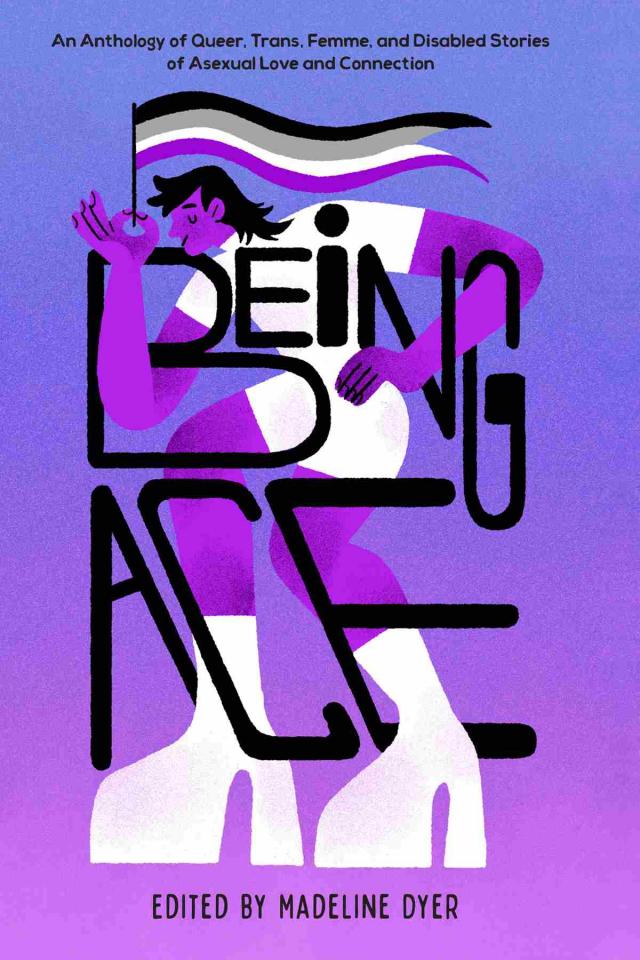


An Anthology of Queer, Trans, Femme, and Disabled Stories of Asexual Love and Connection
BEING
ACE
EDITED BY MADELINE DYER
Begin Reading
Table of Contents
About the Author
Copyright Page
Thank you for buying this
Page Street Publishing Co. ebook.
To receive special offers, bonus content,
and info on new releases and other great reads,
sign up for our newsletters.
Or visit us online at
us.macmillan.com/newslettersignup
The author and publisher have provided this e-book to you for your personal use only. You may not make this e-book publicly available in any way. Copyright infringement is against the law. If you believe the copy of this e-book you are reading infringes on the author’s copyright, please notify the publisher at: http://us.macmillanusa.com/piracy.
CONTENT WARNING
Sexual assault, sexual violence, and coercion; abuse (sexual, verbal, emotional, mental, physical); acephobia; transphobia; misgendering; ableism; abduction; death of a parent, a love interest, a sibling, and best friend; bullying; and mental illness including depression, suicidal ideation, and eating disorders with discussion of calorie counts
INTRODUCTION
CODY DAIGLE–ORIANS
If people recognize me, it’s usually from the internet. They know me as Ace Dad, that silver-bearded gay asexual guy in glasses who makes educational videos about asexuality, gives advice and encouragement to “live your best ace life!” and tells a lot of dad jokes.
Ace Dad is a pretty confident guy. But I wasn’t always like Ace Dad.
When I was sixteen, I was really confused about who I was. I knew I was different. I knew that difference had a name. But I didn’t have the courage or understanding to name it.
Then, I watched the film version of A Chorus Line.
A Chorus Line is a special show. It’s a musical about musicals, a Broadway show about Broadway. And that really worked for theater-loving teenage me. Watching A Chorus Line changed my life. Sure, I loved the songs, the dance numbers, and the creative passion expressed in each of the characters. But what changed my life was a scene with none of those things. No music. No dance steps.
Just … Paul.
There’s a scene in the second half of A Chorus Line where one of the dancers, Paul, is alone onstage with the director. He’s been hesitant to open up throughout the audition, but in this moment, he allows himself to be vulnerable. He talks about being gay. About being so afraid his parents would discover this and reject him. About wanting to make them happy, but also wanting to be true to who he was. About the thrill of finding community as a performer with other queer people. About standing in his truth and being seen by his parents, seen and accepted and loved.
In that scene, I saw my truth reflected. I wasn’t a dancer, and I wasn’t auditioning for a Broadway show, but I did know that pain. I knew that fear. I was beginning to understand I was gay like Paul, also desperate to live that truth authentically, and also afraid that doing so would cost me my family. They were truths I’d been feeling but had no words for yet, and that scene spoke those truths with language I didn’t have, with confidence I hadn’t built.
That scene spoke me into existence. Hyperbolic? Maybe. But if Paul and his truths could exist within the world of this musical, I knew, for the first time, that I could exist in the world as well.
It was my first real encounter with magic.
It would be twenty years before I encountered a different magic that revealed a second, deeper truth of myself—I was also asexual—but I wouldn’t find that reflected in a story. I’d find it on Tumblr, a useful but maybe less glittery magic than a big Broadway musical. I’m not complaining. Sixteen-year-old me didn’t have any access to depictions of asexual lives. A book like the one you hold in your hands was something teenage me in the mid-1990s couldn’t have ever imagined.
Seeing ourselves depicted in stories—be they films, television shows, or books like these—is one of the most powerful ways we come to understand ourselves. Depiction shows us we have a place in the world. It proves someone like us, someone with our experiences and thoughts and feelings, can live, dream, act, and occupy space. And it proves we can do those things as ourselves, without hiding, without denying our truths. Depiction says we can be anything—a villain, a hero, a wisecracking sidekick, a caring best friend, a curious adventurer, an ordinary someone, a being of impossible magic. We are bound only by what we can imagine ourselves to be.
Depiction is a powerful magic, but this book enacts an even deeper kind: representation.
It’s one thing to see ace characters depicted in stories. It’s another to have ace writers writing those stories. Representation is depiction in the hands of those needing to be depicted. It takes the magic of depiction further. Representation says, “You deserve more than just the ability to see yourself in a story. You deserve to tell that story.”
This book imagines asexual people into myriad worlds, each of them holders of some new ace possibility. We are, as ace people, not only centered in these worlds but also put there by other ace people, writers who authentically live the lives they’re writing into the world. This book is not just giving ace characters a space; this book is allowing ace artists to create that space for us.
That is a magic of unfathomable power. And this anthology is brimming with that magic.
You will notice as you journey through the stories that while all the authors identify on the asexual spectrum, I am the only author here who identifies as a cisgender male. This is not an intentional exclusion on the part of the creators of this anthology, nor is it some statement on the value and importance of cis male writers in ace literature. It’s a reflection of an ace reality that’s worth illuminating here.
In the 2019 Asexual Community Survey, an annual survey that’s the largest survey of ace communities, only 13.9 percent of survey respondents identified as male. While the survey doesn’t break down whether these male-identifying respondents also identify as cis or trans, this number remains surprising.
Are women that much more likely to be asexual? No. But there are many cultural forces at play that make it harder for men to recognize or accept their aceness. Asexuality is still hard to see in the world. While visibility and representation of ace lives is rising, there’s still very little about asexuality available in the world. And men are strongly socialized to prioritize sexual pursuit and prowess. So asexuality is not just hard for men to imagine; it’s an identity in contradiction to how society conceives of “being a man.” We still have much work to do in creating a space where more men can imagine asexuality as one of their possibilities.
This anthology still contains universes of ace possibilities. These stories speak to everything it means to be ace. Some look deep into the difficult realities of our contemporary lives. Some use bits of ancient fantasy to heal familial wounds. Some explore our lives as we shoot across the stars. Some explore aceness through the manners and machinations of courtly fantasy. But all of these stories reach the same destination. They reveal some truth of what it means to be ace: a truth of our heartbreak, of our joy, of our fear, of our love, of our courage, of our resilience, and most important, of our place in the world.
We often compare stories to mirrors, reflecting glimpses of the world around us. But the stories here are something more. These stories are windows, allowing us to see beyond what we’ve ever been told about what aceness is and can be. These stories are doors, encouraging us to leave the normative boxes that have limited us and to step into new worlds of ace possibilities. These stories are paths we can walk together, toward a more complete picture of what it means to be asexual as well as what it means to be human.
That is transformative, powerful magic. It is our magic.
Let the conjuring begin.
HOW TO LOVE A SIDEWINDER
KAT YUEN
If there was one thing Xiaoying didn’t know how to find, it was true love’s kiss. Of course, then, that was what her best friend made bind the curse, in a sweep of petty rage. So, after a week of puking up snakes with every half-truth, Xiaoying bit her tongue and decided it was time to visit her mother.
The afternoon burgeoned with bugs as she trudged barefoot across the marsh toward her mother’s reed-raised house, shaved head shiny with sweat, nerves sloshing in time with her gut. She carried her bag carefully overhead, and upon reaching the bamboo ladder up to the deck, Xiaoying first vaulted the satchel over to safety. Climbing up would be a task. Years of ignoring welcome turned the bamboo slick under Xiaoying’s hands; her mother always knew how to make her emotions known, seep grudges into her surroundings. If not for the vestiges of familial bond, the ladder might have jostled her grip and sent her into the bog waters. As it was, the door-side light only faintly illuminated in greeting, and for a few minutes, Xiaoying stood before the door panting, sweating, awaiting entry. Mosquitoes threatened to give her even more ear piercings; choral bullfrogs sang a song of missed calls.
Xiaoying twisted the jade bracelet around her left wrist—the only piece of jewelry she had on for this trip. It had been a warm green when her mother had first gifted it to mark Xiaoying’s departure to college; it had become increasingly smoky with the years. Below, a crane blinked long and slow, and sighing, the door opened.
Her mother, growing ever shorter, pulled Xiaoying down for a hug; they spoke in rehearsed greeting—So happy to be home (
Already, the ever-present question. “Siu Haam, bi, you are always just talking about your friends, ah. When will you bring home a handsome husband?”
Xiaoying had turned to remove her sweaty outer shirt; she lingered there, facing away from her mother. A baby corn snake writhed, predicting. “My friends I already know. I don’t have time to find a man.” She spat the corn off to the side; it slithered through an old hole in the wooden floors.
Her mother sighed and quickly turned her attention elsewhere, exclaiming: “Ai ya! How are you so thin?” Gripping Xiaoying’s wrist, she inspected it. “I keep telling you, the food there is not good enough. Now look at you. Here, help me make your favorite, so you have no excuse not to eat.” And so, hands washed, within short notice they became preoccupied with rice flour, rolling small spheres of dough in their hands. Thumb-indentations; glops of red bean paste. Wrapped cozily closed, secured with a twist.
They worked silently, patiently, filling up the boiling plate. Chatted idly: of her mother’s latest batches of potion-steeped pastries; about some paper or other Xiaoying had read recently; after how Paw-paw was getting on; childhood friends; Xiaoying’s dating prospects.
Xiaoying had made at least twenty tangyuan by then, lined the plate as quickly as her mother, but no number could compensate for never making a child. Her mother never said explicitly her expectation of grandchildren, but it wasn’t a necessary articulation. She asked enough of potential suitors.
“You always liked Peter,” her mother suggested. Hard-lined eyes forward, her calloused hands formed dumplings like clockwork. Age had only sharpened her attention to match the knife-shining wisps of her remaining hair.
“Peter lives far away now, Ma.” Easier not to point out that Peter was already married—and to a man. “Besides, he wasn’t even a good friend.” A king cobra hissed under Xiaoying’s tongue, as if in her dear friend’s incredulity.
“Maybe abroad has made him better. Good husband material.”
“I don’t think it could work out in the long run.” Was quoting what he’d said to her a lie? It wasn’t up to her to decide. Fresh black scales slithered out and down into her lap, wound through the kitchen and out a side door propped open for the breeze.
They’d been the only two in their primary-school class who had never expressed interest in their classmates of other genders. Occasionally, boys would capture Peter’s attention, but he and Xiaoying had remained close to maintain the illusion, even after they’d begun contacting alike others out in the world. It was convenient, after all, and comfortable, knowing they lacked compatibility. They’d joke about becoming adoptive parents together, making a home—a safe place—in the world at large.
And for Peter, they had only ever just been jokes. Open arms awaited at their university filled with boys who didn’t move away at the end of the semester, forging a home much more permanent than any of which they’d dreamt.
Besides, you got your own person, Xiaoying imagined him chiding, with a conciliatory smile. We don’t need to rely on each other, anymore. You have her.
Around the kitchen, old photos were pinned alongside recipes and runes, calligraphy bleeding together characters and concocted symbols. Stamps denoting high marks on exams stood alongside stamps for pressing good-luck charms into mooncakes. Dried herbs and various oils and sauces lined the walls in glass bottles. Invisible leaks, hairline cracks in each, were letting her mother’s precious time and love slither out.
Evening settled densely around the cabin lanterns and the fireflies flickering through the fog. Yellow light, offset from gold, illuminated an otherwise impenetrable night. After dinner, Xiaoying lay out on the porch, trying to pick out stars.
Astrological divination had never been her best subject, but hopefully once she’d swept away the blurred notes, the sky would reveal a better blessing than before. She begged it to be.
When Xiaoying had entered college, there had been a vacancy in her life—but not for long, as Trinh sailed in. A girl who lived in the room across from her own, Xiaoying had been glad to have someone who seemed to understand her dilemma. Trinh had decided even before leaving home to disavow her parents’ expectations—chose a life free from familial restraint, to thrive on the embrace of other women. She’d gladly brought Xiaoying into her friend group and had always been affectionate. Like family.
Maybe too much like family. In her own habituation to familial closeness and casual friendly touch, Xiaoying had overlooked all of the signs. Trinh had assumed that Xiaoying had been so immediately thrilled for the same reason as she, bonded by a shared lesbianism that didn’t need speaking. Gaps in understanding were innocuous; harmless. Unnecessary to discuss. Sure, Trinh called it odd occasionally when Xiaoying would turn down invitations to go to socials, and funny how Xiaoying preferred to watch than participate in the flirting game, but they were two modern women, weren’t they? One and the same; sisters. For the most part.
In the time they had been sharing a small studio, Xiaoying passed it off as common decency among roommates whenever Trinh asked if bringing home others was okay. She gave no thought to Trinh’s warm nature; it was as Xiaoying had been with Peter. Until.
Trinh had posed a question about the future.
A question about their future.
The next day, Xiaoying and her mother trudged through the mud and water, woven baskets hovering just over the splash, to where lotus grew in a wide thicket; armed with machetes and eyes, they chose and cut individual plants out from their silt. Stalks and great frond leaves into one basket, tube roots into the other. Inspection, selection, deconstruction. Then, the wading back through the sweaty marsh for washing and scrubbing. The kind of physical work that her university fellows would probably automate, but her mother always insisted on the extra magic imbued through one’s own labor, the individual flaws and selfish toils.
Around the kitchen table they piled the rinsed roots and partitioned: The youngest would be prepared and consumed that evening, and the rest chopped and soaked for future meals.
“—Ma.”
Her mother stopped abruptly mid-sentence. “What? Don’t interrupt me like that.”
“Sorry.” Dui bu qi. Accidentally, she slipped into Mandarin; her mother’s gaze upended from the roots she had begun skinning.
“No need to be so formal!” her mother chastised. “You are my daughter. It’s okay.”
Xiaoying just nodded; rolled words around with her tongue, testing their shape.
In gradual quiet, her mother returned to working. “Well?” she prompted. “Say it.”
Xiaoying swallowed a venomous breed; no use in continuing to sidewind. Trinh had cursed her for “lying,” mostly out of caustic incredulity, but maybe it had also been foresight that earning a kiss would mean making amends, coming clean. With earnest nerves Xiaoying asked, “Would it be okay if I never bring someone home to you?”
Her mother finished peeling the root in her hand. She didn’t quite set it aside, wrist leaning against the wooden table, resharpened knife glinting in her other hand. The scuffed lotus skin lay in discards, leaving behind the exposed flesh.
And then, her mother set it into the bowl with the rest. “Don’t speak of never, ah. That is too much time to ever be sure of anything.” She placed the knife on the table and deliberately carried the bowl of roots over to where a pot of water lay not-yet-boiling on the stove. As Xiaoying watched, her mother bent down and with a snap aroused the fire; as she watched, her mother coerced the flames into rising in grandeur and raising the water to a boil; as Xiaoying eyed every movement, her mother dumped the hard brown roots into the pot to soften and cook.
“But,” Xiaoying proposed, “what if I never found a guy that I wanted to marry?”