Vast, page 1
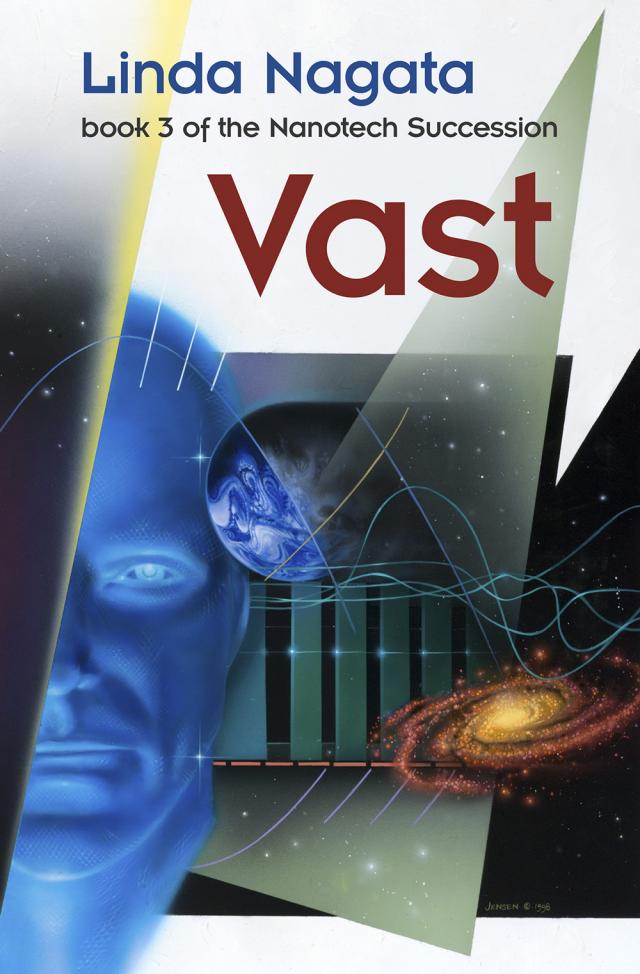


Vast
book 3 of the Nanotech Succession
Linda Nagata
Published by Mythic Island Press LLC
Kula, Hawaii
Mythic Island Press LLC
Love to Read?
Looking For More
Science Fiction & Fantasy?
Subscribe to Linda Nagata's free monthly newsletter and you'll get updates on her forthcoming books as well as her personal reading recommendations.
SIGN UP NOW
at MythicIsland.com
This is a work of fiction. All the characters and events portrayed in this novel are fictitious or are used fictitiously.
Vast
Copyright © 1998 by Linda Nagata.
All rights reserved.
This novel was first published by Bantam Books in August 1998 as a paperback original.
First electronic edition November 2010.
The text of this edition contains minor changes or additions determined by its author.
Electronic ISBN 978-0-9831100-3-3
Print ISBN 978-1-937197-04-9
Cover art copyright © 1998 by Bruce Jensen, used by permission
Mythic Island Press LLC
PO Box 1293
Kula, HI 96790-1293
MythicIslandPress.com
Prelude
Point zero: initiate.
A sense kicked in. Something like vision. Not because it emulated sight, but because it revealed. Himself: Nikko Jiang-Tibayan. An electronic pattern scheduled to manifest at discrete intervals. Nikko Jiang-Tibayan. He’d been an organic entity once. Not now.
Point one: identify.
Personality suspended on a machine grid: He is the mind of the great ship, Null Boundary. His memories are many, not all accessible. He’s locked much of his past away in proscribed data fields. He interrogates his remaining inventory, seeking an explanation. It comes in an amalgam of cloudy scents: the clinging stink of living flesh parasitized by aerobic bacteria. All defenses down. “Don’t be sad, my love,” she whispers. “Whatever the cost, you know we had to try.”
He explores no farther.
Point two and counting: status check.
A scheduled mood shift floods his pattern with easy confidence. He confirms that Null Boundary has long ago reached maximum velocity, four-tenths lightspeed. The magnetic scoops have been deactivated; the solenoids folded to a point piercing the increasingly thick interstellar medium. Duration? Over two centuries ship’s time have elapsed since Null Boundary left Deception Well.
Two more centuries.
His past has become unconscionably deep for a man who’d been condemned to die at the age of thirty standard years. Still, death is never far off.
There are four telescopes mounted on tracks around the ship’s hull. When two or more are fixed on the same object, their optical signals can be combined, creating an effective lens aperture far greater than any individual scope. At least two lenses are continuously fixed on the alien vessel that has hunted Null Boundary for 150 years.
It’s a Chenzeme courser, an automated warship designed by a race that vanished millions of years before the human species even came into existence. It first appeared when Null Boundary was less than fifty years out of Deception Well. Then, it was moving at close to thirty-nine percent lightspeed, on a course that would take it toward the star cluster called the Committee—opposite to Null Boundary’s vector. Nikko watches its fleeting image, wondering if it will manage to get past the defenses of the human settlements there.
Nikko knows little about the Chenzeme, but he knows this much: Their ships are not powered by conventional physics. The old murderers learned to tap the zero point field, that all-pervasive sea of energy where particles and antiparticles engage in a continuous dance of creation and annihilation. It’s a deadly talent. With the zero point field to power their ships and guns, each Chenzeme vessel has far more energy at its command than any human installation. Their gamma ray lasers can burn away the atmosphere of a living world. Nikko has seen it happen.
A twinge of pain, like the tenderness of a half-forgotten wound, warns him away from memories he does not want to awaken. It’s enough to know the Chenzeme will not be beaten until the frontier worlds own the zero point technology too.
Yet even for the old murderers, energy does not flow in infinite quantity. To catch Null Boundary, the courser would need to swing about and accelerate—a huge investment of both time and energy that can gain it only a very tiny prize. So that first time Nikko sees it, he knows it will ignore him to push on toward the inhabited worlds of the Committee. He has no reason to think he will ever see it again. He aims the ship’s prow at the natural navigation beacon of Alpha Cygni, a white-hot giant star that blazes against a background of dark molecular clouds—and he pushes on, in the direction called swan, where the Chenzeme warships seem to originate. He has set out to find their source, and he will not be distracted. Like a tortured man stumbling vengefully toward his tormenters, he has to know why.
A century and a quarter later, the courser reappears in Null Boundary’s telescopes, approaching obliquely, far to the stern.
Now it has closed to 21.6 astronomical units—some three billion kilometers behind them. It’s a luminous object, agleam with a white light generated by the membrane of philosopher cells that coats its needle-shaped hull.
Human ships and human worlds were not the original targets of the Chenzeme, but their automated ships have proven adaptive. So Nikko has adapted too. He cannot outrun the courser or match its guns, but on Null Boundary’s hull he has grown his own layer of Chenzeme philosopher cells, forever dreaming their simulated strategies of war and conquest.
The cells are an intellectual machine. Not so much a mind, as a billion dedicated minds in competition, gambling their opinions. Approval means more and stronger connections to neighboring cells. Disapproval means an increasing isolation. Links are made and shattered a thousand times a second and long-chain alliances are continuously renegotiated. Consensus is sought but seldom found.
This is the clumsy system that guides the Chenzeme warships. Nikko thinks on it, and he doesn’t know whether to laugh or to weep in terror.
He suspects he has done both ten thousand times before. It’s been twenty-two years since he learned to live within the skin of his enemy. Null Boundary’s hull has gleamed white all that time, a skin-deep Chenzeme masquerade.
If nothing else, this ruse has bought time. Though the courser has not been persuaded to turn away, it seems unsure, as if its instincts have been confused by Null Boundary’s metamorphosis. Seventeen years ago it ceased to accelerate. Yet because its velocity is slightly greater than Null Boundary’s, the gap between the two ships continues to narrow. In another 125 days Null Boundary will fall within range of its gamma ray laser.
That is Nikko’s deadline. He must convince the courser of his authenticity before then, and persuade it to leave them alone. In the ship’s library, an army of subminds is dedicated to the problem, interpreting and reinterpreting every record of Chenzeme communication to uncover all identifying codes. Nikko has used the results in repeated attempts to contact the courser, but to no effect—it has never answered his radio hails.
He adds one more submind to stew upon the problem, while instructing a Dull Intelligence to continue the observations. He will be unable to do so himself, as his present existence is limited to ninety seconds. At the end of this time, if nothing has gone wrong, his personal memory of the period will be dumped and a new interval will begin, so that from his point of view, Null Boundary’s transit time will seem to require only ninety seconds, though years have elapsed. This is Nikko’s defense against boredom.
Point twenty: Additional subminds report in. Their assessments are pleasingly dull. Reactor function is nominal. Air quality is nominal. Crew health: nominal. There are only three crew members. Four, if Nikko counts his own rarely used physical incarnation. He finds Lot and Urban awake and active; only Clemantine still hibernates in a cold storage nest.
Point thirty: Nikko scans Null Boundary with remote eyes. He discovers Urban in the library, linked to an interface that records the activity of the philosopher cells. Urban insists that with practice and refinement, the interface can be made to translate the cell’s chemical language into something meaningful to a human mind. Nikko doesn’t agree. Experience has taught him that Chenzeme language finds meaning only within Chenzeme neural structures.
This is something Lot understands. He is in a transit bubble just beneath the ship’s hull. One side of the bubble is open, so that he lies squeezed against the underside of the colony of philosopher cells. He’s dressed in an insulating skin suit, but the hood is down. His close-cropped blond hair shines in the cells’ white light. On his cheeks are moist sensory glands that look like glistening teardrops. These “sensory tears” are a Chenzeme structure, integrated into the genetic system of Lot’s ancestors by some unknown engineer, thousands of years in the past. Through them, Lot can perceive the cells’ chemical language and respond in kind, with molecules synthesized in the tears’ nanoscale factories.
The philosopher cells are Lot’s creation, and he is still the only one who can effectively communicate with them. He mined their design from the living dust of Deception Well’s nebula, storing the pattern in his fixed memory, a data vault contained within the filamentous strands of the Chenzeme neural organ that parasitizes his brain. Nothing degrades in fixed memory. Lot used the pattern to synthesize a seed population of philosopher cells within his neural tendrils, exuding them through the shimmery surfaces of his sensory tears. It’s a neatly circular survival strategy in which the parasitic tendrils use their host to reproduce Chenzeme mind. Clearly this has happened many times before in the thirty-million-year history of the Chenzeme, and it is the warships that have survived it, while their challengers have all vanished.
All except us, Nikko thinks.
He is acutely aware that they play a dangerous game.
After the first cells were made, it took three years of experiments before they learned to feed the young colony with nutrients delivered through the hull. Now the original cells have reproduced many times over. Lot is learning to delve into their inherited histories, and with luck, he will discover the proper radio hail to sooth a Chenzeme warship.
The warships are known to rendezvous in the void, to exchange cell histories encoded in dust. How Nikko is aware of this is a mystery locked behind the black wall of another proscribed field, but again, he makes no inquiries. It doesn’t matter how Null Boundary’s neural system came to be tainted by the Chenzeme, just that it has, in a primitive way, so that Nikko too can distinguish meaning in the cell-talk. He doesn’t have Lot’s talent. He is like a dog listening to its master’s voice—aware of mood, but deaf to specific meaning. Forever surprised by what Lot will say.
Chapter
1
The cramped arc of the transit bubble pressed on Lot like a gigantic, gentle hand, pushing him sideways into the only soft tissue within the cold, brittle membrane of Chenzeme cells that coated Null Boundary’s hull. The philosopher cells glowed with an intense white light that Lot could feel even when his eyes were closed. At this one point Nikko had created a vacuole beneath the membrane’s fixed surface, preventing it from bonding with the body of the ship. Lot thought of the site as a wound, because the cell tissue here was slushy, like overripe fruit or decaying flesh, on the verge of freezing.
He sank into it, eager, and a little bit scared: this thin amalgam of living alien cells was all that lay between him and hard vacuum. His gut clenched when he thought about it. He had no backups of himself. But the membrane had been in existence for twenty-two years, and it had not failed yet.
In the wound, the philosopher cells were loosely attached to one another. They felt glassy and granular as they molded around his shoulder, flowing up and into his ear, across his closely trimmed scalp, and around his mouth. He kept one eye closed. Their touch was cold, though it was not unbearable because the chemical reactions within the cells required relatively high temperatures.
Not high enough to suit Lot. The skin suit kept his body warm, but he’d left the hood off so as not to block the tiny, drop-shaped silver glands of his sensory tears that studded his cheeks just beneath his eyes. Now the right side of his face was embedded in the wound and it felt half frozen. He turned his head to keep his nose in the transit bubble’s thin pocket of air. Over most of the hull, the membrane was a petrified layer only a few millimeters deep. Here in the wound it remained soft and it continually thickened. Lot worried about that. He didn’t want to drown in the cells.
Finally, his shoulder brushed the crisp tissue of the membrane’s outer wall. Relief flooded him. This time, he would sink no farther.
Over the past two years, Lot had spent up to fifteen hours a day with the cells, sometimes talking to Urban about what he felt. Urban monitored his communications, seeking to interpret the cell-talk for himself—and failing utterly. No surprise. Chenzeme thought was not like human thought. Lot could do one or the other, but serious fudging was needed to bridge the two.
Often, Lot just listened to the philosopher cells. Sometimes he would try to sway the waves of competitive simulations that swept round and round the field, and sometimes he would introduce his own notions to the tumult. Today though, he would try something new.
He closed his eyes, his heart beating hard in anticipation as he visualized the molecular structures assembling within the pheromonal vats of his sensory tears.
Nikko was convinced they could establish a Chenzeme identity through radio hails. Lot was less sure. Chenzeme radio signals were intricate and highly variable, but they were not immune to counterfeit . . . a fact that had started Lot wondering if there might be another level of identification among the warships, and if so, what might it be?
It didn’t take long for him to fix on the chemical language of the philosopher cells. If Null Boundary could communicate with the courser on that intimate level, it might be persuaded they were authentic Chenzeme. It might let them live.
A golden spider clung to Lot’s left earlobe. It was his radio link to the ship’s datasphere. Now the spider squeezed his earlobe with its legs, whispering in an airy, synthesized voice: “Looptime equal to seventy.”
Twenty more seconds then, until Nikko purged his memory.
Urban, you ready? He wanted to check in, but Nikko might be listening. It was impossible to tell. Usually Nikko left them alone, relying on a nonsentient submind to look out for their welfare and ring an alarm should something go wrong.
Nikko would stop them if he knew. He would see the very real possibility that the courser would be provoked into a close approach to seek a mating—that’s what Nikko called it—an exchange of chemical histories with the philosopher cells of Null Boundary.
Lot had no idea if they could survive that level of contact—Nikko refused to even talk about the possibility—but for Lot, even gray uncertainty looked better than the zero chance they would have if the courser crept within weapons range still unconvinced.
He took slow, shallow breaths, determined to appear calm. Nikko would stop looping if he thought Lot was having a bad time.
Calm.
“Ten seconds,” the spider whispered.
Near the end of his loop, Nikko sometimes had a few seconds with nothing to do, free time that could be spent looking over Lot’s shoulder. Of course, whatever he saw would be forgotten as soon as the memory of this ninety-second segment was dumped.
“Four seconds,” the spider whispered.
Nikko’s program would take two seconds to purge and reset. Lot breathed softly as a chemical language slipped in discrete packets to the surface of his sensory tears. The charismata. They were molecular messengers, and he could sculpt them to influence human moods or Chenzeme protocols.
“Three seconds. Two—”
“Do it, fury.” Urban’s voice issued from the spider, overriding the count.
“Zero—”
Lot released the charismata. The chemical message flushed across the bridge of liquid that linked his sensory tears to the glowing cells pressed against his cheek. Immediately, he felt a mottled red-cold burst of acknowledgment from the philosopher cells as they replicated the message, transferring it throughout the membrane’s vast field. Within seconds, Lot was breathing the respondent chemical structure: a mélange of identification codes and demands for radio communications from one Chenzeme vessel to another—
The wall of the transit bubble shuddered. Lot yelped in surprise as the bubble’s tissue oozed over him, sliding like a flexible knife between his skin suit and the philosopher cells. Between his skin and the cells: he could feel the bite as it sliced the nascent bonds the cells had made with his sensory tears. He twisted in an instinctive—and utterly ineffectual—attempt to escape, then cried out in hoarse protest: “Urban!”
“It’s not me, fury.”
“Then Nikko. Dammit, listen—”
The transit bubble’s tissue sealed around him like a layer of skin, cutting off both his protest and the cells’ white light, plunging him into darkness. He could not breathe.
The bubble expanded. Cold air puffed against his cheeks. He felt the pressure of acceleration as the bubble raced inward through the ship’s insulating tissue. His face throbbed as his skin began to warm. He tried again. “Nikko, listen to me.” He had no idea if the experiment had succeeded. “I know you’re pissed, but I need to be at the hull now—”
The bubble slammed to a stop. In the same instant, the wall beneath his belly snapped open and Lot found himself hurtling through the zero-g environment of Null Boundary’s core chamber.