

Come to This Court and Cry, page 1


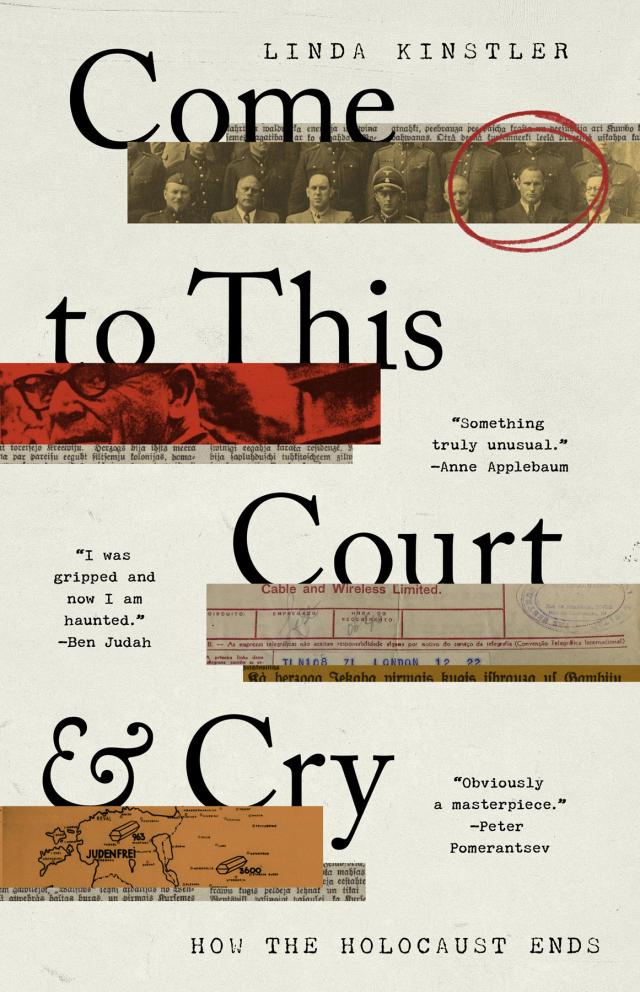
Copyright © 2022 by Linda Kinstler
Cover design by Pete Garceau
Cover images courtesy of the author
Cover copyright © 2022 by Hachette Book Group, Inc.
Hachette Book Group supports the right to free expression and the value of copyright. The purpose of copyright is to encourage writers and artists to produce the creative works that enrich our culture.
The scanning, uploading, and distribution of this book without permission is a theft of the author’s intellectual property. If you would like permission to use material from the book (other than for review purposes), please contact permissions@hbgusa.com. Thank you for your support of the author’s rights.
PublicAffairs
Hachette Book Group
1290 Avenue of the Americas, New York, NY 10104
www.publicaffairsbooks.com
@Public_Affairs
Originally published in Great Britain in 2022 by Bloomsbury Publishing
First US Edition: August 2022
Published by PublicAffairs, an imprint of Perseus Books, LLC, a subsidiary of Hachette Book Group, Inc. The PublicAffairs name and logo is a trademark of the Hachette Book Group.
The Hachette Speakers Bureau provides a wide range of authors for speaking events. To find out more, go to www.hachettespeakersbureau.com or call (866) 376-6591.
The publisher is not responsible for websites (or their content) that are not owned by the publisher.
Library of Congress Control Number: 2022936823
ISBNs: 9781541702592 (hardcover), 9781541702615 (e-book)
E3-20220705-JV-NF-ORI
Contents
Cover
Title Page
Copyright
Epigraph
Maps
Author’s Note
Prologue
PART I 1 The Police Academy, December 2019
2 Boris
3 Cukurs
4 The Kommando
5 ‘The trial begins’
6 Come to This Court and Cry
7 The Committee Men
8 The Victory Day Parade
9 A Deposition
10 The Crime Complex
11 Mr Pearlman’s Non-Fiction
12 Shangrilá
13 Past as Prelude
PART II 14 Aron Kodesh
15 Before the Law
16 The Plot
17 Forgotten Trials
18 Agent Stories
19 The Cosmochemist
20 The Musical
21 The Body of the Crime
22 Road of Contemplation
PART III 23 The Appeal
24 Race for the Living
25 The Violinist’s Son
26 ‘God bless their souls’
27 One Witness, No Witness
28 Foreign Fred
29 Baltic Troy
30 The Antonym of Forgetting
Photos
Acknowledgements
Discover More
About the Author
Notes
Explore book giveaways, sneak peeks, deals, and more.
Tap here to learn more.
Once, in a moment of inexcusable curiosity, I went to the trouble of hunting up Riga in the Encyclopedia Britannica. That fount of current information describes it as a thriving port on the Baltic Sea, from which agricultural products, chiefly oats, are exported to England. Obviously, it was an old edition of the Encyclopedia. By this time the rumors far outnumber the oats.
The Drifter, Nation magazine, 25 January 19281
Author’s Note
This book takes place largely in Latvia, a nation that has known many foreign rulers and foreign tongues. Since the thirteenth century, it has been claimed at different times by the Germans, Poles, Swedes and Russians. The modern nation of Latvia came into existence on 18 November 1918, when it declared independence from Russian imperial rule. It enjoyed twenty-two years of tumultuous sovereignty until the summer of 1940, when it was occupied by the Soviet Union and became the Latvian Soviet Socialist Republic. From 1941 to 1944, Latvia was under German control, referred to by its rulers as a province of Ostland. In 1944, Latvia returned to Soviet rule, and remained a Soviet Socialist Republic until the collapse of the Soviet Union in 1991.
The story in this book emerges from the upheavals wrought by these successive occupations and their aftermaths. It also reflects the rich and varied linguistic culture of the land: I have done my best to preserve spellings as they are presented in the original primary and secondary source texts. As a result, the reader may note discrepancies in the spellings of several names and proper nouns. Many of these discrepancies stem from the grammatical rules of the Latvian language, in which almost all male names end in “s”, while female names usually in “e” or “a”. Herbert, in English, becomes Herberts in Latvian, Viktor becomes Viktors. My surname, in Latvian, is not Kinstler but Kinstlere.
But this is also a global story, one that traces the search for war criminals and Holocaust survivors across several continents. It was a frenzied and plurilingual effort: correspondence issued in German was sometimes answered in Yiddish; witnesses who gave testimony in Russian later had their accounts translated into Latvian, German, English, Hebrew and Portuguese. Wherever possible, I have remained faithful to the spellings I encountered in the archive, in the hope that this will both enrich the prose and serve future researchers who may venture down this path.
Prologue
the novel
It is March 1965. Two men stand facing one another in a Riga cemetery. They are there on official business, their meeting hurried, clandestine. Elsewhere in the city, celebrations marking twenty-five years of Soviet rule are underway.1 The whole year had been dedicated to commemorating the anniversary. Never mind the fact that the anniversary itself was something of a fiction. To count twenty-five years of Soviet rule meant strategically omitting the three years of Nazi occupation that punctuated the period 1941 to 1944. Three years when blood ran down Riga’s streets like summer rain.2
The man who poses the question is identified as ‘Boris Karlovics’. He asks his colleague why it was necessary to kill and butcher the target; the plan had been to bring him back to Riga alive. It was supposed to be a kidnapping, not an assassination. His colleague demurs and hands Boris a package. ‘It just happened,’ the man says. ‘Boris Karlovics, please understand, it wasn’t planned… one member of the group went too far.’
Boris returns to his apartment and reflects on his poor luck. It was his job to ensure that the mission went smoothly, the most important assignment of his decades-long career in the KGB, the crowning achievement of a lifetime of evasion, duplicity and deceit. Now, he cannot see a way out of the ‘whirlpool of revanchism’ in which he is trapped. Inside the package, he finds news clippings announcing a murder in Montevideo. A separate envelope contains photographs of the crime scene: a trunk smeared with blood, a disfigured corpse crumpled inside. ‘Is it possible that this is Herberts Cukurs?’ he thinks. Herberts Cukurs, a man who had once seemed larger than life, a pioneering aviator known as the ‘Latvian Lindbergh’, more famous and more beloved than the last Latvian prime minister. Boris had known Cukurs during the war. They both belonged to the Arājs Kommando, one of the most brutal killing brigades under Nazi command, composed exclusively of local volunteers. Boris had embedded in the unit as a double agent, relaying news of the brigade’s actions back to Moscow. He had won the trust of Cukurs and his colleagues, and then, one by one, he had betrayed them.
There is a knock on the apartment door. A KGB general is outside − Boris’s boss, holding a bottle of vodka. Together, the two men go over the crime scene photos, they discuss why the operation went wrong. His boss had asked Boris to see the mission through, to supply whatever was necessary to incriminate Cukurs and bring him back to Riga. Boris had falsified testimonies, embellishing the accounts of Jewish survivors. He had doctored interrogation records of Arājs Kommando members to underscore Cukurs’s cruelty, depicting him as someone who took ruthless pleasure in destroying human lives. He had sent Soviet agents to South America to keep watch over his target. And still he had failed.
Boris leaves the general alone for a moment to go to the toilet. He cannot shake the suspicion that the body in the photographs does not actually belong to Cukurs. Something about the mission went awry. But it is too late. At the table, the general has drawn his gun. When Boris emerges, it will all be over.
*
If this sounds like the plot of a cheap spy novel, that is because it is. The spy novel is a seductive genre, one that offers an alluring release from mystery, ambiguity and unknowns. ‘To the spy, no choice is accidental; everything is deliberate,’ the literary scholar Nicholas Dames writes. Spy novels speak to a base desire for clarity and conservation, an assurance that a small army of agents is somewhere out there, that they not only possess the truth but also nobly shield the rest of us from it. They offer an escape from the cascading uncertainties of past, present and future. They assure us that the mistakes and close calls of history were committed in the service of the status quo. Dames argues that the genre of the spy novel stands for a ‘pessimistic, fatal nationalism’, the kind of nationalism that operates in the service of vanished ideals: ‘Spies are devoted to the old world − whatever old world one believes in − once it becomes clear the old world is setting.’3 The most important function of the spy novel is, perhaps, to provide us with a discernible, comforting plot. Immersed in its pages, readers m
I encountered this particular spy novel for the first time while browsing through a bookshop in the old city of Riga in 2016. The novel was propped up on the ‘new releases’ display. It was called Jūs Nekad Viņu Nenogalināsiet, or, in English, You Will Never Kill Him.4
I asked the shopkeeper if it was a popular title, and she said yes, of course. Why else would it be up there on the wall? I cracked the spine open, and there on the first page of the first chapter found my dead, disappeared grandfather’s name and patronymic: Boris Karlovics.
It is hard to describe the sense of disorientation brought about by this encounter. One can reasonably expect to find dead relatives and familiar surnames in photo albums, cemeteries, letters, mementos, deeds, maybe even historical texts. But novels are another story. It was not quite vertigo that overcame me, seeing his name, but a certain unsteadiness, a feeling of being in two places at once. It felt like encountering an anachronism in the flesh − like an ambush. The writer Maria Tumarkin describes the past as ‘vortex-like’, something that cannot be confined to ‘little zoo enclosures’, that ‘cannot be visited like an aging aunt’. Once it grabs hold of you it does not let go. ‘At least in certain places,’ Tumarkin writes, ‘it is like a criminal’s mark burned into your family’s skin.’5
Growing up, I had been told that my paternal grandfather had disappeared after the Second World War, and until very recently that had seemed like explanation enough. Millions vanished over the course of that terrible decade, and I had always thought of him as just another one among them, a man buried anonymously in an unmarked grave, a dead citizen of a dead country, like so many others. He did not come up in family conversations, and there were no photographs of him on display. It was only later that I learned there was good reason for the silence: Boris had indeed been a member of the same killing brigade that Cukurs had belonged to, the Arājs Kommando. He had become a KGB agent after the war, and then he had vanished. My father had dedicated much of his life to finding out what really happened to his own father, to no avail. One day, he had called me in distress. He wasn’t making any progress, the archives were turning up no answers. He delegated the search to me: ‘You’re a journalist,’ he said. ‘Why don’t you find out?’
I told him I would try, but I wasn’t sure I wanted to. My parents and older sister had emigrated from Soviet Latvia in 1988, and my parents divorced a few years after arriving in the United States. I grew up among my mother’s circle of Soviet Jews and spent years in Jewish day school, where every day began with the recitation of the American national anthem, followed by the Israeli one. The only grandfather I ever thought of was my mother’s father, Misha, a man who nearly lost his foot fighting for the Soviet army and danced through his old age. The absence on the other side of the family did not concern me − indeed, it rarely crossed my mind.
All that changed in 2016, when, as a graduate student at the University of Cambridge, I came across a series of curious old headlines in the Latvian newspapers. I had taken an interest in familiarising myself with the contours of my family’s abandoned life. I said it was scholarly research: I made their Soviet past into an object of academic intrigue. That was how I came to read a 2011 article in one of the major Latvian news outlets, Delfi, reporting that the Latvian Prosecutor General’s office was investigating whether a dead man named Herberts Cukurs had been involved ‘in the killing of Jews’.6 Cukurs is remembered, by some, as the ‘Butcher’ or the ‘Hangman’ of Riga, though neither of these monikers is quite right. He bears the ignominious honour of being the only Nazi whom the Israeli Intelligence Agency, Mossad, is known to have assassinated. The same agent that orchestrated the logistics of Adolf Eichmann’s kidnapping, in 1960, flew back to South America five years later with a new mission: court-martial and kill Cukurs and leave his rotting body behind for the police.
That spring, I wrote to the Latvian Prosecutor General’s office asking for more information about the case. I read the newspaper reports and tried to piece together the story: how could a dead man be the subject of a criminal investigation? Why had the press secretary, in one article, said that it was impossible to ‘confirm or deny’ his participation in the Holocaust?7 On what legal basis was the investigation proceeding, and where could it possibly lead? My curiosity about the legal particulars acted as a kind of cover: I also couldn’t help but wonder if my grandfather’s name might turn up somewhere among the files.
I received a detailed response from the prosecutor in charge: the case remained open, no decision had been issued. In a long, dense paragraph, the prosecutor enumerated the potential legal outcomes of the case. It was a thicket of conditional clauses, an avalanche of ‘ifs’ and ‘coulds’. His office had been searching the world for evidence, they had petitioned all the relevant nations − Russia, Israel, Brazil, Uruguay, Germany, the United Kingdom − for supporting documents. There would be a decision, and theoretically, the letter explained, a trial. A trial over the misdeeds and memory of a dead man. A ghost in the dock.
The prosecutor’s explanation was accompanied by a postscript written in italics: ‘The surname “Kinstler” which belongs to the person requesting this information is more or less significant in the Herberts Cukurs case. This is due to the fact that one of the flamboyant members in [the] so called “Arājs team” where Herberts Cukurs was a member − Boris Kinstler had the same surname (who also had other alias[es] and was closely related to Arājs himself in this team). Maybe it is not only a case of similar surnames?’8
If only he knew. I wrote back, confirming his suspicion about my relation, and asked that his office keep me apprised of any developments. The press secretary responded, relaying a question and a recommendation from the prosecutor. The question was: did I have any family documents that might pertain to the case? Any official papers from Boris’s wartime service? I told them the truth: we had nothing. The recommendation was more intriguing: a novel called You Will Never Kill Him had recently come out in Riga. The book ‘was presented as a literary not documentary work’, the prosecutor explained, but it nevertheless contained a wealth of information about both my grandfather and Cukurs, and the connection between their two stories. He suggested that I read the novel and reach out to the author to learn more.
Soon enough, I began my own investigation. I bought the books, I read the conspiracy theories. Every lie contains a sliver of truth, I reminded myself. Every lie is an index of desire. I started to become familiar with the major protagonists in my grandfather’s life. What began as a family story quickly became an investigative journey through the archives of ten nations, across three continents.
To probe the past is to submit the memory of one’s ancestors to a certain kind of trial. In this case, the trial came to me, or at least the spectre of one. I found myself retracing the prosecutor’s steps, following the origins and evolution of this unexpected case. I learned all I could about Cukurs, the man at the centre of the criminal investigation. He died a spectacular death, the target of an assassination aimed at expanding the limits of law, his body left to rot in a place called Shangrilá.
*
This book is not a spy novel. Though spies, security agents and their circles do play their role, this book does not explain away the gaps of history. Instead, it leans into the great unknown. I have tried to gaze down into the abyss of the past and pull out what I can, to understand how the stories we tell about ourselves, our families, and our nations are passed down, preserved and altered along the way.
The subtitle – How the Holocaust Ends – is neither prediction nor, God forbid, prescription. It is a warning. The stories that make up the heart of this work are the testimonies of Jewish survivors and their descendants, people who are repeatedly asked to reiterate what they have seen and experienced, whose remembrances and inheritances are challenged at every turn. Following the prosecutor’s investigation meant that I was forced to confront the fragility of survivor testimony in the twenty-first century, to observe the ease with which it can be − and is being − dismissed and undermined. The literary scholar Marc Nichanian documented this phenomenon long ago, in his work on the Armenian genocide. ‘Genocide is not a fact because it is the very destruction of the fact, of the notion of fact, of the factuality of fact,’ he wrote in 2006.9 Genocide is not just the murder of a people or nation. The genocidal will destroys the evidence of its crimes as it is committing them. It ‘seizes testimony at the very moment it is uttered,’ Nichanian writes.10 It refutes testimony, silences witnesses. He warned of this impossible problem years ago, but perhaps, just as we ceased to hear the voices of the survivors, no one was listening closely enough.





