

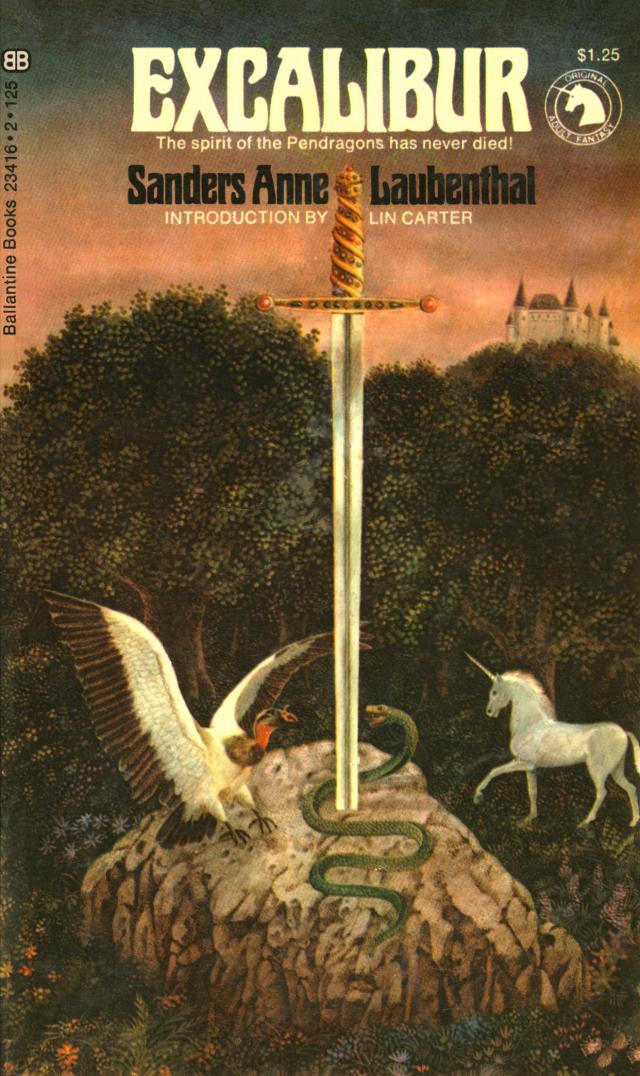
BAF 60 - Excalibur, page 1
part #60 of Ballantine Adult Fantasy Series


15-07-2024
THE ARTHURIAN LEGEND
One of the most enduring legends of the Western hemisphere is the story of Arthur Pendragon, the Round Table, and the mighty sword Excalibur—which only a Pendragon could wield.
When Power is vested in an object, even though the people surrounding it might be long dead, the object itself grows in strength and stature—achieving, in time, the force of religious significance. Equally, an object of Evil can be so invested—and hence, can grow as dangerously Powerful.
This, then, is a tale of the age-old struggle between good and evil; a struggle which has never ceased, a struggle in which the chief protagonists remain linked to the earlier champions by heredity or by witchcraft It is an extraordinary tale of wonders, of adventure, of heroic courage—and of lovers who might have been. In short, it is Adult Fantasy—the heartland of great story-telling, and a proud addition to Ballantine Books’ Adult Fantasy series.
This is an original publication—not a reprint
EXCALIBUR
Sanders Anne Laubenthal
Introduction by
Lin Carter
BALLANTINE BOOKS • NEW YORK
Copyright © 1973 by Sanders Anne Laubenthal
Introduction Copyright © 1973 by Lin Carter
All rights reserved.
SBN 345-23416-2-125
First Printing: August, 1973
Printed in Canada.
Cover art by Gervasio Gallardo
BALLANTINE BOOKS, INC.
201 East 50th Street, New York, N.Y. 10022
Contents
Introduction ~ About EXCALIBUR and Sanders Anne Laubenthal:
1. Rhodri
3. Supper at Silverthorne
4. Doors
5. The Queens of Earth and Air
6. The Seeing and the Cup
7. Night in the Atlantis Tower
8. Stones of the Sun
9. The Hidden Country
10. The Wild Shores
11. Caer Sidi
12. The End of the Quests
Epilogue
About EXCALIBUR and
Sanders Anne Laubenthal:
The Quest for King Arthur’s Sword
The rich and fertile field of Arthurian fantasy literature has been very seriously neglected by the Ballantine Adult Fantasy Series up to now, a fact which has been called to my attention by a surprising number of readers. In fact, save for a brief excerpt from Sir Thomas Malory’s Le Morte d’Arthur, which I included in the contents of Dragons, Elves, and Heroes—the first of the eight major fantasy anthologies which thus far bear the Sign of the Unicorn’s Head—we have done nothing in the Arthurian vein at all in the six years since the Series was founded.
To each of the readers who wrote in to complain of this lack, which seemed to them inexplicable, I patiently replied that I have nothing against Arthurian literature personally, and in fact am very fond of it. Unfortunately, however, the best works in this field known to me are already in print in paperback from other publishers (as, for example, the brilliant and beautiful novels by T. H. White—The Sword in the Stone and its sequels, which make up White’s magnificent tetralogy, The Once and Future King, to my own taste so nearly perfect as to be perhaps the finest single fantasy novel in modem literature, or, at least, one of the three finest).
Sanders Anne Laubenthal wrote me about Excalibur long before the work was ready for an editor’s eye. Quite frankly, a synopsis of the story-idea made it seem unworkable. An Arthurian fantasy set in Mobile, Alabama? The idea sounded neither viable nor commercial, and I could not imagine a book based on so untenable a thesis. Considering the above, then, you can imagine my delight when I read Miss Laubenthal’s completed work.
While I generally dislike being proven wrong as much as any other member of Homo sapiens, in this particular case I am truly delighted. Miss Laubenthal knew what she was talking about, and I had been dead wrong. Not only is her novel publishable and readable, it is in fact a splendid, exciting, gloriously entertaining, and completely enthralling work of imaginative literature, which I am very happy to see through the press.
The earliest appearances of the legends of King Arthur in literature are in the surviving remnants of the lost legendry of the Welsh. The first dim stirrings of that great epic myth may be seen in the famous collection of heroic tales now known as the Mabinogion, a cycle of tales compiled from even earlier texts such as the White Book of Rhydderch (written down circa 1300-1325) or the Red Book of Hergest (circa 1375-1425), both of which derive from oral material circulated for centuries before being set down.
The first picture of King Arthur we have portrays him as a warrior-prince of the Cymri—and such, in fact, the man behind the myth may actually have been, for as in many heroic legends, a nucleus of historical fact lies at the heart of the tale. But the fascinating question of the “historicity” of Arthur Pen-dragon is neither here nor there, and is, anyway, beyond the scope of this brief introduction. (Readers interested in pursuing the matter further are advised to look up a perfectly fascinating and scientifically reputable book by Geoffrey Ashe called The Quest for Arthur’s Britain, published in New York by Praeger in 1968).
What is more to the point is that, even in the earliest of the Welsh legends about King Arthur, he was armed with the famous enchanted sword Caliburn, later known as Excalibur.
Now, as for Prince Madoc and his famous pre-Columbian voyage to North America: well, the Prince might be a historical personage, but his voyage is probably purely mythical. The story goes that when civil war broke out in Wales upon the death of the Northern king, Owain Gwynedd, the king’s son, Madoc, led a party of Cymric followers to sea rather than fight and slay his fellow countrymen. The voyage to America is supposed to have taken place in 1170, and Madoc is supposed to have dropped off one hundred and twenty peace-loving Welshmen and then headed back to Wales for more potential colonists; but at that point he vanishes from history, so to speak.
True or untrue, the story has vast imaginative and romantic appeal. It also had a certain degree of propaganda value to another Welshman, King Henry VIII of England, whose court historians and hangers-on reiterated and embroidered the myth in order to substantiate the British claim to historical priority over Spain regarding territorial and colonization rights to the New World. And so tales of a tribe of white-skinned, blue-eyed, Welsh-speaking Indians abound in early Tudor travel books, such as Hakluyt’s Voyages. And Queen Elizabeth’s court astrologer, the notorious Dr. John Dee,* added Prince Madoc’s colony of Welsh-speaking Indians to his map of North America, done in 1583. (This map is none too reliable even at best; it shows three imaginary islands encircling the North Pole, the Northwest Passage—that is, an imaginary river which traverses the North American continent from sea to sea—and the famous American city of “silver and rock-crystal,” Norumbega—none of which exist. But the map does, and the original can be seen in the collection of the Free Library of Philadelphia.)
*Later to become even more notorious, when H. P. Lovecraft invented the fact that Dr. Dee had translated that “shocking and abhorrent” (and equally imaginary) volume of eldritch lore, the Necronomicon, into English.
But the story was simply too promising to be left there; it finally reached its full flowering in a romantic or heroic epic by Robert Southey called Madoc, at which the poet puttered away over a period of seven years, finally publishing it in 1805. I’ve never seen the first edition, but the Paris edition of 1845 contains a section of “historical and scholarly” notes half as long as the poem itself, which, being in twenty-seven full-length cantos, is indeed rather long and probably a bit more Robert Southey than anybody can easily digest, these days. Southey, in fact, got a trifle carried away with the plot Not content with the trans-Atlantic voyage and the American colony, he has Madoc and his nephew, Llewelyn, sail all the way down to the Gulf of Mexico with a full fleet of loyal
Welshmen and poke their way rather nosily into the middle of some political squabbles among the Aztecs.
Using the Madoc legend as the medium by which Excalibur was brought to the New World, Miss Laubenthal has spun a deliciously absorbing story. I think the best thing about the book is her people, for the characters truly come alive on the page and you become deeply involved in their problems and perils and adventures. You may wonder (as I certainly did!) why such an odd place as Mobile, Alabama, was chosen as the site of Prince Madoc’s settlement, and the hiding place of the famous Excalibur. This, I have since discovered, was not Miss Laubenthal’s idea at all, but simply part of the Madoc myth itself. “By force of mere repetition,” as Samuel Eliot Morison points out in The European Discovery of North America (New York, Oxford University Press, 1971), “it even got into American school histories. And the Daughters of the American Revolution embalmed the story in bronze by erecting on Fort Morgan, Mobile Bay, a tablet inscribed ‘in Memory of Prince Madoc, a Welsh explorer, who landed on the shores of Mobile Bay in 1170 and left behind…the Welsh language.’” Miss Laubenthal was born in Mobile in 1943 and graduated summa cum laude from Spring Hill College in 1965. She took her Master’s degree in English at the University of Alabama graduate school in 1967, and her Ph.D. in 1970; her dissertation was on the Anglo-Saxon period. For three years (1969-1972) she taught medieval studies at Troy State University. “Troy is a little country town,” she explains in a recent letter, “about fifty miles from Montgomery. In the recession which hit schools all over the country, Troy suddenly d
But here I will let her tell us her own story…
So I proceeded,to practice on short stories and lyrics. Then, at the age of fourteen, I embarked on my first book: a set of twenty imaginary-world stories, more or less connected, set in the same world as Namia, though my characters never actually ventured into C. S. Lewis’s territory. I wrote C. S. Lewis, asking if I could use his world this way; and he very nicely wrote back, saying I could. He also asked if I had read The Lord of the Rings—“just exactly our sort of book.” I had never heard of it; but I had a friend at the public library, a fellow-admirer of Lewis, and he induced the orders department to get the three volumes. I read them avidly. Later, when I was in college, I discovered the third member of the group, Charles Williams. Those three—Lewis, Tolkien, and Williams—did most to teach me how to write.
By this time Miss Laubenthal had published a collection of verse called Songs of Mobile (1962), later followed by two more, The Gates of Wonder (1966) and Interlude (1969). Between publication of the last two volumes she completed a novel called The Last Confederate, published in 1967.
I asked Miss Laubenthal in a recent letter when she first became caught up in the magic of the Arthurian mythos. She replied:
I have to admit that I do not remember. My father probably mentioned it to me sometime in earliest childhood; he ha$ always been interested in the Middle Ages. When I was in Cornwall, I went to Tintagel, and picked up a striped stone on the beach nearby as a gift for him. But in childhood I read all the heroic legends I could find, in every version I could get—not only Arthurian but French, Spanish, Irish, Norse, Greek.
The inspiration for Excalibur really came in the summer of 1963, when I was reading Malory in the old two-volume Everyman edition. Malory, of course, was working from diverse sources, trying to fit them into a coherent narrative; and his version has many elements which do not appear elsewhere in English. I had always had the impression that Arthur had, first, an unnamed sword which he pulled out of the stone, and that later, when that was broken, he received Excalibur from the Lady of the Lake. But, in one passage, Malory identifies Excalibur as the sword from the stone. Evidently Malory was trying to reconcile two versions of the sword story and never could quite make up his mind about it; so I eventually had to reconcile them in my own way.*
Malory’s accounts of Morgan le Fay also interested me. How could one account for her behavior? These trains of thought coalesced with others, such as the Madoc legend.
* Actually, the two swords are separate and require no reconciling
of different versions of their acquisition. The young Arthur drew the
sword from the stone by a miracle, thus proving himself the true-born
King of Britain; the sword from the stone was then offered up by him
on the altar of St Stephen’s, the cathedral-church at Camelot; it was
kept by the church and he never used it again. Neither is it without a
name; in at least one source, a medieval English poem
known as “the Alliterative Morte Arthure,”which dates from about
1360, the sword from the stone is named as “Clarent,” and is considered
part of the Regalia, Arthur’s “sword of state,” wherewith Mordred arms
himself for the final battle with King Arthur at Camlan.
I had been familiar, more or less, with the Madoc story since childhood…and I had read somewhere that the royal house of Gwynedd claimed descent from Arthur. Suppose, somehow, that Madoc had had possession of the sword and brought it with him; suppose it were still around somewhere? That was the point from which I started…
And the finished product is now in your hands. When you read it I think you will agree that Lewis, Tolkien, and Williams make very good teachers, indeed.
—Lin Carter
Editorial Consultant:
The Ballantine Adult Fantasy Series
Hollis, Long Island, New York
Introduction copyright (c) 1973 by Lin Carter
“Sir,“ said Merlin to Arthur, “fight not with the sword that ye had by miracle, till that ye see ye go unto the worse, then draw it out and do your best.…Then he drew his sword Excalibur, but it was so bright in his enemies* eyes, that it gave light lie thirty torches
—LE MORTE D’ARTHUR
Excalibur
1. Rhodri
“We were not born,” said Linette out loud, “to sit and look at the rain.”
Her words echoed strangely in the empty house. As she sat at the open window, the candles burned behind her in the silver candelabra, for the storm had blacked out a part of the city. The lightning flickered behind the old roofs opposite, showing for a second the wet street; there was no other light anywhere except the remote gaslights of De Tonti Square. A man was walking along the street, his face bent against the rain. The darkness fell again, and in a moment she heard the heavy growl of the thunder. The storm must be moving out across the bay.
They’ll be getting it at Silverthorne, she thought But it’s always candlelight there.
She rather wished she could have gone to Silverthorne with the others, but they had left her at home in case the wretched archaeologist called. Just as well, she thought with a flurry of scorn; Anthony might be there. He was there often now, doing research in Aunt Julian’s library.
I’d rather be an old maid like Aunt Julian, Linette thought. I even look like her—black hair, grey eyes, the Silverthorne nose. I’d make a good old maid.
She stared out at the darkness and the remote pinpoints of gaslights which lit nothing around her. The wet July night poured in its smell of recently sun-baked earth now quenched with rain.
Through the sound of the rain she could hear the man’s footsteps as he came along the sidewalk, and could even make him out as a vague dark movement Suddenly, for no reason, she felt that sense of impending glory which sometimes descended on her out of nowhere, the sense of fabulous adventure and the piled-up splendor of life; it was the rain and the wet earth-smell and the dark movements outside that released it, and suddenly she could have laid her head on the windowsill and shed tears of happiness.
Then she realized that the man had stopped walking; he was standing on the pavement looking at the house. She thought of moving away from the window. But in her unreasonable happiness she did not move after all, but sat and watched him trying to see the number.





