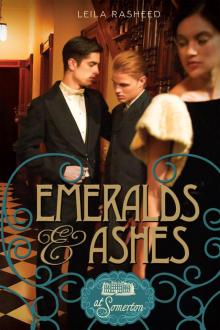
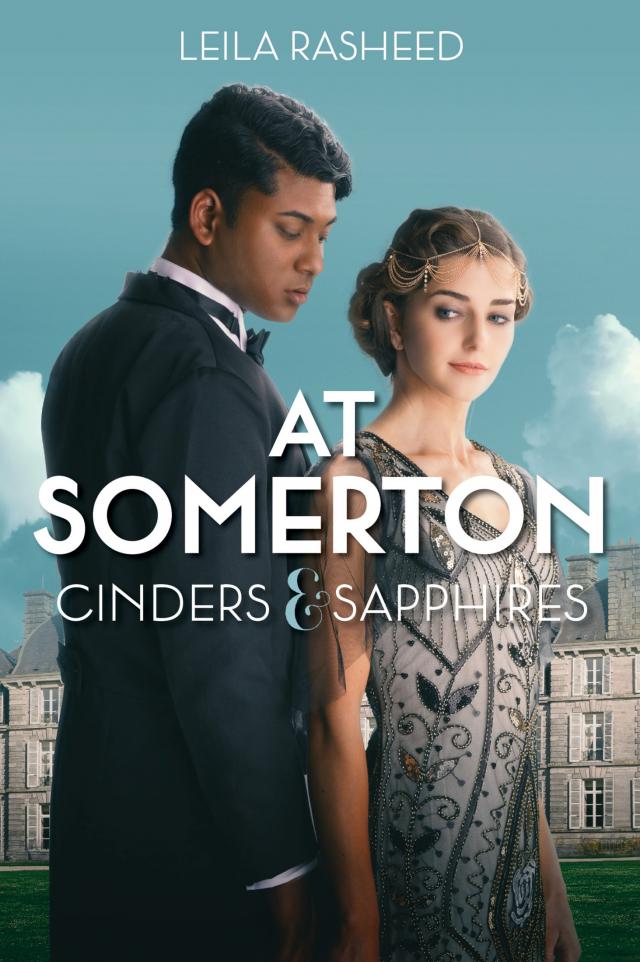
Cinders & Sapphires, page 24


Rose thought hard. Lord Westlake had bought her a simple string of pearls. It was all a debutante was expected to wear. But even that seemed like too much. It didn’t feel like her. Instead, she reached for the bouquet of white and pink roses that had been sent from Somerton. She plucked a single one and held it up to her hair. The shining petals reflected light onto her face and neck. It reminded her of Somerton—of her mother.
“Is this acceptable?” She glanced up anxiously at her maid.
Céline smiled. “Bien sûr, mademoiselle. That will be perfect.”
Lord Westlake’s face was fixed in a thoughtful frown as he studied the newspaper that lay on the hall table. But he smiled as he saw Rose and Ada coming down the staircase. The morning light shone through the stained glass and cast shimmering colors over their white dresses.
“My dears, you look wonderful,” he said, as they reached him.
Ada smiled, and Rose blushed.
“Oh, look at all these flowers!” Ada exclaimed a moment later. The hall was crowded with bouquets from admirers and friends. Roses, carnations, and lilies filled the room with their scent and color. “So beautiful!”
Rose went eagerly to look at the flowers. Ada was about to follow, but her father held her back.
“Is everything all right, Papa?” she asked. “You look troubled.”
“Oh, no—I mean, yes, everything is fine.” He glanced at the newspaper again. “I’m a little concerned by events in Europe—nothing you need bother yourself over. But I…would like you to step into the study for a moment. There is someone there who would like to speak to you.”
“Of course.” Ada was surprised, but she went to the study door and pushed it open. Closing it behind her, her eyes took a moment to adjust to the light. A familiar face smiled at her.
“Lord Fintan!”
“Ada.” He gazed at her in admiration “You look exquisite.”
Ada blushed and curtsied.
He went on, “I hope you will forgive an old friend visiting you at such a time, but I wanted to remind you of a conversation we had not so long ago.”
“Of course,” said Ada slowly. It was not something she wanted to think about at once.
“I have spoken to your father. I hope you don’t mind.”
“It’s quite proper,” said Ada. But she could not help feeling that she disliked being discussed behind her back, as if she were property to be disposed of.
Lord Fintan cleared his throat. “I understand from my sister that you want to go to Oxford, and that this has put you off the idea of marriage.”
Ada nodded. It was half the truth, at least.
“I told your father, therefore, that I would expect my wife to be educated. He agreed. He will let you go to Oxford if you become engaged to me.”
Ada stared at him in silence.
“It is not something to be answered immediately,” Lord Fintan said hastily. “But it is something I wished you to be aware of—before the start of the season.”
“This is extraordinarily generous of you,” Ada said, stumbling over the words.
“Nonsense. Our views on women’s education have always coincided. In fact, I believe our views on every subject have always coincided—which is one reason I believe we would be well matched.”
Well matched, thought Ada—but is that enough? She thought of Ravi. The memory of him was like a dagger to her heart.
“It will take some time to come to a decision—” she began.
“Of course,” Lord Fintan replied at once. “I will wait as long as you wish.”
He raised his hand, and she saw for the first time that he carried a small bouquet of roses and carnations. “I hope you will do me the honor of carrying these with you today.”
“They’re beautiful,” said Ada sincerely. She took the flowers, thinking that, after all, she would have liked to choose her own blooms. But she could not refuse the gesture without offending him. She took a couple of the sprays and fixed them into her dress, smiling at him.
“The perfect touch,” he said, and bowed over her hand. “I wish you a delightful presentation, and I will hope to have the pleasure of dancing with you at the state ball.”
Ada smiled her farewell. Deep in thought, she walked into the hall. The flowers, massed by the stairs, overwhelmed her with their scent. She went to them, reading the cards that had come with them, her mind far away.
“Ada, are you ready?” Rose came toward her, flustered. “Mrs. Verulam is here and it is time to go.”
Ada started and put down the cards. “Quite ready,” she said, and followed Rose out of the door to the waiting carriages and motorcars.
As she followed Charlotte and Rose into Mrs. Verulam’s carriage, a footman hurried breathlessly up to them.
“Special delivery, my lady. It came just now.” He handed her a small, white box.
“For me?” Ada was surprised. She opened the box, and a rich, delicious scent was released, a scent which made her head spin with memories of India. Inside lay a small bouquet of white flowers, their blooms shaped like strange, exotic sculptures.
“How lovely,” Mrs. Verulam said, leaning forward to see. “I think they are Indian orchids. Who sent them?”
“I don’t know,” said Ada, blushing as she caught Rose’s eye. “There was no card.”
And yet she knew. It was Ravi. It had to be. Ignoring Charlotte’s cold stare, she pulled out Lord Fintan’s flowers, and tucked the spray of orchids into her dress. These were the flowers she would wear, and no others.
The Court was hushed, and the queue of young girls waiting to make their curtsy waited nervously on the threshold as one by one they were called forward into the royal presence.
“Lady Ada Averley!” announced the footman. Their Majesties smiled graciously as the young woman walked toward them, her eyes cast down, and sank into a deep, unwavering curtsy.
Charlotte watched from the queue. Her mind was not on the ceremony. It had been ruined for her anyway. She was a laughingstock among her friends, having to make her curtsy alongside a housemaid. And almost worse than that, the news was out about Lord Fintan and Ada. One stepsister a common drudge, the other a shameless poacher.
“Lady Rose Averley!”
Charlotte pressed her lips together so that they were even whiter than her pearls, which had a faint but brazen pink blush. Rose looked nervous, but to Charlotte’s great disappointment she did not trip. Her curtsy was a model of grace and elegance.
“Miss Charlotte Templeton!”
Oh, but she would have her revenge, Charlotte thought, as she glided forward and sank into a deep curtsy, her white satin skirts rustling on the blood-red carpet. She had seen Ada compromise herself with that filthy Indian boy. And she would pick her time to use that knowledge as a man forced to fight for his life would pick a weapon: very, very carefully.
READ ON FOR A SNEAK PEEK OF THE NEXT BOOK IN THE AT SOMERTON COURT!
THE LONDON SEASON, 1913
Ellen scurried along the servants’ corridor, her aching arms stacked high with dirty dishes from the garden party outside. It was a blazing hot London day in May, but it seemed as if even the sunlight didn’t dare enter the servants’ passage for fear of getting under Cook’s feet. The only rays came through a small, dirty window, sunk slightly below the level of the gardens, and screened by a box hedge. The sunbeam crossed Ellen’s path like one of Cupid’s golden arrows.
She paused at the sight of it, glancing back toward the kitchen. Mrs. Strong’s voice echoed down the corridor, but no one was watching her. Shifting the tower of plates so they sat more securely on her hip, Ellen went up to the window and stood on tiptoes to peer through.
At first she could see only ivy and whitewashed walls, but by squinting a little and craning her neck she was able to catch sight of one the season’s unmissable events—the first Milborough House garden party since its mistress, Mrs. Fiona Templeton, one of the richest widows in London, had metamorphosed into the Countess of Westlake. Lady Westlake and her family now spent most of the year at the earl’s estate, Somerton Court.
To Ellen it looked as if angels were gathered on the lawns, glowing in chiffon and delicately embroidered lace, with halos of flowers around their heads. Ellen was a country girl, and Lord and Lady Westlake’s assembled guests reminded her of the stained-glass figures in the church she used to attend before she had gone into service: bright and far out of reach, people who lived in a happy land she could not even dream of setting foot in.
“Ellen!”
Ellen jumped as Cook’s voice rang down the corridor.
“What are you dawdling over? Get down to the scullery with those plates!”
“Yes, Mrs. Strong!” Ellen scurried off. She wondered if the day would ever end. Her feet felt too tired to take another step. Tweenies like her—halfway between a house maid and a kitchen maid—got all the dirtiest, most tiring jobs loaded onto them. But like all the other staff at Milborough House, she was willing to work as hard as she had to so that this day could be a success. It meant something, to be the tweeny at Milborough House. It meant something to touch the angels, even if all you touched was the rim of their dirty plate. From the footman who handed out the champagne, to the chef who had given himself a migraine slicing cucumbers into discs so thin they were like transparent jade, to the gardener who had marshaled a team of fifteen men to whip the flower beds into shape in time for the big day, to the tiny insignificant dot that was Ellen ferrying plates back and forth along the Stygian corridor, all the staff at Milborough House felt this, and it pulled them together with a force stronger than gravity.
As Ellen approached the laundry room, she noticed that the door was ajar just a crack. Then she heard voices.
“…the last time. I’m serious.”
It took her a moment to work out that the man who had spoken could not be a servant. Not with such a voice. But that wasn’t possible. The ladies and gentlemen were never to be found downstairs, any more than she was to be found in the drawing room. And what on earth would they be doing in the laundry room, besides? She slowed, unwilling to intrude.
“You know you don’t mean that.” A woman’s voice this time, and an oddly familiar one.
“I do.”
“Oh, Laurence”—a sweet, lilting laugh. “You say that”—a teasing sigh—“every time.”
Ellen drew closer. She heard the whisper of silk. There were gasps. More sighs. Still not understanding what she was hearing, she looked through the chink of the door. She saw a mist of pink-and-white chiffon, tumbling blond hair. A man’s hand was pressed into a bare white shoulder, half crushing a crimson silk rose adorning the woman’s dress. Two golden heads, lips locked together, kissing passionately. That was all she glimpsed, then the man pulled away.
His eyes were pale and shrewd, his face was handsome, and more than that, aristocratic. The woman was facing toward him, away from Ellen. Ellen did not see her face, just the silken sheen of pearls against the nape of her bare neck as she reached up to draw her hair over her shoulder.
“This time I mean it,” the man whispered furiously.
The woman was half laughing as she said: “You scold me so often, darling, I’m beginning to suspect we’re married.”
The gentleman—Ellen was sure she knew his voice, she had heard it behind the wainscoting a hundred times this season—reached for his hat and cane. The young lady caught his arm.
“Let me go,” he said, but he did not pull away from her.
“Let you go? I don’t force you to meet me like this. You are free to leave whenever you wish—if you can.”
The man made an angry sound. He shook her off as violently as he had drawn her to him a moment earlier. The woman gasped. Ellen jumped back into the shadows, quivering with fear as the man pushed the door open, and glanced left and right down the corridor.
“Laurence!” the woman hissed. It was hard to tell if it was fury or love in her voice.
The man—Laurence—raised a hand to straighten his cravat. His face was set, hard, arrogant, as if he would cut down any challenger. Ellen knew he did not see her, in her drab clothes, stained with dishwater, a stray potato peel down her sleeve and her cap askew, her hair lank and sweaty from the kitchen. She blended into the shadows of the servants’ corridor. But she saw Lord Fintan—the cut of his morning coat, the folds of his sunshine-colored cravat, the smooth line of his gloves as he pulled them on one by one. She saw the swing of his cane and heard the crack of his shoes walking away from her down the corridor toward the open back door. The sun blazing through it touched his golden hair like a halo, as if he were an angel returning to heaven, leaving behind nothing but a faint whiff of expensive cologne and some crimson silk petals scattered on the black-and-white-tiled floor.
“Rose, are you quite well?” Ada Averley placed a hand on her sister’s arm and drew her to one side, looking into her face with concern. They were with a small group in the Arabian summerhouse at the bottom of the gardens, where the ornamental fountains cast crystal music into the warm, scent-laden air.
Rose, beneath her Poiret hat, was wilting. She wanted to say: No, I’m hot, and I have a headache, and I’m exhausted from the ball last night, and I wish the eternal din of London would fall silent for just one moment so that I could hear my own heart beat—but she couldn’t say that. Plain Rose Cliffe, housemaid, might have done it, but not Lady Rose, second daughter of the Earl of Westlake. Lady Rose had standards to uphold, a family who could be let down.
Instead she said, “Perfectly, just a little tired.”
Ada smiled sympathetically. Her hand remained on Rose’s arm as they turned back to the group. Rose steeled herself to face the sharp, amused eyes of Lady Gertrude de Vere, Lady Cynthia Fetheringale, and Lady Emily Maddox, three other debutantes. It seemed such a long time since she had been Ada’s lady’s maid, carrying secret letters between her and Ravi, the Indian student with whom Ada was in love. Not for the first time this season, she wondered how Ada was bearing the separation from him. Every time she tried to raise the subject—not often, for they were always in company, always watched; there was never the opportunity to be alone together as there had been when they were mistress and maid—Ada deflected her. Rose was puzzled, and worried.
“The gardens are simply exquisite,” Lady Gertrude said, glancing about her. “I feel as if I were standing in a painting.”
Rose smiled her agreement. The gardens of Milborough House were one of the seven wonders of the London world. It was Gertrude Jekyll who had designed them, creating bold, painterly sweeps of color around sinuous paths that led from lily-studded lakes to charming pergolas and secluded bowers. The best of the flowers were artfully designed to bloom and release their enticing, musky scent just at the height of the season.
“And such a delicious scent!” Ada agreed, as if she had read Rose’s mind.
“A little tainted with washing soda, don’t you think?” murmured Lady Cynthia, with a sidelong glance at her companion.
Lady Gertrude tittered. Rose’s headache intensified, but she managed not to lose her polite smile. She tried to focus on the strains of the Russian string quartet mingling with the chatter and laughter of the guests. It seemed forever since she had been at a piano, and she knew the lack of practice was beginning to tell. She would once have found music in everything, in the morning birdsong at Somerton, in the wind in the trees, in the rattle of the housemaids’ brushes and buckets. But music needed a backdrop of silence, and there was none in London.
“I think it’s simply wonderful how my stepmother always manages to put on such a delightful party,” Ada replied. Rose was grateful for her sister’s tact; she did not feel she could have spoken so calmly.
“We are all wondering which celebrity she has invited to entertain us this evening,” Lady Emily replied.
“Yes, indeed! After Nijinsky and Melba, it’s hard to see who else she can surprise us with.” Lady Cynthia had an extraordinary nose, a little like a shark’s dorsal fin broaching the waters, and she had the habit of raising her chin so that she was looking down it at whomever she spoke to. She raised her chin now and directed her voice at Ada—despite being introduced, she had not yet spoken a word directly to Rose. “She is so lucky with her staff.”
“We are very lucky indeed,” Ada replied quietly.
“No doubt the servant question never bothers your family, Lady Ada.” Lady Gertrude took up the theme. “My mother is quite concerned about the availability of housemaids these days. But I hear the Averleys have plenty of them—almost, one might say, too many.”
“Oh, one can never have too many housemaids,” Ada said cheerfully. Her hand was still on Rose’s arm, a reassuring, strong presence. Rose was glad of it as she took a couple of good deep breaths and counted to ten. It seemed that everyone they met knew that Lady Rose Averley was the illegitimate daughter of Lord Westlake and his housekeeper—and that until a year ago she had been a mere housemaid at Somerton. I might not be aware of the finer nuances of table manners and social calls, she imagined herself retorting to Lady Gertrude, but I have become expert in the fine distinctions between whispers, smirks, stares, sniggers, and outright jibes.
“Rose, Ada, I don’t think you’ve met the Duchess of Ellingborough.” Rose turned, relieved to hear her father’s voice interrupt the conversation. Lord Westlake joined them. With him was a tall, elegant lady wreathed in fox furs and pearls.
“But I have met Lady Ada,” the duchess said, her voice piercing as an icicle. “I had the pleasure at your wedding, Edward. Lady Rose, however…” She turned a pale-blue gaze upon Rose, who just managed to stop herself from curtsying. “I don’t think I have had the pleasure.”
“It is my sister’s first season,” Ada said hastily.
“And yet your face does look familiar,” the duchess continued.
That’s because I carried your bathwater up five flights of stairs the night of my father’s wedding, Rose thought. You glanced at me long enough to scold me for dropping the soap. She held out a hand. “I am very glad to make your acquaintance, my lady,” she said.
“Is this acceptable?” She glanced up anxiously at her maid.
Céline smiled. “Bien sûr, mademoiselle. That will be perfect.”
Lord Westlake’s face was fixed in a thoughtful frown as he studied the newspaper that lay on the hall table. But he smiled as he saw Rose and Ada coming down the staircase. The morning light shone through the stained glass and cast shimmering colors over their white dresses.
“My dears, you look wonderful,” he said, as they reached him.
Ada smiled, and Rose blushed.
“Oh, look at all these flowers!” Ada exclaimed a moment later. The hall was crowded with bouquets from admirers and friends. Roses, carnations, and lilies filled the room with their scent and color. “So beautiful!”
Rose went eagerly to look at the flowers. Ada was about to follow, but her father held her back.
“Is everything all right, Papa?” she asked. “You look troubled.”
“Oh, no—I mean, yes, everything is fine.” He glanced at the newspaper again. “I’m a little concerned by events in Europe—nothing you need bother yourself over. But I…would like you to step into the study for a moment. There is someone there who would like to speak to you.”
“Of course.” Ada was surprised, but she went to the study door and pushed it open. Closing it behind her, her eyes took a moment to adjust to the light. A familiar face smiled at her.
“Lord Fintan!”
“Ada.” He gazed at her in admiration “You look exquisite.”
Ada blushed and curtsied.
He went on, “I hope you will forgive an old friend visiting you at such a time, but I wanted to remind you of a conversation we had not so long ago.”
“Of course,” said Ada slowly. It was not something she wanted to think about at once.
“I have spoken to your father. I hope you don’t mind.”
“It’s quite proper,” said Ada. But she could not help feeling that she disliked being discussed behind her back, as if she were property to be disposed of.
Lord Fintan cleared his throat. “I understand from my sister that you want to go to Oxford, and that this has put you off the idea of marriage.”
Ada nodded. It was half the truth, at least.
“I told your father, therefore, that I would expect my wife to be educated. He agreed. He will let you go to Oxford if you become engaged to me.”
Ada stared at him in silence.
“It is not something to be answered immediately,” Lord Fintan said hastily. “But it is something I wished you to be aware of—before the start of the season.”
“This is extraordinarily generous of you,” Ada said, stumbling over the words.
“Nonsense. Our views on women’s education have always coincided. In fact, I believe our views on every subject have always coincided—which is one reason I believe we would be well matched.”
Well matched, thought Ada—but is that enough? She thought of Ravi. The memory of him was like a dagger to her heart.
“It will take some time to come to a decision—” she began.
“Of course,” Lord Fintan replied at once. “I will wait as long as you wish.”
He raised his hand, and she saw for the first time that he carried a small bouquet of roses and carnations. “I hope you will do me the honor of carrying these with you today.”
“They’re beautiful,” said Ada sincerely. She took the flowers, thinking that, after all, she would have liked to choose her own blooms. But she could not refuse the gesture without offending him. She took a couple of the sprays and fixed them into her dress, smiling at him.
“The perfect touch,” he said, and bowed over her hand. “I wish you a delightful presentation, and I will hope to have the pleasure of dancing with you at the state ball.”
Ada smiled her farewell. Deep in thought, she walked into the hall. The flowers, massed by the stairs, overwhelmed her with their scent. She went to them, reading the cards that had come with them, her mind far away.
“Ada, are you ready?” Rose came toward her, flustered. “Mrs. Verulam is here and it is time to go.”
Ada started and put down the cards. “Quite ready,” she said, and followed Rose out of the door to the waiting carriages and motorcars.
As she followed Charlotte and Rose into Mrs. Verulam’s carriage, a footman hurried breathlessly up to them.
“Special delivery, my lady. It came just now.” He handed her a small, white box.
“For me?” Ada was surprised. She opened the box, and a rich, delicious scent was released, a scent which made her head spin with memories of India. Inside lay a small bouquet of white flowers, their blooms shaped like strange, exotic sculptures.
“How lovely,” Mrs. Verulam said, leaning forward to see. “I think they are Indian orchids. Who sent them?”
“I don’t know,” said Ada, blushing as she caught Rose’s eye. “There was no card.”
And yet she knew. It was Ravi. It had to be. Ignoring Charlotte’s cold stare, she pulled out Lord Fintan’s flowers, and tucked the spray of orchids into her dress. These were the flowers she would wear, and no others.
The Court was hushed, and the queue of young girls waiting to make their curtsy waited nervously on the threshold as one by one they were called forward into the royal presence.
“Lady Ada Averley!” announced the footman. Their Majesties smiled graciously as the young woman walked toward them, her eyes cast down, and sank into a deep, unwavering curtsy.
Charlotte watched from the queue. Her mind was not on the ceremony. It had been ruined for her anyway. She was a laughingstock among her friends, having to make her curtsy alongside a housemaid. And almost worse than that, the news was out about Lord Fintan and Ada. One stepsister a common drudge, the other a shameless poacher.
“Lady Rose Averley!”
Charlotte pressed her lips together so that they were even whiter than her pearls, which had a faint but brazen pink blush. Rose looked nervous, but to Charlotte’s great disappointment she did not trip. Her curtsy was a model of grace and elegance.
“Miss Charlotte Templeton!”
Oh, but she would have her revenge, Charlotte thought, as she glided forward and sank into a deep curtsy, her white satin skirts rustling on the blood-red carpet. She had seen Ada compromise herself with that filthy Indian boy. And she would pick her time to use that knowledge as a man forced to fight for his life would pick a weapon: very, very carefully.
READ ON FOR A SNEAK PEEK OF THE NEXT BOOK IN THE AT SOMERTON COURT!
THE LONDON SEASON, 1913
Ellen scurried along the servants’ corridor, her aching arms stacked high with dirty dishes from the garden party outside. It was a blazing hot London day in May, but it seemed as if even the sunlight didn’t dare enter the servants’ passage for fear of getting under Cook’s feet. The only rays came through a small, dirty window, sunk slightly below the level of the gardens, and screened by a box hedge. The sunbeam crossed Ellen’s path like one of Cupid’s golden arrows.
She paused at the sight of it, glancing back toward the kitchen. Mrs. Strong’s voice echoed down the corridor, but no one was watching her. Shifting the tower of plates so they sat more securely on her hip, Ellen went up to the window and stood on tiptoes to peer through.
At first she could see only ivy and whitewashed walls, but by squinting a little and craning her neck she was able to catch sight of one the season’s unmissable events—the first Milborough House garden party since its mistress, Mrs. Fiona Templeton, one of the richest widows in London, had metamorphosed into the Countess of Westlake. Lady Westlake and her family now spent most of the year at the earl’s estate, Somerton Court.
To Ellen it looked as if angels were gathered on the lawns, glowing in chiffon and delicately embroidered lace, with halos of flowers around their heads. Ellen was a country girl, and Lord and Lady Westlake’s assembled guests reminded her of the stained-glass figures in the church she used to attend before she had gone into service: bright and far out of reach, people who lived in a happy land she could not even dream of setting foot in.
“Ellen!”
Ellen jumped as Cook’s voice rang down the corridor.
“What are you dawdling over? Get down to the scullery with those plates!”
“Yes, Mrs. Strong!” Ellen scurried off. She wondered if the day would ever end. Her feet felt too tired to take another step. Tweenies like her—halfway between a house maid and a kitchen maid—got all the dirtiest, most tiring jobs loaded onto them. But like all the other staff at Milborough House, she was willing to work as hard as she had to so that this day could be a success. It meant something, to be the tweeny at Milborough House. It meant something to touch the angels, even if all you touched was the rim of their dirty plate. From the footman who handed out the champagne, to the chef who had given himself a migraine slicing cucumbers into discs so thin they were like transparent jade, to the gardener who had marshaled a team of fifteen men to whip the flower beds into shape in time for the big day, to the tiny insignificant dot that was Ellen ferrying plates back and forth along the Stygian corridor, all the staff at Milborough House felt this, and it pulled them together with a force stronger than gravity.
As Ellen approached the laundry room, she noticed that the door was ajar just a crack. Then she heard voices.
“…the last time. I’m serious.”
It took her a moment to work out that the man who had spoken could not be a servant. Not with such a voice. But that wasn’t possible. The ladies and gentlemen were never to be found downstairs, any more than she was to be found in the drawing room. And what on earth would they be doing in the laundry room, besides? She slowed, unwilling to intrude.
“You know you don’t mean that.” A woman’s voice this time, and an oddly familiar one.
“I do.”
“Oh, Laurence”—a sweet, lilting laugh. “You say that”—a teasing sigh—“every time.”
Ellen drew closer. She heard the whisper of silk. There were gasps. More sighs. Still not understanding what she was hearing, she looked through the chink of the door. She saw a mist of pink-and-white chiffon, tumbling blond hair. A man’s hand was pressed into a bare white shoulder, half crushing a crimson silk rose adorning the woman’s dress. Two golden heads, lips locked together, kissing passionately. That was all she glimpsed, then the man pulled away.
His eyes were pale and shrewd, his face was handsome, and more than that, aristocratic. The woman was facing toward him, away from Ellen. Ellen did not see her face, just the silken sheen of pearls against the nape of her bare neck as she reached up to draw her hair over her shoulder.
“This time I mean it,” the man whispered furiously.
The woman was half laughing as she said: “You scold me so often, darling, I’m beginning to suspect we’re married.”
The gentleman—Ellen was sure she knew his voice, she had heard it behind the wainscoting a hundred times this season—reached for his hat and cane. The young lady caught his arm.
“Let me go,” he said, but he did not pull away from her.
“Let you go? I don’t force you to meet me like this. You are free to leave whenever you wish—if you can.”
The man made an angry sound. He shook her off as violently as he had drawn her to him a moment earlier. The woman gasped. Ellen jumped back into the shadows, quivering with fear as the man pushed the door open, and glanced left and right down the corridor.
“Laurence!” the woman hissed. It was hard to tell if it was fury or love in her voice.
The man—Laurence—raised a hand to straighten his cravat. His face was set, hard, arrogant, as if he would cut down any challenger. Ellen knew he did not see her, in her drab clothes, stained with dishwater, a stray potato peel down her sleeve and her cap askew, her hair lank and sweaty from the kitchen. She blended into the shadows of the servants’ corridor. But she saw Lord Fintan—the cut of his morning coat, the folds of his sunshine-colored cravat, the smooth line of his gloves as he pulled them on one by one. She saw the swing of his cane and heard the crack of his shoes walking away from her down the corridor toward the open back door. The sun blazing through it touched his golden hair like a halo, as if he were an angel returning to heaven, leaving behind nothing but a faint whiff of expensive cologne and some crimson silk petals scattered on the black-and-white-tiled floor.
“Rose, are you quite well?” Ada Averley placed a hand on her sister’s arm and drew her to one side, looking into her face with concern. They were with a small group in the Arabian summerhouse at the bottom of the gardens, where the ornamental fountains cast crystal music into the warm, scent-laden air.
Rose, beneath her Poiret hat, was wilting. She wanted to say: No, I’m hot, and I have a headache, and I’m exhausted from the ball last night, and I wish the eternal din of London would fall silent for just one moment so that I could hear my own heart beat—but she couldn’t say that. Plain Rose Cliffe, housemaid, might have done it, but not Lady Rose, second daughter of the Earl of Westlake. Lady Rose had standards to uphold, a family who could be let down.
Instead she said, “Perfectly, just a little tired.”
Ada smiled sympathetically. Her hand remained on Rose’s arm as they turned back to the group. Rose steeled herself to face the sharp, amused eyes of Lady Gertrude de Vere, Lady Cynthia Fetheringale, and Lady Emily Maddox, three other debutantes. It seemed such a long time since she had been Ada’s lady’s maid, carrying secret letters between her and Ravi, the Indian student with whom Ada was in love. Not for the first time this season, she wondered how Ada was bearing the separation from him. Every time she tried to raise the subject—not often, for they were always in company, always watched; there was never the opportunity to be alone together as there had been when they were mistress and maid—Ada deflected her. Rose was puzzled, and worried.
“The gardens are simply exquisite,” Lady Gertrude said, glancing about her. “I feel as if I were standing in a painting.”
Rose smiled her agreement. The gardens of Milborough House were one of the seven wonders of the London world. It was Gertrude Jekyll who had designed them, creating bold, painterly sweeps of color around sinuous paths that led from lily-studded lakes to charming pergolas and secluded bowers. The best of the flowers were artfully designed to bloom and release their enticing, musky scent just at the height of the season.
“And such a delicious scent!” Ada agreed, as if she had read Rose’s mind.
“A little tainted with washing soda, don’t you think?” murmured Lady Cynthia, with a sidelong glance at her companion.
Lady Gertrude tittered. Rose’s headache intensified, but she managed not to lose her polite smile. She tried to focus on the strains of the Russian string quartet mingling with the chatter and laughter of the guests. It seemed forever since she had been at a piano, and she knew the lack of practice was beginning to tell. She would once have found music in everything, in the morning birdsong at Somerton, in the wind in the trees, in the rattle of the housemaids’ brushes and buckets. But music needed a backdrop of silence, and there was none in London.
“I think it’s simply wonderful how my stepmother always manages to put on such a delightful party,” Ada replied. Rose was grateful for her sister’s tact; she did not feel she could have spoken so calmly.
“We are all wondering which celebrity she has invited to entertain us this evening,” Lady Emily replied.
“Yes, indeed! After Nijinsky and Melba, it’s hard to see who else she can surprise us with.” Lady Cynthia had an extraordinary nose, a little like a shark’s dorsal fin broaching the waters, and she had the habit of raising her chin so that she was looking down it at whomever she spoke to. She raised her chin now and directed her voice at Ada—despite being introduced, she had not yet spoken a word directly to Rose. “She is so lucky with her staff.”
“We are very lucky indeed,” Ada replied quietly.
“No doubt the servant question never bothers your family, Lady Ada.” Lady Gertrude took up the theme. “My mother is quite concerned about the availability of housemaids these days. But I hear the Averleys have plenty of them—almost, one might say, too many.”
“Oh, one can never have too many housemaids,” Ada said cheerfully. Her hand was still on Rose’s arm, a reassuring, strong presence. Rose was glad of it as she took a couple of good deep breaths and counted to ten. It seemed that everyone they met knew that Lady Rose Averley was the illegitimate daughter of Lord Westlake and his housekeeper—and that until a year ago she had been a mere housemaid at Somerton. I might not be aware of the finer nuances of table manners and social calls, she imagined herself retorting to Lady Gertrude, but I have become expert in the fine distinctions between whispers, smirks, stares, sniggers, and outright jibes.
“Rose, Ada, I don’t think you’ve met the Duchess of Ellingborough.” Rose turned, relieved to hear her father’s voice interrupt the conversation. Lord Westlake joined them. With him was a tall, elegant lady wreathed in fox furs and pearls.
“But I have met Lady Ada,” the duchess said, her voice piercing as an icicle. “I had the pleasure at your wedding, Edward. Lady Rose, however…” She turned a pale-blue gaze upon Rose, who just managed to stop herself from curtsying. “I don’t think I have had the pleasure.”
“It is my sister’s first season,” Ada said hastily.
“And yet your face does look familiar,” the duchess continued.
That’s because I carried your bathwater up five flights of stairs the night of my father’s wedding, Rose thought. You glanced at me long enough to scold me for dropping the soap. She held out a hand. “I am very glad to make your acquaintance, my lady,” she said.