Pumpkin Patch Peril (Brook Ridge Falls Ladies' Detective Club Book 1), page 1
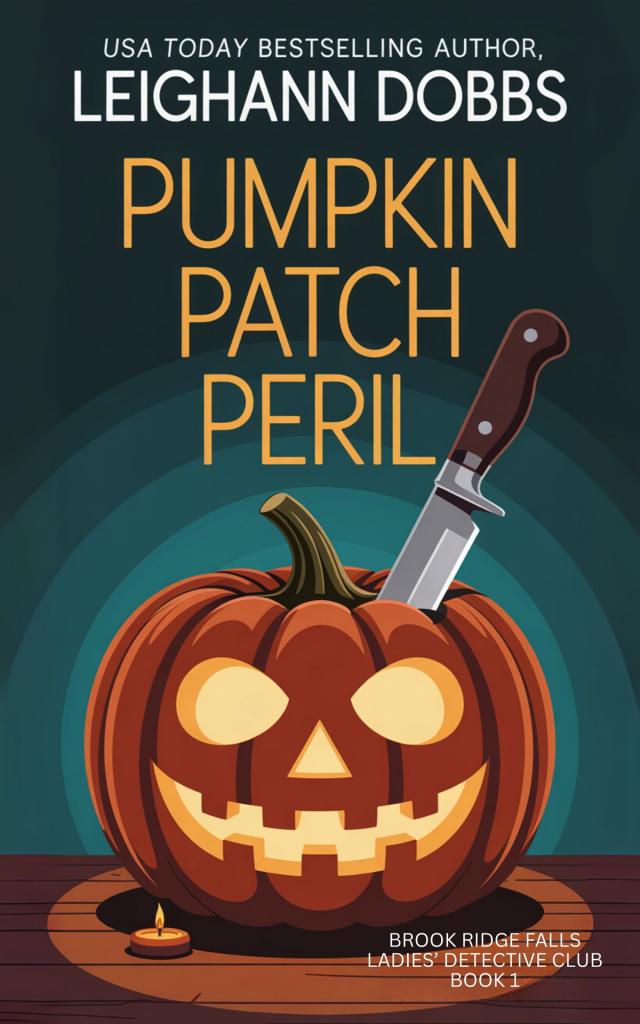


PUMPKIN PATCH PERIL
LEIGHANN DOBBS
CONTENTS
Chapter 1
Chapter 2
Chapter 3
Chapter 4
Chapter 5
Chapter 6
Chapter 7
Chapter 8
Chapter 9
Chapter 10
Chapter 11
Chapter 12
Chapter 13
Chapter 14
Chapter 15
Chapter 16
Chapter 17
Chapter 18
Chapter 19
Chapter 20
Chapter 21
Also by Leighann Dobbs
About Leighann Dobbs
CHAPTER ONE
The Cup and Cake smelled of cinnamon sugar and roasted beans, with an undertone of pumpkin that made Mona’s mouth water before she’d even ordered. October had transformed the cozy bakery into an autumn wonderland. Pumpkins of every size lined the windowsills, their orange faces catching the morning light. Strings of paper leaves in brilliant reds and golds dangled over the counter, swaying gently in the warm air from the ovens. A harvest wreath hung on the door, and someone had scattered acorns and pinecones along the display cases.
Mona Baker stood inside the entrance, breathing in the familiar comfort of her granddaughter’s bakery. Behind her, Ruth clutched her oversized purse like a shield against the autumn chill, while Ida practically bounced with excitement at the seasonal pastries lined up in the glass cases. Helen brought up the rear, already eyeing the corner table they’d claimed as their own years ago.
“Oh good, our spot’s free,” Helen said, making a beeline for the round table by the window. The morning light caught the silver in her hair, making her look distinguished rather than simply old.
“Let’s see what delights await us today,” Helen said, steering the group toward the glass display case that ran along the front counter. The autumn-themed pastries were arranged like edible artwork—golden pumpkin scones dotted with crystallized ginger, maple pecan muffins crowned with brown sugar crumbles, and apple cider donuts that practically glowed with their cinnamon sugar coating.
Behind the counter, Mona’s granddaughter, Lexy, looked up from arranging a fresh tray of mini pumpkin pies, her dark hair pulled back in a neat ponytail and flour dusting her apron. At twenty-six, she had her grandmother’s warm eyes but twice the energy, bouncing between customers with the kind of cheerful efficiency that kept The Cup and Cake running like clockwork.
“Well, well,” Lexy said, wiping her hands on her apron and giving the quartet a knowing look. “The Ladies Detective Club is here early today. What are you up to today? Another mystery brewing in Brook Ridge Falls?”
Mona’s shoulders slumped slightly with disappointment. “Unfortunately, no. We’re just here for breakfast.”
“No missing persons? No stolen jewelry? No mysterious accidents?” Lexy pressed, clearly hopeful for some excitement in her day.
“Nothing,” Ruth said with a sigh, pointing to a pumpkin scone. “I’ll take one of those, please.”
“It’s a bit dull,” Helen said, pointing to a pecan pumpkin brownie with maple frosting. “I’m going to eat away my boredom.”
Ida, who had her face practically pressed against the glass, said, “You can say that again. I’ll take a pumpkin bran muffin and an apple cider donut.”
“Two pastries?” Ruth raised an eyebrow.
“Gotta stock up for later,” Ida said.
Ruth raised her left brow. “I’ll have a snickerdoodle.”
“Cinnamon roll for me.” Mona said.
Lexy plated their selections, and the four made their way to their usual corner table by the window.
Ida suddenly perked up, pulling a small spiral notebook from her oversized purse. The cover was worn from handling, and multicolored tabs stuck out from various pages. “I’ve been working on something revolutionary.”
“Uh oh,” Ruth muttered, recognizing the gleam in Ida’s eye.
“I’m developing a foolproof mathematical system to beat bingo,” Ida declared, opening the notebook to reveal pages covered with charts, graphs, and neat columns of numbers. “Look at this frequency analysis!”
She pointed to a meticulously maintained chart showing each bingo letter and number combination, with tiny tick marks indicating how often each had been called over the past month.
“Ida,” Helen said gently, “bingo is pure chance. That’s the whole point.”
“Ha!” Ida waved a dismissive hand. “That’s what they want you to think. But everything has a pattern if you look hard enough. See here?” She jabbed at a series of numbers. “B-7 gets called 23% more often on Tuesday nights than Thursdays. And G-52? Haven’t heard it in three weeks.”
Ruth leaned over to examine the elaborate charts with the bemused expression of someone watching a friend explain their theory that cats were secretly running the government. “Ida, you realize that past results don’t influence future outcomes in games of chance, right?”
“Numbers don’t lie,” Ida said firmly, flipping to another page that showed a complex grid system. “I’m also tracking caller tendencies. Mrs. Henderson always pauses before announcing numbers with sevens in them. Mr. Martinez rolls his Rs on numbers ending in four. These are measurable patterns!”
Mona was halfway through her cinnamon roll, savoring the sticky sweetness, when she froze mid-bite. The fork hung suspended between plate and mouth. “Did you hear that?”
“Hear what?” Ida looked up from her charts, then glanced around the bustling café. Customers chatted at nearby tables, and the espresso machine hissed contentedly behind the counter.
“Pssst…” The sound came again, low and urgent, barely audible above the morning bustle.
Four heads swiveled in unison, like elderly meerkats on high alert. Nothing but the familiar murmur of customers, the gentle clack of cups against saucers, and the rhythmic hiss of the espresso machine.
“Maybe it was the steam from the coffee machine?” Helen suggested, though she sounded doubtful.
“Pssst!” Louder this time, more insistent.
Ruth’s eyebrows shot up. “That’s definitely not the coffee machine.”
Helen’s eyes darted under the table, then toward the floor near the counter. “Mouse?”
“Don’t be ridiculous,” Ruth whispered, leaning forward conspiratorially. “A mouse can’t pssst. They squeak.”
“Depends on the mouse,” Ida said seriously, carefully closing her bingo notebook and tucking it back into her purse. “I once knew a mouse that could whistle ‘Yankee Doodle.’”
The other three stared at her.
“What? It was a very talented mouse.”
They craned their necks, scanning the café like a surveillance team. Customers sat obliviously at their tables, scrolling through phones or reading newspapers.
Then Mona spotted her. Brenda from Mossberry Farm leaned out from the narrow space between the coffee pot stand and the wall, her face half-hidden by a tower of paper cups. Her usually confident demeanor had been replaced by something that looked suspiciously like panic. She jerked her head sharply toward the back hallway, her eyes wide with urgency.
“Well, that’s suspicious,” Mona said, setting down her fork.
Ruth followed her gaze and snorted. “You don’t know suspicious until you’ve seen her try to sell zucchini at full price in August. Highway robbery, that’s what it was.”
Brenda motioned again, more frantically this time. Her eyes darted around the café as if she expected someone to leap out from behind the cake display. She clearly didn’t want anyone else to notice her clandestine gesturing.
“She looks terrified,” Helen observed. “What do you suppose has gotten into her?”
Ida squinted across the café. “Maybe she finally realized how much she overcharges for those tomatoes.”
Mona sighed, recognizing the look of someone who needed help and was too proud or too scared to ask for it properly. She pushed back her chair with the resignation of someone whose peaceful morning was about to become significantly more complicated. “Hold my cinnamon roll,” she announced, dabbing her mouth with a napkin. “If I’m not back in five minutes, come looking.”
“Dibs on her scarf,” Ida said to the others, eyeing the soft blue wool draped over Mona’s chair.
Mona crossed the café, weaving between tables of chattering customers who seemed blissfully unaware of the drama unfolding. She slipped into the hallway, where Brenda was waiting.
“Thank goodness,” Brenda whispered, hustling Mona down to the end by the storage closet. The space smelled of coffee beans and cleaning supplies, a cramped refuge from the café’s cheerful bustle.
“Keep your voice down,” Brenda hissed, glancing back toward the main room as if expecting eavesdroppers to materialize from thin air.
“I haven’t said a word yet,” Mona pointed out reasonably.
Brenda peered back down the hallway, then leaned so close Mona could smell her lavender perfume mixed with what might have been panic sweat. “I need to hire you.”
Mona blinked, caught off guard. She’d expected complaints about the coffee, maybe gossip about the upcoming Harvest Festival, possibly even a request for Lexy’s chocolate chip cookie recipe. This was not on her lis t of likely scenarios. “To help with your harvest?”
“No.” Brenda’s voice dropped to barely above a whisper. “To find my pumpkin.”
“Your what?”
“My pumpkin,” Brenda repeated, the words coming out like a fierce prayer. “Five hundred and twenty pounds. Gone.”
Mona studied her carefully. Brenda was usually brisk, confident, bossy as a barn cat with opinions about everything from weather patterns to proper soil pH. She ran Mossberry Farm with military precision and had never been seen to back down from an argument about farming methods. Now her hands shook, and her usually perfect ponytail had come loose, wisps of graying brown hair framing her face.
“Who steals a pumpkin?” Mona asked, genuinely bewildered. “I mean, you can buy them anywhere this time of year, and they don’t cost much.”
“Not like this one,” Brenda said urgently. “I’ve been nurturing it all season, Mona. Custom fertilizer, hand-watering. It was going to be my entry in the Giant Pumpkin Competition at the Harvest Festival.”
“And now it’s just... gone?”
“Vanished. Sometime between Sunday night and Monday morning. I had it in the barn for safekeeping. Someone took it on purpose.” Brenda’s voice cracked slightly. “The Harvest Festival’s in four days. If word gets out that my entry’s missing, I’ll be the laughingstock of Brook Ridge Falls. Do you know how many people I’ve told about that pumpkin? How many times I’ve bragged about keeping my winners title?”
Mona folded her arms, her investigative instincts starting to kick in despite the unusual nature of the case. “So you want us to keep it quiet, track it down, and deliver it back in time for judging?”
“Yes,” Brenda said, relief flooding her voice at Mona’s understanding. “I’ll pay whatever your fee is. I know you ladies have solved real mysteries before—murders and such. This might seem small compared to that, but—”
“A crime is a crime,” Mona interrupted. “And pride is a powerful motive for all sorts of mischief.” She tapped her chin, stalling while she absorbed this unexpected turn. She’d solved murders, certainly. Thefts, fraud, and at least one memorable case involving a missing ferret that turned out to be living in the church organ. But produce theft was a new one, even for the Brook Ridge Falls Ladies Detective Club.
“Do you have any enemies?” Mona asked. “Anyone with a grudge against you or your farming practices?”
Brenda’s laugh was bitter. “Half the vendors at the farmer’s market think I’m too competitive. The other half think I’m too picky about quality. And don’t get me started on the Gertrude Hartwell. She’s practically foaming at the mouth to take the pumpkin contest win from me.”
From the café, Ida’s voice carried clearly: “Mona! Your cinnamon roll’s getting cold! And I’m not responsible for what happens to unattended pastry!”
Mona grimaced. “Step one of the investigation—guard my pastry from Ida. Step two—find your pumpkin.” She paused, studying Brenda’s desperate expression. “All right. We’ll take the case. We’ll need to check out your barn, of course.”
“I’ll leave it open for you.”
“We’ll be by later tonight. And if anyone asks, we’re just four ladies enjoying our seasonal treats and taking a nice autumn drive to admire the foliage.”
Brenda squeezed her hand, eyes shining with relief and gratitude. “Thank you. Just... please be careful. I may be paranoid, but I have the feeling whoever took it could be dangerous.”
Mona returned to the table, noting how three sets of eyes tracked her progress across the café. The others had clearly been speculating about her mysterious conference, probably inventing increasingly elaborate theories.
“Well?” Ruth demanded before Mona had even settled into her chair. “Don’t keep us in suspense.”
“She’s missing something,” Mona said, sitting down and immediately checking her cinnamon roll for signs of Ida interference.
“Her manners?” Helen guessed.
“Her mind?” Ida suggested hopefully. “Because that would explain the zucchini pricing.”
Mona shook her head and then leaned in and whispered, “Her pumpkin.”
They blinked at her in unison.
“Five hundred and twenty pounds,” Mona added for clarification.
Ida whistled low, a sound of genuine appreciation. “That’s a lot of pie. Or soup. You could probably make enough pumpkin bread to feed the entire retirement center.”
Ruth leaned forward, her practical mind already working. “Who steals a pumpkin that size? You’d need a truck, maybe a crane. It’s not exactly a crime of opportunity.”
“Someone who didn’t want Brenda to win the Giant Pumpkin Competition at the Harvest Festival.” Mona said. “And I already have our first suspect.”
CHAPTER TWO
The Cup and Cake’s door chimed behind them as the four ladies emerged into the crisp October air, Mona clutching a white bakery box tied with a cheerful orange ribbon. The box contained what Ida had deemed “investigation fuel”—an assortment of apple cider donuts, pumpkin muffins, and enough cinnamon rolls to keep them sharp through whatever the day might bring.
“Now where did I park?” Ruth muttered, fumbling in her oversized purse for her keys. The familiar jingle of metal was accompanied by the rustle of napkins, the crinkle of hard candy wrappers, and what sounded suspiciously like a set of measuring spoons.
Helen pointed toward the corner. “Over there. Next to that lovely flower bed.”
They approached Ruth’s vintage blue Oldsmobile, which sat like a gentle giant among the smaller cars. The vehicle had character—chrome bumpers that could double as small benches, tail fins that belonged in a museum, and a light blue paint job.
“Oh,” Ruth said, her voice climbing an octave. “Oh, dear.”
The “lovely flower bed” Helen had mentioned was now significantly less lovely. What had once been a neat row of late-blooming mums and ornamental kale now looked like a botanical crime scene. Orange and purple petals were scattered across the sidewalk, and several plants lay flattened beneath the Oldsmobile’s considerable whitewall rear tire.
“MURDERER!”
The accusation rang out across the street with the force of a battle cry. A woman with a long brown braid and the posture of someone prepared to take on the world came marching toward them, clipboard in one hand and a pen in the other. She wore a hemp jacket decorated with embroidered sunflowers and what appeared to be genuine disapproval.
“Murderer of innocent pollinators!” Laura Jenkins declared, jabbing her pen toward the devastated flower bed. “Look what you’ve done to these poor chrysanthemums! Do you know how many bees depend on late-season blooms for survival?”
Ruth took a step back, nearly bumping into Ida, who was looking into the bakery bag focused on the contents of the bakery box. “I’m sure they were very nice bees,” Ruth said weakly.
“Nice?” Laura’s eyes blazed with environmental fervor. “They’re essential! Without pollinators, our entire ecosystem collapses. And here you are, rolling over their food source like some kind of... of gas-guzzling destroyer of nature!”
Mona cleared her throat diplomatically. “I’m sure Ruth didn’t mean to harm any bees. Or flowers. It was an accident.”
“Accidents happen when people don’t consider their impact on the environment,” Laura announced, her voice carrying the weight of someone who’d given this speech many times before. “Which brings me to my mission.” She held up her clipboard with the fervor of a crusader displaying a holy relic. “I’m collecting signatures to ban the use of harmful pesticides in our community. Specifically, at Mossberry Farm.”
The four ladies exchanged glances that could have powered a small telecommunications network.
“Brenda’s farm?” Helen asked, her journalist instincts perking up like a cat hearing a can opener.
“Exactly!” Laura’s enthusiasm ratcheted up another notch. “She’s been poisoning our local ecosystem for years with her so-called ‘family farming methods.’ Those chemicals don’t just stay on her property—they run off into our groundwater, they drift on the wind, they kill beneficial insects by the thousands!”
Ruth shifted uncomfortably. Whether from the environmental lecture or the proximity to her parking disaster, it was hard to tell. “I had no idea.”