Sense of Wonder: A Century of Science Fiction, page 356
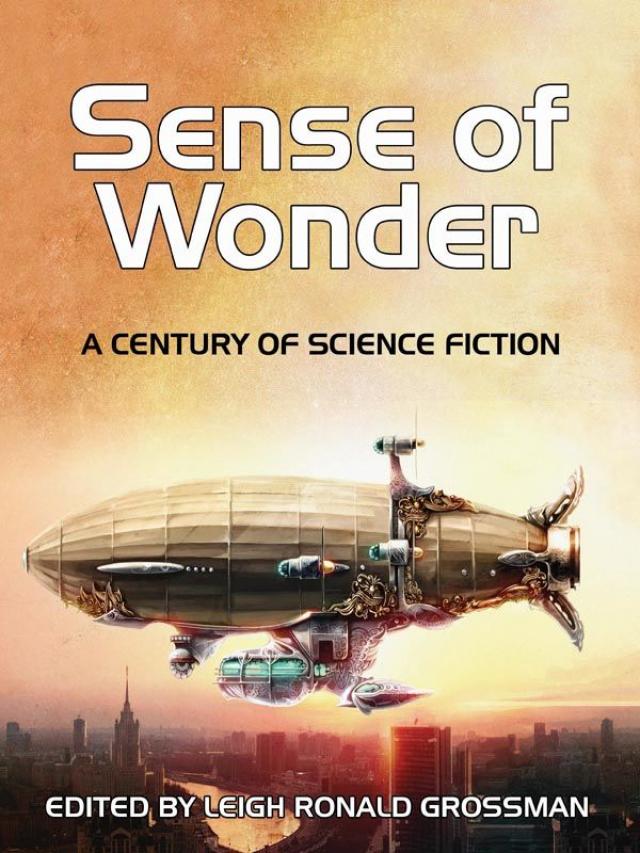


The Lady Margaret had topped the rise when the cloud scud overhead lit with a white glare. The explosion cracked like a monstrous whip; the shock wave slapped at the trailers, skewed the steamer off course. Jesse fought her straight, hearing echoes growl back from distant hills. He leaned out from the footplate, stared down past the shoulders of the load. Behind him twinkled spots of fire where the hell-burner, two score kegs of fine-grain powder packed round with bricks and scrap iron, had scythed the valley clear of life.
Water was low. He worked the injectors, checked the gauge. “We must live how we can,” he said, not hearing the words. “We must all live how we can.” The firm of Strange had not been built on softness; what you stole from it, you were welcome to keep.
Somewhere a semaphore clacked to Emergency Attention, torches lighting its arms. The Lady Margaret, with her train behind her, fled to Durnovaria, huddled ahead in the dim silver elbow of the Frome.
* * * *
Copyright © 1966, 1968 by Keith Roberts.
SPIDER ROBINSON
(1948– )
Although I’ve certainly enjoyed the company of Spider and his late wife (and sometime co-author) Jeanne now and again, I wouldn’t say I know them. How do you know someone who’s done everything? As a kid I thought of Spider mainly as the author of the humorous and pun-filled Callahan’s Crosstime Saloon stories for which he’s probably best-known. As an adult I’ve had much more of a sense of the breadth of his writing, and how much he’s contributed to the field through his essays and criticism and other ways beyond his fiction.
Born Paul Robinson to a Catholic family in the Bronx, Robinson spent a year in a seminary and “several years in the woods, deliberately trying to live without technology” before switching to SUNY Stony Brook in the 1960s. There he earned an English degree while honing his guitar and singing skills in coffee houses. When the best that degree landed him was a night job guarding sewers in New York City, Spider turned to writing, selling his first story to Analog in 1972.
He met his wife Jeanne, a choreographer, dancer, and Zen monk, in the woods of Nova Scotia in 1975. By that time Spider had already won the Campbell Award for best new writer, begun the Callahan series, and was reviewing for Galaxy. Relocating to Canada permanently (he became a Canadian citizen in 2002), Spider continued to write prolifically, mixing science fiction, reviews and criticism, essays on politics and technology, and occasionally poetry. He’s primarily known for his shorter fiction, winning three Hugos and a Nebula (for “Stardance,” co-written with Jeanne) as well as the Robert A. Heinlein Award for lifetime achievement in 2008.
Jeanne died of cancer in 2010, shortly after the birth of their first grandchild.
Although Spider is best known for lighter stories and an optimistic view of the universe, “Melancholy Elephants” has a much darker undercurrent. The subject of intellectual property rights has become even more contentious in the years since he wrote this prophetic story, which won a Hugo in 1983.
MELANCHOLY ELEPHANTS, by Spider Robinson
First published in Analog Science Fiction/Science Fact, June 1982
This story is dedicated to Virginia Heinlein
She sat zazen, concentrating on not concentrating, until it was time to prepare for the appointment. Sitting seemed to produce the usual serenity, put everything in perspective. Her hand did not tremble as she applied her make-up; tranquil features looked back at her from the mirror. She was mildly surprised, in fact, at just how calm she was, until she got out of the hotel elevator at the garage level and the mugger made his play. She killed him instead of disabling him. Which was obviously not a measured, balanced action—the official fuss and paperwork could make her late. Annoyed at herself, she stuffed the corpse under a shiny new Westinghouse roadable whose owner she knew to be in Luna, and continued on to her own car. This would have to be squared later, and it would cost. No help for it—she fought to regain at least the semblance of tranquillity as her car emerged from the garage and turned north. Nothing must interfere with this meeting, or with her role in it.
Dozens of man-years and God knows how many dollars, she thought, funneling down to perhaps a half hour of conversation. All the effort, all the hope. Insignificant on the scale of the Great Wheel, of course…but when you balance it all on a half hour of talk, it’s like balancing a stereo cartridge on a needlepoint. It only takes a gram or so of weight to wear out a piece of diamond. I must be harder than diamond.
Rather than clear a window and watch Washington, D.C. roll by beneath her car, she turned on the television. She absorbed and integrated the news, on the chance that there might be some late-breaking item she could turn to her advantage in the conversation to come; none developed. Shortly the car addressed her: “Grounding, ma’am. I.D. eyeball request.” When the car landed she cleared and then opened her window, presented her pass and I.D. to a Marine in dress blues, and was cleared at once. At the Marine’s direction she re-opaqued the window and surrendered control of her car to the house computer, and when the car parked itself and powered down she got out without haste. A man she knew was waiting to meet her, smiling.
“Dorothy, it’s good to see you again.”
“Hello, Phillip. Good of you to meet me.”
“You look lovely this evening.”
“You’re too kind.” She did not chafe at the meaningless pleasantries. She needed Phil’s support, or she might. But she did reflect on how many, many sentences have been worn smooth with use, rendered meaningless by centuries of repetition. It was by no means a new thought.
“If you’ll come with me, he’ll see you at once.”
“Thank you, Phillip.” She wanted to ask what the old man’s mood was, but knew it would put Phil in an impossible position.
“I rather think your luck is good; the old man seems to be in excellent spirits tonight.”
She smiled her thanks, and decided that if and when Phil got around to making his pass she would accept him. The corridors through which he led her then were broad and high and long; the building dated back to a time of cheap power. Even in Washington, few others would have dared to live in such an energy-wasteful environment. The extremely spare decor reinforced the impression created by the place’s very dimensions: bare space from carpet to ceiling, broken approximately every forty meters by some exquisitely simple objet d’art of at least a megabuck’s value, appropriately displayed. An unadorned, perfect, white porcelain bowl, over a thousand years old, on a rough cherrywood pedestal. An arresting colour photograph of a snow-covered country road, silkscreened onto stretched silver foil; the time of day changed as one walked past it. A crystal globe, a meter in diameter, within which danced a hologram of the immortal Shara Drummond; since she had ceased performing before the advent of holo technology, this had to be an expensive computer reconstruction. A small sealed glassite chamber containing the first vacuum-sculpture ever made, Nakagawa’s legendary Starstone. A visitor in no hurry could study an object at leisure, then walk quite a distance in undistracted contemplation before encountering another. A visitor in a hurry, like Dorothy, would not quite encounter peripherally astonishing stimuli often enough to get the trick of filtering them out. Each tugged at her attention, intruded on her thoughts; they were distracting both intrinsically and as a reminder of the measure of their owner’s wealth. To approach this man in his own home, whether at leisure or in haste, was to be humbled. She knew the effect was intentional, and could not transcend it; this irritated her, which irritated her. She struggled for detachment. At the end of the seemingly endless corridors was an elevator. Phillip handed her into it, punched a floor button, without giving her a chance to see which one, and stepped back into the doorway. “Good luck, Dorothy.”
“Thank you, Phillip. Any topics to be sure and avoid?”
“Well…don’t bring up hemorrhoids.”
“I didn’t know one could.”
He smiled. “Are we still on for lunch Thursday?”
“Unless you’d rather make it dinner.”
One eyebrow lifted. “And breakfast?”
She appeared to consider it. “Brunch,” she decided. He haIf-bowed and stepped back. The elevator door closed and she forgot Phillip’s existence.
Sentient beings are innumerable; I vow to save them all. The deluding passions are limitless; I vow to extinguish them all. The truth is limitless; I—
The elevator door opened again, truncating the Vow of the Bodhisattva. She had not felt the elevator stop—yet she knew that she must have descended at least a hundred meters. She left the elevator. The room was larger than she had expected; nonetheless the big powered chair dominated it easily. The chair also seemed to dominate—at least visually—its occupant. A misleading impression, as he dominated all this massive home, everything in it and, to a great degree, the country in which it stood. But he did not look like much.
A scent symphony was in progress, the cinnamon passage of Bulachevski’s “Childhood.” It happened to be one of her personal favourites, and this encouraged her.
“Hello, Senator.”
“Hello, Mrs. Martin. Welcome to my home. Forgive me for not rising.”
“Of course. It was most gracious of you to receive me.”
“It is my pleasure and privilege. A man my age appreciates a chance to spend time with a woman as beautiful and intelligent as yourself.”
“Senator, how soon do we start talking to each other?”
He raised that part of his face which had once held an eyebrow.
“We haven’t said anything yet that is true. You do not stand because you cannot. Your gracious reception cost me three carefully hoarded favours and a good deal of folding cash. More than the going rate; you are seeing me reluctantly. You have at least eight mistresses that I know of, each of whom makes me look like a dull matron. I concealed a warm corpse on the way here because I dared not be late; my time is short and my business urgent. Can we begin?”
She held her breath and prayed silently. Everything she had been able to learn about the Senator told her that this was the correct way to approach him. But was it?
The mummy-like face fissured in a broad grin. “Right away. Mrs. Martin, I like you and that’s the truth. My time is short, too. What do you want of me?”
“Don’t you know?”
“I can make an excellent guess. I hate guessing.”
“I am heavily and publicly committed to the defeat of S.4217896.”
“Yes, but for all I know you might have come here to sell out.”
“Oh.” She tried not to show her surprise. “What makes you think that possible?”
“Your organization is large and well-financed and fairly efficient, Mrs. Martin, and there’s something about it I don’t understand.”
“What is that?”
“Your objective. Your arguments are weak and implausible, and whenever this is pointed out to one of you, you simply keep on pushing. Many times I have seen people take a position without apparent logic to it—but I’ve always been able to see the logic, if I kept on looking hard enough. But as I see it, S. ‘896 would work to the clear and lasting advantage of the group you claim to represent, the artists. There’s too much intelligence in your organization to square with your goals. So I have to wonder what you are working for, and why. One possibility is that you’re willing to roll over on this copyright thing in exchange for whatever it is that you really want. Follow me?”
“Senator, I am working on behalf of all artists—and in a broader sense—”
He looked pained, or rather, more pained. “…for all mankind,’ oh my God, Mrs. Martin, really now.”
“I know you have heard that countless times, and probably said it as often.” He grinned evilly. “This is one of those rare times when it happens to be true. I believe that if S. ‘896 does pass, our species will suffer significant trauma.”
He raised a skeletal hand, tugged at his lower lip. “Now that I have ascertained where you stand, I believe 1 can save you a good deal of money. By concluding this audience, and seeing that the squeeze you paid for half an hour of my time is refunded pro rata.”
Her heart sank, but she kept her voice even. “Without even hearing the hidden logic behind our arguments?”
“It would be pointless and cruel to make you go into your spiel, ma’am. You see, I cannot help you.”
She wanted to cry out, and savagely refused herself permission. Control, whispered a part of her mind, while another part shouted that a man such as this did not lightly use the words “I cannot.” But he had to be wrong. Perhaps the sentence was only a bargaining gambit…
No sign of the internal conflict showed; her voice was calm and measured. “Sir, I have not come here to lobby. I simply wanted to inform you personally that our organization intends to make a no-strings campaign donation in the amount of—”
“Mrs. Martin, please! Before you commit yourself, I repeat, I cannot help you. Regardless of the sum offered.”
“Sir, it is substantial.”
“I’m sure. Nonetheless it is insufficient.”
She knew she should not ask. “Senator, why?”
He frowned, a frightening sight.
“Look,” she said, the desperation almost showing through now, “keep the pro rata if it buys me an answer! Until I’m convinced that my mission is utterly hopeless, I must not abandon it: answering me is the quickest way to get me out of your office. Your scanners have watched me quite thoroughly, you know that I’m not abscamming you.”
Still frowning, he nodded “Very well. I cannot accept your campaign donation because I have already accepted one from another source.”
Her very worst secret fear was realized. He had already taken money from the other side. The one thing any politician must do, no matter how powerful, is stay bought. It was all over.
All her panic and tension vanished, to be replaced by a sadness so great and so pervasive that for a moment she thought it might literally stop her heart.
Too late! Oh my darling, I was too late!
She realized bleakly that there were too many people in her life, too many responsibilities and entanglements. It would be at least a month before she could honourably suicide.
“—you all right, Mrs. Martin?” the old man was saying, sharp concern in his voice.
She gathered discipline around her like a familiar cloak. “Yes, sir, thank you. Thank you for speaking plainly.” She stood up and smoothed her skirt. “And for your—”
“Mrs. Martin.”
“—gracious hos—Yes?”
“Will you tell me your arguments? Why shouldn’t I support ‘896?”
She blinked sharply. “You just said it would be pointless and cruel.”
“If I held out the slightest hope, yes, it would be. If you’d rather not waste your time, I will not compel you. But I am curious.”
“Intellectual curiosity?”
He seemed to sit up a little straighter—surely an illusion, for a prosthetic spine is not motile. “Mrs. Martin, I happen to be committed to a course of action. That does not mean I don’t care whether the action is good or bad.”
“Oh.” She thought for a moment. “If I convince you, you will not thank me.”
“I know. I saw the look on your face a moment ago, and…it reminded me of a night many years ago. Night my mother died. If you’ve got a sadness that big, and I can take on a part of it, I should try. Sit down.”
She sat.
“Now tell me: what’s so damned awful about extending copyright to meet the realities of modern life? Customarily I try to listen to both sides before accepting a campaign donation—but this seemed so open and shut, so straightforward…”
“Senator, that bill is a short-term boon, to some artists—and a long-term disaster for all artists, on Earth and off.”
“‘In the long run, Mr. President—’,” he began, quoting Keynes.
“—we are some of us still alive,” she finished softly and pointedly. “Aren’t we? You’ve put your finger on part of the problem.”
“What is this disaster you speak of?” he asked.
“The worst psychic trauma the race has yet suffered.”
He studied her carefully and frowned again. “Such a possibility is not even hinted at in your literature or materials.”
“To do so would precipitate the trauma. At present only a handful of people know, even in my organization. I’m telling you because you asked, and because I am certain that you are the only person recording this conversation. I’m betting that you will wipe the tape.”
He blinked, and sucked at the memory of his teeth. “My, my,” he said mildly. “Let me get comfortable.” He had the chair recline sharply and massage his lower limbs; she saw that he could still watch her by overhead mirror if he chose. His eyes were closed. “All right, go ahead.”
She needed no time to choose her words. “Do you know how old art is, Senator?”
“As old as man, I suppose. In fact, it may be part of the definition.”
“Good answer,” she said. “ Remember that. But for all present-day intents and purposes, you might as well say that art is a little over 15,600 years old. That’s the age of the oldest surviving artwork, the cave paintings at Lascaux. Doubtless the cave-painters sang, and danced, and even told stories—but these arts left no record more durable than the memory of a man. Perhaps it was the story tellers who next learned how to preserve their art. Countless more generations would pass before a workable method of musical notation was devised and standardized. Dancers only learned in the last few centuries how to leave even the most rudimentary record of their art.