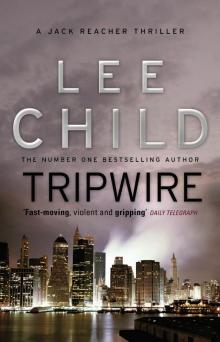
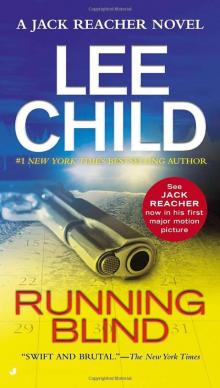
Jack Reacher, page 2


Language evolved way back when leisure was simply unheard of. Language was all about survival and cooperation and the dissemination of facts in pursuit of literally life-and-death issues. For most of our existence language has been for telling the truth. Then fiction started up, and we started burning brain cells on stories about things that didn’t happen to people who didn’t exist. Why? The only answer can be that humans deeply, deeply desired it. They needed the consolation. Real life is rarely satisfactory.
The transaction is clearly apparent in romantic fiction. In real life, you sit on the subway and you see a beautiful girl. Truth is, you aren’t going to dinner with her, you aren’t taking her home, you aren’t going to live happily ever after. In fact, you aren’t even going to talk to her. But in a novel, all that good stuff happens. It’s a way to live vicariously.
Same for crime fiction. In real life, your house gets burgled or your car gets ripped off, they aren’t going to find the bad guys, and you aren’t going to get your stuff back. Someone bullies or disrespects you at work or in school or in a relationship, there isn’t much you can do about it. But something can be done about it in a book, and people enjoy watching it happen. They love it. It’s closure, albeit also vicarious.
So I wanted Reacher to do what we all want to do ourselves— stand strong and unafraid, never back off, never back down, come up with the smart replies. I thought of all the situations that we— timid, uncertain, scared, worried, humiliated—find ourselves in and imagined a kind of therapeutic consolation in seeing our wildest dreams acted out on the page.
So Reacher always wins.
Which is theoretically a problem. He’s a plain, uncomplicated man who breezes through life without evident trouble. Shouldn’t he be boring?
In theory, yes. But readers don’t agree. Because actually he has plenty of minor problems. He’s awkward in civilian society. He gets around his difficulties by assembling a series of eccentricities that border on the weird. If he doesn’t know how something works, he just doesn’t participate. He doesn’t have a cell phone, doesn’t understand text messaging, doesn’t grasp e-mail. He doesn’t do laundry. He buys cheap clothes, junks them three or four days later, and buys more. To him, that’s a rigorously rational solution to an evident problem. To us, it’s almost autistic.
The contrast between his narrow and highly developed skills and his general helplessness humanizes him. It gives him dimension. He has enough problems to make him interesting, but, crucially, he himself doesn’t know he has these problems. He thinks he’s fine. He thinks he’s normal. Hence interest without the whiny self-awareness of the bullet-lodged-near-the-heart guys.
What motivates him?
He has no need for or interest in employment. He’s not a proactive do-gooder. So why does he get involved in things? Well, partly because of noblesse oblige, a French chivalric concept that means “nobility obligates,” which mandates honorable, generous, and responsible behavior because of high rank or birth.
Reacher had the rank and the skills, and he feels a slightly Marxist obligation “from he who has, to him who needs.” Again, that attitude predates the twentieth century by a long way. It shows up in nineteenth-century Western heroes, and thirteenth-century European heroes, all the way back to the Greeks and, we can be sure, much further back into oral traditions where no written records exist. Added to which, in Reacher’s case, is a cantankerousness that provokes him.
In Persuader, during a flashback to his military days, he is asked why he became an MP when he could have chosen any other branch of the service. He gives a vague answer, along the lines of wanting to look after the little guy.
His questioner is skeptical. She says, disbelievingly, “You care about the little guy?”
“Not really,” Reacher admits. “I don’t really care about the little guy. I just hate the big guy. I hate big smug people who think they can get away with things.”
That’s what motivates him. The world is full of unfairness and injustice. He can’t intervene everywhere. He needs to sense a sneering, arrogant, manipulative opponent in the shadows. Then he’ll go to work. Partly because he himself is arrogant.
In a sense, each book is a contest between Reacher’s arrogance and his opponent’s. Arrogance is not an attractive attribute, but I don’t hide Reacher’s because I think the greatest mistake a series writer can make is to get too chummy with his main character. I aim to like Reacher just a little less than I hope you will. Because basically a book is a simple psychological transaction.
“I’m the main character,” the main character announces. The reader asks: “Am I going to like you?”
There are several possible answers to that question. The worst is: “Yes, you really are, and I’ll tell you why!”
But Reacher answers: “You might or you might not, and either way is fine with me.”
Because, as an author, I believe that kind of insouciant self-confidence forms a more enduring bond.
Does it?
About the Author
Lee Child was born in 1954 in Coventry, England. His family soon moved to Birmingham, where he went to the same high school that J. R. R. Tolkien once attended. He received a formal English education, learning Latin, Greek, and Old English, before he attended law school in Sheffield. After working in the theater, he began an eighteen-year career with Granada Television in Manchester. After company-wide restructuring, he left, embarking on a fiction-writing career.
Jack Reacher, who has been featured in all of Child’s novels, made his first appearance in 1997 in Killing Floor, which was an immediate success, winning both the Anthony and Barry Awards for best first novel of the year. The series has increased in popularity each year, with foreign rights selling widely around the world, while making regular appearances on major bestseller lists everywhere. One Shot (2005), was made into the movie Jack Reacher, starring Tom Cruise.
The James Bond–like author drives a supercharged Jaguar and divides his time between the south of France and Manhattan, where he has become an enthusiastic fan of the New York Yankees. He is married and has a daughter.
All rights reserved, including without limitation the right to reproduce this ebook or any portion thereof in any form or by any means, whether electronic or mechanical, now known or hereinafter invented, without the express written permission of the publisher.
Copyright © 2007, 2009 by Lee Child. Originally published by The Mysterious Bookshop.
Cover design by Mauricio Díaz
ISBN: 978-1-5040-7437-7
This edition published in 2022 by MysteriousPress.com/Open Road Integrated Media, Inc.
180 Maiden Lane
New York, NY 10038
www.openroadmedia.com
MYSTERIOUS PROFILES
FROM MYSTERIOUSPRESS.COM
AND OPEN ROAD MEDIA
MYSTERIOUSPRESS.COM
Otto Penzler, owner of the Mysterious Bookshop in Manhattan, founded the Mysterious Press in 1975. Penzler quickly became known for his outstanding selection of mystery, crime, and suspense books, both from his imprint and in his store. The imprint was devoted to printing the best books in these genres, using fine paper and top dust-jacket artists, as well as offering many limited, signed editions.
Now the Mysterious Press has gone digital, publishing ebooks through MysteriousPress.com.
MysteriousPress.com. offers readers essential noir and suspense fiction, hard-boiled crime novels, and the latest thrillers from both debut authors and mystery masters. Discover classics and new voices, all from one legendary source.
FIND OUT MORE AT
WWW.MYSTERIOUSPRESS.COM
FOLLOW US:
@emysteries and Facebook.com/MysteriousPressCom
MysteriousPress.com is one of a select group of publishing partners of Open Road Integrated Media, Inc.
The Mysterious Bookshop, founded in 1979, is located in Manhattan’s Tribeca neighborhood. It is the oldest and largest mystery-specialty bookstore in America.
The shop stocks the finest selection of new mystery hardcovers, paperbacks, and periodicals. It also features a superb collection of signed modern first editions, rare and collectable works, and Sherlock Holmes titles. The bookshop issues a free monthly newsletter highlighting its book clubs, new releases, events, and recently acquired books.
58 Warren Street
info@mysteriousbookshop.com
(212) 587-1011
Monday through Saturday
11:00 a.m. to 7:00 p.m.
FIND OUT MORE AT:
www.mysteriousbookshop.com
FOLLOW US:
@TheMysterious and Facebook.com/MysteriousBookshop
SUBSCRIBE:
The Mysterious Newsletter
Find a full list of our authors and titles at www.openroadmedia.com
FOLLOW US
@ OpenRoadMedia
Lee Child, Jack Reacher