Darkness to Light, page 1
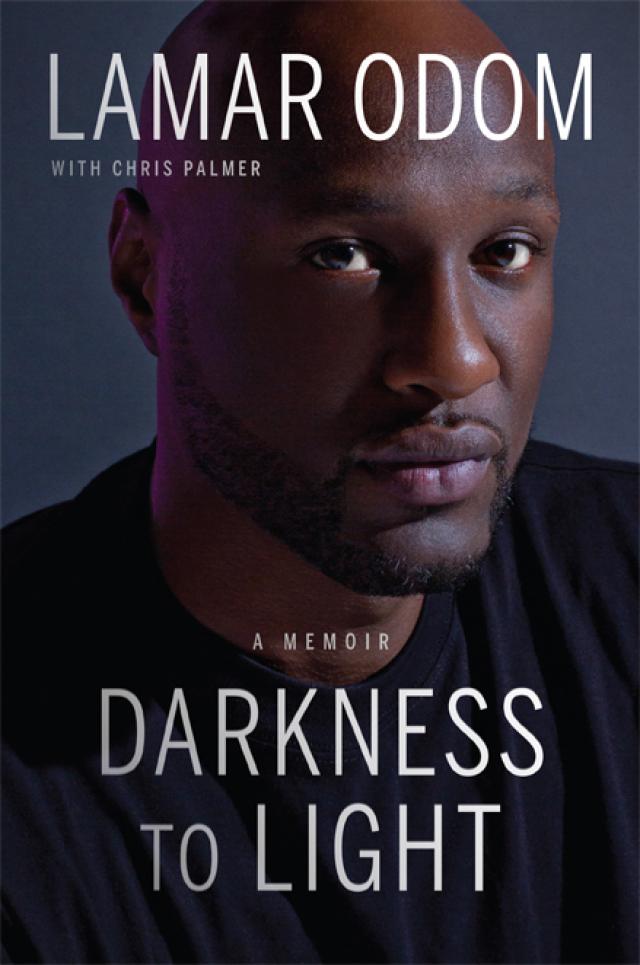


DARKNESS TO LIGHT
This book is based on notes and recollections of Lamar Odom. Some names and locations have been changed or omitted to protect the privacy of individuals. In passages containing dialogue, quotation marks are used when the author was reasonably sure that the speaker’s words were close to verbatim and/or that the intended meaning of the speaker was accurately reflected.
Copyright © 2019 by Nunnbetter Productions.
All rights reserved. No part of this book may be used or reproduced in any manner whatsoever without written permission except in the case of brief quotations embodied in critical articles or reviews.
BenBella Books, Inc.
10440 N. Central Expressway, Suite 800
Dallas, TX 75231
www.benbellabooks.com
Send feedback to feedback@benbellabooks.com
First E-Book Edition: May 2019
Library of Congress Cataloging-in-Publication Control Number: 2019002815
ISBN 9781948836081
ISBN 9781948836203 (ebook)
Editing by Joe Rhatigan
Copyediting by Scott Calamar
Proofreading by Laura Cherkas and Lisa Story
Text design and composition by Aaron Edmiston
Cover design by Sarah Avinger
Cover image by Scott Hebert
Printed by Lake Book Manufacturing
Distributed to the trade by Two Rivers Distribution, an Ingram brand www.tworiversdistribution.com
Special discounts for bulk sales (minimum of 25 copies) are available.
Please contact bulkorders@benbellabooks.com.
To Cathy, Mildred, Liza, Destiny, and Lamar Jr.
—L.O.
To my parents, Ransford and Sally
—C.P.
CONTENTS
Chapter 1
Chapter 2
Chapter 3
Chapter 4
Chapter 5
Chapter 6
Chapter 7
Chapter 8
Chapter 9
Chapter 10
Chapter 11
Chapter 12
Chapter 13
Chapter 14
Chapter 15
Chapter 16
Chapter 17
Chapter 18
Chapter 19
Chapter 20
Chapter 21
Chapter 22
Chapter 23
Chapter 24
Chapter 25
Chapter 26
Chapter 27
Chapter 28
Chapter 29
The Last Chapter
Acknowledgments
About the Author
1
This is where I was born.
This is where she died.
I can close my eyes and still see it.
It’s cold outside. There are no leaves on the trees.
The concrete is cracked and broken.
Cathy has to take the bus.
She doesn’t know where Joe is.
The bedroom is empty.
I am alone.
I am Lamar Joseph Odom.
And I am alive.
I was born in the autumn of her twenty-third year. She had always wanted a child. A boy who would grow to be handsome and tall. When she got pregnant, she was living with her mother in an upstairs bedroom and working for the New York City Department of Transportation in Queens.
Joseph Odom was a charismatic Vietnam War vet who worked as a janitor in the Woodside Houses projects in Queens. My mother was visiting a friend there when Joe first noticed her and won her over with his good looks and an easy brand of charm. She liked his smile; he liked her round, pretty eyes. He was twenty-three. She was twenty-one and just finding her way in the world.
Shortly after their first encounter, Cathy Mercer, tall, lithe, and beautiful, was walking by Woodside when Joe saw her again. He was cutting the grass, and his boots were stained green. He shut off the mower and met her at the sidewalk.
“What’s up, Slim?” he said. That’s what he would call her. A cute nickname to break the ice and set him apart from the other guys.
“Nothing, just trying to get home,” Cathy replied. “But I don’t have a token.” She needed to jump on the 7 train. Joe had but one subway token in his pocket. He needed it to get home.
“Take mine,” he said. He reached in his pocket and placed the token in her palm. Cathy smiled and gave him her number.
“You gonna call me, right?” she asked.
“I got the number memorized.”
My father walked the seventy-two blocks home. He repeated her phone number the whole way. That token, something so small yet quintessentially New York, is the beginning of my story.
Joe grew up in Williamsburg, Brooklyn, long before the hipsters invaded.
“We was on the block,” my dad told me, years later. “We had to do for ourselves. It wasn’t pretty like it is now. We had drugs and temptation. We were young and innocent. Our lives were at stake.”
My dad first tasted marijuana at fourteen. From there he dove headfirst into hard drugs. He hustled on the block. He dealt to pimps, gangsters, and bangers. He’d get a fix from a neighborhood dealer with the promise of more to come if he could sell on the street.
He often found himself holed up in an abandoned building getting high. His parents were furious when he dropped out of high school his sophomore year. When Joe finally told his father, he ordered Joe into the family car, a 1968 Cadillac Eldorado. They drove for two hours, talking about repercussions and dreams and where Joe’s life was headed.
Back in the driveway, my grandfather put the car in park. They sat in silence for ten minutes. He looked at Joe and saw himself in the youngest of his five children. This boy, who was bright and tall and strong, began to cry.
“I’m a drug addict,” Joe said.
“I know, son,” said his father.
The next day my dad enlisted in the army. There was a recruitment office near their apartment. Two weeks later he was shipped to Fort Dix in New Jersey to begin his military training. Shortly after, he was deployed to Saigon. He reached the rank of E-4 Specialist and trained with M16s.
The experiences in a foreign land traumatized him.
He returned to Brooklyn a broken man. He was introduced to heroin in Vietnam. Many soldiers used it to deal with the stress of taking human life. It was how they coped. They were made to kill people they didn’t know. They pulled the triggers and stood there as the bodies dropped. It destroyed my father psychologically. Any empathy he had evaporated.
Joe moved back into his parents’ apartment. He was twenty-two and paranoid, depressed, anxious, and without direction. He looked over his shoulder on the rare occasions he left the apartment. And he only left in search of a fix. Within the year, Joe contacted a Veterans Affairs administrator who had one arm and an addiction of his own. He helped my father get back on his feet. That’s how Joe got the job at the Woodside Houses.
Cathy and Joe didn’t know each other very well, and in many ways, they never would. But Joe said they would give birth to a prince.
The things a man will tell a woman.
So, love blossomed in the ghetto. Concrete gave way to something softer. Joe loved her. Cathy would tell her friends about this guy from Woodside. She wanted a husband and a son and a home. They had started something that could not be undone. Their lives would take disparate paths, but ones that would forever be bound by me . . . the only thing they truly had in common.
I weighed seven pounds, fourteen ounces when I came into the world. “Man, he is long,” said Joe at St. John’s Hospital just past noon on the first Tuesday of November. “And he looks just like me. We done good, babe.”
I would be at once precious and tormented. Cherished and forgotten.
My grandmother Mildred Mercer was born to a family of sharecroppers and former slaves in rural Athens, Georgia, in 1934. When she was in her twenties, after scraping together twenty-nine dollars for a seat on the Greyhound, where she was relegated to the back of the bus with no air-conditioning, she and her sister moved to a tough working-class neighborhood in the Bronx in search of jobs and with designs on settling down and starting families of their own.
When Mildred had her first daughter, Cathy Celestine Mercer, they moved to a modest two-bedroom house on 131st Street and Linden Boulevard in South Ozone Park, Queens, just north of John F. Kennedy International Airport. My grandparents plopped down $250 for the down payment. The small abode was Queens through and through with its black gate and awning-covered porch, which was fronted by a row of tidy bushes. Their neighbors were bus drivers and toll workers and street sweepers and clerks in local government offices. They had found their heaven in the middle of New York’s biggest and most Italian borough.
I grew up in Grandma Mildred’s house, and it was always the center of neighborhood activity on 131st Street. Whenever there was a major life milestone or tragedy, our family and close neighbors gathered at the house. Graduations, birthdays, wakes, and new jobs were all reasons to get together over a barbecue in the backyard to either celebrate or commiserate.
My grandmother was the matriarch, setting house rules and curfews, and making certain that bellies were always full of her turkey wings, cabbage, fried chicken, and dumplings. I lived in this house growing up, except for a short time right after Joe and Cathy got married.
It was 1985, and I was six years old. And for the brief time Joe and Cathy were married, we lived in an apartment near t he beach in Far Rockaway, Queens. I was part of a complete family.
But the tranquility and good times were short-lived. I have to search deep in my mind to find happy moments from my childhood. And I still have to convince myself that they actually happened. The only memories that come forth easily involve fear, pain, and anxiety. The smell of Mildred’s meals starts to fade and my mother’s angelic smile blurs in my memory. All that’s left is a frightened, powerless ten-year-old boy.
2
It took less than a year for my parents’ arguments to grow louder and more frequent—setting off a period of angst, uncertainty, and turmoil that would shape my life indelibly. That’s when the violence started. Even though I couldn’t understand the source of the arguments and why my parents just couldn’t get along, I knew what it felt like to see my father hit my mother. Her screams and then muffled cries made me feel powerless as I hid from my father’s anger.
It scared me. What’s worse, it scarred me. I’m still recovering from the trauma of being unable to protect my mother from the noise, from the pain, from the arguments. And one day, my mother screamed “Enough!”
And in a flash, my father was gone, leaving behind his seven-year-old son. Less than a year after my parents married, my father returned to the streets where to me he became as much a rumor as a mystery. He loved my mother once. Very deeply. A long time ago when my eyes were young. But he left, and my heart filled with hate. And yet I wanted him to love me more than I hated him. He always had the benefit of the doubt . . . his weakness more powerful than my greatest strength.
My hate for him burned. But I sought his junkie approval above all things.
Mom and I moved back into Grandma Mildred’s house on 131st Street. Along with my mother’s sister, JaNean, we tried to salvage our family and insulate ourselves from the harshness of everyday life. I shared an upstairs bedroom with Mom. It was the first door on the left and had been my mother’s alone before I was born. She moved another twin bed in and cleared out some closet space. Each and every night we talked to each other until one of us fell asleep. I always seemed to fall asleep first.
Soon she got a new job as a corrections officer at Rikers Island, one of the most notorious prisons in America . . . where there was no assurance its staff would make it home after they clocked in. Most people assumed that because she had such a dangerous job, she was some tough-as-nails broad. But she wasn’t. Now, she didn’t take any mess from anyone, but she wasn’t hardened. That place couldn’t rob her of being a mother or a daughter. Her humanity was more resilient than the concrete walls and razor wire that housed hopelessness and despair.
In my young eyes, she was soft and angelic. Beautiful. Her delicate voice a song on the wind. Even at five feet nine she never seemed imposing to me. More of a protector who would rather love than quarrel. And all her love was for her little Mookah. That’s what she called me.
Once we settled in at Grandma Mildred’s house, my life started to return to some semblance of normalcy. The sounds of my mother’s favorite artists, Anita Baker and El DeBarge, filled the house. She sang along to Anita’s “Giving You the Best That I Got” as Grandma Mildred fried chicken in the kitchen on a Saturday night.
This was the best time of my young life. My mother was happy. I felt safe. I was a regular kid.
In 1991, I turned twelve and made the Lynvet Jets, a youth football squad for eleven- to fourteen-year-olds. My mother came to nearly every game she could when she wasn’t working. During one of our Saturday afternoon games, while playing quarterback (I dubbed myself a young Randall Cunningham), I rolled out to the right and got hit pretty hard by a much bigger kid.
As I writhed on the ground, the only thing worse than the pain in my knee was my complete embarrassment as Mom dashed onto the field to take care of her only son.
“Ma, what are you doing?” I screamed as my teammates laughed.
At Christmastime, presents under the tree were sparse. Birthdays usually yielded just as little. Sometimes it was a piece of athletic equipment or a Nintendo cartridge, but it didn’t matter because I knew she tried. One particular Christmas I kind of wish she hadn’t. She worked extra shifts at Rikers for a month to get me a new, fancy mountain bike with rugged tires and racing stripes. The only problem was that it had these weird, old-timey U-shaped handlebars. When I rode it down the street, I had to awkwardly steer it as my knees popped up to my shoulders while pedaling. It was way too hard to look cool on it in the hood, so I parked it behind the house and hoped my mother wouldn’t notice I had stopped riding it.
I was seven when I first dribbled a basketball at P.S. 155, an elementary school that was a block away if you hung a right out of my front gate. Little kids gathered there after school and on weekends to thrash around the asphalt imitating basketball gods such as Rod Strickland, Mark Jackson, or Pearl Washington, heaving the ball toward the rim with both hands.
As I hit middle school, I turned my sights toward Lincoln Park, the neighborhood proving ground where physicality and artistry clashed on a daily basis. The park had an unforgiving asphalt court with rims with no nets in the shadow of the Van Wyck Expressway. It’s where everything went down, and you had to bring it or go home. It didn’t hurt that by eighth grade I had sprouted to six feet even. I always played with guys who were older, quicker, and stronger than me. When I was thirteen, I told them I was fifteen so they’d let me in games. The running joke in my neighborhood was when I would actually tell the truth about my age, someone would say, “Damn, you’ve been fifteen for two years.”
My game developed rapidly during the educationally brutal runs at Lincoln Park. I insisted I was Magic Johnson reborn. I loved the way the six-foot-nine point guard could bring a crowd to its feet with the flip of a no-look pass and how his teammates loved to play with someone who could get the ball to them in just about any situation. I discovered early on that while my mind wandered in the classroom or during a test, I could figure things out easily on a basketball court.
I became a problem solver. Where other kids forced shots up, I drew defenders and made the extra pass. I saw the value in surveying the entire concrete court to make plays instead of pounding the ball into the pavement with my head down. I wasn’t exactly bucket-getter Bernard King, but I was unusually tall for my age and not without skills . . . to the point where the local tournament announcers began to invite me to play at Lincoln Park.
Around this time I’d see my father about once a month. He’d stop by to give me some money or maybe a pair of shoes. I still had a tremendous amount of animosity toward him. The gulf between us was flooded with unanswered questions: Why did you leave us? Why did you hit my mother? Why did you choose drugs? Why did you try to destroy our home? Why didn’t you love me?
I was just a fucking kid.
I imagine those conversations were just as hard for him as they were for me. But he was the adult. He ran and hid and refused to deal with things, leaving me to fall deeper down the hole of confusion and regret. Accountability was a concept that never occurred to him. Getting high was easier. He thought he could just show up and press twenty dollars in my hand and everything would be okay. I didn’t know it at the time, but he was handing me a blueprint to follow, and the things I hated him for . . . I would become.
3
The only thing I knew about cancer when I was a kid was that you could die from it. Adults always explained cancer away as God’s will. I never had to meet it face-to-face and didn’t know it could touch the ones closest to me. Until it did. I was too young to feel anything when my dad’s father died from it about six years before my mother got sick in the summer of 1991. I remember my mother slowing down and not laughing as much. She had a cough that wouldn’t go away, and her energy decreased more and more by the month.
After a stay in the hospital for exhaustion, the doctors gave us the words we dreaded. “Cathy, you have colon cancer.”
I didn’t even know where on the body that was. I thought my mother would get better even if things might not be the same. I tried to do everything I could to make her feel happy while deeply burying my own fears. I thought that if I could make her laugh it would ease her pain, but I never knew how much pain she was in because she hid it from me.