

We're Here, page 1


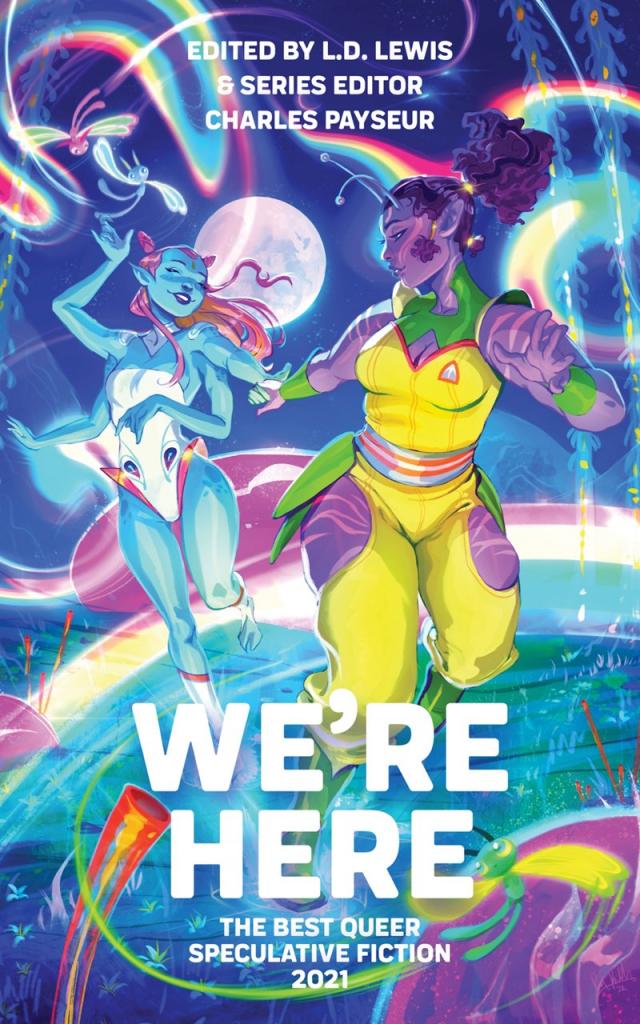
WE’RE HERE
The Best Queer Speculative Fiction 2021
Editor
L.D. LEWIS
Series Editor
CHARLES PAYSEUR
Neon Hemlock Press
www.neonhemlock.com
@neonhemlock
© 2022 Neon Hemlock Press
We’re Here: The Best Queer Speculative Fiction 2021
Edited by L.D. Lewis and Series Editor Charles Payseur
All rights reserved. No part of this publication may be reproduced, stored in a retrieval system or transmitted in any form or by any means, electronic, mechanical, photocopying, recording or otherwise without the prior permission of the publisher or in accordance with the provisions of the Copyright, Designs and Patents Act 1988 or under the terms of any license permitting limited copying issued by the Copyright Licensing Agency.
These stories are works of fiction. Names, characters, places and incidents are the products of the author’s imagination or are used fictitiously. Any resemblance to actual events, locales, organizations or persons, living or dead, is entirely coincidental.
Cover Illustration by Paul Kellam
Cover Design by dave ring
Paperback ISBN-13: 978-1-952086-54-0
Ebook ISBN-13: 978-1-952086-55-7
A NOTE FROM THE SERIES EDITOR
2021 was certainly...a year. One that saw renewed and widespread anti-LGBTQ+ legislation and energy across the United States, and indeed across the world the fight for queer rights continues to be hard fought and often disheartening. Even in the realm of publishing, book banning and censorship in the name of “family values” has been a rapid and virulent push from those who consider conversations and education about gender and sexuality better off silenced. I can only take heart that, despite the hate and discrimination finding new footholds, queer expression and art has continued to flourish. Do I worry that this very book might be banned and withheld from the hands of readers who desperately need it? I do. But I also know that the only way to counter organized hate is organized defiance. And in the face of intolerance, it’s important to shout it to those all over the world, to all those needing to hear a voice of solidarity.
And of course we affirm that even as we acknowledge that some people pass, some publications close. Prismatica Magazine joins other queer-centered speculative publications who have shuttered in recent years. With Glittership becoming dormant as well, it means that outside of anthologies or yearly efforts like Decoded Pride, the number of publications focusing on LGBTQ+ stories has dwindled. Anathema still publishes works by authors who are LGBTQ+ as well as BIPOC. And Baffling Magazine publishes quarterly issues packed with queer flash fiction. And I do still list dozens of LGBTQ+ short speculative fiction a month on my Patreon lists. So it’s not expressly accurate to say that, overall, queer stories are being published less frequently than in years past.
It was, after all, a very good year for queer-authored collections. I had my own The Burning Day and Other Strange Stories out at Lethe Press. 2020 We’re Here contributor Charlie Jane Anders’s Even Greater Mistakes came out from Tor, Isabel Yap had Never Have I Ever from Small Beer, and Kelly Robson’s Alias Space and Other Stories was released by Subterranean. Brian Koukol put out a collection of his work independently with Handicapsules: Short Stories of Speculative Crip Lit. And queer speculative novellas were all over the publishing world as well, from Aimee Ogden’s Local Star to Nino Cipri’s Defekt, from Arula Ratnakar’s “Submergence” to Shingai Njeri Kagunda’s & This is How to Stay Alive (indeed, Neon Hemlock once again put out a flight of four queer speculative novellas).
Queer-focused anthologies are still coming out with some regularity as well. Speculatively Queer, a relatively new press, published It Gets Even Better: Stories of Queer Possibility in 2021, and ran a successful crowdfunding campaign for the 2022 plant-themed follow up, Xenocultivars: Stories of Queer Growth. Lethe Press, long a stalwart of queer publishing, put out Burly Tales: Finally Fairy Tales for the Hirsute and Hefty Gay Man. From the Farther Trees published Queer Blades: A Queer Sword and Sorcery Romance Anthology. And Neon Hemlock whetted many an appetite for queer short speculative fiction with Unfettered Hexes: Queer Tales of the Insatiable Darkness. And, as briefly mentioned before, QueerSpec returned for another year of Decoded Pride: A science fiction, fantasy, and horror story-a-day anthology for Pride month. I definitely don’t want to minimize those amazing contributions to the queer speculative fiction scene.
It’s possible that queer stories are simply reaching a level of saturation across the speculative fiction field. Certainly memorable examples from prestigious publications have been nominated for and won the field’s highest honors. In many ways this very book is a testament to how widely queer stories are published, as works in this volume come from fourteen different publication. And we again received hundreds of submissions for this volume of We’re Here, which combined with my reading from the field in general, means that I probably considered over 600 stories for this volume.
That’s fantastic, and certainly a sign of the enthusiasm and passion for queer speculative fiction. But a large number does come from the special projects listed above, and though having queer stories appear across the field is definitely a good thing, I still mourn the loss of publications who keep queerness explicitly in their vision and mission.
Which is another reason why I am so happy to be a part of We’re Here, to shine this light on stories and put them into the hands of people who might have missed them otherwise. To celebrate these works from a diverse array of authors and publications and not shy away from saying that they are explicitly queer. They say that part out loud, and in a time when more and more people are trying to silence queerness, to stifle and legislate away the truths of so many, that’s vitally important.
I am especially happy to be joined in this work by this year’s guest editor, L.D. Lewis. She is an award winning writer and editor, and currently the publisher of Fireside Fiction. She is a founding creator, Art Director, and Project manager for the World Fantasy and Hugo Award-winning FIYAH Literary Magazine. She has done foundational and transformational work through her role as the founding Director of the Hugo-nominated FIYAHCON. She also acquires novellas for Tor.com and researches for the LeVar Burton Reads podcast. Her short fiction has appeared across the field, including the amazing “From Witch to Queen to God” at Mermaids Monthly in 2021 and “The Currant Dumas,” originally in Glitter + Ashes, which appeared in We’re Here 2020.
As a writer, editor, and organizer, L.D. has done so much to push speculative fiction as a field in a better direction. To show what’s possible when people step away from systems that only work for some and try to be as inclusive as possible while also getting great things done. I am so honored that she took the time amidst all the other things she’s doing to edit this volume of We’re Here. We are all very lucky.
In writing this introduction to the second volume of We’re Here, I’m struck that I’ve already done the work last year of defining what I think queer speculative fiction is and making the argument for why there should be a Best Of anthology dedicated to it (and technically I argued that there should be more Best Ofs devoted to queer speculative fiction). And rather than lay that out again, I think it’s important to recognize that the work of pushing for recognition and celebrating queer stories doesn’t become less vital over time. The origins of our title is a chant, and part of the power of a chant is that it repeats. Hopefully, it grows. And as the chant spreads from person to person, from place to place, ideas travel with it. A kind of magic happens. So that even as some voices fall silent, others fill in, and more, and more until there is no ignoring it. No avoiding it. No banning it or censoring it.
The stories in this volume once more justify their own prominence with their beauty and their defiance. With their charm and their compassion. With their centering of queer characters and themes in remarkable and remarkably diverse ways. They are the voices raised against the efforts to erase queer stories, saying...We’re Here.
* * *
Charles Payseur
May 2022
Eau Claire, WI
A NOTE FROM THE EDITOR
I’ve had this tab open for maybe a month now. The problem, you see, is I can’t quite remember where 2021 began and ended. I’m only vaguely certain it isn’t still 2021 right now.
What I’ve learned about myself over the pandemic years is that my stress response is: work. When in doubt, another project is always good medicine, the busying of idle hands leaves them unavailable as a devil’s playthings, et cetera. Create a convention. Create an awards series. Create a writing contest for LeVar Burton. Take a job administering some queer awards. Co-edit a queer lit anthology.
Between researching for LeVar Burton’s podcast and selecting material for this latest iteration of We’re Here, I have been drowning—in all the best ways— in rich, diverse, gorgeously executed short fiction.
There is something specific about queer speculative literature. In much the same way as any marginalized storytelling, there is an insistence in envisioning ourselves in every conceivable universe with every kind of power, in every quiet and cacophonous environment, every moment of vulnerability or righteous violence. I love the rebellion of it, especially now. The guerilla nature of writing and publishing defiantly with these identities is a tangible, palpable concept. Every story in a world where throngs of people want your voice and history silenced for no other reason than because your existence highlights the emptiness of their own, becomes a taunt,
And with that, I am thrilled to co-present some of the best queer speculative storytelling 2021 had to offer. Rest assured that these selections represent a drop in an ever-growing sea’s worth of us
L.D. Lewis
June 2022
Atlanta, GA
CONTENTS
A Note From the Series Editor
A Note From the Editor
The Captain & the Quartermaster
C.L. Clark
A Study in Ugliness
H. Pueyo
Mulberry and Owl
Aliette de Bodard
The Lake, the Valley, the Border Between Water and Wood, and the End of Things
Watson Neith
Let all the Children Boogie
Sam J. Miller
The Hidden Language of Flowers
Laurel Beckley
The Art and Mystery of Thea Wells
Alexandra Seidel
To Rest and to Create
L.A. Knight
A Technical Term, Like Privilege
Bogi Takács
Root Rot
Fargo Tbakhi
Twenty Thousand Last Meals on an Exploding Station
Ann LeBlanc
Blood in the Thread
Cheri Kamei
Sutekh: A Breath of Spring
Sharang Biswas
To Rise, Blown Open
Jen Brown
To Exhale Sky
Shingai Njeri Kagunda
Story Acknowledgements
Contributors
About the Editors
About the Press
THE CAPTAIN & THE QUARTERMASTER
C.L. Clark
Commander Maeb Len knows that, more than anything, an army needs hope in order to struggle onward. They need a vision to fight for and faith that the future will be better than the past. Better than the present.
The People’s Army itself is one such hope. The fall of the Tyrant is one such vision.
Commander Len also knows that people find hope in other, smaller things.
In the laughter that replaces the moaning of the wounded after a quiet winter of healing and souls put to rest.
In the green shoots of grass, wildflowers blooming in the untrampled fields around the army’s camp.
In the unwavering dedication of Commander Len and Quartermaster Omopria to each other, and to The People’s Army. Their teasing romance. The brilliance of their successes. Together, they can do anything.
Anything to remind the army that the world will go on, and that perhaps, they will, too.
Commander Len clasps arms and grips shoulders with the other officers as they gather in the command tent one last time before the final campaign against the Tyrant begins. (No one has said out loud that it is the final campaign. No one would dare.)
Captain Dhissik, the new leader of Len’s old company, gives her a fierce hug. High Commander Aulia does not. She nods gravely, warily. Lately, Len has been keeping her distance from her old sparring partner.
The new season brings new promotions, and it will take time to see how they fit.
Once they are all seated on the circle of blankets, High Commander Aulia raises a hand for quiet.
“Officers of The People’s Army.” Aulia looks at them each in turn, and Len feels the strength in Aulia’s certainty spread from officer to officer, commander and captain alike. “We’ve been fighting against the Tyrant for six years. He’s stolen our youth. He’s stolen our good looks.” She smiles, and the scar that splits from below her right eye to the left side of her sharp chin stretches. She sobers immediately, though. “He’s stolen the happier lives we might have lived, and the loved ones we might have spent them with.”
Solemn nods from all. Len isn’t the only one whose grip tightens around a sword hilt or into a fist. Here in this stuffy tent, they are the same. The People’s Fist. The Hand That Would Open the Cage.
“It’s time we steal from him.” The officers cheer Aulia’s words. “This spring, when the flowers bloom and the trees fruit, so do we.” They cheer again.
But as the high commander details the plan for the campaign, Len’s heart sinks. They will need the best quartermaster in the world for such a risky campaign. The Army’s standing supply caches had been targeted early in the war. Their quartermaster had worked without sleep to decentralize what remained. From then on, each unit became responsible for carrying a portion of the Army’s stores so the Tyrant couldn’t destroy them with a single blow. It is a delicate balance; one overlooked shortage or faulty supply line, and the entire Army risks slaughter or starvation.
And unlike everyone else in the room, Len knows in her bones that the best quartermaster in the world wants to leave The People’s Army and go home. She doesn’t think Quartermaster Omopria will last another full campaign.
The worst part about it is that Len can’t blame her, won’t blame her, if she leaves.
While the other officers leave the command tent feeling determined, Len finds herself drifting. Instead of convening with her captains, she stands outside of the tent and watches the camp shake off winter’s slumber. There, in the eastern corner, is the sparring square, bright with the clack of wood, the grunts of effort and laughter.
There, toward the center of the camp, the supply wagons, where Quartermaster Omopria and her staff would be, counting and loading, loading and counting. Someone is cooking the beans for lunch.
Then she looks to the north, toward the city where the Tyrant waits, not knowing he has rats in his larder, stealing hope for The People.
“Is everything all right?”
Len jumps at High Commander Aulia’s soft voice beside her. “Fifth,” Len greets her with her old company’s name.
Len knows that the smile she gives doesn’t pass muster. Aulia’s expression softens with understanding. Somehow, the scar on her face only makes the expression more tender.
“I know it’s none of my business, but the soldiers talk and—”
Len walls up her expression, and she looks balefully at the high commander of The People’s Army.
Aulia crosses her hands awkwardly behind her back, leather armor creaking. “Just. If you need anything, I’m here. I was married once, too.”
“Oh?” Len turns sharply, hungry for someone else’s answers. Someone else’s sorrow to show her what to do with her own. “What happened?”
“A little thing called a civil war.” A complicated grief crosses Aulia’s face.
Cold fills Len’s belly as realization dawns. “We’re fighting them.”
Aulia nods solemnly. “We’re fighting them.”
“I’m so sorry.”
“So am I.”
A long time ago, when The People’s Army was first born from the spark of rebellion against the Tyrant, Captain Maeb Len of the Third Company trudged back into camp on her own sore feet. Agno, her horse, had fallen, stabbed behind one of his legs, and she’d jumped from the saddle, praying for mercy and so much blind luck. She hadn’t even had time to cut his poor throat before she had to face the onslaught of the enemy. Maybe the very ones who’d brought down Agno.





