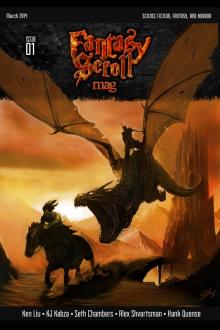
The Veiled Throne, page 24


“You know what I miss the most?” asked Toof one day as the group of linguists, finished with another joint lesson, lounged about the foredeck. The sun was bright, the sky cloudless, and the sails flapped gently in the cool breeze.
“What?” asked Captain Gon. He was supervising the sailors as they set up a grill on the foredeck in preparation for the catch of the day.
“Mouflon sponge,” said Toof.
“Oh, I’ll second that,” said Radia. Even Takval nodded and licked his lips.
“How do you make it?” asked Captain Gon. As part of the linguistic exchange around Thoryo, they were conversing in a mixture of languages at this point, with the Lyucu and Agon instructors trying to speak as much as possible in Dara, while the Dara instructors endeavored to speak in the language of the scrublands.
“Definitely hot,” said Toof, “especially if cooked in the cap, without being plucked.”
“Definitely cold,” said Radia, “preferably sliced fresh and served with the original sauce.”
“Definitely dried,” said Takval, “preferably salted, though honeyed sponge is good too.”
“Only an Agon would think that an appropriate way to prepare mouflon sponge,” scoffed Toof.
“Only a Lyucu would think it appropriate to deny those away from the hunt the pleasures of mouflon sponge,” said Takval.
Captain Gon spoke for the rest of the Dara in the group when he asked, “Err… just where do you find this ‘mouflon sponge’?”
Toof and Radia, being relatively unskilled in speaking Dara, sometimes made memorable howlers. Captain Gon wasn’t sure Toof knew the exact words he was looking for.
The three mouflon sponge aficionados turned as one to him. “You mean you don’t eat the sponge of animals? It is the most delicious part,” said Radia.
“Maybe we do,” said an exasperated Captain Gon. “But I don’t know what you’re talking about!”
“The best way to enjoy sponge, whether mouflon, deer, or cattle, is to leave the sponge where it is and cook the whole skull like a pot over a banked bed of ashes,” Toof said. He had to swallow a mouthful of saliva as he conjured up memories of his favorite treat. “And then, you just sprinkle in some sea salt and squirt in a few lobes’ worth of gash cactus juice, and dig in with an antler spoon.”
“Is this ‘sponge’… the brains of the mouflon?” Commander Tho’s face was turning white.
“Of course!” said Radia. “But you don’t call it ‘brains’ when eating it. It is the most nourishing part of the animal. However, Toof is wrong about the best way to enjoy the dish. It’s best to extract the sponge and cut it into very thin slices with a good stone knife. Then you should eat it raw so that the flavor is unspoiled by any extra seasoning, except perhaps a dipping sauce of blood. This has to be done when the sponge is very fresh, though, and ideally when the heart hasn’t yet stopped beating.”
“But that’s barbaric!” said Commander Tho.
“How is that barbaric?” asked Takval.
“To have the heart of the animal still beating while you dine upon its brains—” Commander Tho couldn’t finish as she gagged at the thought.
“Do you not kill your animals to obtain meat?” asked Radia.
“We do,” said Captain Gon, his face twisted in distaste. “But we don’t delight in the slaughter.”
“And a gentleman of learning and virtue goes nowhere near the kitchen, especially not a Cultivationist,” said Razutana. “The Moralist Poti Maji said that to cultivate virtue, one must stay away from the chopping block and the cleaver, the blood and gore of the slaughterhouse, as well as the smoke and oil of the frying pan. To be exposed to death in this manner corrupts the sensitive soul dedicated to growth and breeding.”
“Then a virtuous and learned gentleman must starve?” asked Takval.
“Of course not! But the food should be prepared by servants into a civilized form before it may be consumed. Fish should be filleted, meat should be chopped into bite-sized chunks, and birds should not be served unless feet and heads are removed.”
“Well, that’s only if you could afford it,” muttered Tipo Tho. “The rest of us eat fish heads and chicken feet, and are grateful for it.”
“It’s an ideal to aspire to,” said Razutana.
“In other words, the food should be served so that it doesn’t resemble food,” said Takval contemptuously.
“That’s not quite how I would put it—”
“That is exactly how you should put it,” said Takval. For the moment, there seemed to be a kind of Lyucu-Agon alliance against Dara in the debate. “It sounds to me like your Moralist and Cultivationist philosophers advocate hypocrisy so that they may ignore the fact that their lives depend on slaughter. I think it’s far more ‘civilized’ to face the reality of what we eat, to feel the blood squirting out of the dying body even as we feast on it, to be thankful for the gift of the weak to the strong by consuming every part that may yield nourishment.”
“Even if all eating depends on death,” said Razutana, “there is a difference between taking pleasure in the death throes of the victim and minimizing exposure to pain and suffering. Kon Fiji, the One True Sage, said that if we could all survive on dew and air, we should do so. That we cannot is a great tragedy of our mortality. We are better than beasts who know only tooth and claw, or at least we should strive to be.”
“I think there is no greater barbarism than to eat meat while pretending it is something else,” said Takval. His face had turned red and his voice had risen.
“That’s enough, all of you,” said Théra, arriving late to the argument. She didn’t like how a harmless conversation about food had degenerated so quickly into mutual contempt and accusations of barbarism. It revealed just how much tension there was beneath the surface of her crew.
The others seemed unwilling to give up the fight, but in that temporary lull, the sounds of quiet weeping grabbed their attention. They turned and saw that it was Thoryo, who stood crying over the fish being grilled on the foredeck.
“What’s wrong?” asked Théra.
“I think the greatest barbarism of them all is that we all have to die,” she said. “You’re here arguing over what way to kill and eat is more civilized, but what separates any of you from this fish? Nothing. Whether we are strong or weak, barbaric or civilized, in the end we all end up as food for something else. Why spend so much of the little time you have to show how you’re superior to someone else? That is all vanity.”
“But the Ano sages say that there are things more important than life—” began Razutana.
“But the gods have promised the brave and worthy a ride upon the cloud-garinafin—” began Takval.
“Why should I listen to the Ano sages and the gods?” said Thoryo. “The sages no longer breathe and the gods never speak as we do. What do they know of the bodies scattered upon the sea after a battle? What do they know of the infinite wonders of the mind extinguished upon the death of every life? What do they know of being alive?”
* * *
As the days grew longer and then shorter, as the sun shifted from one side of the ship to the other, as the stars changed overhead, the fleet sailed into even more eerie waters.
From time to time, lookouts announced that they sighted land in the distance, replete with shimmering cities and streaming carriages on the horizon. Knowing that they were mirages, Théra and Takval refused to steer for them.
But the fleet also sailed over vast sunken reefs, and as sunlight glinted off the colorful corals, they thought they could see cities beneath. The decision was made to have Dissolver of Sorrows dive beneath the surface to investigate, having first tethered her to two other ships on the surface for propulsion.
The officers stood in the captain’s quarters and watched in awe as their ship glided over a sunken ruin.
“This is like being in an airship,” whispered Commander Tho. And those who had flown in an airship nodded.
Beneath them, broken stone columns showed the outlines of ancient temples, and formations of corals sketched out long-inundated roads. Collapsed buildings lay open to the sea, their angular roofs in pieces at their feet. Crabs skittered across courtyards with mosaic floors whose patterns were still discernible after who knew how many millennia.
They saw piles of rubble with broken walls and lintels, through which schools of fish swam as though they were the natural heirs of the lost civilization. They saw eels dash from crumbled towers as the shadow of their underwater ship passed over them like the shadow of a cloud, as though the eels were still defending the lost city against a prophesied invasion. They saw jellyfish dance through the tiered seats of octagonal theaters, as though performing for a ghost audience.
“It was said that the Ano had escaped their homeland far to the west when it sank into the ocean,” whispered Théra. “Could these be the ruins of that mystical realm?”
No one answered.
As evening fell, Dissolver of Sorrows surfaced, and the fleet was back on their way, but for a long time that night, no one could sleep, thinking about what they had seen.
Takval heard light scratching noises against his cabin door. He opened it and found Théra standing outside. Surprised, he asked her to come in.
“What’s troubling you?” he asked.
“I don’t know how to explain it,” she said, hesitant. “But I fear that the ruins were an ill omen.”
“Why?”
“The Ano were a wondrous people, refined and full of knowledge. But they were also riven from within by divisions. In the sagas, it was said that when their homeland began to sink into the ocean, instead of coming together to meet the common threat, they fell into internecine warfare over the dwindling land. In the end, they had no choice but to leave for new shores, refugees who found a new home in Dara.”
“What does that… have to do with you?”
“The Ano were my ancestors, and we revere them. But what if we have inherited not just their civilization and refinement, but also their capacity for self-destruction?”
“My ancestors were also a wondrous people, and they also had stories that serve as warnings against internal strife.”
And so Takval told Théra the story of Kikisavo and Afir, of their unparalleled bond, of their victories over the gods, of Kikisavo’s jealousy and betrayal, and of Afir’s reluctant decision to go to war against him.
“According to some shamans,” said Takval. “Kikisavo and Afir were not just friends, but also lovers. She never could forgive him, but she also couldn’t forget him. After Kikisavo was exiled beyond the sea after his defeat, Afir would send him food on the backs of turtles.”
“A sort of care package, I suppose,” said Théra, smiling. When Takval did not understand the reference, she explained the Dara custom for wives to send husbands comfortable under-tunics and warm socks they made when the men were away at war, or for parents to send homemade treats to children studying in Ginpen or taking the Grand Examination in Pan.
“Though I don’t understand all the customs of Dara,” said Takval, “I understand the love that endures between husband and wife, between parent and child, between brother and sister, between individuals who consider themselves one people.”
“But is love enough? Will Dara survive the Lyucu invasion? Will we be able to rally your people to freedom? Or will petty jealousy and ambition destroy all that we yearn for? Have we been shown a sign today in the ruins beneath the waves?”
“We’re not our ancestors,” said Takval. “We can only do what we believe is best.”
“I don’t know if the best is enough, when weighed against human nature, fate, and the whims of the gods. I’m afraid, Takval. I’m afraid.”
“Stay with me then, and we’ll tell each other happier stories. I am no shaman and cannot read omens, but don’t you remember how beautiful the ruins looked? How full of life? Finned and clawed, the new denizens were not troubled by tales of the past.”
Théra smiled. “That’s lovely. The fish did look happy, didn’t they?”
“So let my thinking-breath comfort your heart and yours mine.”
She nodded and leaned against him, and he embraced her, less awkwardly than before.
* * *
Thoryo’s quick progress in languages never slackened. Once she was confident with her speech, she demanded her instructors tell her about the histories of the three peoples she found herself among. She learned about Dara legends as well as Lyucu myths; she listened to stories about Ano sages as well as Agon heroes. She didn’t pass judgment on what she heard, seemingly soaking it all in like a sponge.
“Why do the gods seem to decline in power in all of your stories?” she asked one night as the group gazed up at unfamiliar stars and tried to make new patterns out of them.
“How do you mean?” asked Takval.
“In your stories, the gods once created the heavens and the earth, and fashioned the people and every living thing. At a whim they created new stars out of failed gods and new races out of inert matter. But now they are living beyond the mountains at the world’s edge, and do not make their presence felt except to bring about a storm or guide the mouflon herds from one part of the scrublands to another.”
Takval, Radia, and Toof contemplated this and were silent.
“And in your stories,” Thoryo said, turning to Théra and Razutana and the others from Dara, “the gods once constructed the Islands with tears and sweat, created mountains out of valleys, brought lakes forth from the desert. They fought right next to the heroes of your sagas, slaughtering thousands at a single blow. But now they seem absent from the world, only speaking through obscure oracles that are subject to diverse interpretations, giving no clear guidance.”
“I have wondered the same myself,” said Théra. “The apparent withdrawal of the gods from human affairs is a question that has plagued philosophers throughout history.”
“Could the gods, in fact, not exist at all?” asked Thoryo. “Are they but figments of the imagination, metaphors and allegories offered to explain what could not be explained? Are the old legends mere stories?”
Toof, Radia, Captain Gon, and Commander Tho, who were more pious, muttered prayers to their own gods and looked askance at the others. There was an uncomfortable silence.
“You ask a question that may be unanswerable.” It was Razutana who eventually spoke. “The best answer I know comes from Kon Fiji, who admonished us to respect the gods but to keep them at arm’s length.”
“What did Kon Fiji mean, exactly?” asked Admiral Roso. “I’ve never quite understood that particular adage.”
“I think he meant that we can’t know for certain if the gods are mere metaphor and allegory,” said Razutana. “But if the gods have chosen to remain mostly silent now, it’s best to heed their wishes and to seek our own answers to our problems.”
“So the gods are lazy?” asked Thoryo. “Having created the world and populated it, they then abandoned everything?”
“I wouldn’t put it as lazy,” said Razutana. “Parents must do everything for their children when they’re first brought into the world, but then they stand back when the children are grown. It’s possible that the gods thought fit to intervene much more in the infancy of the human race, but now that we’re more mature, they’ve decided to let go. We can no longer rely on them for everything like a toddler still attached to the apron strings of its mother.”
“I find this answer most unsatisfactory,” said Thoryo. “In the legends of the Agon, Lyucu, and Dara, the gods were jealous, vain, self-serving, worse than humans in many ways. They didn’t always behave as fit parents, and I cannot see why we should assume they’ve changed. I think the most likely answer is that the gods were constructed in the image of the humans themselves, and not real at all.”
Once again, the pious members of the group looked uncomfortable, but they were not skilled in debate and hoarded their words carefully.
“That is a position that many philosophers over the years have taken as well,” said Théra eventually. “Huzo Tuan, a leading voice of the Skeptic school, argued that faith in the gods is the source of all our problems. But I have felt the presence of divinity in my own life, and so I cannot subscribe to a theory of complete denial. The world is more interesting, to my mind, with the gods in it than without.”
“Then why do you think the gods seem so much more distant and weaker now?” asked Thoryo.
“I’m no priest nor philosopher,” said Théra, “and so I cannot say I’ve given this deep thought. But perhaps the gods are like children on the beach, who, having constructed wondrous cities and sculpted animals out of sand, now prefer to stand back in admiration rather than stomping through their creation, which would wreck it.”
“That is an interesting interpretation,” said Thoryo. “So the gods are not parents in your view, but fellow children with humanity.”
“There is a wonder that comes to us after having built something beautiful,” said Théra, “and I don’t think the gods are immune to such charms.”
“When I was little,” said Takval, “the other children and I built miniature tent-cities and landscapes from grass, mud, discarded bone, and bits of skin and sinew. Sometimes we caught voles and sand lizards and populated these camps with them. We watched them fight and run and told epic tales of glory and conquest. I know of what you speak.”
Théra smiled at the thought of her intended as a playful god over a domain of his creation. “I remember weaving houses out of twigs and grass in the Palace Garden as a little girl, and Fara would put a roof on each with a banana leaf. Phyro and Timu liked to pull up the flowers planted by our mothers to create wide avenues and line them with pebble-built palaces. We peopled them with ants, caterpillars, turtles from the creek that ran though the Palace Garden, and even baby birds we found hopping through the grass.”