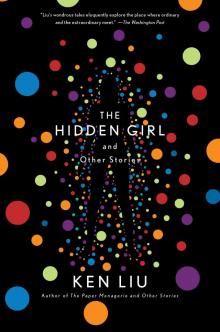
The Hidden Girl and Other Stories, page 1


Thank you for downloading this Simon & Schuster ebook.
Get a FREE ebook when you join our mailing list. Plus, get updates on new releases, deals, recommended reads, and more from Simon & Schuster. Click below to sign up and see terms and conditions.
CLICK HERE TO SIGN UP
Already a subscriber? Provide your email again so we can register this ebook and send you more of what you like to read. You will continue to receive exclusive offers in your inbox.
Publisher’s Notice
The publisher has provided this ebook to you without Digital Rights Management (DRM) software applied so that you can enjoy reading it on your personal devices. This ebook is for your personal use only. You may not print or post this ebook, or make this ebook publicly available in any way. You may not copy, reproduce, or upload this ebook except to read it on your personal devices.
Copyright infringement is against the law. If you believe the copy of this ebook you are reading infringes on the author’s copyright, please notify the publisher at: simonandschuster.biz/online_piracy_report.
To my grandmother, Xiaoqian, who taught me how to tell stories.
And to Lisa, Esther, and Miranda, who showed me why stories are important.
Contents
Preface
Ghost Days
Maxwell’s Demon
The Reborn
Thoughts and Prayers
Byzantine Empathy
The Gods Will Not Be Chained
Staying Behind
Real Artists
The Gods Will Not Be Slain
Altogether Elsewhere, Vast Herds of Reindeer
The Gods Have Not Died in Vain
Memories of My Mother
Dispatches from the Cradle: The Hermit—Forty-Eight Hours in the Sea of Massachusetts
Grey Rabbit, Crimson Mare, Coal Leopard
A Chase Beyond the Storms
An excerpt from The Veiled Throne, The Dandelion Dynasty, book three
The Hidden Girl
Seven Birthdays
The Message
Cutting
Acknowledgments
About the Author
Preface
There is a paradox at the heart of the art of fiction, at least as I’ve experienced it: while the medium of fiction is language, a technology whose primary purpose is communication, I can only write satisfying fiction by eschewing the communicative purpose.
An explanation. As the author, I construct an artifact out of words, but the words are meaningless until they’re animated by the consciousness of the reader. The story is co-told by the author and the reader, and every story is incomplete until a reader comes along and interprets it.
Each reader comes to the text with their own interpretive frameworks, assumptions about reality, background narratives concerning how the world is and ought to be. These are acquired through experience, through every individual’s unique history of encounters with irreducible reality. The plausibility of plot is judged against these battle-scars; the depth of characters is measured against these phenomenon-shadows; the truth vel non of each story is weighed with the fears and hopes residing in each heart.
A good story cannot function like a legal brief, which attempts to persuade and lead the reader down a narrow path suspended above the abyss of unreason. Rather, it must be more like an empty house, an open garden, a deserted beach by the ocean. The reader moves in with their own burdensome baggage and long-cherished possessions, seeds of doubt and shears of understanding, maps of human nature and baskets of sustaining faith. The reader then inhabits the story, explores its nooks and crannies, rearranges the furniture to suit their taste, covers the walls with sketches of their inner life, and thereby makes the story their home.
As an author, I find trying to build a house that would please every imagined future inhabitant limiting, constricting, paralyzing. Far better to construct a house in which I would feel at home, at peace, consoled by the sympathy between reality and the artifice of language.
Yet, experience has shown that it is when I am least aiming to communicate that the result is most open to interpretation; that it is when I am least solicitous of the comfort of my readers that they are mostly likely to make the story their home. Only by focusing purely on the subjective do I have a chance at achieving the intersubjective.
Picking the stories for this collection was thus, in more than one way, much easier than picking the stories for my debut, The Paper Menagerie and Other Stories. Gone was the pressure to “present.” Rather than worrying about which stories would make the “best” collection for imaginary readers, I decided to stick with stories that most pleased myself. My editor, Joe Monti, was invaluable in this process and managed to weave the result into a table of contents that told a meta-narrative I couldn’t have seen myself.
May you find a story in here to make your home.
Ghost Days
3.
NOVA PACIFICA, 2313
Ms. Coron pointed to the screen-board, on which she had typed out a bit of code.
(define (fib n)
(if (< n 2)
1
(+ (fib (− n 1)) (fib (− n 2)))))
“Let’s diagram the call-graph for this classic LISP function, which computes the n-th Fibonacci number recursively.”
Ona watched her Teacher turn around. The helmetless Ms. Coron wore a dress that exposed the skin of her arms and legs in a way that she had taught the children was beautiful and natural. Intellectually, Ona understood that the frigid air in the classroom, cold enough to give her and the other children hypothermia even with brief exposure, was perfectly suited to the Teachers. But she couldn’t help shivering at the sight. The airtight heat-suit scraped over Ona’s scales, and the rustling noise reverberated loudly in her helmet.
Ms. Coron went on, “A recursive function works like nesting dolls. To solve a bigger problem, a recursive function calls on itself to solve a smaller version of the same problem.”
Ona wished she could call on a smaller version of herself to solve her problems. She imagined that nested inside her was Obedient Ona, who enjoyed diagramming Classical Computer Languages and studying prosody in Archaic English. That would free her up to focus on the mysterious alien civilization of Nova Pacifica, the long-dead original inhabitants of this planet.
“What’s the point of studying dead computer languages, anyway?” Ona said.
The heads of the other children in the classroom turned as one to look at her, the golden glint from the scales on their faces dazzling even through the two layers of glass in their and Ona’s helmets.
Ona cursed herself silently. Apparently, instead of Obedient Ona, she had somehow called on Loudmouth Ona, who was always getting her in trouble.
Ona noticed that Ms. Coron’s naked face was particularly made up today, but her lips, painted bright red, almost disappeared into a thin line as she tried to maintain her smile.
“We study classical languages to acquire the habits of mind of the ancients,” Ms. Coron said. “You must know where you came from.”
The way she said “you” let Ona know that she didn’t mean just her in particular, but all the children of the colony, Nova Pacifica. With their scaled skin, their heat-tolerant organs and vessels, their six-lobed lungs—all engineered based on models from the local fauna—the children’s bodies incorporated an alien biochemistry so that they could breathe the air outside the Dome and survive on this hot, poisonous planet.
Ona knew she should shut up, but—just like the recursive calls in Ms. Coron’s diagram had to return up the call stack—she couldn’t keep down Loudmouth Ona. “I know where I came from: I was designed on a computer, grown in a vat, and raised in the glass nursery with the air from outside pumped in.”
Ms. Coron softened her voice. “Oh, Ona, that’s not… not what I meant. Nova Pacifica is too far from the home worlds, and they won’t be sending a rescue ship because they don’t know that we survived the wormhole and we’re stranded here on the other side of the galaxy. You’ll never see the beautiful floating islands of Tai-Winn or the glorious skyways of Pele, the elegant city-trees of Pollen, or the busy data warrens of Tiron—you’ve been cut off from your heritage, from the rest of humanity.”
Hearing—for the millionth time—these vague legends of the wonders that she’d been deprived of made the scales on Ona’s back stand up. She hated the condescension.
But Ms. Coron went on, “However, when you’ve learned enough to read the LISP source code that powered the first auto-constructors on Earth; when you’ve learned enough Archaic English to understand the Declaration of New Manifest Destiny; when you’ve learned enough Customs and Culture to appreciate all the recorded holos and sims in the Library—then you will understand the brilliance and elegance of the ancients, of our race.”
“But we’re not human! You made us in the image of the plants and animals living here. The dead aliens are more like us than you!”
Ms. Coron stared at Ona, and Ona saw that she had hit upon a truth Ms. Coron didn’t want to admit, even to herself. In the Teacher’s eyes, the children would never be good enough, never be fully human, though they were the future of humanity on this inhospitable planet.
Ms. Coron took a deep breath and went on as if nothing had happened. “Today is the Day of Remembrance, and I’m sure you’ll impress all the Teachers with your presentations later. But let’s finish our lesson first.
“To compute the n-th term, the recur sive function calls itself to compute the (n–1)th term and the (n–2)th term, so that they could be added together, each time going back earlier in the sequence, solving earlier versions of the same problem.…
“The past,” Ms. Coron continued, “thus accumulating bit by bit through recursion, becomes the future.”
The bell rang, and class was finally over.
* * *
Even though it meant they had less time to eat, Ona and her friends always made the long walk to have lunch outside the Dome. Eating inside meant squeezing tubes of paste through a flap in her helmet or going back to the claustrophobia-inducing tanks of the dormitory.
“What are you going to do?” Jason asked, biting into a honeycomb fruit—poisonous to the Teachers, but all the children loved it. He had glued white ceramic tiles all over his suit to make it look like an ancient space suit from the old pictures. Next to him was a flag—the old Stars and Stripes of the American Empire (or was it the American Republic?)—his artifact, so that he could tell the legend of Neil Armstrong, Moonwalker, at the Remembrance Assembly later that evening. “You don’t have a costume.”
“I don’t know,” Ona said, twisting off her helmet and stripping off her suit. She took deep gulps of warm, fresh air, free of the suffocating chemical odor of the recycling filters. “And I don’t care.”
Everyone presenting at the Remembrance Assembly was supposed to be in costume. Two weeks ago, Ona had received her assigned artifact: a little, flat metal piece with a rough surface about the size of her palm and shaped like a toy spade. It was dark green in color, with a stubby, fat handle and a double-tined blade, heavier than its size would suggest. It was a family heirloom that belonged to Ms. Coron.
“But these artifacts and stories are so important to them,” Talia said. “They’ll be so angry that you didn’t do any research.” She had glued her artifact, a white veil, over her helmet and put on a lacy white dress over her suit so that she could enact a classical wedding with Dahl, who had painted his suit black to imitate the grooms he had seen in old holos.
“Who knows if the stories they tell us are true, anyway? We can never go there.”
Ona placed the little spade in the middle of the table, where it absorbed the heat from the sun. She imagined Ms. Coron reaching out to touch it—a precious keepsake from a world she will never see again—and then screaming because the spade was hot.
You must know where you came from.
Ona would rather use the spade to dig up the past of Nova Pacifica, her planet, where she was at home. She wanted to learn about the history of the “aliens” far more than she wanted to know about the past of the Teachers.
“They cling to their past like rotten glue-lichen”—as she spoke she could feel fury boiling up inside her—“and make us feel bad, incomplete, like we’ll never be as good as them. But they can’t even survive out here for an hour!”
She grabbed the spade and threw it as hard as she could into the whitewood forest.
Jason and Talia stayed silent. After a few awkward minutes, they got up.
“We have to get ready for the Assembly,” Jason murmured. And they went back inside.
Ona sat alone for a while, listlessly counting the darting shuttlewings overhead. She sighed and got up to walk into the whitewood forest to retrieve the spade.
Truth be told, on bright, warm autumn days like this, Ona wanted nothing more than to be outside, suitless and helmetless, wandering through the whitewood groves, their six-sided trunks rising into the sky, the vibrating silver-white hexagonal leaves a canopy of mirrors, their susurration whispers and giggles.
She watched the flutter-bys dance through the air, their six translucent, bright blue wings beating wildly as they traced out patterns in the air she was sure was a kind of language. The Dome had been built on the site of an ancient alien city, and here and there, the woods were broken by hillocks—piles of angular rubble left behind by the mysterious original inhabitants of this planet who had all died millennia before the arrival of the colony ship, alien ruins exuding nothing but a ghostly silence.
Not that they’ve tried very hard, Ona thought. The Teachers had never shown much interest in the aliens, too busy trying to cram everything about old Earth into the children’s heads.
She felt the full warmth of the sun against her face and body, her white scales coruscating with the colors of the rainbow. The afternoon sun was hot enough to boil water where the whitewood trees didn’t shade the soil, and white plumes of steam filled the forest. Though she hadn’t thrown the spade far, it was hard to find it among the dense trees. Ona picked her way slowly, examining every exposed root and overturned rock, every pile of ancient rubble. She hoped that the spade hadn’t been broken.
There.
Ona hurried over. The spade was on the side of a pile of rubble, nestled among some tinselgrass that cushioned its fall. A small spume of steam was trapped under it, so that it seemed to be floating over the escaping water vapor. Ona leaned closer.
The steam held a fragrance that she had never smelled before. The spume had blasted away some of the green patina encrusting the spade, revealing the gleaming golden metal underneath. She suddenly had a sense of just how ancient the object was, and she wondered if it was some kind of ritual implement, vaguely remembering the religion excerpts from Customs and Culture class—ghost stories.
She was curious, for the first time, whether the previous owners ever imagined that the spade would one day end up a billion billion miles from home, on top of an alien tomb, in the hands of a barely-human girl who looked like Ona.
Mesmerized by the smell, she reached for the spade, took a deep breath, and fainted.
2.
EAST NORBURY, CONNECTICUT, 1989
For the Halloween dance, Fred Ho decided to go as Ronald Reagan.
Mainly it was because the mask was on sale at the Dollar Store. Also, he could wear his father’s suit, worn only once, on the day the restaurant opened. He didn’t want to argue with his father about money. Going to the dance was shock enough for his parents.
Also, the pants had deep pockets, good for holding his present. Heavy and angular, the little antique bronze spade-shaped token had been warmed by his thigh through the thin fabric. He thought Carrie might like to use it as a paperweight, hang it as a window decoration, or even take advantage of the hole at the handle end to turn it into an incense holder. She often smelled of sandalwood and patchouli.
Picking him up at his house, she waved at his parents, who stood in the door, confused and wary, and did not wave back.
“You look dapper,” Carrie said, her mask on the dashboard.
He was relieved that Carrie had approved of his costume. Indeed, she did more than approve. She had dressed up as Nancy Reagan.
He laughed and tried to think of something appropriate to say. By the time he settled on “You look beautiful,” they were already a block away, and it seemed too late. So he said, “Thank you for asking me to the dance,” instead.
The field house was festooned with orange streamers, plastic bats, and paper pumpkins. They put on their masks and went in. They danced to Paula Abdul’s “Straight Up” and then Madonna’s “Like a Prayer.” Well, Carrie danced; Fred mostly tried to keep up.
Though he still moved as awkwardly as ever, the masks somehow made it easier for him not to worry about his lack of the most essential skill for surviving an American high school—blending in.
The rubber masks soon made them sweaty. Carrie drank cup after cup of the sickly-sweet punch, but Fred, who opted to keep his mask on, shook his head. By the time Jordan Knight began to sing “I’ll Be Loving You (Forever),” they were ready to get out of the dark gym.
Outside, the parking lot was filled with ghosts, Supermans, aliens, witches, and princesses. They waved at the presidential couple, and the couple waved back. Fred kept his mask on and deliberately set a slow pace, enjoying the evening breeze.
“Wish it could be Halloween every day,” he said.
“Why?” she asked.