

Hellfire c-20, page 12
part #20 of Carrier Series
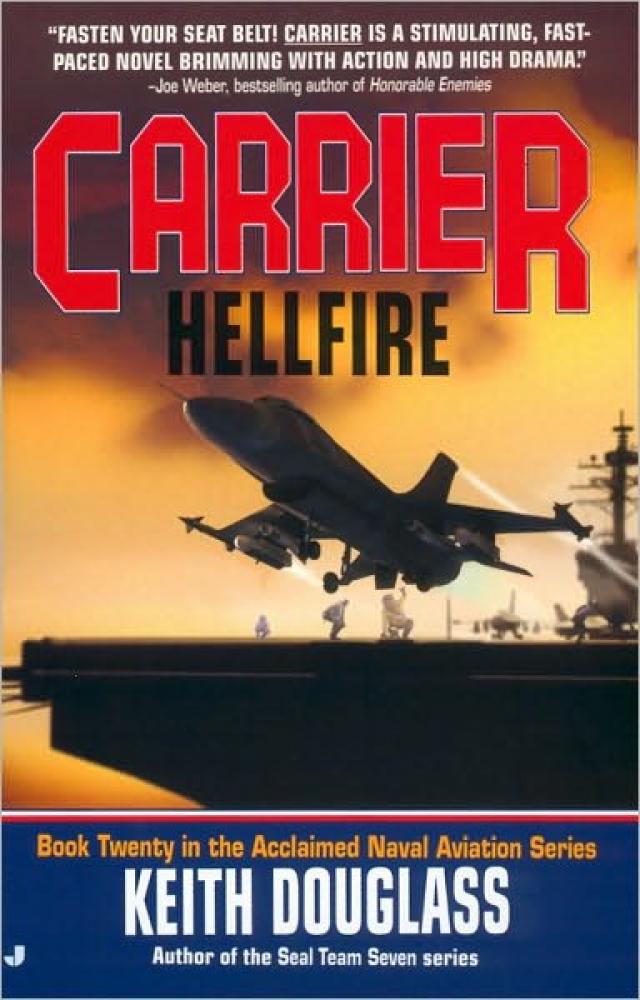


“He sees it,” Jeremy said. “It’s got a lock, he’s got a lock — shit, they’ve launched! Incoming, Tombstone!”
“I got it,” Tombstone said as the symbol popped into being on his display. “Activating countermeasures — hold on, Jeremy.”
Tombstone put the Tomcat into a hard climb, rocketing up at nearly a completely vertical angle. The g-forces slammed Jeremy back into his seat, sitting on his chest like a five-hundred-pound tiger. He grunted, tensing all his muscles, forcing oxygen to his brain to prevent gray out. Just when he thought he would lose the battle, even with his anti-G suit, Tombstone pulled the Tomcat out of the climb and into level flight.
“It’s still on us,” Jeremy shouted as his vision cleared enough for him to make out the radar screen. “More countermeasures!” He popped off chaff and flares from the undercarriage of the aircraft. The bright hot spots and confusing metal strips would create additional targets for the missile, be it heat-seeking or radar. “Commencing spoofing.” The test electronics built into the new model of Tomcat enabled it to intercept radar signals and to feed back, with a split-second difference, an identical pulse to the original sender. The transmissions from the Tomcat would look like returns from the missile’s own radar. This would confuse it, causing it to reposition and chase the false target. The false radar returns had to be just right, not so strong that they were immediately obvious as a countermeasure, yet solid enough to override the real returns from the radar’s own signal generator.
This particular Tomcat possessed one of the most advanced spoofing sets ever designed. Tombstone’s uncle had a close relationship with a contractor, the result of all of his years as chief of naval operations, and quietly, without informing anyone else, he had loaded the latest electronics along with signal generators into this particular bird. The problem in using them lay in the fact that they would confuse the carrier as well, who was not expecting to see that particular signal radiating from a Tomcat.
“Got it!” Jeremy crowed as the missile turned hard to the right and was lost in the midst of the flares. “Not sure which one worked, maybe all of them. More incoming!”
On tactical, the other Tomcats were calling out their shots as well, firing the preferred AMRAAM and following it up with heat seekers. The orderly arrangement of Tomcats and Forgers was now a furball of launches, missiles, and countermeasures. The confusion was made worse by the fact that they were all working off the carrier’s targeting data, and the carrier was still having a problem dealing with Tombstone’s Tomcat’s spoofing.
“Jamming is secured,” a surprised voice said over tactical. “Turn on your own radars — stand by for synchronization.”
Jeremy flipped a switch. His radar had been placed in standby rather than completely secured — standard procedure — and was already warmed up and ready to transmit. In moments, their own picture was back on the screen.
Below them and off to their right, a fireball exploded in the air. It was a hard yellow and orange, so bright that it hurt to look at it. Black smoke boiled out immediately, and encompassed the entire area until it looked like a thundercloud with a fire inside.
“Bears,” Jeremy said, noting that all the Tomcats were still present. “And another!” A second fireball, slightly higher than the first one, tore through the sky.
“Stony, Home Plate,” a voice said, and Jeremy recognized it as the admiral. “Change of plans — you’re first on deck. I’m turning you over to the TAO for further instructions, but I want to see you as soon as possible.”
“They’re running,” Jeremy said. The two symbols representing the remaining Forgers had turned away from the port fireball and were going on afterburner toward their own carrier. “Coming to their senses or working off orders?”
“Maybe they finally got it straightened out,” Tombstone said. “It still doesn’t make sense that they went after the COD. Especially not after what happened.”
“Maybe they were trying to retaliate.”
“Maybe.” But Jeremy could tell that Tombstone wasn’t convinced. To tell the truth, neither was he.
Greyhound 601
0316 local (GMT-9)
Beside her, Jeff was swearing quietly. They could both see the fireballs high in the air, as could a few of the other passengers. Even with the noise in the passenger compartment, she could hear voices raised, and feel the uneasiness crescendoing to fear running through the aircraft.
Suddenly, they smashed into the deck, the motion throwing them all forward hard against their restraining harnesses. After the roller-coaster motion in the roiled air astern of the carrier, it felt like they had crashed.
Someone near the tail of the aircraft screamed, a high-pitched voice clearly well advanced into terror. Drake smiled. “Welcome to the fleet, Winston.” Beside her, Jeff nodded.
Tomcat 201
0330 local (GMT-9)
“One zero one, call the ball,” the tower said, indicating that Tombstone should sing out when he located the Fresnel lens on the stern of the carrier. From that point on, his flight would be controlled by the landing signals officer, or LSO, who would have visual contact on him and his position relative to the carrier’s deck.
“Ball, 101,” Tombstone said, his voice calm but tense.
“Roger, 101, I have you, sir,” came the voice of the LSO. “One zero one, say needles.” This was a request that Tombstone report on the readings of his automatic glide path indicators. If they agreed with the LSO’s assessment of Tombstone’s position on the required flight path, Tombstone would be told to fly needles, meaning that he could rely on them in making corrections to his flight path. More often than not, the LSO was not satisfied with the needles picture and would proceed to guide the aircraft in by himself.
“Needles high and right,” Tombstone said. That assessment disagreed with his own assessment of where they were, and it was no surprise when the LSO said, “One zero one, disregard needles. I hold you on path, no corrections.”
“Roger, concur.”
In the backseat, Jeremy was silent. Aside from tanking at night and landing on the carrier at night, every landing was a special situation. It required the utmost concentration by the pilot. The backseater’s only role at this point was to avoid distracting the pilot and to keep an eye on altitude and the area around them. Deconflicting the airspace was the carrier’s responsibility, but aviators never liked to rely on anyone else to do that.
“Like riding a bicycle,” Tombstone said, his voice tight. He eased back slightly on the power, letting the Tomcat sink gently down through the turbulent air. “A beer says I nail the three wire.” There were four arresting wires stretched across the deck rapidly rising under them. Intercepting the three wire with the tail hook was considered the optimum landing.
“No bet,” Jeremy said. “I always lose.”
Tombstone chuckled slightly. “Okay, then, we’ll bet on your next landing. I got a beer that says you can’t nail the three wire.”
“Stony, watch your attitude,” the LSO said, unaware of the conversation taking place inside the cockpit, but referring to the angle of the Tomcat in the air. “Drop your nose a bit — yeah, that’s it, looking good, looking good,” the LSO continued, following their progress toward the deck.
“Come on,” Tombstone said as the Tomcat slammed to the deck. “Bet me!”
“Three wire,” the LSO said, confirming Tombstone’s judgment. “Good one, sir.”
As they hit, Tombstone slammed the throttles forward to full military power. There was a remote chance that something would go wrong between the tail hook and the restraining wire, and until the moment that a plane captain was willing to step in front of the aircraft to confirm that he was safely on deck, standard procedure required staying at full power for another takeoff. Jeremy had seen the consequences of ignoring the rule once. A new Tomcat pilot, overconfident after successfully qualifying, cut power immediately after snagging the one wire. The Tomcat tail hook had “kiddy hopped,” or bounced away from the wire, and the Tomcat had started a rollout, but with insufficient power to get airborne. The pilot had not been able to brake in time, and the Tomcat had skidded across the deck, then over the edge. The pilot and his NFO had managed to eject safely but the aircraft was a complete loss. Had it been at full military power when the tail hook failed, the pilot would have been able to take off again and come around for another try.
“There’s our COD,” Jeremy said. The Greyhound had pulled forward into a spot and was in the process of shutting down. The ramp had dropped and passengers were starting to disembark. Two efficient white shirts and a few plane captains were herding them into the ship.
A plane captain stepped in front of Tombstone’s aircraft and calmly held up his fists, indicating that Tombstone should reduce power. He then made the hand signal for retracting the tail hook. Tombstone did so, and the noise inside the cockpit dropped considerably. Then, following hand signals from the plain captain, he taxied the Tomcat to a spot across the deck. When given the engine shutdown signal, he shut it down, and they both pulled out checklists to begin the post-shutdown checks.
Jeremy glanced over at the passengers heading into the ship. One had stopped and was resisting efforts to drag her. She waved, making sure he saw her, and headed back into the ship.
“Yep, that’s our COD,” Jeremy said.
ELEVEN
Admiral Kurashov
0310 local (GMT-9)
The general listened to the captain of the ship rage on and on. If you listened to Bolshovich long enough, you started to believe that the ship was invincible, the American battle group a mere technical problem, and the glory and rewards that the crew would reap inevitable. Yes, it all sounded very fine indeed. As the general studied the faces around him, he could see that they were buying it.
Fine, unless you’d led a company on the ground in Afghanistan, the same assurances of glory ringing in your ears. Fine, until you heard the first bark of heavy artillery, saw the shadows in the mountains that moved closer. Fine, until the shooting started and your men coughed blood and scrambled frantically for cover, not finding it except behind the bodies of others.
It was a lesson he’d learned the hard way: the enemy can never be trusted to cooperate with your most brilliant plan. He wondered if the captain had ever learned it.
Probably not. Russia and the Soviet Union fought ground wars. Until recent decades, the purpose of the navy had been homeland defense, and that mind-set had never entirely left its officers. The scars of Afghanistan were on the hides of her army officers.
Maybe that’s why I’m here. A sanity check, balance. Somebody who has lived in the fog of war, not just read about it at the staff college.
If that was the reason, he’d best start speaking up now. Throw some cold, hard reality on the cheerleading, make them know what it was to go into combat.
“Captain,” the general said, his voice courteous yet commanding. “It is a good plan, a fine plan.”
“Thank you, General. As you can see—” the captain continued, trying to override the general.
I was right. The general felt that intuition that had kicked in before the disastrous midair incident, and he continued as though the captain had not interrupted him. He had more experience dealing with officers headed for trouble than the captain, and there was the deference due his rank as well. “However,” he said, “I question the wisdom”—better take a hard line right from the beginning; he’s not listening to suggestions—“of challenging the American battle group head on. That was not in our mission statement. We are here simply to monitor their laser experiments and validate our own capabilities. We must not lose sight of that.” He let his last sentence carry a harsh tone of rebuke.
The captain reddened. The general could tell that he was weighing the odds. At sea, the captain was the absolute commander of his ship and his people, subject only to orders from his fleet commander. The general was not in his chain of command, and the orders that had accompanied the general to the ship simply “suggested” that the captain give consideration to the general’s advice and requirements. Not an order handing over command of any operational capabilities or even requiring the captain to do any more than consult with the general on issues regarding the laser, on the theory that the equipment would eventually be used in support of the general’s campaigns. All in all, there was no legal authority for requiring the captain to obey the general’s suggestions.
Except for the fact that he was a general, and a decorated, well-known one at that. His reputation in the army had not been ignored by the navy, and among the younger officers and enlisted men he was regarded with a degree of respect bordering on awe. It was only from officers of the captain’s grade, ambitious men snapping at the heels of his career, that he faced any challenge.
“Thank you for your comments,” the captain said finally. “Advice,” he corrected, as he glanced around the room and saw a few other officers nodding in agreement. “It is always helpful to have insights from those in other warfare specialties. Sometimes an outside opinion can bring insights.”
Outsider. Nicely done. The general let no trace of his thoughts cross his face. Give him a bit more rope, I think.
“However,” the captain continued, fatally emboldened by the general’s lack of response, “I can assure you that our capabilities are more than a match for the Americans. Their attack on our forces constitutes an act of war and we will retaliate.”
Enough of this. Suddenly, the general had no more patience for the posturing bantam rooster parading before him. He felt an old rage surge through him. “No,” the general said. “There will be no retaliation. Not until the investigation into the sinking of the civilian ship is completed. I need not remind you that the evidence shows that we may have been at fault in that.”
Complete silence. The general locked his gaze on the captain’s face. No one dared move, as though any movement would topple the unprecedented confrontation one way or another.
Afghanistan. Angola. Chechnya. Weariness swept through the general. Why was there no other way to learn these lessons other than through hard experience?
“They will attack,” the captain said finally.
“They will not. They have as much to lose as we do.” And I am willing to bet that the man calling the shots in the American battle group has much more in common with me than with this captain.
“They will,” the captain said again.
The general sensed the mood change within the room as the spell the captain had woven crumbled and then collapsed. “You will prepare for that remote possibility. In the meantime, I suggest you stand your forces down from general quarters. There is no point in muddying the waters further.”
And now he understands what it means when orders from a senior officer use the word suggest. It is a polite, face-saving way of ordering him to obey me.
TWELVE
USS Jefferson
Bridge
0355 local (GMT-9)
Captain Jack Phillips stood silently just inside the black curtain that protected the bridge from white light from the corridor, waiting for his eyes to adapt to the night. Around him, the quietly reassuring sounds of a normal watch. He knew he didn’t have to be up here. It wasn’t achieving anything except making the OOD nervous. But, under the circumstances, what did they expect? The major incidents at sea in two days — and how nice and sterile that sounded, the attack on the COD, calling the destruction of Montego Bay and the loss of a Hornet “incidents”—and paranoia was running rampant among the officers on board. And it wasn’t like he spent every hour up here, although he suspected that those times that he was away the XO and the senior department heads were covering the bridge. No, it was just that in some way he felt his presence on the bridge prevented anything bad from happening and was an encouragement to the rest of them.
It wasn’t, of course. Leaving them alone to stand their watches in their usual ways would show that he had complete faith and trust in his officers of the deck. And he did, of course. Otherwise they wouldn’t be OODs on his ship. It was just that — well — hell, under the circumstances, any CO would have spent a lot of time on the bridge.
But you’re not just any CO, are you? Maybe you’re more like everyone else than you like to think.
Maybe so. There was such a crushing sense of responsibility, commanding an aircraft carrier. And right now, right as things stood, he needed to be on the bridge. Had to be.
The Russian task group remained twenty miles to the east, carefully pacing the American carrier and her escorts. For a battle group supposedly on independent operations, she was spending an awful lot of time following the Jefferson around. Not that he could blame them. They’d probably claim that Jeff was following them.
So far, the coordinated search-and-rescue operations had gone fairly well. No further incidents, not even a near miss. It was bound to play well with the international community that this was a joint effort. It wouldn’t make up for what happened earlier, but it was a historic effort, almost on par with seeing the Russian ships listed as friendly forces during Desert Storm.
Two helos were just returning from three hours of searching the ocean below them. There had been no signs, not even floating debris or an oil slick. And of everything that had happened, that just didn’t make sense. They should have found something by now. The ocean wasn’t so rough that it would have destroyed all the evidence. And it would be another five days at least before they could call off the search. They couldn’t, no way, quit before the Russians did.


