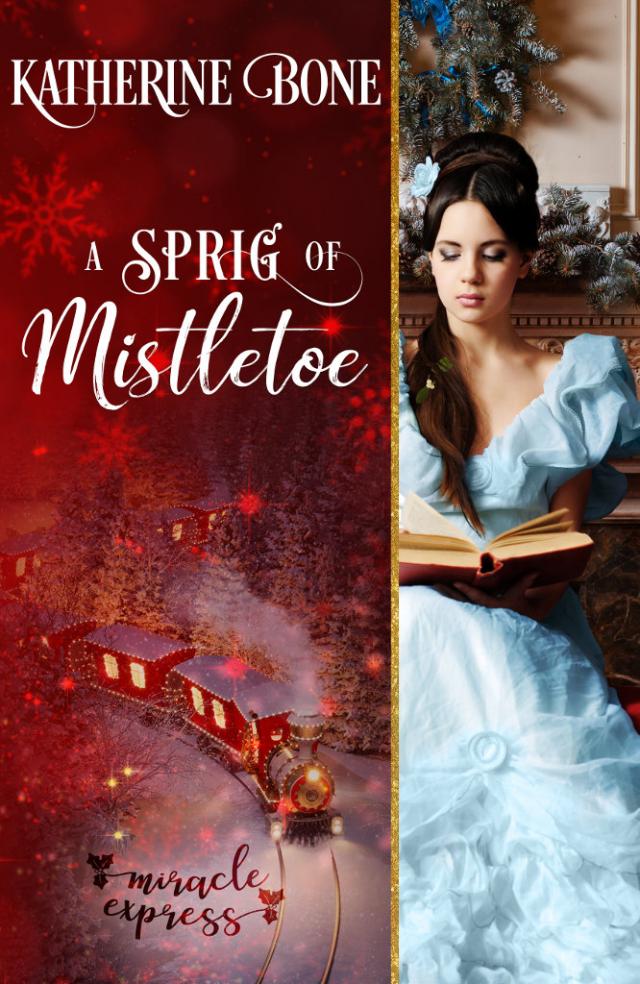
A Sprig of Mistletoe, page 15


“That isn’t true. Your music makes me feel more alive than I’ve felt in a very long time.” By Jove, her crestfallen face stole his breath. “None of this is your fault.”
“Bah,” she scoffed, heavy with sarcasm. “I have tried in vain to hide my feelings.” His heart squeezed in anguish as she bared her soul. “To discover what or who—if anyone—has a hold on you. It grieves me that you will not allow yourself to enjoy Christmas like the rest of us. For the life of me, I do not know why.” She dabbed her eyes with her gloves. “No one should be alone at Christmas, and the way you left so quickly proves something or someone has driven you to it.”
“I simply needed air.” It was the truth. He wasn’t used to feeling anything but despair anymore. A man incapable of acknowledging where he came from was doomed to repeat his ancestors’ offenses, and his line of work called for a sound, intellectual mind and a sober heart. “I did not intend to be rude.”
“What did you intend?” she asked. “Are you so cynical that you cannot see what is right in front of you?” She dropped her hands and closed the distance between them, stoking a fire within him. “Whatever you are running from, I am here. You need not suffer alone.” She tilted her head, her gaze focusing on something above them.
He glanced upward, spying a paltry bunch of smooth-edged, waxy leaves with clusters of white berries hanging from a branch. “What do you see?”
“Mistletoe.”
How could he forget the botanical hanging above them, its traditional use or its meaning?
“’Tis only a sprig,” he said. “Not as bountiful as the bunch we hung this morning.”
“And yet, it is mistletoe nonetheless.” She reached up and picked a berry, then smiled, quickening his pulse. “Here is something you do not know. It is customary to pick a berry before a kiss. If you need to be reminded, it’s a tradition—”
“To kiss a maiden under the mistletoe,” he finished for her. He took the berry from her, frowning. It was delicate and quite beautiful in its purity, like Kitty. Even as his arms encompassed her waist, he couldn’t bear the thought of corrupting her spirit. “I am not a sentimental man. It’s not in my nature. Forgive me. I never meant to hurt you.”
“There is nothing to forgive,” she said sweetly. “You are here now.”
“I owe you an explanation for my behavior.”
She shook her head, clearly intending to deny it. He placed his finger over her mouth before she could speak, the warmth of her lip tingling his skin. “Shh,” he said. “You must allow me to explain. There are things about me you do not know. Christmas . . .” A disturbing ache pricked him, making it hard to speak. He began slowly. “Christmas is a reminder of all that I have lost.” He caressed her face. “My darling girl, I am not running from you. I am trying to save you from me.”
“What could you possibly need to save me from?” she asked expectantly. She searched his face. “Please confide in me, Bart. What has distressed you so?”
She spoke his name, but it wasn’t his name. Not really. The moment he’d dreaded from the first time he’d met Kitty had arrived. “My name—my real name—is George,” he offered solemnly.
Her brow furrowed. “George? I am not sure I understand.” He doubted she would, even once the circumstances of his upbringing became known. “Ambrose said your name was Bartholomew.”
He glanced away, gathering his courage. “Yes, that is the name I use. But your brother knows that isn’t the name I was given at birth.” His heart raced. When she knew the truth, she’d hate him. But she’d finally understand the turmoil boiling inside him, understand why he wasn’t good enough for her. By jingo, when she did, that would be the death of him. “My guardian, Matthias Fernsby, gave me a new name, and he became Uncle Matthias. I am all you see, Kitty—a humble merchant, an investor, a philanthropist, a friend, and . . .”
He couldn’t finish. He wanted to add eager suitor but the odds were not in his favor. The social divide made it clear where he stood.
“Your uncle gave you a new name?” She grabbed his hand. “Why would he do such a thing?”
“We both had our reasons.” He’d die a thousand deaths in order to change what could not be undone. “I am Sir George Richard Clere, Baronet, grandson of Admiral Sir George Clere, son of Richard Clere.”
Her eyes widened. “I do not know any Cleres.”
It wouldn’t take long for her to discover the truth. And when she did . . . He took a deep breath. “My father was an unrepentant gambler. His sins earned him—and the rest of my family—an occupancy at the Marshalsea.”
She gasped. “The Marshalsea?”
He blinked at the censure audible in her voice. Powerlessly, he searched the depths of her gaze, both longing for and fearing her thoughts.
“You are truly Sir George,” she repeated slowly and incredulously. Her eyes widened in sudden clarity. “And the name Bartholomew, Bart for short, refers to baronet.”
No one had spoken his real name, except his lawyers, in many years, and the sound of it coming from her beautiful lips was an aphrodisiac he couldn’t resist.
“Yes,” he said, amazed by her quick wit. She was an intuitive woman. In fact, her unswerving instincts were what he hated and loved most about her. “It was my uncle’s idea.”
“And your . . . guardian?” She stepped back and placed two fingers upon each of her temples. “I confess to being confused on one score: how did you end up with your uncle if your family is in the Marshalsea?”
“My parents are no longer there.” Raw hurt strangled him as he struggled to find his voice to open his soul to her. “But while they were, I worked in a bottle factory, washing bottles to earn money to help pay off my father’s debts. I ate breakfast and dinner with my parents, and slept in the workhouse at night.”
“Oh, Ba—” She covered her mouth. “George,” she said softly. “How dreadful.” She came to him, grasped his hand, and placed a kiss upon his palm. “Now I understand why you devote yourself to the children at the Ragged Schools.” She placed her hand on the side of his face. “Who else knows?”
He laid his forehead against hers. “Besides you and your brother, only my solicitor. Everyone else believes I am a member of the nouveau riche. I’ve made plenty of new money speculating on the railroad, and I confess there isn’t any of the old left, so that much is true.” He pulled back and gazed into her eyes.
“Don’t you see, Kitty? This is what I was trying to protect you from. My life is built on a lie.” He broke away from her, busying himself with Pegasus’s saddle. “Now you know everything there is to know about me. I am not worthy of you. I deceived your father, your mother, and . . .” He couldn’t go on.
“No.” She turned his face so he had to meet her eyes. “You didn’t.” Surely she didn’t mean it. “I know you,” she said, placing her hand over his. “And I understand your reasons for keeping your identity private.”
But how could she? Still, he adored her for saying what he wanted to hear, and he wanted to kiss her lips for the joy of it. Any other woman would have pummeled him with insults, or maybe even her fists.
“I am glad you told me, George.” She lowered her fingertips to his chest. “Your secret is safe”—she focused on his lips—“with me. I shall never speak of it again unless you wish it.”
“I do not wish it.”
“If I may . . . can I ask, why?”
It was an innocent enough question. Even so, he had to swallow the very large lump forming in his throat. “It is difficult to explain.”
“Because it has something to do with Christmas,” she correctly guessed, bringing the conversation back to where it had started.
“Yes.” He swallowed again.
Realization dawned in her eyes. “Something terrible happened to you at Christmas, didn’t it?”
He nodded. “I’ve spent a lifetime trying to put it behind me.” Why hadn’t he kissed her under the mistletoe when he’d had the chance? Now he’d have to bleed himself dry before her. “My father mortgaged everything to the Jew King on Clarges Street.”
“Oh no.” Pity filled her gaze. “I am constantly warning Ambrose to steer clear of his clubs.”
“As well you should. But my story is different from any you might have ever heard.”
“But it is your story, and therefore, it is worth hearing.” The tenderness on her face was heaven-sent. “It is the most important story I wish to hear.”
The panic that had been growing in his chest suddenly faded. He sucked in a steady breath. “Then I shall tell you everything, Kitty. I ask not for sympathy but only that you open your eyes. I am not all that I appear.”
“Nothing you say can change my admiration for you,” she said, her voice a soothing balm to his soul. “I know who you really are.”
“Do you?” Then he held her close, and began describing his grandfather and the pride that hastened the elder’s demise. He told her about his parents and their descent into poverty, the loss of all they’d held dear, the humiliation of the Marshalsea, and how they’d been cast out of Society. He told her of their wretched existence, the period of time he spent at the workhouse, the miasma that had struck them, and the missionaries who’d pried him from his dead mother’s arms to nurture him back to health.
“After years of fending off false accusations of cowardice,” he went on, “my grandfather heard the news that my parents were dead and I had disappeared and he took his own life.” Silence lingered between them until he found the energy to continue. “I cannot help but wonder what would have become of my grandfather had he known I was still alive. Perhaps then—”
“You cannot torture yourself,” she said, grazing his cheek with the tips of her fingers. “No child should experience such heartache. But sometimes things happen beyond our control. You were but a boy then, combatting a deadly illness. There was nothing more you could have done.” Her expression softened the lines around the corners of her mouth. “Epidemics hit the poor hard. You know this. It’s a miracle you survived. And oh, how I am glad of it. If events had unfolded any differently, you wouldn’t be here . . . with me.”
She was right. His heart skipped a beat at the realization. Still, he dared not believe either of them capable of loving each other so soon. He cupped the sides of her face and searched her eyes. They sparkled like dazzling stars, twin universes he yearned to explore.
“I am only alive because of the kindness bestowed on me at a time when I needed it most,” he said. “My parents, poor as they were, had no one to assist them. No one to bring them food except the bread I stole to lessen their hardship. I think of my mother often, picturing her reassuring smile even as I watched the life fade from her body. How she must have suffered . . .” His heart clenched. “Then I got sick and was unable to work, to steal, or beg for food.” He shook his head. “I am as driven as I am now because of her. I have done everything in my power to improve the lives of children in the city so that no other child ends up like me. It is the only way I can live with myself.”
“You are not alone anymore. You will never be alone.”
Her smile sent his pulse racing. “But your father . . .”
“Ambrose and I will deal with him,” she said, flattening her palms against his chest. “You needn’t worry. Papa only wants my happiness.”
“I do not blame him.” Her sultry brown eyes captured his. “That is all I desire, too.”
“All?” she asked. “You have been denied so much. Surely, you want something for yourself.”
He wanted many things but had denied his thoughts access to them. He knew he wanted Kitty, though. He wanted her more than anything else in this world. He glanced up above their heads. “Well, there is something.”
“What?” she asked.
“I’ve never kissed a woman under the mistletoe.”
Her laughter was low and throaty. “Then kiss me, George,” she said, a rush of pink staining her cheeks. “Kiss me.”
It wouldn’t erase his childhood or the pain he’d carried with him all these years, but kissing Kitty under the mistletoe could be exactly what he needed to begin putting his misery and guilt behind him. He gazed into her eyes. “Are you sure this is what you want?”
“I am.” She tilted her head, her moist lips full and ready, a heady expectancy glistening in her eyes.
Bart gently brushed his mouth against hers. Her lemony balsam scent washed over him as he tested the plump texture of her lips hesitantly at first, and then with a hunger that belied his outward calm. The taste of her . . . Oh! What a delicious drug, an elixir he’d instinctively known he would always crave. Her warmth, her willing response, emboldened him. He slipped his arms around her, pressing her firmly against his chest before realizing he didn’t want to end their coupling. Kitty knew his secrets and hadn’t turned away. But she deserved better.
His faculties returning, he set her away from him, the distance an agonizing chasm. “I am a wretch who doesn’t believe in miracles, Kitty.”
“Then believe in me,” she said. “It’s Christmas.” She rose up on tiptoe, her affectionate smile somehow lightening his burdens. He wanted to believe. He wanted to love her. “In A Christmas Carol, Mr. Scrooge was blinded by bitterness, and yet he found salvation. If a man like Mr. Scrooge can learn a thing or two about Christmas, there is hope for you yet.” She tapped his nose, her bewitching dimples making him want to believe even he could be saved. “Return home with me. Let us experience Christmas together, the way it should be experienced, for we are all wounded creatures soiled by life and washed clean by forgiveness.”
“What if I cannot forget or forgive myself for being happy?” he asked through the thickness in his throat.
“You saved my life at Euston Station. You are the man who convinced Mr. Hatchard to give me, a total stranger, three books. You arranged for me to meet Miss Burdett-Coutts. And, I suspect, you are responsible for introducing my brother to Locke, Moulton, Morrison, and Starey, as well as persuading Mr. Dickens to sign a copy of his book for me.” She stroked his face, and years of self-loathing melted away. “That is the kind of man you are. I know I shall always see you that way.” She grabbed the lapels of his greatcoat and pulled him closer. “Kiss me again, George. Magic happens under the mistletoe.”
“Do you mean to tell me Christmas is not just about Tannenbaums, evergreen, carols, and plum pudding?” he teased.
“Yes.” Her melodic laughter warmed his blood. “That too. But Christmas is a miracle of love—yours and mine.”
“That’s too much to hope for.” He grinned, however, remembering the minx he’d encountered after that runaway child spun her his way, praying she would always be his side. “But,” he said, winking as he picked a piece of evergreen, “as a reminder, I shall keep a sprig of mistletoe with me at all times, so that I might steal a kiss whenever the mood strikes.”
She smiled mischievously. “You are a quick study.”
“Yes, and I intend to keep you on your toes. That is, if your father allows it.”
“Papa will glean all he needs to know about your worthiness from Ambrose and our guests.” She kissed his chin. “You can be sure of it.” She kissed his cheek, driving him mad with desire. “Until then, we should—”
He kissed her then. Misery fled, and in its place, a spark of hope ignited, soaring through him like a sunrise burning through fog. Every inch of him came alive, yearning to live, to believe, to discover the true meaning of Christmas. And he was sure that he would, in Kitty’s arms.
Epilogue
Field Lane Ragged School, London
One year later
“Scrooge was better than his word,” Kitty read with delight to the rapt children gathered around her and her reformed husband, who now reveled in Christmas as much as, if not more than, she did. “He did it all, and infinitely more; and to Tiny Tim, who did not die, he was a second father. He became as good a friend, as good a master, and as good a man as the good old city knew, or any other good old city, town, or borough, in the good old world.”
She turned the page, the movement of the crisp gold-foiled parchment penetrating the air. “Some people laughed to see the alteration in him,” she read, “but he let them laugh, and little heeded them; for he was wise enough to know that nothing ever happened on this globe, for good, at which some people did not have their fill of laughter in the outset; and knowing that such as these would be blind anyway, he thought it quite as well that they should wrinkle up their eyes in grins, as have the malady in less attractive forms.”
She examined the faces of the children, then her husband’s. He held a wee girl named Emma in his arms. He was not Mr. Scrooge, “a squeezing, wrenching, grasping, scraping, clutching, covetous old sinner,” at all. The baronetcy was also no longer thought extinct because he’d gone public with his identity, to her father’s shock and bewilderment. Bart was now known to all as Sir George Egerton-Clere, a man with more depth and generosity than she’d ever thought possible. And he continued to prove his compassion knew no bounds with each passing day.
George lowered Emma to her feet and then made his way to Kitty.
“His own heart laughed: and that was quite enough for him. He had no further intercourse with Spirits, but lived upon the Total Abstinence Principle, ever afterwards.” Emma raced ahead of him and grabbed Kitty’s skirts. Kitty threaded her fingers through Emma’s pretty blond hair. “And it was always said of him”—her gaze locked with George’s—“that he knew how to keep Christmas well, if any man alive possessed the knowledge. May that be truly said of us—”
“All o’ us!” Emma exclaimed.
“Yes.” Laughter bubbled up from Kitty’s chest. “And so, as Tiny Tim observed, God bless us . . .”
“Every one!” all the children answered in unison.
Kitty took the sprig of mistletoe George had plucked last Christmas Eve and placed it on the first page where Dickens had signed his name before closing the book. There it would stay until the next time she read it.