The Map of Bones, page 1
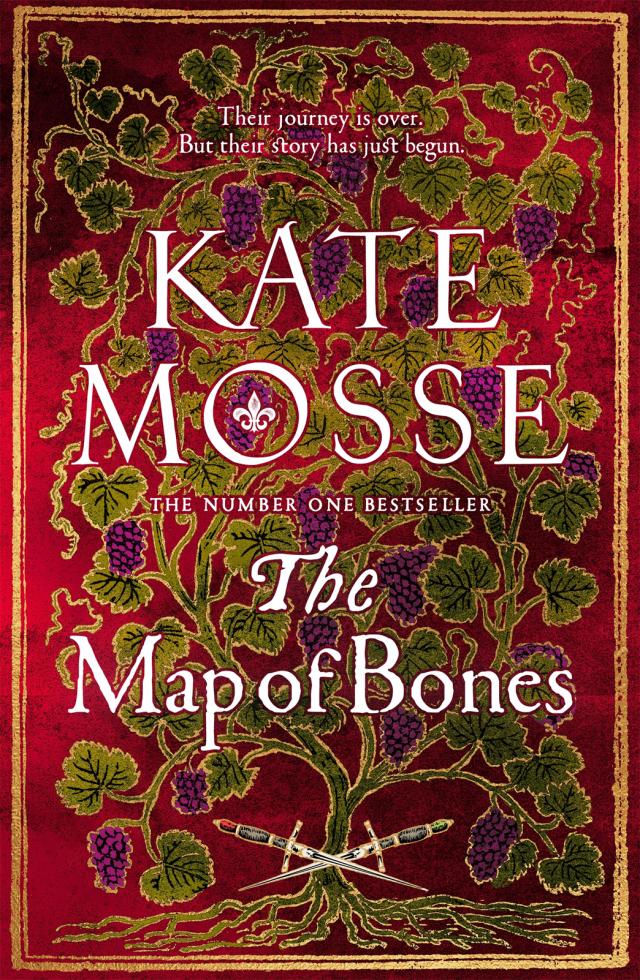


KATE
MOSSE
The Map of
Bones
As always, for my beloved
Greg, Felix, Martha, Ollie and Finn
For the first Huguenots in southern Africa
and every refugee, past and present, fleeing
persecution and war in the hope of a safer life
‘Words strain,
Crack and sometimes break, under the burden,
Under the tension, slip, slide, perish,
Decay with imprecision, will not stay in place,
Will not stay still.’
‘Burnt Norton’
Four Quartets, T. S. Eliot
CONTENTS
PROLOGUE
La Rochelle
May 1687
PART ONE
The Cape Colony
August 1688–March 1689
PART TWO
The High Seas & Cornwall
April–July 1689
PART THREE
Cape Town, Stellenbosch & Franschhoek
January–March 1862
EPILOGUE
London
September 1872
Author’s Note
The Map of Bones is the fourth and final book in a series of novels* about the Huguenot diaspora, a narrative of sixteenth-century France to the Cape of Good Hope in the nineteenth century by way of Amsterdam and the Canary Islands. Each novel is inspired by one of the four elements – fire, water, air and earth.
The sequence of religious civil wars between Catholics and Huguenots in France began on 1st March 1562 and ended – after several million had been persecuted, slaughtered or displaced – with the signing of the Edict of Nantes on 13th April 1598 by the previously Protestant King, Henri IV or Henri of Navarre. On 22nd October 1685, his grandson Louis XIV revoked the edict, precipitating the exodus of those few Huguenots still remaining on French soil. Though the first Huguenot refugees had begun to arrive in the Cape of Good Hope as early as 1671, the majority arrived in southern Africa on eighteen ships setting sail from the ports in the United Provinces between June 1687 and June 1688. The spiegelretourschip the Berg China – referred to in Dutch records simply as the China – arrived in Table Bay from Goeree, under the aegis of the Rotterdam Chamber, on 4th August 1688. The names of those first families – including Jourdan, de Villiers, Roux, Joubert, du Toit, Retief, Malherbe, Meinard, Jacob, Grange – are still present in South Africa today. My Joubert family is fictional and not related to the real Joubert family of South Africa (originally Jaubert) from Motte d’Aigues in Provence.
The Commander of the Colony, Simon van der Stel, initially set aside land for Huguenot settlement in the Drakenstein Valley. The land was poor and the refugees petitioned for farmland on the banks of the Berg River in Olifantshoek, the first being allotted to Heinrich Müller from Basel in 1692. He named it ‘Keerweder’, meaning ‘turn back’. Many of the wine farms in today’s Franschhoek still bear the names given to them by their original Huguenot owners, including ‘La Motte’, ‘La Cotte’, ‘Cabrière’, ‘La Dauphiné’, ‘Bourgogne’, ‘La Terra de Luc’, ‘Champagne’, ‘La Bri’ and ‘La Provence’.
After years of conflict, the British finally wrested control of the Cape from the Dutch for good after the Battle of Blaauwberg in 1806 and, in the Anglo-Dutch Treaty of 1814, Cape Town was permanently ceded to the United Kingdom. In 1713, Olifantshoek was renamed le coin Français, the ‘French corner’, and was known as Franschen Hoek (and, briefly, as Roubaixdorp) before the Dutch version of its name, Franschhoek, was settled on. The name ‘Cape Town’ started to be used from 1733. For the sake of the narrative, I have taken certain liberties in my descriptions, topography and history of Cape Town, Stellenbosch, Drakenstein, Franschhoek and Joubertsgat Bridge.
On the question of language, to strike the balance between historical veracity and modern usage, I have used both ‘enslaved’ and ‘slave’ when unavoidable within the text. Hottentots Holland remains a place name in the Republic of South Africa. There were many different and shifting groupings within the indigenous peoples of the Cape during the seventeenth century and there is much debate among historians and scholars about nomenclature. I have focused on the Khoi, and used Khoi and San in the text rather than Khoikhoi or Bushmen. When referring to the language, I have also used Khoi rather than Khoe (or Nama). There is also discussion about the word ‘leader’ being preferable to ‘chief’ or ‘headsman’. Because this is historical fiction, I have occasionally used ‘headsman’ as well as ‘clan leader’ as being more appropriate to the time in which this novel is set.
The influence of the Huguenots is extraordinary, a diaspora that took them as skilled immigrants all over the world – one branch of my family, also. Every country which accepted the refugees – including the Dutch Republic, England, Ireland and South Africa – was enriched by their presence despite their relatively small numbers. The word ‘refugee’ comes from refugié, a French word first used to describe the Huguenots. For those readers who would like a fuller history, I recommend Pieter Coertzen’s The Huguenots of South Africa 1688–1988 and Huguenots at the Cape by Philippa van Aardt and Elaine Ridge, both published by the Huguenot Society of South Africa.
Central to this novel are the operations of the United Dutch East India Company – the VOC (Verenigde Oostindische Compagnie) – which was established in March 1602, granting it a twenty-one-year monopoly to carry out trade activities in the Far East. Their modus operandi was not to establish colonies, but rather refreshment stations to provide the VOC ships with fresh food and water on their voyages to Batavia (Jakarta) and beyond to places such as China and Japan. The one exception to this was the Cape of Good Hope, which was a colony built on the labour of enslaved people brought from other parts of East and West Africa, as well as from Madagascar, India and Indonesia.
At the heart of The Map of Bones is a belief in the power of words, that unless women’s stories and testimonies are included alongside those of men in the historical records, it cannot really be called history at all.
There is no Joubert Family Archive and Reading Room in London, nor was there a ship called the Gouw. The wine farm ‘La Justice’ in Olifantshoek, owned by the fictious Barenton family, does not – and never did – exist, nor does Klein Bethlehem. All the characters in The Map of Bones, unless otherwise specified, are imagined, though inspired by people who might have lived: ordinary women and men, struggling to survive and flourish against a backdrop of religious war and displacement.
Then, as now.
Kate Mosse
Chichester
April 2024
Principal Characters
IN THE CAPE COLONY (17TH CENTURY)
Suzanne Joubert
Florence Amiel (née Reydon-Joubert), Suzanne’s grandmother & Louise Reydon-Joubert’s cousin
Driek Holsteen, sailor
Lars Eltorp, mercenary
Adriaan van Dijk, VOC official
Marie Lombard, refugee
Pieter Odendaal, landdrost
Anke Odendaal, his sister
Tia Nemen (Kroket), a Khoi servant
Harrie Nemen (Khemy), a Khoi interpreter
Kmame, the Cochoqua headman’s son
Shansi, a female elder
Fala, a midwife
Khasso, a Khoi guide
Théodore Barenton, settler
IN STELLENBOSCH & FRANSCHHOEK (19TH CENTURY)
Isabelle Joubert Lepard, writer
Mrs Müller, landlady
John Turner, guide
Hans van Aarnhem, farmer
Griet van Aarnhem, his wife
Piet and Jan van Aarnhem, their sons
Andries Barenton, settler
Xavier Barenton, settler
Maya Barenton, Xavier’s wife
Magdalena Barenton, his daughter
HISTORICAL FIGURES
Pierre Jaubert (recorded as Joubert in VOC records), refugee
Isabeau Jaubert, his wife
Pierre Grange, refugee
Jean and Louise Meinard, refugees
Jean Prieur du Plessis, barber-surgeon
Judith Verbeek, orphan (though her relationship with Adriaan van Dijk is imagined)
Catrina Janse van der Zee, orphan
Petronella van Capelle, orphan
Wilhelmina de Wit, orphan
Simon van der Stel, Commander/Governor of the Cape Colony (1679–1699)
Johannes van Andel, Dutch pastor of the Cape Colony (1688–1689)
Johannes Neethling, Dutch pastor in Stellenbosch (1858–1904)
Alexander Macmillan, Co-Founder of Macmillan & Company (1818–1896)
Lily Watson, novelist (1849–1932)
Samuel Watson, solicitor (1839–1921)
PROLOGUE
LA ROCHELLE
May 1687
RUE DES GENTILSHOMMES
18th May 1687
Suzanne could hear them rampaging through the house. More like animals than men, except animals did not destroy wantonly. These men, dragonnades, were uncouth and violent bullies: Catholic soldiers billeted with Protestant households and given licence by the King to intimidate, humiliate, abuse, thieve. Huguenots were no longer citizens in their own country.
Kill or be killed.
She froze at another huge crash below. A splintering of wood, a cacophony of metal striking the tiled floor of the main hall, discordant chimes. She clenched her fists, suspecting the lawless soldiers had pulled down the lantern clock from the wall, simply because they could.
> Suzanne had never before felt such rage, such fear, as over this past week. Dragonnades had been coming to the rue des Gentilshommes several times a day on the pretext of searching for Huguenot ‘malefactors’, as they called them. Then, five days ago, the soldiers had moved in and behaved as if the house was a muster camp on the battlefield: slashing portraits with their swords; shattering the Venetian wine glasses that had been in the Joubert family for generations; fouling the yard at the back of the house so the air stank. Drinking and drinking and drinking. Her grandmother, Florence, had sent their servants away, unwilling to put them at risk, so it was just the two of them left. Yesterday, as Florence was bringing food to the table, one of them had stuck out his foot and she had gone sprawling.
‘What kind of man takes pleasure in humiliating an old woman?’ Suzanne protested sharply. The soldier had laughed, then slapped her face for her insolence. Who was there to stop him?
Florence was not hurt, but she was badly shaken and had remained in her chamber for the rest of the day. Suzanne had thought herself civilised, but now she knew she would kill every one of them were it not for the fact that it would leave her grandmother unprotected.
She checked the door to her bedchamber was locked, having made sure Florence was secure in her room. The nights were the worst, listening to the rough voices getting louder and more strident, arguing and fighting, then an uneasy silence falling as the soldiers collapsed into an inebriated stupor. As a child, she had lain in this same chamber hearing the sounds of customers being ejected from the taverns at the port. Ugly sounds, aggressive voices, but she had felt safe.
Now, the threat was inside her own home.
From below, she heard a sudden bellow of triumph. ‘Hey, will you look at this!’
Suzanne heard a new and unwelcome sound, the unmistakable scrape of the heavy walnut table in the hall being dragged away from the panelled wall. Her heart sank. She had moved it there after the first visit of the dragonnades, in the hope of concealing the small door down to the wine cellar. She had prayed that, once they had eaten and drunk the pantry dry, the dragonnades would move on to find another household to terrorise.
In despair, she knelt on her prie-dieu and muttered the same words over and again.
‘Post tenebras lux.’ After darkness, the light. Perhaps, tonight, God would be on their side?
After a while, she moved to sit on her bed. Below, the sounds of carousing grew louder. It went on so long that she eventually fell into a troubled half-sleep.
A little later, Suzanne awoke with a jolt to see that her candle had burnt right down. She heard the bells of the grosse horloge striking three o’clock, then realised the house was silent: no shouting, no singing. Instantly, Suzanne was on her feet. She tiptoed to the door, carefully turned the key in the lock, and opened it a crack.
Not a sound. Could it be that they would make it through another night? Then, across the landing, she saw the tray she had left outside her grandmother’s door was still there. Unease trickled down her spine. She did not want to wake Florence if she was lost in the comforting arms of sleep, but what if she had been more hurt than either of them had realised? What if she was lying in her bed in need of help?
Suzanne hesitated, then stepped out onto the landing.
In her stockinged feet, she moved as quietly as she was able towards her grandmother’s chamber. She could not stop herself glancing down, then wished she had not. The hall looked as if an army had marched through: glass everywhere, a flagon lying on its side with the last dregs of wine dripping red from the neck and pooling like blood on the tiled floor. One soldier was sprawled in the high-backed armchair, stains down his uniform jacket; another was slumped over the table with his head on his arms; a third was at the bottom of the stairs, his shirt patterned with vomit.
Revolted, Suzanne turned away and tapped on Florence’s door.
‘Gran’mère?’ she whispered. ‘Ça va?’
There was no answer but, when she pressed her ear to the door, she could just hear gentle snoring. Relieved, she turned away. Then her breath caught in her throat. Standing at the top of the stairs, between Florence’s chamber and her own, was the fourth soldier. She had foolishly assumed him to be in the yard.
Their eyes met: the hunter and his prey.
Suzanne leapt forward, but he was quicker. He encircled her waist with his arms, then pulled her towards him. She struck at him with her fists, beating against his chest, urgently trying to prise herself free.
‘Come, come, I’m only after a kiss.’
Suzanne recoiled, striking out with her stockinged feet. Her assailant was briefly knocked off his stride. She took the chance to slip free, running across the landing towards her room.
He laughed, pawing at her skirts, dragging her back towards him.
‘No harm in a kiss,’ he wheezed, and she realised that her resistance was inflaming his blood.
‘Let me go,’ she murmured, scared to make a noise in case she woke her grandmother. Or, worse, his unconscious companions.
Suddenly, she remembered something she’d seen down in the port when she was a girl. One of the doxies who frequented the waterfront when the ships came home from the sea had been manhandled by a customer. The woman’s face had been red and furious, Suzanne remembered, when she suddenly brought up her knee between the man’s legs. He had fallen screaming and writhing to the floor. She hadn’t understood at the time, only that the woman had bested him.
The soldier’s lips were now on her neck, his hands groping at her bodice, fumbling with the hooks and eyes.
With all the strength she could muster, Suzanne lifted her leg and brought her heel back. Kicked. It wasn’t enough. He gasped, but tightened his grip.
‘Wild little cat, aren’t you?’ he hissed, with a cold edge to his voice.
In a last desperate attempt to free herself, Suzanne twisted and clawed at his face. She gouged his cheek, drawing blood. He froze, then his expression changed, transforming things from a rough game into something darker. Before she had the chance to duck, he pulled back his fist and punched her on the jaw.
The pain reverberated around her head, disbelief too, as she felt herself falling. Then another explosion of pain as her temple hit the newel post at the top of the stairs.
Suzanne could not have been unconscious for more than a few moments but, when she came to, the man was on top of her. Her chemise had been torn open – she could feel the night air cool on her bare skin – and her skirts were pushed up around her waist. Suzanne panicked. She couldn’t breathe, she couldn’t move. In vain she tried to push him off, but he barely seemed to realise she was there. His eyes were closed and he seemed in the grip of some violent turmoil.
Pinned, she stopped struggling, now wanting more than anything for it to be over. Praying that her grandmother would remain in her room and not have to witness what was happening. She felt a final, tearing pain between her legs, then the soldier collapsed on top of her. Suzanne felt her ribs were cracking, as if her whole body was being crushed. There was something wet on her cheeks. She stuck out her tongue, thinking it would be blood from the wound on her temple, but tasted salt.
Suddenly, the man rolled off her. Suzanne gulped at the air, rolling onto her side. Now he was tying his breeches and shrugging his arms back into his uniform jacket. She didn’t move, not wanting to provoke him to some other assault.
Something cold struck her cheek. She turned her head and saw a silver coin lying bright on the floorboard beside her.
‘For your trouble,’ he said.
Was it her imagination, or was there shame in his voice? Then he turned and staggered down the stairs, leaving her lying on the floor.
Suzanne did not move. She was stunned. Numb, as if this horror had happened to someone else. Then, as always, thoughts of her grandmother took over. She couldn’t risk Florence waking and finding her like this. She was an old woman and, though she had survived much in her long life, Suzanne would not inflict another ordeal on her.
She stood up, setting her head spinning. She steadied herself, then staggered to her bedchamber, pulled off the sullied clothes that had not protected her and rolled them into a bundle beneath her bed. Taking a plain garment from her chest, she dressed quickly and laced her boots. She cleaned herself, wiped the blood from her temple, washed her hands with water from the nightstand and tidied her hair so it hung in its usual curls on either side of her face.