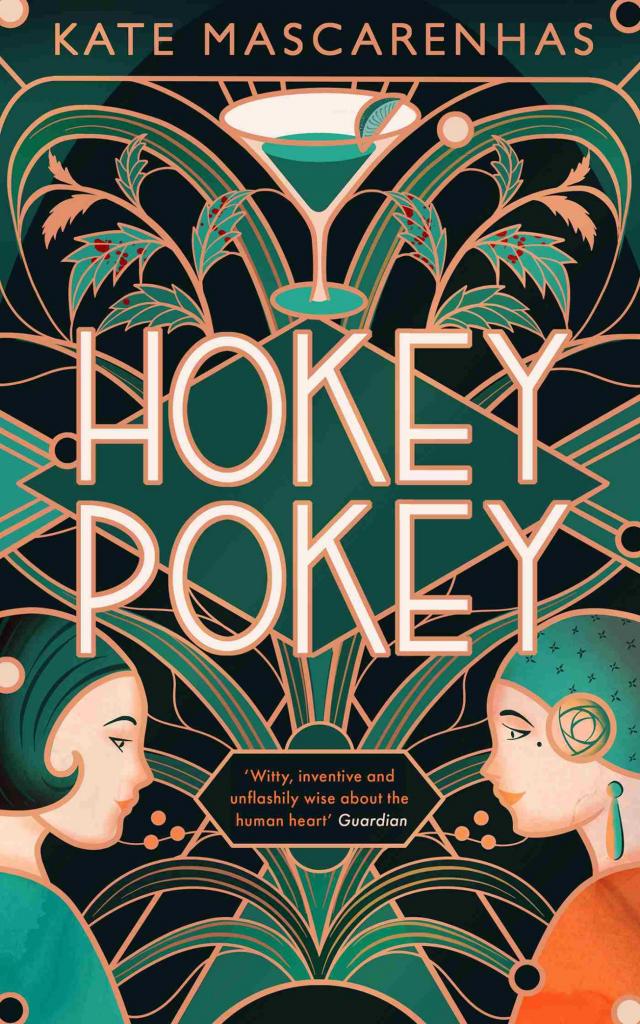
Hokey Pokey, page 8


Westall might have feared trouble, but that didn’t make him guilty. Crouch kept harping on the wrong dog. There was no point repeating her objections. He’d be as obstinate as last time. More so, possibly, because Harvey had buoyed his theory. But Nora knew just what the dog in her room looked like. She’d pictured him perfectly outside the cathedral: a dog on a lead, following a man hanged for murder, who didn’t know he was dead. Enid said Edward Markham was a ghost. Nora thought he was a memory, made vivid by hunger and the strangeness of returning to England. He was haunting her, either way. In stories, the dead returned for vengeance; or to correct a lie. They might come back to ask forgiveness, but Edward Markham wouldn’t do that. She thought of the redeeming waters, running through the hotel, and the guests Crouch liked least flocking to clean their conscience. Maybe he would have liked Markham.
“What are you thinking?” Crouch demanded, at her silence.
She still didn’t want to speak of Markham. Not to Enid, and not to Crouch. Better to speak a partial truth: “I was thinking of the well, in the basement. It does rather a lot of work for you, doesn’t it, even though you don’t believe in its powers?”
“What do you mean?”
“You like to tell people about it, and see how they react, and sort them accordingly into whether they are your sort of person. The ones that want forgiveness aren’t, and the ones that don’t, are. That’s why you waited for me in the bar. Because – unlike Mrs Reid – I disdained the very idea of redemption as soon as we met.”
“That isn’t why I waited for you.”
“No?”
He stood up. “You haven’t seen the well yet, have you? Let’s go visit now.”
*
The cellar was unlit, and they each used their lighters to guide their path. Nora could taste brickdust. Although she couldn’t see outside her small circle of illumination, she knew the room was expansive because she could hear the echo. Coming down here with Crouch was charged in a way she couldn’t quite identify: it wasn’t sexual – more that he had hinted at a revelation to come, and that gave her a pleasurable nervousness. She pictured those identically uniformed cleaners and wait staff, all of them precisely the same height, coming to life in the dark: seizing moments to drink or smoke, or even conduct affairs, below stairs and between shifts.
“Do the hotel workers come down here much?”
“In summer. But not in a February like this one. It’s too blasted cold. They could have the comfort and warmth of a vacant room.”
Nora had felt her forearms break into gooseflesh but didn’t yet mind the chill. The meat and alcohol were still in effect. She startled at the touch of Crouch’s hand on her elbow, but he was only guiding her from collision. Before them stood an upright stone cylinder, about six feet in diameter and as high as her chest. A smooth iron cap concealed her view of the water she could hear rushing inside. This was the old well, sustaining the hotel’s plumbing system. To the left was a second cylinder, twice as wide and half as high, connected by a sloping pipe. She knew little of the working of wells, or whether they could ever flood, and assumed the pipe allowed excess to drain away. Mrs Reid, she imagined, would be very disappointed by the well’s prosaic exterior.
“No one pictures this when they hear the words local spring,” Nora observed. She touched the cast iron, and it was cold enough to cause pain in her fingertips.
“Water is water,” Crouch said dismissively. “I brought you here because we need to have a conversation without being overheard.”
“That sounds very solemn.”
“I find you a puzzle, Dr Dickinson.”
“There isn’t anything mysterious about me.” Nora’s tone was light, but she sensed Crouch was going to ask a difficult question.
“Let’s talk about tattoos.”
Nora said nothing, knowing the claret might affect her judgement of what was, and wasn’t, safe to mention. She waited for him to continue.
“On your first night here, at dinner, I noticed you had a tattoo of flowers and speckles on your forearm. Your sleeve slipped along your arm when you raised your wine glass – you quickly covered the tattoo again, but I’d seen. And then, before the meal was out, Miss Oxbow described exactly your tattoo in her bogus vision. Ever since then, your tattoo has been disguised. What exactly is going on with you two? I can’t make head nor tail of it.”
“You were mistaken. I have no tattoo—”
“It was plain as day, before my own eyes. Would you be happy to take soap and water to your arm to prove me wrong? Or should I ask Miss Oxbow instead?”
“No, don’t do that,” Nora said quickly. Leo had told her to say nothing to Berenice; if she defied his wishes, she might damage her chances of replacing the Icon. “Just – give me a moment. I will explain, in exchange for you keeping your observation from her. Please.”
“Let me hear, before I give any assurances.”
Nora nodded. She could provide a plausible explanation, one which was wholly true, if incomplete. “Although Miss Oxbow is a stranger to me, her husband is not. I’ve known him for many years. He suspected her tour was an opportunity for promiscuity and asked me, as a confidante, to set his mind at ease.”
“What kind of friendship does he keep secret from his wife?”
“An unusual one.”
“You’re his mistress?”
“No. He has been faithful since his marriage. No one could accuse him of anything but devotion to Berenice.”
“But before their courtship? During it? Don’t be mealy mouthed, Dr Dickinson; I don’t want to have to tease the truth from you question by question.”
“We had an affair,” Nora confessed, and it felt like a lie. It wasn’t an affair in the ordinary sense of the word.
“And the tattoo?”
“I’ve had this tattoo since I was twenty. My school teacher had one very like it – hence the old-fashioned appearance – and I wished to imitate it. Rather sentimental of me, because she died young.” Nora shivered. The cold, staved off till now, was finally reaching her bones. She offered another partial truth. “Soon after Berenice and Leo were married, she saw a photograph in his wallet, of my tattoo. It wasn’t a lurid photo – but it was an intimate one, I suppose. I wasn’t otherwise identifiable. That tattoo is the only thing she knows about my appearance.”
“How did he explain this little memento?”
In the flickering light, Crouch’s lips were parted with anticipation. His tone had settled into ordinary prurience, and had lost its accusatory timbre. Yet the next part in Nora’s story felt hardest to say. She closed her eyes, the half darkness insufficient for Nora to pretend she wasn’t there at all: that she was nothing but a voice, speaking.
“Badly,” Crouch concluded from her silence.
“Berenice either suspects or knows Leo has eyes on her, and his lover is the likeliest spy. When she faked her vision on her first night, she was trying to flush me out, by provoking a reaction.”
“I’ll admit I was expecting you to reveal a grift, between you and her.” Crouch bit his lip. “A fight over a man is rather more pitiable.”
A fight over a man? This wasn’t a fight over a man. It was a fight to be Berenice, with Leo as the arbiter. But she wouldn’t expect Crouch to understand and she didn’t bother to enlighten him. For one who’d eschewed forgiveness, her partial confession had left her oddly light. She said, blithely: “I’ve succeeded in what I set out to do. I discovered Berenice shares her bed with Merlini. When she returns to Zurich, Leo will tell her everything he knows, then I will take Berenice’s place in his eyes. Do I have your assurance, now? You won’t mention it to her? Leo wishes to be the first to confront her.”
“I’ve no interest in telling her. Miss Oxbow doesn’t mean anything to me,” Crouch said. “But you should probably remember, Dr Dickinson – there’s no guarantee he’ll give her up for you. She’s the one he married.”
He took off his jacket and draped it over her shoulders.
“It’s too cold to stay down here any longer,” he said.
8
They went to the Narcissus; then to dinner; then to the Narcissus again. Cocktail hour had arrived. The Narcissus Bar was the most profitable concern in the Regent, and cocktails were the bar’s most profitable offering. Maintaining cachet involved labour and expense in hidden quarters. Laundry maids washed and starched pristine white jackets for the barmen; they had to be the brightest white, the easiest colour to stain, as a show of confidence in the barman’s steady hand. The abundance of conical glasses, coupes and thick-based crystal tumblers that flashed on the shelves was worth twice the average man’s salary. To account for customer breakages the head barman restocked glassware daily. He had a memory for three hundred separate cocktail recipes; he knew the prices by heart too, though he never provided those unless they were asked for. Drinks were credited to the room. He devised new drinks with seriousness. He experimented with vermouth, or orange peel, or Bénédictine, and turned equally seriously to the business of naming. The Hunt and Peck; Comfortable Importance; Amoroso; Apple Squire; Drowsy Bess; Varlet; Star Gazer; Roaring Boy; Lombard Fever; Chanticleer; the Hokey Pokey. That last was his favourite, evoking for him every childhood brush with the heat and sting of woodland nettles, and the scent of warm leaves; but it was a connoisseur’s choice and, in the rush on the bar that night, was drunk by Nora alone, while Crouch matched her drink for drink with martinis. By the time Nora returned to her bedroom, it was late.
She’d lost some, but not all, of the bravado she’d brought that morning. Nora pushed the dressing table up against the door, because a chair seemed inadequate for a full night’s protection from invasive elements. Moving the dressing table required considerable exertion and she had to lift one corner at a time to shuffle it along. Each time she released a corner it struck the floor with a thud. She hoped that, downstairs, the occupant wouldn’t complain of the noise; a visit from the housekeeper would mean moving the table back again just to speak to her.
Eventually the door was blocked. Nora rubbed her palms with her thumbs, where they had suffered friction against the table. She prepared for bed. And then, in the darkness, beneath the covers, she closed her eyes, allowed her breathing to slow.
Nora’s right hand rested above the covers. Her skin felt the wet, slippery contact of a tongue and Nora’s eyes shot back open. How was that blasted dog getting—
A cry stuck in her throat.
For a terrifying moment she thought a man wrapped in pelts licked her skin. Then she saw an outstretched hoof clear enough. This was no man, and no dog. The beast breathed with a panting rasp.
She watched the creature lift his head into the shaft of light from the window. She saw his long snout, and curved teeth which he revealed in a yawn, white and glistening in a dark mouth. The truth returned to her with profound clarity. She recognised his kind: this was a hyring. His odour was familiar... like leaves silting. Another such beast stalked her childhood memories and Leo told her it could not exist. She had resisted Leo, then succumbed, and now saw he was wrong.
Nora was very still as the hyring dropped from the bed to the floor. He stretched his long legs before him on the rug and juddered.
Nora glanced at the bedroom door, with its barrier still intact. She sat up, and drew her knees to her chest as the beast bounded upon the bed. He lay down among the kicked-off covers, the mattress sighing beneath the beast’s considerable weight. His eyes were wet and fixed upon her. His tongue flashed back out, over his mouth, as though she were something appetising.
Nora got out of bed, never turning her back on the animal. She fumbled for her coat in the wardrobe. It came down to her calves. No one would see her nightclothes beneath that. The monster watched as she hauled the dressing table far back enough to open the door. Then she flinched in the light of the corridor, her hands shaking as she drew the door shut again, keeping the threat inside. Her feet were bare. How had she come out with no shoes? To go back inside, with that thing, was unthinkable. Harvey had denied there was any alternative entrance to the room. Now Nora saw the hyring didn’t need a concealed panel or a trapdoor. It had entered by paranormal means. It had entered by the mirror. She shuddered, knowing no one would believe her. If only, she thought resentfully, people accepted her testimony as readily as the Icon’s.
She remembered Berenice’s fantasy that a killer was on the loose. Fine; Berenice could face the hyring down. Let her be eaten.
Nora strode down the corridor, clutching the lapels of her coat round her neck. Fortunately she encountered no other guests. She took the back stairs to Berenice’s floor rather than wait for the lift like a sitting duck. But the staircase took on the same shifting quality that the corridors had done her first night: she was certain the hotel was moving around her, responding to her every step with a step of its own in a different direction. Stumbling in her haste, she reached the correct floor and walked to Berenice’s suite.
Nora rapped on Berenice’s door with force and rapidity. How noisy she was being this evening! First the dressing table, now this. She would not be ignored. It was imperative that Berenice hear the urgency of Nora’s knock and respond. If she were asleep, or bathing, she must be roused by the volume of Nora’s fist on the satin pink of the door. There was, of course, the risk that the cinema king or one of his privileged neighbours would be similarly roused; Nora anticipated just how he would react to her current appearance, barefoot and half asleep. But she did not relent. For what was surely a full minute, Nora knocked without ceasing. She was rewarded with the sound of Berenice’s footfall and the apparition of Berenice in the doorway.
“Dr Dickinson,” Berenice scolded. “What a hullaballoo!”
Nora’s words burst forth like water from the mouth of a girl pulled to shore. “There’s something in my room – There’s something – in my—”
Berenice’s eyes glittered.
“A kind of beast,” Nora gasped. “I’m not going back down there. You can see it on your own. Room 427. The door isn’t locked—”
Berenice pushed past her and walked towards the lift, a smirk playing about her lips. She’d find out it wasn’t a laughing matter soon enough.
Nora waited half a minute. When she heard the lift doors close, she entered Berenice’s suite. She passed through the drawing room and the orchid-strewn hall. No sight nor sound of Merlini. She returned to Berenice’s midnight blue sleeping quarters, en route to a wardrobe large enough to constitute a room of its own.
Nora took a dark worsted dress from the rack, a pair of equally plain black shoes from the shelf above, and some combinations from a drawer. It was emboldening, to swap her nightclothes for Berenice’s undergarments, to replicate her in layers upwards from the body. Over the top Nora fastened the dress. Her skin itched against the fibres. It clung more tightly than it would have over Berenice’s body, but not conspicuously so. Nora decided she would keep the clothes. When she next saw Leo she must wear them. She wondered whether the dress was one he liked. Probably it was too plain for his tastes. But Nora didn’t necessarily want his admiration; she wanted the reaction from him that Berenice would have received. If he didn’t like Berenice in this dress, then it would be fine for him not to like Nora in the dress either.
She picked up her own nightgown and carefully draped it over a hanger. The shoes were on the floor, their toes pointed towards the door in readiness. She stepped into them, right foot first. Ten peaks rose in the leather where her knuckles bunched. She pictured the ugly sisters. But there was no need to cut off her toes. They were tolerable. Perhaps she could learn to walk in them as Berenice walked, to stand as she did, to lie, prone, upon Leo’s couch without removing them, crossed at the ankle, the scuffing of the soles visible.
Nora checked, then, if the soles were indeed scuffed. They were not. They were as smooth as if Berenice never walked anywhere – merely glided.
“I found nothing,” Berenice said from the bedroom door.
Nora’s mouth tasted bitter. The monster was still loose, and Berenice was still here.
“Did you say you saw a beast?” Berenice asked. “What shape did it take – a man?” The question was laced with innuendo, suggesting a different, everyday kind of scandal.
“No. It revealed its full monstrousness.” When she spoke to Leo he would tell her not to trust her senses. It would be painful, but admittedly simpler, to let him convince her she was deluded. She did not want to believe in hyrings again. Even if she could still feel that tongue on her skin. Even if— “He smelt of the woods. And like… formaldehyde.”
“How disappointing that he didn’t stay for me to see.” She was humouring Nora, assuming that every story of the occult was as false as her own.
“I’ve seen such things before, when I was growing up,” Nora said. “They’re called hyrings. They shapeshift and they eat human flesh. I don’t want to go back there. None of my barricades kept it out.”
“You can stay here.” Berenice cocked her head, looking upon Nora’s theft of her clothes with a benevolent air. “We’ll be like schoolgirls in a dormitory, won’t we?”
She opened a door, camouflaged with wallpaper, onto a second bedroom. So much for Nora’s initial reconnaissance. It seemed to be a mirror of Berenice’s own room, though the walls were purple, not blue. Nora stepped inside and sat upon the bed. The door remained open as Berenice readied herself for sleep in Nora’s view; she turned her back, and slipped off her gown to the waist while singing snatches of song. Not operatic in style. Less self-conscious, more homely. Nora looked at the pale arcs of her shoulder blades, the sierra of her spine. Berenice donned a bathrobe and Nora quickly looked away again, lest she be noticed watching.
“Did you go to a boarding school?” Nora called, interrupting the song.
“I did in America for a short time – not much like an English boarding school I don’t think – did you go to one?”