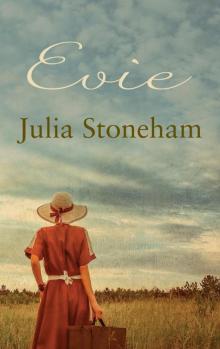
Evie, page 7



Chapter Four
For Georgina and Christopher the month it took the SS Oronsay to cover the thirteen thousand nautical miles between Tilbury and the docks in Wellington on New Zealand’s north island had been an idyllic, extended honeymoon.
A trail of picture postcards, most of them written by Georgina, had arrived at her parents’ home and at Higher Post Stone. Roger and Alice, John and Isabel had telephoned one another to compare notes as the newly-weds’ voyage progressed.
‘We had a card from Gibralter last week,’ Isabel announced. ‘They saw the apes!’
‘We had one this morning!’ Alice replied. ‘All about Pompeii. Some of the murals are so saucy that women are not allowed to see them! Georgie was furious!’ At Port Said they had ridden camels. The Suez Canal had been ‘amazing’, at Aden they walked through the old town and at Colombo Christopher had bought Georgina a moonstone ring and they had swum in the Indian Ocean at Mount Lavinia. The ship had called briefly at Perth, Adelaide and at Melbourne on ‘cup day’, when everything and everyone was focused on the world famous horse race and Georgina and Christopher had the city centre almost to themselves. Many of the public houses only allowed women into their saloon bars. ‘A bit prehistoric don’t you think’ Christopher wrote to his father ‘for a progressive country?’ While in Sydney they boarded the ‘the Manly boat’ and were impressed by the extent and beauty of the harbour: ‘blue silk surrounded by green hills,’ Georgina wrote, waxing lyrical to her mother. ‘And a rocky foreshore broken by sandy coves.’
‘It’s no wonder Australians brag about this place,’ Christopher told his father and step-mother, ‘It’s truly amazing, “bonza” as they call it. Only another week before we arrive in Wellington.’
‘What will it feel like?’ Georgina wrote to Alice, ‘coming down to earth again after this brilliant voyage? I could go on forever! Up through the Indonesian islands, “dipping through the tropics by the palm green shores”, across to Panama, through the canal and down to South Africa! Why stop now? Why stop ever? What’s going on at Post Stone in my absence? Anything I should know about? Love to everyone. Georgie. XXX.’
Alice wrote back, addressing her envelope c/o The New Zealand Forestry Commission. There was very little news other than the unfolding of the as yet unresolved saga of Evie and Giorgio, so her letter was all about that, finishing, disturbingly with the news that ‘We don’t know where they are or what is happening to them. Edwin Lucas is keeping Giorgio on his payroll for the time being, which is good of him, otherwise he would be in serious trouble for breaking his contract with the War Office.’
The government apartment which had been put at Christopher’s disposal until a more permanent posting was decided upon, was in a civil service office block in the business district of Wellington. Its mean windows looked out onto the back of a similar building, its three rooms were small and beige. Immediately after their arrival, while Christopher was sent on a series of surveys, which took him on extensive tours of both islands, Georgina found herself alone in the beige apartment with their unpacked trunks. Twice Christopher had returned for a brief weekend but there had been times when she had been alone for almost three weeks. It was true that the wife of one of Christopher’s colleagues had invited her to ‘baked tea’.
Georgina had been unsure what to expect at five o’clock on a Sunday afternoon and had been surprised when a plate piled with overcooked lamb, roasted pumpkin and baked potatoes was put before her.
Noeline was a kind-hearted girl with two small children. Her husband was a forest ranger who worked for weeks at a time in remote areas, spending only a few days a month at home with his family.
‘No, we don’t see that much of each other,’ she told Georgina, equably, ‘but you get used to it!’
Georgina was not, nor had she ever been, a snob. Nevertheless, the life experiences of these two young women were so totally different that each was as conscious as the other of the effort they were both making to communicate. Georgina told her hostess that she was hoping to get a job in order to usefully fill her time while Christopher was away.
‘That’d be a good trick,’ Noeline enthused, smilingly spooning mashed pumpkin into her two-year-old. ‘What sort of job d’you fancy?’
‘I don’t know,’ Georgina said ‘It would depend what’s on offer.’
‘What was your last job?’ Noeline enquired, helpfully.
‘Flying,’ Georgina told her.
‘Flying? Flying what?’ Noeline had paused, mid spoonful. Her baby, fascinated, fixed its huge, blue eyes on the dripping spoon.
‘Planes,’ Georgina said, conversationally. ‘We were what they called “ferry pilots” for the ATA. That’s short for Air Transport Auxiliary. It was part of the RAF.’ If Neoline was astonished, Georgina was unaware of it. ‘Before that I was a land girl,’ she added. ‘Because I was a conscientious objector, you see. All my family are.’
‘What … pacifists you mean?’
‘Yes. I had to do war work but didn’t want to fight. So the Land Army fitted the bill. My parents farm, you see.’
‘Oh.’ Noeline was confused. ‘But … you said you were in the RAF.’
‘No. Just affiliated to it,’ Georgina corrected. ‘Not in it. No combative ops. We just moved planes around. From workshops to airfields.’
‘Oh. But … if you were a pacifist, why did you leave the Land Army?’ Noeline wanted to know.
‘Long story,’ Georgina told her, hoping that Noeline would transfer her attention back to her young child. The baby was drowsy. His mother laid him in the crook of her arm and rocked him. The second child was playing happily on the floor at her feet.
‘Go on, then,’ Noeline said. So Georgina told her how, just weeks before he cracked up as a result of his experiences during the aftermath of the Battle of Britain, she had met the man who was now her husband, an RAF pilot in Fighter Command and seen him go to pieces. ‘This brave person, not much older than a schoolboy, was reduced to a shambling ruin. It was awful. He was out of his mind for months. In a loony bin, basically. And it changed my views on pacifism. I wanted someone to be punished for what they’d done to him. Stupid, really!’ Despite herself the old feelings almost overwhelmed her.
‘No,’ Noeline said, cradling her youngest. ‘I think it’s nice. Really nice. You must have loved him ever so much.’
‘I did,’ Georgina said, then she laughed and added lightly, ‘I do.’
‘Dear Alice,’ Georgina wrote, a few days after her visit to Noeline.
If I’d known it was going to be like this I wouldn’t have come! I’m in a dreary rented flat with absolutely nothing to do. Chris is away week after week and although it’s lovely when he’s here, most of the time he isn’t. I’ve tried to get a job to fill in the time but my only experience is in agriculture and flying. Not much of either in this dreary city! I’ve done all the sights. Museum. Art gallery. Oh Alice, I do wish we hadn’t come out here! I wish we were back in the Post Stone valley making our home in the lower farm. Hester and Dave and little Thurza across the yard. You, Edward John and Father-in-Law just up the hill, Rose in her tea shop and ‘all right with the world’. I suppose two years is not forever, but today it feels like it.
She reread the letter. Then she sighed, screwed it up and tossed it into the beige waste-paper basket where it lay with two other discarded letters, one to her mother and one to Christopher.
It had been weeks since Norman Clark’s appearance at Lower Post Stone and the simultaneous disappearance of Giorgio and Evie. Ferdie Vallance’s bruises had faded, work on the wall round the slurry pit was completed, the mangels were harvested and were ready to be fed to the cattle when the grass failed, the nights were drawing in and woodsmoke hung about the village chimneys.
Alice spent a couple of days in London working on the early planning stages of a new kitchen for a north London hospital before returning home to complete her design plans in the comfort of the room at Higher Post Stone that was now her studio. Edward John, in his last year of prep school, had become a vigorous and enthusiastic rugby player. Because of his height and his powerful build he was selected to play as a right-winger for his house team.
As usual at the weekends, Rose did not use her big ovens for the pasties she sold during the week. Often the Crocker family would arrive on Sunday mornings to find a large piece of roasted meat reaching perfection and lying, its juices flowing, surrounded by crisply baked potatoes. While Rose thickened the gravy, Dave slid the carving knife through the succulent flesh, laid the thick slices on his mother’s willow-patterned dinner plates and set them on the white tablecloth in front of his wife, his mother and himself. Hester watched as Rose cut two slices of the meat into small pieces and put them into a dish from which, twenty-seven years ago, Dave himself had taken his first solid food.
‘That be too much for Thurzie, Mother-in-law,’ Hester said, removing half the helping from her daughter’s plate.
‘Well then, give it to Dave,’ Rose muttered, adding something about daughters-in-law always knowing best. ‘’E won’t say no, will you, son!’
‘’S a great piece of pork, Mum. Yeah, I’ll ’ave Baby’s.’
They ate with gusto. The easy family silence only broken by Rose enquiring if everything was all right with the potatoes, carrots, Brussels sprouts and gravy and Hester and Dave repeatedly assuring her that it was. Knives and forks clattered and Dave mopped up his gravy with a thick slice of his mother’s homemade bread.
‘Well, it’s discourteous, to my way of thinking,’ Rose announced suddenly.
‘What is?’ Dave asked her with his mouth full.
‘Those two. Evie and what’s ’is name. Buggering off like that, without so much as a thank you to Mr Bayliss and Alice – or Edwin Lucas, come to that. They’d all been good to ’em, one way and another – but off they goes without a bloomin’ word.’ This was Rose Crocker’s method of opening a discussion which she intended to use in order to procure information. She waited patiently through the short silence which followed.
‘Mr Bayliss wrote a letter to Annie las’ week,’ Hester told her, ‘for to ask if they’d turned up at ’er place by any chance. Annie wrote back straight off and said she and Hector hadn’t seen or heard a dickie bird.’
‘They could be dead,’ Dave said, helping himself to more pork.
‘Dead? Why would they be dead?’ Hester wanted to know.
‘Norman might of tracked ’em down and done ’em in.’
‘Done ’em in?’
‘Yeah. Taken an axe to ’em. Hacked ’em up and chucked the bits in the Exe where they would of bin carried out to sea.’
‘Don’t say that, Dave, that’s terrible!’ Hester looked at the half-eaten pork flesh in front of her, and then, when her mother-in-law’s eyes were not on her, slid it onto her husband’s plate.
‘Beats me where they could be to,’ Rose said, thoughtfully. ‘It’s not as if either of ’em’s got any family to help ’em out, and there’s precious little work about this time of year, specially when they’ve got no ration books nor nothin’.’
‘Evie might have hers,’ Hester said. ‘She must of ’ad one in Coventry – Mrs Todd would of give it ’er when Norman come to fetch ’er ’ome that night.’
‘Well, she didn’t have it when she come to me,’ Rose told her, and Dave’s opinion was that she’d have hardly waited to pick it up when she was giving her old man the slip by climbing out of his bedroom window. By the time they had finished Rose’s apple pie and clotted cream it had been agreed that neither Evie nor Giorgio had ration books and consequently were most probably both dead.
It was Sunday night in Wellington. It had been a good weekend. Christopher had arrived at the beige apartment on the Friday night. On the Saturday they had hired a car and headed out of town along the coast road, found a ramshackle cafe overlooking a wide beach and eaten baked lobster. By midday Sunday, faced with another fortnight alone, Georgina, when Christopher asked her why she was so quiet, had told him.
‘You can’t imagine how boring it is!’ she began. ‘What am I supposed to do all day? And this place!’ she glared around the beige room, warming to her subject. ‘Look at it! It’s enough to drive anyone insane!’
‘I think you got a bit spoilt on the voyage, Georgie,’ he told her. ‘We both knew it would be down to earth with a bump once we got here!’
‘But that’s the point, don’t you see? You have your work! I have nothing! Nothing to do but sit here, waiting for you to come back!’
‘It’s only for a few weeks. Once I get posted—’
‘It’s been six weeks already, Chris! And now it’s going to be another two … Have you any idea what it’s like?’ Christopher shrugged his shoulders, which was unwise of him. Georgina’s eyes narrowed. ‘You have no idea how I feel! You might at least try to understand! You think I’m behaving like a spoilt brat, don’t you!’ He smiled. This too, was unwise.
‘Well … You are a bit, darling, don’t you think?’ he asked her gently, but, arguably, not gently enough.
It was not often that Georgina lost her temper. She had done so once when Roger Bayliss had refused to go to visit Christopher when he was locked in a psychiatric ward at the start of his breakdown. She did so now for basically the same reason. Just as his father had done, Christopher was proving himself incapable of seeing past his own feelings when someone else needed, even demanded, indulgence and understanding. While it was true that Georgina was being unreasonable and that these early weeks of his contract were demanding a lot of Christopher, leaving him focused on more immediate and pressing things than his wife’s moodiness, he was proving to be curiously inept when it came to a simple demonstration of sympathy. Much as his father had done when he himself had most needed him, Christopher was focusing on his own situation and was blind to Georgina’s. Just as Roger had done when faced with Christopher’s breakdown and ignominious dismissal from the RAF, Christopher was sidestepping his responsibility to Georgina, slamming down the portcullis and hauling up the drawbridge, leaving himself in an isolated state of self-defence. It was how both he and his father had reacted when his mother had died and they had carried on with their lives almost as though it had never happened. ‘Life must go on, my boy,’ Roger Bayliss had said to the nine-year-old Christopher on the day after earth had thudded down on his mother’s coffin lid. ‘So we won’t dwell, overmuch, on our loss of your mother.’
Although mortified by the distress he had caused Georgina, instead of taking her in his arms, Christopher seemed to her to be almost embarrassed by her outburst. So she suppressed her feelings and they spent the rest of that evening behaving like well-brought-up strangers. At one point she had smiled at him.
‘What?’ he said. She shook her head.
‘I had never realised until now how amazingly alike you and your papa are.’
‘Chip off the old block, am I?’ he said, finishing their bottle of wine and trying to make a joke of her unexpected remark. Georgina blinked hard in order to prevent tears forming in her eyes.
The next morning she went with him down to the ferry where he and his colleagues were to embark for the south island to carry out a feasibility study involving the selection of a particular type of spruce for a specific site. Georgina stood on the dock and waved until, as the boat slipped away from the quay, she lost sight of him.
The morning was sunny. The southern hemisphere seemed to have moved suddenly into full summer. Unable to bear the thought of the beige apartment, Georgina walked aimlessly, eventually finding herself in a small, shady park. Office workers on their lunch breaks sprawled on the grass or sat on benches, eating sandwiches.
She found a cafe, and sitting at a table outside it, drank a delicious glass of iced ginger beer. Her spirits rose slightly. Someone had left a local newspaper on her table. She picked it up and read about a pod of dolphins that had become stranded on a nearby beach. A man had severed his thumb in a sawmill. A woman had given birth to triplets only one of which had survived. She ran her finger down the small ads. A department store was advertising for assistants in its soft-furnishings department. There were vacancies for waitresses and cleaners. It was as she refolded the paper that she noticed a small news item that immediately caught her attention.
Speculation on the whereabouts of Evie and Giorgio continued at the higher farm where Alice, Roger and Edward John exchanged theories at the dinner table when all three of them were together at the weekends.
‘Strictly speaking,’ Roger began, one Friday evening, using his napkin after finishing his helping of a particularly succulent mutton casserole, ‘we should not be referring to them as “runaways”. We are assuming they are together but we have no hard evidence of that. The police have been checking the property in Coventry in case either of them – or both – have returned there—’
‘She might have been taken there,’ Edward John interrupted with his mouth full. ‘Against her will. By Norman.’
‘There was no sign of either of them when the police searched the place. They’ve dug up quite a bit of information about Norman’s history, incidentally. No existing birth certificate but evidence that an aunt and uncle took him out of a foundlings hospital in Birmingham. But it seems the aunt died when he was about six and the uncle was deemed “unfit”, so Norman ended up in an orphanage.’
‘You’re not suggesting that excuses him, are you?’ Edward John had been scandalised by Norman’s attacks on both Evie and Ferdie Vallance. ‘He beat a woman and knocked down a cripple!’