Milly-Molly-Mandy & Co, page 5
part #1 of Milly-Molly-Mandy Series


Soon the bonfire had grown to a fine, great heap, so that only Father or Uncle could add things to it, because nobody else could reach high enough.
And then on Guy Fawkes day – would you believe it! – it rained.
Going to school, Milly-Molly-Mandy and little-friend-Susan and Billy Blunt did hope it would stop in time for the bonfire that evening. It wasn’t far for little-friend-Susan to come from the Moggs’ cottage, but it was quite a walk for Billy Blunt, right down in the village.
“We wouldn’t want to light the bonfire if you couldn’t come, Billy,” said Milly-Molly-Mandy.
“We’d have to have it tomorrow instead,” said little-friend-Susan.
“Wouldn’t be Guy Fawkes day to-morrow,” said Billy Blunt. (Which was quite true.)
“You’ve got our fireworks, don’t forget,” said Milly-Molly-Mandy.
“And our guy, remember,” said little-friend-Susan.
“Don’t you worry,” said Billy Blunt.
But you never knew – mothers often got fussy over your going out on rainy evenings, getting school clothes wet and that sort of thing.
When Milly-Molly-Mandy got home that afternoon she hoped Mother wouldn’t notice her wet coat when she took it off. But Mother did. And she hung it up in the kitchen to dry, and her hat and rubber boots too.
“They’re sopping, Milly-Molly-Mandy,” said Mother. “We shall only just get them dry enough for you to wear to school to-morrow.”
Milly-Molly-Mandy’s heart sank.
“But what about going out to the bonfire to-night?” she asked.
“We shall have to think about that,” said Mother. “Call the others in to tea now, Milly-Molly-Mandy.”
During tea (Milly-Molly-Mandy had a little brown egg with hers) she suddenly wondered out loud: “Why do we have Guy Fawkes day, and burn him?”
Father said: “Don’t you know? He was a real live person once.”
Mother said: “He tried to blow up Parliament with gunpowder years and years ago.”
Grandpa said: “Just when the King and important people were coming to open it.”
Grandma said: “But they found out just in time, and he and his bad friends were punished.”
Uncle said: “And now you kids want to blow us all up with your squibs and bonfires to celebrate him.”
Aunty said: “No, it’s because they are so glad Parliament was saved!”
“Well,” said Milly-Molly-Mandy, sucking her egg-spoon, “I’m glad Guy Fawkes didn’t manage to blow up anything. But I don’t think I want our guy to be burnt – he hasn’t done anything naughty!” And then she asked, “Have you thought about what I can wear when we burn the bonfire to-night?”
So directly tea was over Mother got an old jacket of her own and put it on Milly-Molly-Mandy (she had to tuck the cuffs up a lot). And she wrapped an old shawl round Milly-Molly-Mandy’s head and shoulders. And she put her own goloshes over Milly-Molly-Mandy’s shoes and tied them on with string.
Milly-Molly-Mandy looked like a proper little guy herself!
Then there came a tapping on the back door. And in shuffled little-friend-Susan, in her father’s water-proof cape (which came down below her knees) and her mother’s rubber boots (which came nearly up to her knees) and her own pixy hood.
Little-friend-Susan looked a proper little guy too!
Even Toby the dog barked at them. (But he wagged his tail too.)
Then both the little guys shuffled outside to look for Billy Blunt. It was dark and wet, but not actually raining now, and it felt very exciting to be out.
“I do hope his mother lets him come,” said Milly-Molly-Mandy.
“So do I,” said little-friend-Susan. “He’s got all our things.”
But they couldn’t see him coming along the road, so they shuffled round to the yard to look at their bonfire.
Father and Uncle were both there with a lantern, and just as they came up Father put a match to a rocket fixed to a fence-post. There was a great bang! and a whoosh! and showers of beautiful stars lit up everything.
Milly-Molly-Mandy and little-friend-Susan shrieked with excitement, and Milly-Molly-Mandy cried, “Oh, I wish Billy Blunt would come quickly!”
And then, suddenly, they saw the guy!
It was sitting on the bonfire heap – a splendid guy, with a horrid pink cardboad face, and a dirty old hat and raincoat, and ragged gloves at the end of its stiff, sticking-out arms.
Milly-Molly-Mandy and little-friend-Susan shrieked again with excitement, and they looked about everywhere for Billy Blunt (because, of course, they knew the guy couldn’t have got there by itself). Uncle hung the lantern on the barn door, and they searched in the barn, and round the cowshed. But they couldn’t see Billy Blunt.
“Well,” said Father; “we’d better get your bonfire going now, and not wait any longer.”
“Oh, don’t burn the guy yet!” said Milly-Molly-Mandy. “Let’s save it – perhaps Billy Blunt will come.”
It looked such a horrid guy, with its pink grinning face. She didn’t like to reach up and touch it to push it out of the way. But Uncle said loudly:
“Oh, let’s burn it up and get it done with!” And he struck a match.
And then – what DO you think happened?
The guy suddenly threw up its tattered gardening-glove hands, and it jumped down off the bonfire to the ground in a great hurry, all by itself!
You should have heard Milly-Molly-Mandy’s and little-friend-Susan’s shrieks!
Then the pink cardboard mask fell off and rolled on the ground, and they saw someone else’s face grinning at them under the guy’s shabby old hat.
“It’s Billy Blunt!” shrieked Milly-Molly-Mandy, catching hold of his ragged old coat.
“It’s Billy Blunt!” shrieked little-friend-Susan, picking up the cardboard mask and trying it on herself.
“Boo!” shouted Billy Blunt, waving his arms. But he couldn’t frighten them any more, now that they knew who it was.
So then he told them how his mother hadn’t wanted him to come out and get his school clothes wet again, and how he had taken the old hat and coat off the guy he had made and put them on himself instead. So then Mrs Blunt had let him come along and pretend to be the guy.
“Huh! Frightened you girls properly, didn’t I?” said Billy Blunt, grinning, as he handed them their share of squibs out of his coat-pockets.
“You were frightened too, properly, when you thought Uncle was going to light the bonfire!” said Milly-Molly-Mandy.
“Serve you right for frightening us so!” said little-friend-Susan.
Then Uncle really put a match to the bonfire, and it began to blaze up. And Father let off some more rockets. And Grandpa and Grandma and Mother and Aunty came out to watch (leaving Toby the dog and Topsy the cat safely shut indoors, lest they should get scared at the noise and run away). And Milly-Molly-Mandy and little-friend-Susan and Billy Blunt lit their squibs, which cracked and banged and made Uncle jump so much that they laughed and laughed!
And what with the roaring of the bonfire and the banging of the fireworks and the shouts of Milly-Molly-Mandy and little-friend-Susan and Billy Blunt, anyone would know they had a splendid Guy Fawkes celebration, even though they didn’t burn the guy.
But that, said Father, was because it was really too difficult to choose, with three guys jumping round and round the bonfire!
Anyhow, they burnt the guy’s dirty old hat and gloves. But his raincoat Mrs Blunt had to put into the dustbin as soon as Billy Blunt got home again that evening after the bonfire was out!
About the Author
Joyce Lankester Brisley was born over a hundred years ago, on 6 February 1896. She had two sisters: an elder one, Ethel, and Nina, who was just a year younger than Joyce. The family lived in Bexhill-on-Sea in Sussex, in a house so close to the sea that when there was a very high tide the waves would come right into the garden. Joyce’s father ran a chemist’s shop in the town. Her mother enjoyed drawing and painting, but had to spend most of her time looking after the home and her children.
Joyce and her sisters were all good at art, like their mother, and went to evening classes at Hastings School of Art, taking the train there and back along the coast. By the time they were teenagers, “Eth” (as Ethel was always known in the family) was having her pictures accepted for exhibitions at the Royal Academy in London and was soon selling paintings as a result. Then, through a friend, the girls were invited to meet Miss Brown of the magazine Home Chat. They quickly began to do illustrations for this magazine, so for the first time all three sisters started to earn money for themselves.
This money was soon to become very important for the family. In 1912, when Joyce was sixteen, her parents separated. In her diary (writing in French as if to keep it a secret) she recorded that her father wanted his family to leave the house. They stayed until Joyce and Nina had finished their term at art school, then the three girls moved with their mother to South London, where Eth had found them a tiny flat.
In London, Joyce and Nina enrolled at the Lambeth School of Art in 1912 – an uncle kindly agreed to pay the fees for both girls. They studied there five days a week for two years. In 1913 they moved to a house with a large room that the three girls could use as a studio.
The outbreak of the First World War in 1914 meant that food was scarce. Their mother had to spend a lot of time searching for meat and vegetables she could afford, while the girls worked hard earning money from illustrations for magazines, newspapers and advertisements. Joyce writes in her diary about drawing advertisements for Cherry Blossom boot polish and Mansion floor polish. She also writes about the German bombing raids on London – describing how, in September 1916, the sisters had to get up in the middle of the night and go downstairs for safety, still in their nightclothes and bedtime plaits.
Despite the war and constant worries about money, family life continued happily throughout this time. In 1917 Joyce records in her diary that Nina (daringly) wanted to cut her hair short, and Eth longed to do the same, but Joyce felt “I couldn’t – it wouldn’t suit me well at all”. The sisters obviously got along very well together, but nevertheless Joyce wished she had some privacy. She was delighted when, shortly after her twenty-first birthday, she was able to have a room of her own – “My longing, for years and years.”
In 1918 they all moved again, to a house with a larger studio. Joyce went with her mother and sisters to the local Christian Science Church. There they met an artist who worked for The Christian Science Monitor. As a result, both Joyce and Nina began submitting stories and drawings to the paper, and it was on the Children’s Page in October 1925 that the first story about Milly-Molly-Mandy appeared. The idea had come into Joyce’s mind one day when “the sun was shining and I longed to be out in the country instead of sitting indoors all day, earning a living . . .”
Milly-Molly-Mandy was an immediate success and soon began to gain a strong following among readers. Joyce records that:
“. . . boys and girls began writing letters to the paper, to the editors and to Milly-Molly-Mandy herself, wanting to know more about her, asking, Could she come for a holiday by the sea? Could she have a baby sister to take out riding in the pram? (She couldn’t, as she was an ‘only’ child, but little-friend-Susan could, and did.) Some of the letters enclosed foreign stamps for Billy Blunt’s collection (so generous!). One boy wrote all the way from Australia to tell me that ‘Father’ was shown digging with his wrong foot on the spade (for it seems the left foot is the right foot for digging with!). I wrote back to thank him and promised to alter the drawing before it went into a book – as you may see I did, for it’s nice to get things quite correct.”
Joyce went on writing stories about Milly-Molly-Mandy for the rest of her life, but she wrote about other characters too, in books such as Marigold in Godmother’s House (1934) and Adventures of Purl and Plain (1941). She also illustrated stories by other authors and was specially chosen by her publisher, George Harrap, to draw the pictures for the first edition of Ursula Moray Williams’s Adventures of the Little Wooden Horse (1938).
Joyce always remained close to her sisters. Nina, who became the first and much-loved illustrator of the Chalet School stories by Elinor M. Brent-Dyer, was the only one to marry. Ethel died in 1961, and Nina and Joyce died within a few months of each other, in 1978.
Joyce Lankester Brisley seems to have been rather a shy person and she obviously didn’t like publicity. Once, after two of her pictures had been accepted by the Royal Academy and a journalist wanted to interview her, she telegraphed at once that she “would be out”. Maybe she was a bit like Milly-Molly-Mandy herself – happy to be busily getting on with whatever task or errand she’d set herself for the day, and content with whatever good fortune life might bring her.
Books about Milly-Molly-Mandy from
Macmillan Children’s Books
Milly-Molly-Mandy Stories
More of Milly-Molly-Mandy
Further Doings of Milly-Molly-Mandy
Milly-Molly-Mandy Again
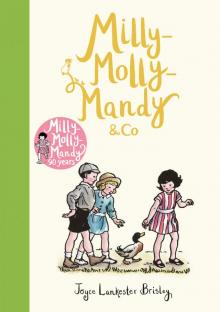
Milly-Molly-Mandy & Co
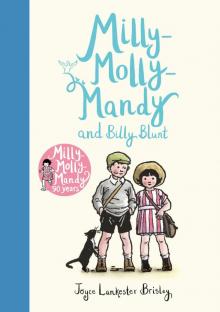
Milly-Molly-Mandy and Billy Blunt
First published by George G. Harrap 1955
This edition published 2018 by Macmillan Children’s Books
This electronic edition published 2018 by Macmillan Children’s Books
an imprint of Pan Macmillan
20 New Wharf Road, London N1 9RR
Associated companies throughout the world
www.panmacmillan.com
ISBN 978-1-5098-4512-5
Copyright © Joyce Lankester Brisley 1955
Pan Macmillan does not have any control over, or any responsibility for, any author or third-party websites referred to in or on this book.
You may not copy, store, distribute, transmit, reproduce or otherwise make available this publication (or any part of it) in any form, or by any means (electronic, digital, optical, mechanical, photocopying, recording or otherwise), without the prior written permission of the publisher. Any person who does any unauthorized act in relation to this publication may be liable to criminal prosecution and civil claims for damages.
A CIP catalogue record for this book is available from the British Library.
Typeset by The Dimpse
Visit www.panmacmillan.com to read more about all our books and to buy them. You will also find features, author interviews and news of any author events, and you can sign up for e-newsletters so that you’re always first to hear about our new releases.
Joyce Lankester Brisley, Milly-Molly-Mandy & Co