

Great or Nothing, page 1


This is a work of fiction. Names, characters, places, and incidents either are the product of the authors’ imagination or are used fictitiously. Any resemblance to actual persons, living or dead, events, or locales is entirely coincidental.
Text copyright © 2022 by Joy McCullough, Caroline Tung Richmond, Tess Sharpe, and Jessica Spotswood
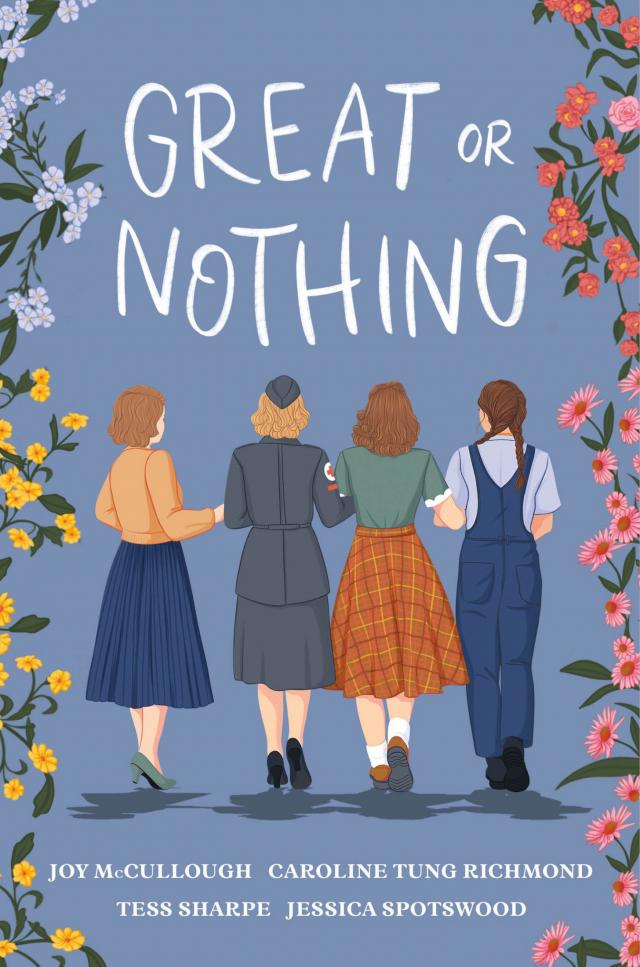
Cover art copyright © 2022 by Louisa Cannell
Cover lettering copyright © 2022 by Ann Chen
All rights reserved. Published in the United States by Delacorte Press, an imprint of Random House Children’s Books, a division of Penguin Random House LLC, New York.
Delacorte Press is a registered trademark and the colophon is a trademark of Penguin Random House LLC.
GetUnderlined.com
Educators and librarians, for a variety of teaching tools, visit us at RHTeachersLibrarians.com
Library of Congress Cataloging-in-Publication Data
Names: McCullough, Joy, author. | Richmond, Caroline Tung, author. | Sharpe, Tess, author. | Spotswood, Jessica, author.
Title: Great or nothing / Joy McCullough, Caroline Tung Richmond, Tess Sharpe, Jessica Spotswood.
Description: First edition. | New York : Delacorte Press, 2021. | Audience: Ages 12 and up. |
Summary: “A reimagining of Little Women set in the spring of 1942, when the United States is suddenly embroiled in the Second World War, this story, told from each March sister’s point of view, is one of grief, love, and self-discovery”— Provided by publisher.
Identifiers: LCCN 2021005587 (print) | LCCN 2021005588 (ebook) | ISBN 978-0-593-37259-3 (hardcover) | ISBN 978-0-593-37260-9 (library binding) | ISBN 978-0-593-37261-6 (ebook)
Subjects: CYAC: Sisters—Fiction. | World War, 1939–1945—Fiction.
Classification: LCC PZ7.1.M43412 Gr 2021 (print) | LCC PZ7.1.M43412 (ebook) | DDC [E]—dc23
Ebook ISBN 9780593372616
Random House Children’s Books supports the First Amendment and celebrates the right to read.
Penguin Random House LLC supports copyright. Copyright fuels creativity, encourages diverse voices, promotes free speech, and creates a vibrant culture. Thank you for buying an authorized edition of this book and for complying with copyright laws by not reproducing, scanning, or distributing any part in any form without permission. You are supporting writers and allowing Penguin Random House to publish books for every reader.
ep_prh_6.0_139378369_c0_r0
Contents
Cover
Title Page
Copyright
Dedication
Tide
Chapter 1: Jo
Feathers
Beth
Chapter 2: Meg
My Dearest Meg
Weed
Chapter 3: Amy
Amy
Eavesdrop
Chapter 4: Meg
Marmee & Father
Madame Alexander
Chapter 5: Jo
Forget
Lies
Chapter 6: Amy
Laurie
For Granted
Chapter 7: Meg
Sailing
Chapter 8: Jo
Dear Jo
Chapter 9: Amy
Frail
Nothing
Chapter 10: Jo
Hello
Striving
Chapter 11: Meg
Fine China
Chapter 12: Amy
Tether
Chapter 13: Meg
Impulse
Practice
Chapter 14: Jo
Betrayal
Blame
Chapter 15: Amy
Penance
Luck
Chapter 16: Meg
Unburden
Chapter 17: Jo
Ideas
Soft
Chapter 18: Amy
Mission
Chapter 19: Jo
Glow
The Fireplace
Chapter 20: Meg
Moxie
Breath
Chapter 21: Amy
Falling
Chapter 22: Meg
The Words
Chapter 23: Amy
Brave
Light
Chapter 24: Jo
Thread
Chapter 25: Amy
To-Do List
Chapter 26: Meg
Salt
Chapter 27: Jo
Scream
Chapter 28: Amy
Safe
Chapter 29: Meg
Imperfection
Chapter 30: Meg
Waiting
Chapter 31: Jo
Acknowledgments
About the Authors
For Jim McCarthy
Tide
The water turns
at the moon’s insistence.
Wild storms rock the surface
but the waves are pulled
by a stronger force.
Jo at the page
Amy at the easel
Meg at the hearth.
Dramatic as lightning,
but this turning, this force
is also the caress of a sister’s hand
soft slow gentle
and certain as death.
CHAPTER 1
JO
There was a moment in each day where she forgot.
It never came at the same time; if it had, perhaps then Jo could have prepared for it. But how could you prepare for forgetting, just for a moment, that what once was a quartet had been reduced to a trio?
There was no rhyme or reason to the moments she stumbled. She had found that there was no rhyme or reason to any of this; grief and war, they were intertwined. Bedfellows in the truest sense. The only way to defeat them was the same: battle.
But there was no way to win hers. Jo was Sisyphus, rolling that boulder up the hill, only to lose her grip right before she reached the top. Because there was no way to bring her back.
Beth was gone. Not the way Laurie or Father was gone or how Amy was gone. But really, truly gone.
It still felt so wrong. Like Jo had tripped into a nightmare she couldn’t wrench herself from. Was that why she forgot? Was her mind simply ill prepared for the new world she’d woken to that terrible day?
After, staying home had been unbearable, but she had borne it as long as she could—for Meg’s sake, for Marmee’s, even for Amy’s, though her little sister always seemed to soldier through. But when the attack on Pearl Harbor shocked America, the war that had been knocking at their doors finally burst through in the cruelest, bloodiest way. Grief had no place in the aftermath (grief made its home in her heart, dug a burrow and set up for good) when action was so badly needed. The March sisters—the broken, out-of-tune trio that was left—had scattered. Meg had stayed with Marmee; the good daughter, who’d never rock the boat too much. Amy had done what she did best: put on a smile and sought a way out and found it. And Jo had run.
There was no polite way of putting it, and she wasn’t the most polite in the first place. She wouldn’t lie and deny it to herself, at least. She had run, as far and as fast as she could. The war effort needed women, capable women who could handle explosives and build planes, with steady hands and a smile on their faces for the newsreels.
She would’ve preferred Laurie’s path: a uniform, and a gun in her hands, and a boat overseas and some Nazis to defeat. She’d told him to punch Hitler for her as she straightened the wool lapels of his uniform before he shipped out. He’d let out a laugh, but it hadn’t reached his eyes. He’d been so upset with her, still, but there had been nothing to do but put the sting of her rejection aside. There were much more important things now.
He had shipped out, and she thought she might die, because she may not have loved him the way he wanted, but she did love him—more fiercely than anyone but her sisters and her parents. Jo had never been one to give her love lightly, and now so many pieces of her were missing. Laurie hadn’t taken her heart, but part of her laughter, her joy, her mischief and adventure, for that was what she thought of when she thought of him.
And all she could do was run from her sisters, from her grieving mother who had thrown herself into distraction after distraction, from the memory of her father’s hand cupping her cheek as he said goodbye.
From Beth, in that bed, so, so pale and still.
Was it any wonder that Jo lived for those moments she forgot Beth was gone? She craved them like a drunk craved whiskey. But the crash of remembering: that was worse than the shakes the men too far gone got when they didn’t just want drink but needed it.
Even the sweet things had their bitterness these days: A kiss witnessed on the street could be the last. A love letter sent could end up being unread. A knock at the door and two soldiers outside could destroy an entire family. We regret to inform you…
They all knew the words now. The girls on the line didn’t dare even speak them, like it’d conjure up a curse. But when the news of someone’s husband or father or brother rippled through the factory, it was what ran through everyone’s minds. Those words, that telegram. We regret to inform you…
Jo turned over on her narrow mattress, checking the clock on the rickety table that held her lamp and the stack of Life magazines she’d borrowed from Anna, two doors down. It was still dark out—not even five yet. The boardinghouse should be quiet, yet she heard the unmistakable click of oxfords in the hallway. Mrs. Wilson, who owned the boardinghouse, liked to say that wood floors kept her girls from getting up to no good. Mrs. Wilson hadn’t figured out they’d all just learned how to tiptoe.
Some new girl hadn’t gotten the message.
Six weeks ago, Jo had been the new girl, the rules of the boardinghouse a mystery to her. But she’d grown up in a house full of women: she knew to stake out her territory…and how. Soon enough, she’d be ruling the roost.
She pulled on her robe—plaid and stitched with love by Meg, something that used to make her feel warm, inside and out, and now just made her feel guilty and mad, still so damned mad at her—and padded across the creaky floors of her room. Swinging open her door, she expected to catch Anna or Evelyn, or maybe even Molly, who liked to play at being a good girl but who all the girls knew was up to something with the late nights she kept.
Secrets were hard to keep in the boardinghouse, almost as hard as keeping quiet. But the early-morning visitor was doing nothing to muffle her steps or the thump of her suitcase as she set it down in front of the door across from Jo’s. Her back was to her, red curls that couldn’t be called anything but unkempt swaying, as she tried to get the door to open. Jo could hardly blame her for not keeping up her hair—in these parts, women kept their hair tucked safely under cotton turbans more often than it was styled into pageboys and pin curls.
“I thought the rookies were coming in on Wednesday,” Jo said, her voice hushed in the silence that came before the din that seemed to hum over the boardinghouse at most hours.
Instead of startling like Jo half expected the girl to do, she just cast a look over her shoulder. “Oh, doll,” she said. “If you think I’m fresh meat, you’ve got to be new. I’m just back from my stint in Texas, training the new batch of WASPs.”
Jo had a feeling she wasn’t talking about the insects, but she wasn’t about to ask. The world was full of new words, acronyms, and slang she had never learned and was still trying to. She hated feeling out of the know, and suddenly she was wishing she hadn’t been so eager for distraction she’d flung her door open or spoken at all.
“I’m Peg,” said the girl—woman, really—pressing a hand against the breast of her practical navy gabardine jacket. “You must be the Jo that Mrs. Wilson mentioned when I called. She had to move me to this room because you have my old one.”
“Are you the one who rigged the window with the corkscrew so it’d close properly?”
A smile crept across Peg’s face. “That was me. I’m also the gal to come to if the hot water’s coming out in drips. Me and that rickety hot-water heater have a special bond.”
“The girls’ll be glad to have you back, then. We haven’t had more than five minutes’ worth of hot water for weeks.”
“I arrived just in time.”
“Are you working the line?” Jo asked.
Peg’s smile widened. “I don’t make the planes. I fly them.”
“You’re a pilot?”
“I am.”
Jo had heard of them: the aviatrixes that had been trained to fly the planes she and the other girls built. They ferried them from the factory to the air bases mostly, but there were murmurs that some did more. Secret missions. Flygirls towing targets for the boys’ anti-artillery training. The kind of flying and danger that could get a girl killed. That may already have gotten girls killed.
Once, the thought of that kind of adventure might’ve thrilled her, but now, all Jo could think of was the loss. Most of the girls who lived at the boardinghouse worked at the factory with her, with a few exceptions. But there were other working women streaming in and out of the boardinghouses across the state and the country: girls working in offices, in factories of all kinds, not just munitions and aircraft—plus the girls who stayed at home to take over farming, or teaching like Meg. Everyone had been thrust into new worlds, but Jo felt like she was the only one unmoored from the shift. Surely that couldn’t be true.
“Peg!” A squeal broke out. “You’re back!” Anna came flying out of her room, throwing her arms around Peg. “I want to hear absolutely everything about Texas.”
Inside her room, Jo’s alarm went off and she retreated as Anna’s excited voice rose and, through the hall, muffled clanging—the other girls’ alarms—began. The silence of the morning was broken: it was time to come alive.
Jo closed her door and pressed her back against it for a moment, letting the alarm run to an abrupt halt, the echo hanging there. The murmur of voices in the hall, the rush of water down the way, the giggles and yawns: it was like every morning of her childhood, just more. Mornings always reminded her the most of what she’d left behind. The girls joked about it: Jo needs a cup of joe in the morning, or she’s a bear. They all had their quirks: Anna spent much too long on her hair, and Evelyn tracked in mud wherever she went, because that girl preferred spending time in the Victory Gardens over spending time with people. Jo was grumpy in the morning, and Molly was just plain secretive. Mrs. Wilson looked over them all, extending her benevolent sternness like a quilt to cover them and this hodgepodge place they’d come to call home.
It should have been enough.
It was not. Nothing ever was for Jo. That was the thing, wasn’t it? Laurie wasn’t enough, yet she was for him, somehow. Meg had taken one closer look at John, it seemed, and given up everything she’d ever dreamed of—because, somehow, he had been enough. Jo didn’t know what had changed in Meg: she had known John for ages; he’d been Laurie’s tutor, after all. But suddenly, things were different. At least Jo could understand Amy’s choices more than Meg’s; she’d stepped into the unknown, her little sister. Jo had begrudging admiration for her nerve. Meg had just stepped toward a man. An uninspired, staid one at that. How could she be happy?
And, more importantly, how could Jo not be happy for her? That was the question Meg had hurled during their fight, before Amy had come upstairs like gasoline thrown on an already furious fire.
After everything, Meg had said, how can you not be happy for me?
And how can you not understand me? Jo had shot back.
Meg had no answer, but maybe just as damning—neither did Jo. She’d been trying to find one ever since. All these months, and she’d failed each time.
Jo crossed the room to the vanity crammed underneath the drafty window that was kept shut by Peg’s clever corkscrew trick. Jo’s one good pair of stockings was draped over the mirror. Once she wore holes in this pair, she wasn’t sure where she’d find the money to afford another. She found it hard to care. It seemed ridiculous to dress for the ride to the factory and back, but she couldn’t exactly walk around in the coveralls she wore at work, even if they were damned comfortable.


