Other Worlds Were Possible, page 1
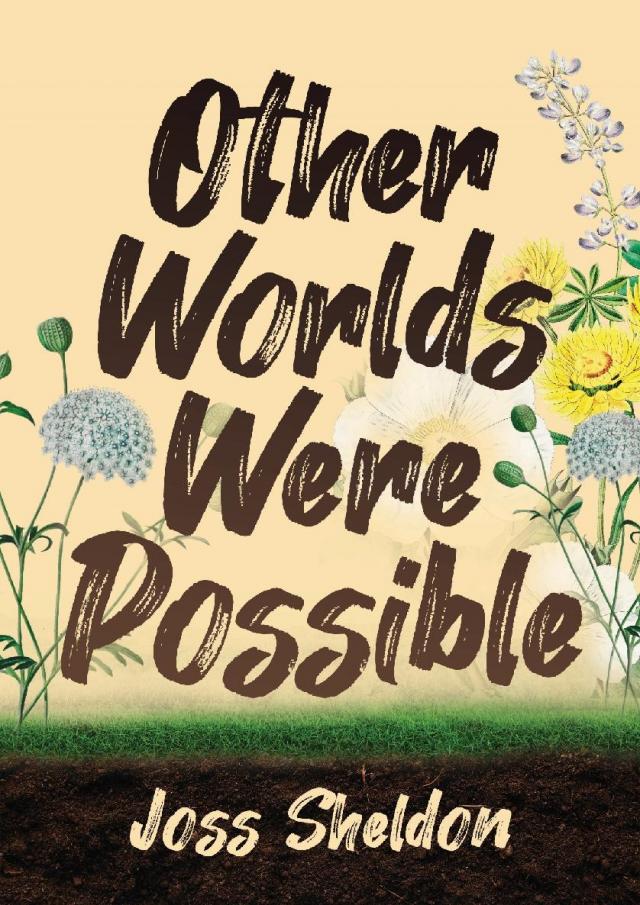


OTHER WORLDS WERE POSSIBLE
JOSS SHELDON
Copyright © Joss Sheldon 2023
ISBN-13: 979-3347753747
ISBN-10: 3347753747
ASIN: B0BNKF82YX
EDITION 1.0
All rights reserved.
This book is sold subject to the condition that it shall not, by way of trade or otherwise, be reproduced, stored in a retrieval system or transmitted, in any form or by any means, without the prior position of Joss Sheldon.
Joss Sheldon asserts the moral right to be identified as the author of this work, in accordance with the ‘Copyright, Design and Patents Act 1988’.
First published in the UK in 2023.
Cover design by Marijana Ivanova.
Edite by Alice Ilunsford, Daniela Costa, Jordan Tate and Geraldine Nyika.
Proofread by Sadia Khan.
“Part of what I mean by the myth of normal is that we assume the conditions of broader society are healthy simply because we’re used to them, even when they’re not healthy at all.”
Gabor Maté
“The assumption that what currently exists, must necessarily exist, is the acid that corrodes all visionary thinking.”
Murray Bookchin
“The struggle of man against power, is the struggle of memory against forgetting.”
Milan Kundera
“The world of hunter-gatherers, as it existed before the coming of agriculture, was one of bold social experiments, resembling a carnival parade of political forms... Many of the first farming communities were relatively free of ranks and hierarchies… A surprising number of the world’s earliest cities were organized on robustly egalitarian lines, with no need for authoritarian rulers… Human beings, through most of our history, have moved back and forth between different social arrangements; assembling and dismantling hierarchies on a regular basis… How did we get stuck? How did we end up in one single mode? How did we lose that political self-consciousness, once so typical of our species?”
David Graeber and David Wengrow
CONTENTS
UNCLE CROW’S LAMENT
SHAMING THE MEAT
SISTER-O, BROTHER-O
A DEBT OF GRATITUDE
THE PRODIGAL SON
AN ECHO FROM THE PAST
OUR ENDLESS NOMADIC DAYS
STONE CIRCLES, TRIANGLES AND SQUARES
THE HUNT
OF LOVE AND LOINCLOTHS
THE URGE TO DESTROY IS A CREATIVE URGE
THE MORNINGS AFTER THE NIGHTS BEFORE
HOME, SWEET AND SOUR HOME
OUR MONEY OR YOUR LIFE
DREAM ON
DOG DAYS
HELL’S BELLS
AN OLD FRIEND
THE END OF HISTORY
UNCLE CROW’S LAMENT
The Tale of Uncle Crow had been rattling around Sunny’s mind...
It was a well-worn fable; one he had heard on innumerable occasions, whilst sitting beside the campfire, chewing on barbecued meat. That yarn was always recounted by the oldest member of their clan, who always swore blind that the subject was their very own uncle; a man not much older than themselves. The other elders must have known this was not the case. Yet they never doubted the truth of the story itself; a story they had first encountered at that impressionable age, when the young believe almost everything they are told.
The story had once been true. Of this, there was little doubt. But it had been embellished by the whimsy of time. It was impossible to say how much of the tale had actually happened, how much had been forgotten, which bits were correct, and which bits had been re-remembered, re-imagined and re-invented; intentionally or by accident, in the recent or distant past.
The story was so simple, it barely merits such an introduction. But it was spinning around Sunny’s head with such ferocity, it was only natural that Sunny ponder these things, as well as the story itself.
Uncle Crow had a big belly, or a big smile, or a big mouth. What was big, had a habit of changing. Sunny, for his part, never had a fixed image of Uncle Crow in his mind. If he had been with his mother, that legendary ancestor might appear to him with his mother’s peculiar eyebrows; the ones which took an unpredictable turn as they reached their outer limits. But if he had been with his sister, Harmony, that character might appear with her marbled eyes; cerulean, turquoise and teak. Uncle Crow could look like a mighty warrior. He could run with a rhythm that matched the wind. And he could look like a gawky teen, with limbs which moved in contradictions. He could be tall or short, stocky or lithe; a fact which said as much about Sunny, and his volatile imagination, as it did of Uncle Crow.
On this particular occasion, however, the image which appeared in Sunny’s mind did not have his sister’s eyes or his mother’s eyebrows. It did not look like a warrior or a teen. This Uncle Crow was the mirror image of Sunny.
The resemblance was uncanny. Here was the scar Sunny got as a boy, when he had insisted on going hunting with the grown-ups. He had struggled to keep pace, tripped, and lacerated his ankle. Here was Sunny’s oversized nose and his broken chin; the two features which dominated his face to such a great extent, that they hid most of his eyes and mouth. Here were the tattoos which covered Sunny’s skin; his loincloth, his only item of clothing; and his legs, which were the second longest in the clan. His torso was not in proportion. It was not especially narrow, but it was a little short. This imbued Sunny with a mildly comedic appearance; something akin to a dog on stilts.
Why did this Uncle Crow share these features with Sunny? And why had he appeared at this specific time?
Uncle Crow may have looked like Sunny. He may have looked different in every possible way. No-one could say for sure. All they knew was this: Uncle Crow was a great hunter. Nobody doubted the fact that he was the greatest hunter the Eagle Clan had ever known. A few people had gone so far as to claim that he was the greatest hunter the world had ever known; an opinion which could neither be confirmed nor denied. Yet such trivialities had never prevented the clans-folk from falling for the superlative; describing Crow’s abilities as “Marvellous”, “Exceptional” and “Wonderful”; remarking on how he was almost certainly better than any hunter a rival clan had ever produced; insisting that he had mastered his craft, and was, dare it be said, pretty much perfect when it came to his ability to hit any target, from any range.
“Why, haven’t you heard? Uncle Crow once downed two antelope with a single arrow!”
“No, it was three!”
“Three antelope with one broken arrow.”
“No! They were buffalo. Uncle Crow killed three buffalo with a single broken spear.”
“And, what was that? His back was turned? Uncle Crow killed three buffalo, with a blunt spear, without even spotting those creatures?”
“No! Surely it cannot be true?”
“But yes. This was the mark of the man.”
***
When he was still a child, Crow’s successes had been welcomed with warmth and appreciation…
Young Crow was a prodigious talent, but he had a lot to learn. He could spend days in the bush, and still return empty-handed. On those rare occasions when he did return with food, his kinfolk celebrated, and complemented his achievement. When he shared that meat, he was received with appreciative gestures; with cheesy grins, stomach rubs, and even the occasional wink.
Young Crow was a quick learner. By the time he reached Sunny’s age, he was bringing home more meat than anyone else, feeding half the clan. Yet his unprecedented generosity was not met with any additional gratitude. If anything, he was met with less appreciation than before. His kinfolk still rubbed their stomachs, whenever the meat was tasty. But the winks had become a thing of the past. The smiles were a little too stony for comfort.
As Crow moved into his prime, there could be no doubting the matter. He was the most successful hunter anyone could recall. Thanks to Crow, everyone was able to eat meat for both lunch and dinner.
But his peers no longer rubbed their bellies, to show their appreciation. They hugged their bellies, to comfort themselves from the stomach pains this meat induced. The cheesy grins went the way of the cheeky winks. Uncle Crow had not seen one for so long, he began to suspect that they had been nothing more than a figment of his imagination.
It had become the norm. Like the clouds, which brought the rain, which nourished the grass. The grass did not give thanks to the clouds. And his kinfolk did not give thanks to Uncle Crow.
Things moved ahead, as things have a habit of doing…
In one of those mythical years, in which the sun shone for just the right amount of time, and the rains fell whenever they were called; the valley bloomed, animals feasted upon the new growth, multiplied, and filled the plains. Uncle Crow took advantage, hunting more animals than anyone had hunted before.
The clans-folk gorged themselves, eating far more meat than was good for their health. They became bloated. They retched. An elderly woman keeled over and died, mid-sentence, whilst addressing her peers. A toddler’s corpse was discovered beneath a tree.
A consensus began to form: This was an abomination, and a single man was to blame.
That evening, the clans-folk held a meeting. Uncle Crow pled his case: He had only tried to help. He was providing them with the very food which kept them alive. Had he not always been there for them? Should they not be grateful? So what if he brought home a little too much? He had not forced anyone to eat th
His kinfolk did not interrupt Uncle Crow, even when they disliked the things they heard. They maintained a dignified silence, as tears assembled in the knuckles of their eyes, and as their brows crumpled into furrows. Members of their tribe always remained silent whilst their peers were speaking, granting them the time they needed to plead their case. They only ever made a decision once they had listened to everyone’s point of view. And even then, a vote had to be held, and the result had to be unanimous.
In this case, the vote was unanimous at the first time of asking. Uncle Crow was invited to enter into a voluntary exile.
Crow respected the group’s decision, agreeing to this request without a word of complaint.
And yet, in an unpredicted turn of events, the clans-folk did heed Uncle Crow’s advice. They did take a little more “Personal responsibility”. Or perhaps it was collective responsibility. Rather than rely on a single hunter, they each hunted a little; sometimes alone, and sometimes as part of a group. They never secured quite as much meat as in the days of Uncle Crow. But that never seemed to matter.
***
The Eagle Clan did not measure time using seconds, minutes and hours…
They could not help but notice the difference between daytime and night. They knew of the seasons, solstices and lunar-cycles. But they had no need for such things as “Weeks” and “Months”. They rose a little before the sun, when the air was at its coolest. They fell asleep as the moon approached its zenith. They hunted if they were moved by a desire to hunt. They fished if they felt like fishing. They gathered plants whenever they appeared. And they repaired their huts whenever it took their fancy. No-one ever told them what to do, and no clock ever told them when to do it.
But if had they used such units, it could have been said that Sunny had recalled The Tale of Uncle Crow, on no fewer than five occasions, in what had been a little under an “Hour”. An image of that legendary hunter was reappearing in his mind’s eye, on an increasingly regular basis.
But why?
It started three days before…
Sunny had awoken before dawn, jumped to his feet, and tiptoed out of the circular hut which he shared with eight other people; avoiding the bark-less wooden pole in the centre of that abode, stepping over the bodies which were strewn across the earthen floor, and slipping out through an opening in the wall; a head-high bamboo structure, which was interwoven with strips of banana leaves.
Sunny had collected a spear from the clan’s communal store, and wandered into the bush.
Things had not gone as smoothly as he might have envisioned…
On that first day, Sunny had only spotted a single animal. Impelled by an inebriating cocktail of excitement and nerves, he had tangled his gangly legs; rustling one too many plants, and kicking one too many pebbles; alerting his prey, who bolted from view.
Too proud to return empty-handed, Sunny had slept in the wilds, and tried again the following morning. This time, he failed to locate a single target.
On the third day, he believed his perseverance had finally been rewarded, when he backed an antelope into a cave. He thought he might die, when that animal readied itself to charge; bowing its head, exposing the points of its antlers. And he thought he might triumph, when he pushed through his fear; lunging forwards, bracing his knees, and thrusting his spear into space.
Neither of these things had come to pass. The two combatants had danced a tango; passing without touching, making a sound, or leaving a mark.
What was Sunny to do?
He needed another plan. And, in one of those rare moments of inspiration, or luck, or destiny; he remembered, or found, or was discovered; by a nomadic clan, who had erected their camp nearby. Perhaps Sunny had spotted the smoke, which bellowed out from their fire. Or perhaps he had smelled their food. He was so drowsy, overcome by hunger and thirst, that he could not be entirely sure how he found those people. Nor could he remember how he had ended up by their fire, clasping a bowl of pigeon soup.
That meal, and the sleep which followed, had set Sunny straight. Come dawn, he was back on his feet, raring to go, and determined to complete his mission.
As he was leaving the camp, he noticed five oxen, who were tied to a tree. He must have been mesmerised by those animals, because he was oblivious to the person who approached him from behind:
“Pretty impressive, right?”
Sunny jumped. His heart missed a beat, and his nose missed a breath. He had to thump his chest back into action, and gulp down a mouthful of air, before he was able to form a response:
“Aah… Aah-ooh… Yes! Yes, yes.”
“Why don’t you take one?”
“Eh?”
“What’s ours is yours?”
“But… It’s just… Well, I couldn’t.”
“Consider it a gift! Take it now, and re-gift us whenever you’re ready.”
“Really?”
The woman nodded.
Sunny shrugged.
It had never been his intention to take another clan’s animal. He would have preferred to hunt one himself. But these were particularly fine oxen. And he could always hunt a different animal, sometime in the future. He could use that to settle his debt.
Sunny reached a conclusion: He would have been stupid not to accept that ox.
He trod back into the camp, spoke to the elders, received their blessing, chose the fattest ox, and led it back to their clan’s Small Camp.
It really was a splendid animal; so shiny it sparkled, as tall as most men, with horns like an eagle’s wings. Sunny supposed it might provide enough meat to feed his peers for half a lunar-cycle.
He daydreamed as he walked, envisioning the claps and cheers which would greet his arrival. Allowing his imagination to roam free, he saw people emerge from their huts, burst into song, lift him, throw him, and catch him as he fell:
“Amazing, Sunny!”
“What a fine animal.”
“Wow, Sunny, you’re the best!”
“You’re a hero.”
“Please will you have sex with me?”
He knew, deep down, that he was unlikely to receive such a welcome. But he still expected a little praise and a modicum of respect. He could have never predicted the sheer indifference with which he was met.
There he stood, as proud as a sunset; with his chest puffed, and his hands on his hips; with the animal before him, and the camp before them both.
And nothing. No-one came to meet him. No-one said a word. At first, no-one even glanced in his general direction.
After several moments had passed, a couple of elders finally turned towards Sunny, almost unwillingly, as though it was the greatest of all possible burdens. They did not say a word, or react in any other way. They merely looked him up and down, before returning to face each other. One nibbled the piece of wood he had been chewing since daybreak. The other nodded, as though to agree with her friend, who was yet to voice an opinion.
Sunny was happy to wait. He knew there wouldn’t be a procession. That was a flight of fancy. There wouldn’t be any hollers or hurrahs. But he was certain that a few people would smile. Someone might offer a word of praise. Someone else might pucker their lips or clap.
As the moments rolled by, his certainty gave way to doubt, which gave way to dejection. This was a fine animal. Its meat would feed the clan for several days. Why was no-one coming to greet him?
He broke.
Calling out to the two elders, he implored:
“Come and see this miraculous beast. Come and wonder at its stupendous thighs, astonishing rump, and eye-boggling hulk. Dearest auntie and beloved uncle: This is the finest catch of the season. Come and feel its bounteous meat. There’s enough to satisfy us all. I mean… I couldn’t possibly take a share, until the elders have taken theirs.”
Nothing.
“Come! Come and look at its muscled limbs. Come and see its opulent coat. Come and feel its sturdy bones.”