The Nostradamus Secret (Danforth Saga Book 3), page 1


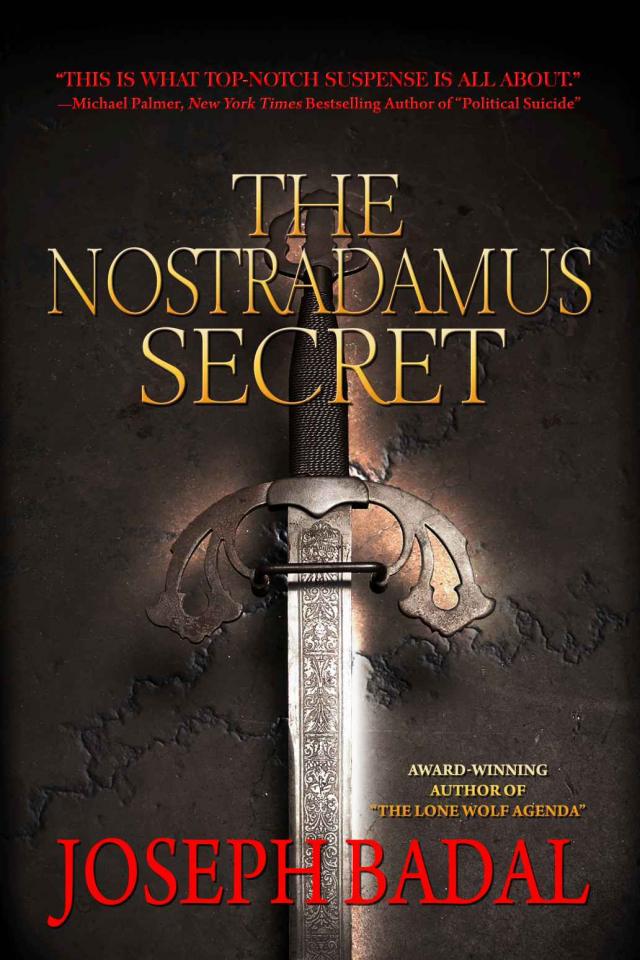
THE NOSTRADAMUS SECRET
JOSEPH H. BADAL
This is a work of fiction. Names, characters, organizations, places, events, and incidents are either products of the author’s imagination or are used fictitiously.
Text copyright © 2011 by Joseph Badal
Originally published by Suspense Publishing
All rights reserved.
No part of this book may be reproduced, or stored in a retrieval system, or transmitted in any form or by any means, electronic, mechanical, photocopying, recording, or otherwise, without express written permission of the publisher.
Published by AmazonEncore, Seattle
www.apub.com
Amazon, the Amazon logo, and AmazonEncore are trademarks of Amazon.com, Inc., or its affiliates.
eISBN: 9781477880494
This title was previously published by Suspense Magazine; this version has been reproduced from Suspense Magazine archive files.
OTHER BOOKS BY
JOSEPH BADAL
STAND-ALONE THRILLERS
THE PYTHAGOREAN SOLUTION
SHELL GAME
ULTIMATE BETRAYAL
DANFORTH SAGA
EVIL DEEDS (#1)
TERROR CELL (#2)
THE NOSTRADAMUS SECRET (#3)
THE LONE WOLF AGENDA (#4)
SHORT STORIES
FIRE & ICE (UNCOMMON ASSASSINS anthology)
ULTIMATE BETRAYAL (SOMEONE WICKED anthology)
DEDICATION
For Sara—my best friend, biggest fan, and ultimate inspiration
AUTHOR’S HISTORICAL NOTE
The use of Michele Nostradamus’s “lost quatrains” as a foundation for the prophecies in this book is historically based. Some scholars believe that, like Nostradamus’s other nine centuries (1-6 and 8-10), which contained 100 quatrains each, the seventh centurie also included 100 quatrains. But only 42 of those quatrains in the seventh centurie have ever been found. The assumption is that the remaining 58 quatrains were either lost or intentionally destroyed. The premise I use in The Nostradamus Secret is that the 58 lost quatrains were actually written and hidden by a Catholic sect in contravention of a Vatican order. That order by the Vatican was due to the anti-Church content of the “lost quatrains.” As the 58 lost quatrains don’t exist, in order to “find” them, I had to create them. In numerous places in this novel there are references to actual quatrains as well as to the fictitious ones. I have made it clear in the writing which verses are among the 58 lost quatrains.
There are references to historical events in this novel, including the Battle of Lepanto of 1571, between the Turks and the Spaniards, in which Ali Reza Naimzadeh’s ancestor, Darioush, is captured. In the interest of brevity, I have not included detail about this battle, but the reader might want to research this conflict and the geopolitical environment of the time.
The abbey in Toulon mentioned in the book where the Nostradamus quatrains are hidden does not exist, but I used the Ceccano cardinal palace for inspiration. This palace is a great example of the medieval palaces erected by Church elders in Avignon when the Church established its headquarters in France. The fact that this structure was a Jesuitical school beginning in 1564 added historical context to the story.
Events in modern day Iran, Iran’s support of terrorist factions, its nuclear weapons ambitions, and the rhetoric of its leaders against Israel and the West inspired much of the content relating to the “war” chapters in the book.
ACKNOWLEDGEMENTS
The following individuals provided valuable feedback that contributed to the final version of this novel: John W. Badal, Robert A. Badal, Anne Beckett, Stacey Cost, and Karla Ponder. Thank you for your efforts and time.
The military and intelligence community characters in this novel are based on an amalgam of individuals with whom I served in the U.S. Army and with whom I have become acquainted over the years since my time in the service.
Thanks to John & Shannon Raab for your support, enthusiasm, creativity, and work on my behalf. You and your staff at Suspense Publishing have made all the difference.
And, finally, thanks to the readers who have been so supportive of all of my novels and short stories. Your support and encouragement helped make this book possible.
PRAISE FOR JOSEPH BADAL
“Crisp writing, masterful pacing, and characters to genuinely care about. This is what top-notch suspense is all about.”
—Michael Palmer, New York Times Bestselling author of “Political Suicide”
“ “Ultimate Betrayal” provides the ultimate in riveting reading entertainment that’s as well thought out as it is thought provoking. Both a stand-out thriller and modern day morality tale. Mined from the familial territory of Harlan Coben, with the seasoned action plotting of James Rollins or Steve Berry, this is fiction of the highest order. Poignant and unrelentingly powerful.”
—Jon Land, bestselling and award-winning author of “The Tenth Circle”
“Joseph Badal has surpassed his own high standards once again. He pulls out all the stops in his new standalone thriller “Ultimate Betrayal,” a tale of crime, espionage, family tragedy, family ties, and ultimately justice and redemption.
“He is the master of the cinematic thriller, in the best sense of the term. His trademark short chapters from multiple points of view take readers on a rocket ride into the worlds of military service, government agencies, law enforcement, family bonds, and organized crime. If you haven’t read a Badal thriller before, “Ultimate Betrayal” is a great first step in immersing yourself in his body of work.
“So put on a pot of coffee and fasten your seat belt.”
—Robert Kresge, former CIA officer and author of the Civil War spy novel “Saving Lincoln” and the Warbonnet historical mysteries
“Joseph Badal has done it again. “Ultimate Betrayal” packs action and revenge into an international conspiracy thriller you won’t soon forget. Read it!”
—Steve Brewer, author of “Firepower”
“Joe Badal keeps getting better and better. He knows how to spin a multi-viewpoint thriller without losing the reader, and he knows the international stage so well that he can take us to both exotic and down-home places in a story that flows effortlessly. And uniquely, he can ratchet up the action to a fever pitch without burying us in pages of techno babble. “In this tale of “Old World vengeance without New World remorse,” you’ll love the good guys and hate the bad guys—just as it should be.”
—Steven F. Havill, author of the Posadas County Mystery Series
“Filled with unexpected twists, unconventional allies and a master-mind villain who makes hired killers look like kindergarten teachers. “Ultimate Betrayal” is Joseph Badal’s best book yet. A must-read for anyone with a craving for a fast-paced, action-packed, beautifully constructed thriller.”
—Anne Hillerman, author of “Spider Woman’s Daughter”
THE NOSTRADAMUS SECRET
JOSEPH BADAL
CONTENTS
PROLOGUE
CHAPTER 1
CHAPTER 2
CHAPTER 3
CHAPTER 4
CHAPTER 5
CHAPTER 6
CHAPTER 7
CHAPTER 8
CHAPTER 9
CHAPTER 10
CHAPTER 11
CHAPTER 12
CHAPTER 13
CHAPTER 14
CHAPTER 15
CHAPTER 16
CHAPTER 17
CHAPTER 18
CHAPTER 19
CHAPTER 20
CHAPTER 21
CHAPTER 22
CHAPTER 23
CHAPTER 24
CHAPTER 25
CHAPTER 26
CHAPTER 27
CHAPTER 28
CHAPTER 29
CHAPTER 30
CHAPTER 31
CHAPTER 32
CHAPTER 33
CHAPTER 34
CHAPTER 35
CHAPTER 36
CHAPTER 37
CHAPTER 38
CHAPTER 39
CHAPTER 40
CHAPTER 41
CHAPTER 42
CHAPTER 43
CHAPTER 44
CHAPTER 45
CHAPTER 46
CHAPTER 47
CHAPTER 48
CHAPTER 49
CHAPTER 50
CHAPTER 51
CHAPTER 52
CHAPTER 53
CHAPTER 54
CHAPTER 55
CHAPTER 56
CHAPTER 57
CHAPTER 58
CHAPTER 59
CHAPTER 60
CHAPTER 61
CHAPTER 62
CHAPTER 63
CHAPTER 64
CHAPTER 65
CHAPTER 66
CHAPTER 67
CHAPTER 68
CHAPTER 69
CHAPTER 70
CHAPTER 71
CHAPTER 72
CHAPTER 73
CHAPTER 74
CHAPTER 75
CHAPTER 76
CHAPTER 77
CHAPTER 78
CHAPTER 79
CHAPTER 80
CHAPTER 81
CHAPTER 82
CHAPTER 83
CHAPTER 84
CHAPTER 85
CHAPTER 86
CHAPTER 87
CHAPTER 88
CHAPTER 89
CHAPTER 90
CHAPTER 91
CHAPTER 92
CHAPTER 93
CHAPTER 94
CHAPTER 95
CHAPTER 96
CHAPTER 97
CHAPTER 98
CHAPTER 99
CHAPTER 100
CHAPTER 101
CHAPTER 102
CHAPTER 103
CHAPTER 104
CHAPTER 105
CHAPTER 106
CHAPTER 107
CHAPTER 108
CHAPTER 109
CHAPTER 110
CHAPTER 111
CHAPTER 112
CHAPTER 113
CHAPTER 114
CHAPTER 115
CHAPTER 116
CHAPTER 117
CHAPTER 118
CHAPTER 119
CHAPTER 120
CHAPTER 121
CHAPTER 122
EPILOGUE
ABOUT THE AUTHOR
“EVIL DEEDS”
“TERROR CELL”
“THE LONE WOLF AGENDA”
“THE PYTHAGOREAN SOLUTION”
“SHELL GAME”
“ULTIMATE BETRAYAL”
PROLOGUE
June 4, 1589
Darioush Naimzadeh made a fist with his right hand over his heart and blew out the air in his lungs in a slow, steady stream. Stay calm, he told himself. He looked around and made sure he was alone. Then, candle holder in hand, he carefully slipped behind the tapestry that concealed the door to the subterranean chamber. He slowly opened the door and then closed it behind him, entering a narrow passage, bending until the overhead clearance increased to five-and-a-half feet, just high enough to allow him to stand erect. The flame of the lighted candle reflected off the stone surfaces of the hidden chamber, casting spectral light and shadow that heightened Darioush’s anxiety.
Fifteen steps lead down to the pathway that serpentined under the monastery. Darioush held the candle high in front of his face as he took slow, mincing steps down the tunnel. He canted his face at an angle away from the candle flame, directing his breath away from the flame. Just the thought of the light going out caused his fear to accelerate. Despite the chill of the secret chamber, perspiration dripped off him and his body shook as though he was wracked with fever. He knew if he were discovered, even Father Paul wouldn’t be able to save him. A quick death was the best he could hope for. By writ from the abbot, this was forbidden territory for all but a few of the most senior monks in residence—the prior, the deans—and even they were not allowed access without the abbot’s authorization.
Darioush understood the reasoning behind the directive: The hidden chamber and its contents were a closely-guarded secret, even from the Holy Father and Ignatius Loyola. Especially from Loyola, called derisively by Father Paul as the Sword of the Inquisition. Were he to learn of the chamber, its secret vault, and the books and manuscripts there, every monk in residence here would be burned at the stake. An infidel caught in the underground chamber would probably be tortured, and then burned. Darioush knew it would make no difference that he had become the abbey’s foremost scholar. To the Catholic Church and even to the monks here in Toulon he would always be an infidel.
He continued his slow pace through the stone cellar, stepping carefully in his leather sandals, trying to avoid the frigid puddles of water; hitching up his coarse, brown robe to keep it dry. He took shallow breaths to minimize the stench from mold and waste.
This wasn’t the first time Darioush had ventured down here but it was the first time he’d been here without Father Paul. He’d accompanied Father Paul on periodic visits to the secret chamber to research ancient texts or to deposit another “forbidden” manuscript that the Church had ordered destroyed. After tonight, he would finally be able to return to his home in Persia. He knew his departure would wound Father Paul, but the old monk was ailing, and Darioush feared his own fate at the hands of the other monks once Father Paul was gone. It had not been a popular move when Father Paul brought Darioush into the abbey in 1575, fourteen years ago. But since then, most of the naysayers had grudgingly come to regard Darioush as a faithful acolyte to Father Paul, who rescued him from a life of slavery in the Extremadura, that hellish region of Spain where cactus predominated and locals spoke a dialect that even other Spaniards had difficulty understanding. But Darioush knew that the monks regarded him as a second-class citizen and they hated the darkness of his skin.
He owed his life to Father Paul, who bought him from a slave trader when Darioush was fifteen years old, and gave him the Christian name of Jean Joseph. Darioush had learned the Christian prayers and memorized the Christian Holy Book. He knew the Catechism and could recite all the liturgies of the High Mass. And he had read every manuscript and scroll that was on the list approved by the Pope.
Darioush had thought many times about fleeing from the monastery and finding his way to Persia. But for what purpose? He had no wealth and would be nothing but a peasant in Persia, scratching out a mean existence. But the manuscript Father Paul had shown him in the hidden chamber for the first time a month ago had changed everything. As did the old monk’s disclosure of an array of church reliquaries—gold, silver and bejeweled crosses and chalices stored behind a bookcase filled with forbidden texts. Two large rubies, the size of quail eggs, and a dozen tear drop-shaped diamonds, along with the manuscript, fueled the desire that had been smoldering within him to return to his home country and to his family. And not as a peasant.
No one, not even Father Paul, seemed to suspect that Darioush had only acted at being a Christian. In his heart, he’d remained a devout Shiite Muslim. The strategy of taqiyya—the hiding of one’s beliefs without falling into mortal sin—had been drilled into Darioush as a small boy. Shiites had adopted taqiyya for 800 years, since the death of the Prophet Mohammed, in order to protect themselves from Sunni persecution.
Darioush prayed to Allah—secretly—whenever possible. A primary mission of Father Paul’s order, the newly formed Societas Jesu, the Jesuits, was the conversion of the Mohammedan. Darioush had to laugh at this. Certainly, the Christians had captured his body and trained his mind, but they would never conquer his spirit or convert his soul. As a young boy, he had submitted to Allah, and would never recant.
A sudden shriek sent his heart tripping. Darioush whipped around, knocking the candleholder against the wall. The candle came loose from its spike and started to fall, its flame sputtering as he grabbed for it. He snatched the candle in mid air as it fell toward the wet stone floor—without its light all would be lost. Who or what had made the noise? Had someone else entered the cellar? He looked back along the passageway. Nothing. He glanced down and saw yellow eyes staring up at him. It was just one of the feral cats that lived down here in the darkness, feasting on the cellar’s mice and rats. The cat screeched at Darioush, then turned and silently raced away.