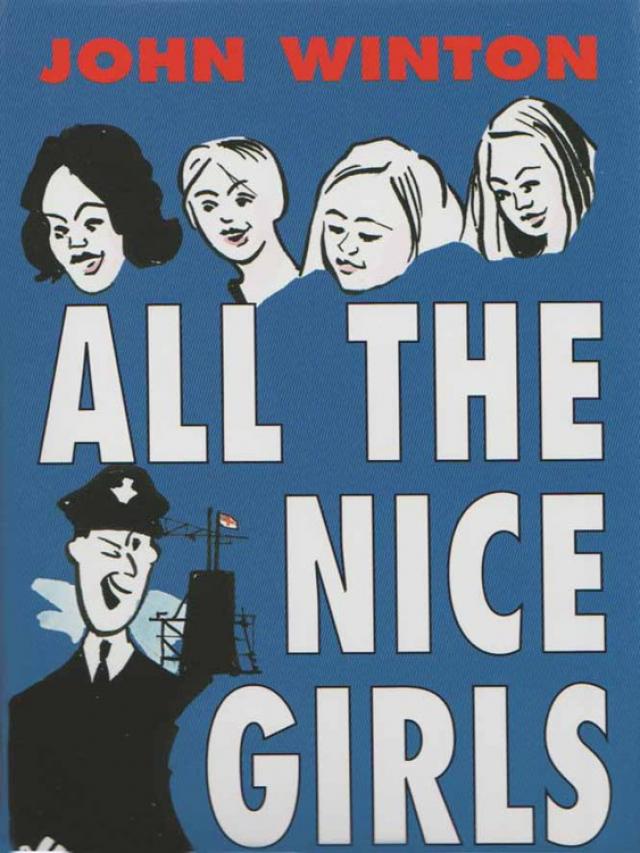
All The Nice Girls, page 15
part #4 of The Artful Bodger Series


‘How shall I allocate them sir?’
‘Dagwood, you are being solid this morning! Out of a hat of course! ‘
‘Thank you very much, sir.’
Dagwood took down two large tomes of Admiralty Fleet Orders (which in the matter of courses corresponded to the Sibylline Books) and went to work. Dagwood had always suspected that the Navy offered a wide variety of courses but he had never realised their scope. It seemed that there was nothing, from nuclear technology to wall-papering, on which the Navy were not prepared to run courses. Dagwood summoned the ship’s company.
‘I’ve got a lot of courses here,’ he said, ‘which you’re going to do as long as the strike lasts. Just so there’s no dripping about who goes on what course, we’re going to draw for them. I’ve written them all on a slip of paper and put them in my hat. I want you to draw in turn. You first, Chief E.R.A.’
There were enough courses for at least two each, and more to come if necessary. The Chief E.R.A. drew ‘Guided Weapons Acquaintance Course’ and ‘Basketball Coaching.’ The Chief Stoker was rewarded by ‘Survival at Sea’ and ‘Boot Repairing and Leatherwork.’ The Electrical Artificer’s selection was equally catholic: ‘Boiler-brick Fastening’ and ‘Helicopter Direction.’ The others drew from the hat in succession, Leading Seaman Gorbles a course where he volunteered for immersion in icy water, and an Outward Bound up Ben Nevis; Leading Stoker Drew, ‘Mine Counter-Measures’ and ‘Hockey Umpiring,’ and Leading Seaman Miles, the torpedoman, ‘Paint Application’ and ‘Moral Leadership.’ The most junior ratings had by no means drawn the most elementary courses. Ferguson, the Chief Stoker’s storekeeper, faced ‘Jam Testing’ and an Arabic interpreter’s course. Stoker Gotobed looked forward to ‘Instructional Technique’ and ‘Gyro-Compass Maintenance,’ while Able Seaman Quickly’s programme was ‘Oxy-Acetylene Welding and ‘Meat-telling.’
‘What do I tell it?’ he asked.
‘Very very funny, Quickly,’ said Ollie. ‘Let me tell you the meat-telling course is normally reserved for very senior supply officers. Nothing less than Commanders or Captains. But you’ve been specially chosen from a host of applicants so you’d better like it.’
Able Seaman Quickly retired, making what Dagwood called mutinous ‘Rhubarb rhubarb’ noises.
15
However, Dagwood’s miscellaneous selection of courses proved to be only a partial solution. Many courses only lasted a few days, some had waiting lists, and others were not due to begin for some weeks. Dagwood and Ollie were still left with a pool of spare sailors on their hands. Ollie might, as a last resort, have asked for them to be returned to spare crew but once there they might never return and besides the strike might end at any time and the subsequent upheaval would have caused more trouble than ever. As time went by, and sailors began to return from courses, Dagwood and Ollie began to have the most widely read, broadly instructed, variously talented, but still the most idle ship’s company in the Submarine Service. It was Mr Tybalt who proposed another solution.
‘Why don’t you have a look and see how the other half lives?’ he said. ‘You’ve got a city of more than half a million people here. Why don’t you and your sailors take the opportunity to find out how they make their livings? I know a few people who run businesses here and one or two local blokes like the Chief Constable. Shall I see if I can fix up a few visits for you?’
‘That sounds a splendid idea, sir,’ said Dagwood.
‘I’ll see what I can do. I’ll check with The Bodger but I expect you’ll have to go in uniform. There’s the recruiting angle to think of. You never know, there might be some Oozemothians soft-headed enough to be thinking of joining the Navy. You and your merry men might just tip the balance. Though which way, I wouldn’t care to forecast.’
Dagwood broached the idea to Ollie.
‘I don’t think I’ll join in,’ Ollie said. ‘I’m going to dig my garden.’
‘How did you find that little house, Ollie, I’ve always meant to ask you.’
‘I didn’t find it. Daphne told me about it. I mentioned that I was looking for somewhere and she told me about this place. Alice and I went to look at it and it was just the job.’
‘There can’t be much going on in this town that Daphne doesn’t know about.’
While Ollie dug his garden, Dagwood and the sailors embarked upon a comprehensive tour of Oozemouth, sponsored by Mr Tybalt, which probably gave them a more intimate knowledge of the city than many of its citizens possessed. They visited breweries, sewage farms, steel-rolling mills, leather tanneries, textile mills and power stations. They were shown round the printing presses of the ‘Oozemouth Echo,’ the totalisator at Oozemouth race course, the operations room at AA headquarters and the finger-print department of the local C.I.D. Dagwood was surprised and touched by the warmth of their reception everywhere.
‘I must say people just couldn’t be kinder,’ he told The Bodger and Mr Tybalt. ‘They fall over backwards to give the sailors a good time. Did you know that the ‘Echo’ took the sailors out to that road-house on the bypass last week and bought them beer and sandwiches all night? They had quite a run ashore, judging by reports.’
‘It’s not very surprising,’ said The Bodger. ‘For some reason, the people of this country are very fond of their Navy. It must be a case where ignorance is bliss but they get all sentimental about it. They like to see sailors about the place. It reminds them they’ve got a Navy. They see a sailor and it bucks them up. They square their shoulders and go on their way rejoicing, singing snatches of “Hearts of Oak.” Some of them even try and grow beards.’
‘There is also a sordid, commercial aspect to it,’ said Mr Tybalt, ‘particularly where you personally are concerned, Dagwood. Why do you think you’re welcomed everywhere, or nearly everywhere? Have you ever stopped to think why nine-tenths of the managing directors in this country will roll out the red carpet for any naval officer, no matter how junior? It’s not because of your frank, boyish good looks, your clear blue eyes, or your casual charming manner, let me hasten to disillusion you. It’s not who you are, laddie, it’s who you might become. They don’t know who you’re going to be when you grow up. You might be a pleasant, fairly nondescript sort of chap now but one day you might be in a position to place a very valuable Admiralty contract and from what I know of him the average naval officer is more than likely to place a socking great Admiralty contract with one particular firm just because they gave him a slap-up dinner and floorshow when he was a sub-lieutenant! ‘
‘You’re a cynical bastard, Frank,’ said The Bodger.
‘Cynical nothing! It’s time you fellows learned the facts of life! You’ll find the small minority of firms who won’t roll out the red carpet for you are those who have all the Admiralty contracts they need already. By the way, how are you getting on with the local talent, Dagwood?’
Dagwood looked pensive, while The Bodger and Mr Tybalt watched his face closely. ‘Oh so-so,’ he said, off-handedly.
‘When’s your visit to the ball-bearing factory?’
‘Tomorrow.’
‘Mind how you go there. Always stay in the middle of the room. Don’t let them lure you into corners.’
‘This sounds interesting, Frank,’ said The Bodger.
‘Interesting isn’t the word. I went there once and it was what I would call a traumatic experience. I reckon it’s left me psychologically scarred for life.’
‘Do you mind if I come with you tomorrow, Dagwood?’ said The Bodger.
‘Don’t say I didn’t warn you,’ said Mr Tybalt.
In spite of Mr Tybalt’s warning, the visit to the ball-bearing factory began quietly enough. The Bodger, Dagwood and the small party of sailors were shown the raw material for the balls - coils of steel wire - being chopped into small cylinders. They watched the rough wire cylinders being forge-stamped, ground, smoothed and polished into shining round balls. They saw the balls being graded for size and truth. It all seemed innocent enough.
It was not until they reached double green doors marked ‘Inspection’ that Mr Tybalt’s words assumed their true meaning. Their guide opened one of the green doors, pushed them in, and stepped smartly back.
The Bodger and his party stood in the doorway, appalled.
The Inspection Department consisted of only one room but it was roughly half the size of a main-line railway terminus. The room contained nearly a thousand girls and its atmosphere was as steamy as a hot-house, with an odour compounded of nearly a thousand sources of perfume, talcum powder and deodorant. The noise level was at such a pitch as to make a perceptible physical impact upon The Bodger’s unaccustomed eardrums. There was the yammering of conversations, the rattling of trolleys, the tapping of feet and above everything else the relentless pounding of a rock-and-roll record being relayed at full volume through loudspeakers set in the roof.
The Bodger’s party were observed at once. Every conversation stopped in mid-syllable. Every trolley-wheel stopped in mid-revolution. Every tapping foot poised. The rock-and-roll record broke off in mid-beat.
For a few moments, there was silence. Then simultaneously the loudspeakers burst into ‘All The Nice Girls Love a Sailor,’ again played at full volume, and there arose from the girls a piercing wailing ululation, more blood-chilling than the howling of wolves, more penetrating than a police siren, gaining in power and intensity, swelling and growing until it reverberated from the air, from the walls, from the ground and from inside The Bodger’s very skull.
The Bodger, looking back afterwards, decided that stepping forward from that door into ‘Inspection’ at the ball-bearing factory was the bravest single act of his whole life. He shuffled forward, encouraged by the stout voice of the Chief Stoker behind him, saying ‘Pack together, men!’
Cautiously, almost back to back, like a wagonload of settlers moving through howling Sioux country, the party from Seahorse edged further into the room.
A petite, dark-haired girl in a blue nylon overall took charge of them. She had ‘Supervisor’ on a badge in her lapel and her name was Doris. She looked about twenty-five years old and she seemed to be in sole command. The Bodger found himself wondering humbly at a discipline which could single-handedly control a number of females corresponding to the ship’s company of a heavy cruiser.
They began to walk round, pursued by giggles, sidelong glances and crescendoes of sudden idiot laughter. Every sailor in turn, including Dagwood, received a hundred signalled invitations. All were invited, except The Bodger. As far as the girls were concerned, The Bodger might not have existed. The Bodger felt piqued.
The basic operation of ‘Inspection’ was very simple. The girls sat at long tables, fifty or sixty girls to a side, each girl having her own stall. Every stall had a small tray fitted with a sliding bottom and, above it, a bright light. Bags of ball-bearings were tipped into trays and the girls moved the tray bottoms so that the balls rolled over and their surfaces could be examined for flaws by the light of the lamps. Doris laid on a demonstration.
‘Here you are, Nessie,’ she said to one woman of about fifty. ‘Show the gentlemen what you can do. We call her Nessie,’ she added to The Bodger, ‘because of the monster, y’see.’
Every girl in ear-shot gave a shrill cackle. Nessie, who did not appear to The Bodger to be at all a bad-looking woman, smiled amiably.
Doris took a ball-bearing from her overall pocket and showed it to The Bodger. ‘It’s a flawed one,’ she said.
The Bodger examined the ball closely. He could just see, if he looked hard, a tiny chip in the surface.
Doris took the ball, dropped it into a bag and poured the contents of the bag into Nessie’s tray.
With a speed that baffled the eye Nessie pulled down her lamp, nudged her tray and deftly poured the shining flow of balls sideways into a shute. One ball remained on her tray. Nessie handed it up to The Bodger. The tiny chip on it was unmistakable.
‘Well I’ll be damned!’ said The Bodger, in astonishment. The whole performance had been as slickly executed as a conjuring trick. The Bodger acknowledged that he could never do Nessie’s job, not if he practised for a year. The Bodger had no doubt that if he were forced to work in this room he would be under the care of a psychiatrist inside a week.
The Bodger noticed that one stall was decorated with greetings cards, flowers, coloured streamers, and an old shoe.
‘What’s that mean?’ he asked Doris.
‘She’s getting married Saturday.’
Here and there, other stalls were appropriately decorated. Every major event in a girl’s life was commemorated. The Bodger could see several ‘Happy Birthday’ signs, one or two golden keys, and a scattering of significant stories. Almost every stall had a piece of red cord in the partition netting.
‘What’s the cord for?’
‘It means she’s had her first man,’ Doris explained.
The ball-bearing factory was patently more than a mere place of employment for the girls who worked there. It was an important part of their lives. They came to it from school, carried on after marriage and left only to have a baby. When their children were grown up they returned, like Nessie, to work until they were too old.
The Bodger had been so absorbed in his tour that he had failed to notice that his party had gradually been dwindling. He awoke just in time to see the Chief Stoker’s hat disappearing through a side door. Even Dagwood was trapped on the other side of the room, surrounded by a crowd of girls. The Bodger was isolated in ‘Inspection,’ with Doris. He intercepted a look flashed between Doris and another girl and it dawned upon him why he had received no welcoming signals. Doris was reserving him for herself. Without a word being spoken, the jungle drums had passed their message; like a banner being carried through the room, the word had been passed: ‘This one’s mine.’
Panic-stricken, The Bodger tapped the nearest girl on the shoulder.
‘Let me have a go at that.’
The girl got up readily. The Bodger sat down and Doris poured a bag of ball bearings into the tray. The Bodger pulled down the light and began to concentrate upon the balls as though his life depended on it. Every girl round about stopped work to watch him.
The Bodger had no doubt that the inspection was almost a formality. The odds against an imperfect ball reaching this stage of production must be several thousands to one. Nevertheless, it would be a triumph if he could find one. The Bodger moved his tray in and out for some time, without noticing anything. Then something caught his eye. It was no more than a suspicion, a reflection which was not quite true. Perhaps it was a minute speck of dust on that ball. The Bodger blew at it. It was still there. Feeling his pulse rate beginning to accelerate, The Bodger manipulated the tray again. Now, he was almost sure. One more roll, and he was certain.
‘There’s a flaw in it! ‘
The Bodger’s cry of glee was apparently the funniest sound he had ever uttered in his life. The girls slapped their thighs, doubled up, and hooted. Some of them staggered about, crying and coughing into their handkerchiefs, and supporting themselves on the table.
‘I tell you there’s a flaw in it!’ cried The Bodger again. ‘Just look! A flaw! ‘
Doris received the news calmly. ‘It’s a special visitors’ bag you got there,’ she said. ‘They’re all flawed.’
16
Dagwood kept in touch with the latest strike situation through Mr Tybalt’s grapevine. There seemed to be no other source of information; the yard itself was virtually shut down, Bob and Fred never visited ‘The Smokers’ again, and the newspapers had relegated the ‘Old Vic’ or ‘Plug-hole’ strike as they called it, to a small middle page paragraph once a fortnight. Only Mr Tybalt seemed always to have the latest gossip.
‘I was hoping to have some good news about the strike today,’ he told Dagwood, one brilliant May morning. ‘Last week the yard did the sensible thing and arranged with the foundry to have the bloody covers drilled before they get here. That was fine, but it meant that the foundry had to take on a driller and as they’ve never employed a driller before their men objected. So now they’re on strike and we’re back to square one again. It’s a case of Go straight to the Doghouse, Do not pass Go, Do not collect Two Hundred pounds. Maddening, isn’t it?’
‘Yes sir,’ Dagwood agreed. He could never have admitted it to Mr Tybalt but Dagwood was secretly enjoying the strike and would be sorry when it ended. Apart from the unexpected holiday it was giving him, it also had other, unforeseen, advantages. For instance the conquest of Barbara, the girl who worked in the Norwegian shipping firm’s office next door to Dagwood.
Dagwood had heard of girls being swept off their feet. He had heard of them succumbing to a cunning, waiting game. (One could, according to the best authorities, either play the part of a mixture of Young Lochinvar and the Sheik ofAraby, or a sort of amatory Quintus Fabius Maximus Cunctator.) But Dagwood would never have believed that a girl would drop into his arms, like a ripe plum, out of sheer boredom. Dagwood had never succeeded in getting on more intimate terms with Barbara than saying good morning and occasional sugar borrowing. From time to time the basin in Barbara’s office was blocked and Dagwood sent in his shock troops, Gotobed and Quickly, to clear it and possibly prepare the way for a closer relationship. But Barbara had hitherto remained aloof.
The strike changed everything. The Norwegian tanker had been within a fortnight of her launch date when the strike began, but when work on her was stopped the firm’s marine superintendent and his assistant, who were Barbara’s immediate employers, both vanished. Barbara was left with nothing to do for days on end but withstand the steady pressure of willpower exerted by Dagwood, lurking next door. Sometimes Barbara’s telephone rang, she would make a note, and occupy herself for an hour or two in searching through her files, typing and dispatching letters. The rest of the time she painted her nails, looked out of the window, and read ‘Woman’s Own.’ Next door, Dagwood watched and waited. His preoccupation was so intense that even Ollie noticed it. ‘Dagwood, you baffle me,’ he said. ‘For a bloke who says he doesn’t want to get married you’re acting in a bloody strange manner. You’re like a man who says he’s terrified of catching pneumonia and then spends all his time cavorting about in the snow in the nude.’