A Hymn Before Battle, page 20
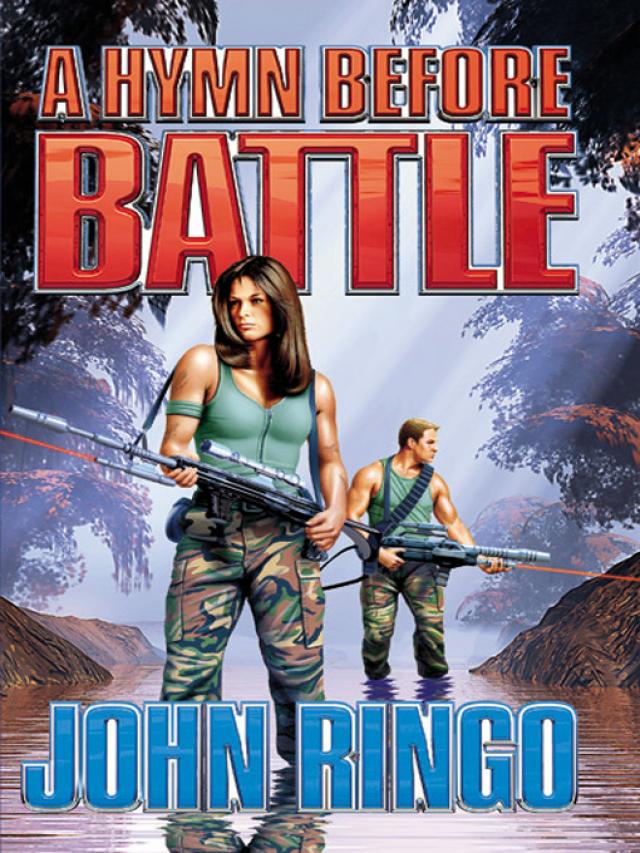


A group of five Posleen burst out of the concealing ferns and charged across the clearing. Mosovich's fire tumbled four of them, but another small group charged out slightly to the side. Neither group fired back, content to close to steel range in the teeth of the fire. As Mosovich tracked on the new group, Trapp hurled his grenades. One landed perfectly in the midst of the second group but the second was a slice and fell out of effective range. Just as both detonated, one taking down the second group wholly, a platoon-sized band charged out of the side of the clearing.
Mosovich switched from carefully controlled blasts to continuous fire as the centaurs closed. Trapp flipped three more grenades but the handful of remaining Posleen closed to steel range in moments.
Trapp flipped around his MP-5 and expended his last three rounds on three head shots as the Posleen got absolutely too close for a SEAL to miss. He threw the now-useless weapon at a closing Posleen as he drew his combat knife. He had studied the physiology of the Posleen the pair had killed. The Posleen chest turned out to be well armored by bone so if it came to hand to hand he had planned on being behind them, but this time lady luck was all over playing favorites.
Mosovich's shotgun locked back and he knew he was done. There were at least six Posleen still moving and he regretted giving up his .45 to Trapp. He drew his Gerber and stepped out from behind the root ball as the centaurs drew their own yard-long blades.
As the centaurs charged, Trapp grasped an out-thrust root and flipped himself into the muck. As the remaining Posleen closed with the injured sergeant major, a steel-filled hand swept out of the muck and disemboweled the trailer. A mud-covered figure erupted from the swamp and slithered across the back of the next Posleen before it could even buck, with a flash of steel faster than the eye could follow. As the nearly decapitated centaur slumped into the mud the group turned towards their slithering attacker but he had disappeared again into the bog.
As the leaderless Posleen milled, fumbling in the mud for the eel-like SEAL, Mosovich leapt on the back of another and quickly slit his throat. While not the match of the SEAL, he wanted to prove that he was no slouch with a knife.
At the same moment, ten yards from the huddle of fumbling Posleen, Trapp erupted once more from the water, his hand filled with Colt. He flicked the barrel downwards to clear it, adopted a two handed grip and fired three rapid shots for three kills. As he tracked to the fourth Posleen, a shotgun blast threw him backward in a welter of blood and intestines.
The .45 spun from the SEAL's grasp and Mosovich knew he had only one chance. He launched himself in a shallow dive from the back of the deceased Posleen and followed the pistol into the muck.
The last two Posleen charged for the spot and began rummaging in the violet mucilage. One of them gurgled in delight as it snagged a combat harness and lifted the camouflage-clad survivor from the watery grave. Mosovich fought the grip like an eel, hooking his boot into its harness and bending like a contortionist to bring his arm around. The Posleen's last surprised sight was of a .45- caliber bore.
24
Orbit, Diess IV
2125 GMT May 15th, 2002 AD
The final conference on whether the ACS battalion would be deployed as planned was a hurried meeting on D-Day minus 1. Most units were already down and moving to their jump-off point, so the mood was somber as the meeting was drawing to a close. The small room had been hastily fitted with a rickety easel and a table large enough for all the people who thought they should have a say in deployment.
The battalion staff had put on a dog and pony show complete with a staff officer in armor. Mike knew to the minute the time the officer had in the suit and recognized various subtle signs of poor assimilation. Despite that fact, the suit and various multimedia demonstrations of the weaponry available to the ACS were effective arguments.
Mike was the last person giving a presentation and he concluded solemnly. He had listened carefully to the other presentations and he felt he knew where the decision was going to go. Despite the briefings that he had given to a vast number of audiences, he knew it all came down to this group. And they were simply not paying attention. Aides and officers scurried in and out of the room constantly, bringing information, carrying away orders. The meeting members were distracted and all and sundry had made up their minds in advance. It made him feel like Cassandra.
"Although the battalion currently meets the minimum eighty percent standards for operational deployment, high readiness and training in some areas, such as the noted performance levels among junior NCOs and officers, mask critical failures in other areas. The lack of comprehension of the technology by senior battalion officers and NCOs with the concomitant weakness in communications and control, leads to a situation ripe for point failure.
"Considering this from either a testing viability or a mission success viewpoint, the Design Team representative cannot recommend deployment at this time. Senior officers require a minimum of one hundred fifty more hours of tactical exercises without troops before they may be considered prepared. Thank you." He dropped the laser pointer into the sleeve of his silks, walked over to his spot and sat down. Since he was the Design Team representative, he at least had a spot at the table.
"Okay," said General Houseman, "let's be straight. Recommendations, deploy or don't deploy? I am accepting input from G-3, the Chief of Staff and the Design Team representative." Excluding the battalion representatives was a deliberate slap in the face to the airborne colonel. The battalion commander knew that if the battalion was not deployed his career was finished. "General Stafford, G-3 says go?"
"Yes, sir," said the lanky general, tapping the table with his fingers. "I take the lieutenant's point about the communications and coordination problems but, no offense, Lieutenant, he sees everything from the uncluttered viewpoint of a junior officer. Those sims are awfully realistic, real enough to create a `fog of war.' In those situations, communications and coordination difficulties occur. Lieutenants, by and large, expect things to be straightforward; they're not. I think they're ready, let's let them off the leash."
"Okay, General Bridges?"
"It is a difficult decision," stated the fussy little Chief of Staff, "I think that with the way we intend to employ them, the respective units are going to receive heavy casualties irregardless of their preparedness level. However, it is my opinion that the suits and the communications package will act as a combat multiplier and we need the concomitant capabilities. These cities are a difficult tactical problem and the suits can maneuver in terrain closed to effective use by other combat systems. I recommend implementation despite patently insufficient preparation." At that description, the battalion commander and operations officer winced.
"Lieutenant O'Neal?"
"I agree that the suits will act as a combat multiplier, but I disagree strongly with the `fog of war' argument. My favorite relevant quote is from a battalion commander in Desert Storm, `Heroes happen because somebody made a mistake.' I think if we deploy the battalion, we're going to have a lot of heroes. The senior battalion command and staff are using the communications and intelligence systems exactly backward of how they are designed and complaining because they don't work right.
"The communications were designed to allow ease of communication, but the commander and S-3 are immuring themselves behind layers of underlings and this is causing a communication snag." He totally ignored the fact that the officers in question were present.
"Twice in sims this snag caused a critical failure because the people who were managing the whole picture and knew what to do were unable to effectively communicate that need. Furthermore, the battalion command and staff have systematically stripped the company commanders of any authority to react without direct orders. Were one or the other not the case, the battalion might have a chance. As it is there is none.
"They have trained like they are going to fight and it will happen in combat. Lieutenant Colonel Youngman and Major Norton are approaching this from a `light infantry' direction but have left out every good light infantry technique and kept every outmoded one. If you deploy the battalion in its current condition it will be Little Big Horn all over again. I strongly urge you to hold them to training." By the time he was done the battalion commander was white-faced with rage and the operations officer was spluttering.
"Well Lieutenant O'Neal," said General Houseman, with a quelling glance at the furious field officers who had been forced to listen to the scathing diatribe, "it's two generals in favor to one lieutenant against. I'm going to have to go with the more experienced officers, but it is my decision. They're getting deployed, Lieutenant." He did not look particularly happy with his decision. Unfortunately, it was a situation where he agreed with the lieutenant on abstract. While the battalion showed an over eighty percent readiness, the unit had yet to survive a single simulated engagement. The hash of cavalry and infantry tactics that worked for O'Neal and that were specified in the ACS doctrine seemed to massively confuse most of the battalion command and staff. It was not a happy prospect.
"It is, of course, your decision, sir." From the look on the lieutenant's face the general suspected he was reading his mind. "Actually, sir, I doubt you could have gotten away with holding them back. Given the cost of fielding them and that they did make minimum specs, Congress would have you for lunch if you didn't deploy them." He shrugged the resignation of soldiers throughout history who were pawns to the political process.
"Lieutenant, if I thought we were going to lose the battalion I'd hold them in training despite all the bureaucrats in Washington."
After the drab interior of the colony ship and the megascraper's plain exterior, Mike was unprepared for the lavish decoration of the interiors. Despite the fact that the room was utilitarian, possibly the Indowy equivalent of a machine shop, the walls, floors and ceiling were covered with intricate paintings, friezes and bas reliefs. All of the corridors he had traveled and the rooms he had poked his head into were equally baroque. The Indowy love of craftsmanship apparently extended to interior decoration. Unlike similar decorations by humans, there were no scenes or portraits. All the decorations were intricate abstract curves and geometrics. Despite their alien nature they were pleasing to the human eye and surprisingly similar to patterns on Celtic brooches.
There were about sixty people milling around in the large room that was to be used for the battalion's tactical operations center. The machinery and tanks of mysterious liquid had been moved against the walls and a set of folding chairs erected facing a low dais; the front row included an upholstered easy chair. On the back of the chair was a sign depicting a silver oak leaf and the words "2 Falcon 6." A rooster in a cage clucked on one side of the dais. As Mike inspected it balefully, it crowed.
Also on the dais were several junior NCOs and enlisted men referring to clipboards and updating easeled maps. They were being supervised—Mike was reminded of the rooster with his hens—by the battalion S-3, Major Norton. A tall, distinguished-looking man, Norton, Mike had quickly come to realize, was not nearly as intelligent as he looked. Extremely energetic and able to parrot doctrine well, he responded poorly to novel situations and ideas. He and Mike had come to verbal blows several times during the battalion's work-up.
Mike dialed up the zoom on his glasses and looked at the battle plan being drawn on the board. "Christ," he whispered, "has anyone talked to the fire support officer?" Just then Captain Jackson, the FSO, got a good look at the board and walked over to Major Norton. When Captain Jackson tried to draw him aside, the S-3 brushed him off. He was, after all, Artillery, there for the battalion's support, and a captain; thus, he could be ignored.
Mike looked around the room filled with camouflage-clad officers and NCOs. There were the commanders of the five companies, with their executive officers, the staff with their assistants and senior NCOs, the attachment leaders, engineering, fire support, medical and artillery. They were all pointedly ignoring him; in the case of a few of them he knew it was for mutual good. Consorting with the company commanders would have drawn fire for both of them from the S-3. Then he started counting chairs.
"Michelle," he queried, "how many personnel first lieutenant and above in the room?"
"Fifty-three."
"And how many chairs?" he asked.
"Fifty."
"Michelle, who was in charge of setting up the seating?"
"The Battalion Operations section."
"Bloody hell." His relations with the battalion commander and his staff had not improved; if anything they had worsened. His, he thought, tactful and constructive critiques of communications and control were viewed as inappropriate to his experience, despite the fact that he limited his comments to subjects directly affected by the combat suits. He did not, for example, comment on the commander's proclivity to place the battalion in a movement to contact formation after the enemy's axis of advance had already been determined. Despite the enormous casualties caused by the resultant open field fighting, the colonel had apparently decided that the suits were invulnerable to the Posleen's weapons and preferred to meet them mano y monstruo. The training scenarios were, after all, "theoretical"; no data on Posleen behavior in combat had yet been gathered by human units. His disdain for the research involved in developing the scenarios had only heightened since Mike's abortive attempt to have the battalion held out of battle.
Mike had felt it necessary, however tactless it might have been, to comment on the communications structure. Lieutenant Colonel Youngman's lack of practice with the suits and general technophobia caused him to fall back on a communications section and RTOs for communications control instead of training his AID to communications tasking. The RTOs were designated for specific nets and the only personnel permitted direct contact with the commander were certain members of the staff and the battalion executive officer, Major Pauley. Further, Youngman had designated the battalion as the sole source to authorize all requests for support except medical and logistics. Company commanders were to contact him to request fire support, for example, and he would determine if the request was valid. The commanders, in fact, had to practically contact him for permission to pass gas. The colonel had discovered that the suit systems gave him an Olympian view of the battlefield, and the ability to control the movement of every platoon if he so chose. He chose. Thus he controlled all aspects of the operation. Perfect micromanagement.
Unfortunately, the resulting managerial and information overload he had chosen to blame on the suit instead of the process. He had responded by placing more layers between himself and the company commanders while continuing to deny them their normal initiative. Thus, in every single combat scenario run to date the battalion had bogged down around its inability to maneuver or respond effectively. And now they were going into battle.
At a few moments before 0900 the groups started to break up and find seats. Surprising him not at all, when everyone was done, Second Lieutenant Eamons, the engineer platoon leader, Second Lieutenant Smith, the scout platoon leader, two of the company XOs and himself along with all the enlisted from the sergeant major to the privates with red pencils were sans chairs. The sergeant major looked really pissed.
A few moments later Major Norton called attention and Lieutenant Colonel Youngman entered and strode down the aisle to his spot. Reaching his seat 2 Falcon 6 sat, accepted a cup of coffee from a hovering mess private and called "As you were," permitting everyone to resume their seats.
"Good afternoon, gentlemen," said Major Norton. "Our mission is as follows: Task Force 2nd 3-2-5 Infantry has been tasked with defense of the III Corp flank in the area of the Deushi megalopolis where it is contiguous with the Nomzedi massif. The S-2 will brief on the threat situation."
The S-2 was First Lieutenant Phil Corley. Dark of hair and slightly below average height, he was highly intelligent but lacked in great order common sense. He stepped up to an easel and threw back its canvas cover dramatically. The canvas cover had been thrown on moments before the colonel's entrance. It was liberally covered with large red TOP SECRET stamps. Mike was not sure who the map was supposed to be kept secret from since the Posleen did not, as far as anyone could tell, use operational intelligence.
"In the big picture, to the southeast the `Bordoli Line,' comprised of Chinese, Russian, southeast Asian and African troops has withdrawn to strategic positions near the Bordoli massif in the Aumoro megalopolis. They are anchored by the massif and the sea. This is their second strategic withdrawal in the week since they landed but the line is now less than sixty kilometers wide. Since it is now held by nearly three quarters of a million troops, further withdrawals are not anticipated.
"The NATO associated Allied Expeditionary Force with attached Chinese and Japanese troops is currently completing its movement to jump-off positions. Delays in landing will force the units to prepare in two phases. The main line of resistance is intended to be in an area similar to the Bordoli Line in the Deushi megalopolis. At that point the Deushi massif stretches to within forty-five kilometers of the sea. NATO forces are to establish a line at that location and hold it. However, the Posleen speed of advance is such that they must be slowed in order to prepare the defenses. Mobile combat units of the Allied forces will, therefore, take up positions in the area of the Nomzedi massif along Avenue Qual.
"The line will be held by the 3rd Armored Division, 2nd Infantry Mechanized, 10th Panzergrenadiere, 7th Cavalry Regiment, Deuxième Division Blindèe, 2nd Lancers Regiment and the 126th Armored Regiment, PRC. The 1st of the 26th German Armored Combat Suit battalion will act as a mobile reserve. The defense plan requires that the line hold, or withdraw no more than six kilometers for twenty-four hours. The Posleen are expected to reach Avenue Qual in twelve hours. Are there any questions?"
Captain Brandon's hand snapped up. "What are the numbers and location of the Posleen along the line?"
"Right now we don't know. As you know, the Posleen landing craft keep up a constant energy weapon sweep of the overhead into deep space. So far we can't get any overhead imagery. The information we are getting is from the Darhel administrators' reports of evacuating megascrapers and a little information from Himmit deep recon scouts. The information from the Darhel do not list any enemy numbers and the Indowy run if they get a sniff of the Posleen in the neighborhood. The Himmit give excellent reports, but their view is limited."