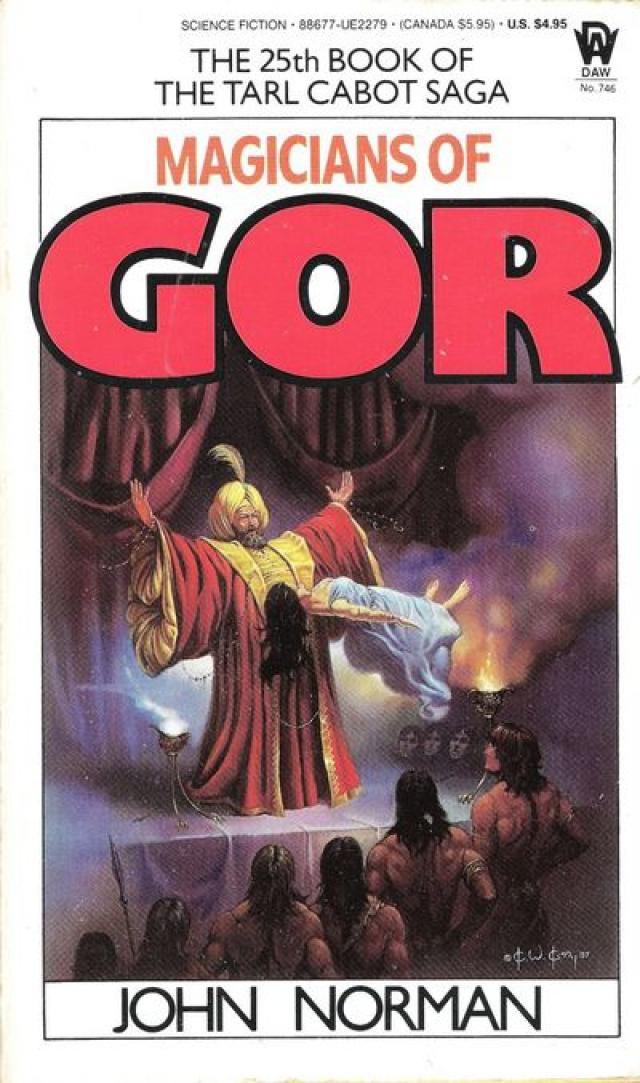
Magicians of Gor coc-25, page 13
part #25 of Chronicles of Counter-Earth Series


This morning, some Ahn before dawn, a convoy of wagons had rattled past our lodgings in the Metallan district, in the insula of Torbon on Demetrios Street. Our room, like many in an insula, had no window there, overlooking the street. Below, guided here and there by lads, with lanterns, were the wagons. There had been a great many of them. Demetrios Street, like most Gorean streets, like no sidewalks or curbs but sloped gently from both sides to a central gutter. The lads with the lanterns, their light casting dim yellow pools here and there on the walls and paving stones, performed an important function. Without some such illumination it is only too easy to miss a turn or gouge a wall with an axle. Marcus had joined me after a time. The wagons were covered with canvas, roped down. It was not the first such convoy which we had seen in the past weeks. "Well," Marcus had asked, "what is being borne?"
"Who knows?" I had asked.
He laughed.
To be sure, we knew, generically, what was being borne. It was not difficult to tell. Normal goods, exports of bar iron, and such, do not move in the city in such numbers. It is true, of course, that sometimes wagons would congregate at meeting places near gates, the wagons, say, of various manufacturers and merchants, and then travel on the roads in convoys, as a protection against brigandage, but in such a case the wagons, having different points of origin, would not form their convoy until in the vicinity of the gates, and, indeed, sometimes outside them, in order to avoid blocking streets. But the formation of such convoys, too, are usually advertised on the public boards, this information being of interest to various folks, say, merchants who might wish to ship goods, teamsters, guards, and such, who might wish employment, and folks wishing to book passage. Sometimes, incidentally, rich merchants can manage a convoy by themselves, but even so they will usually accommodate the wagons of others in their convoys. There is commonly safety in numbers and the greater the numbers usually the greater the safety. A fee is usually charged for entering wagons in a convoy, this primarily being applied to defray the costs of guards. Too, in some cases, it may be applied to tolls, drinking water, provender for animals, and such. Some entrepreneurs make their living by the organization, management and supply of convoys. But these convoys, those of the sort now passing, were not such convoys. For example, they were not advertised. Indeed, many in Ar might not even be aware of them. Another clue as to the sort of convoys they were was that the wagons were not uniform but constituted rather a diverse lot. Some were even street wagons, and not road wagons, the latter generally of heavier construction, built for use outside the city where roads may be little more than irregular paths, uneven, steep, rugged and treacherous. Some Goreans cities, for example, perhaps as a military measure, in effect isolate themselves by the refusal to allocate funds for good roads. Indeed, they often go further by neglecting the upkeep of even those tracks that exist. It can be next to impossible to reach such cities in the spring, because of the rains. Besnit is an example. Beyond this, although many of the wagons were unmarked, many others, in the advertising on their sides, bore clear evidence of their origins, the establishments of chandlers, carders, fullers, coopers, weavers, millers, bakers, and so on, wagons presumably commandeered for their present tasks. As a point this convoy, and those which had preceded it on other days, seemed overstaffed, particularly for the city. Instead of having one driver, or a driver and a fellow, a relief driver or one to help with the unloading, and perhaps a lad to help through the city in the darkness, each wagon had at least four or five full-grown men with it, armed, usually two or three on the wagon box, and another two or three on the cargo itself, on the canvas, or, in some cases, holding to the wagon, riding on sideboards or the step below the wagon gate. Others, too, here and there, were afoot, at the sides.
"Ar bleeds," said Marcus.
"Yes," I had said.
"Where are we going?" asked Marcus, following me.
"I want to see what is going on at the walls," I said.
"The same thing," said he, "as was going on last time."
"I wish to see what progress is being made," I said.
"You merely wish to observe the flute girls," he said.
"That, too," I admitted.
In a few Ehn we were on the Avenue of Turia, one of the major avenues in Ar. It is lined with Tur trees.
"What a beautiful street!" exclaimed Phoebe. The vista, when one comes unexpectedly on it, particularly after the minor side streets, is impressive. Marcus turned about, sharply, and regarded her. She stopped.
"Are you in a collar?" he asked.
"Yes, Master!" she said.
"Are you a slave?" he asked.
"Yes, Master!" she said.
"Do you think," he asked, "that just because I did not slay you on the day of the victory of Cos, that I am weak?"
"No, Master!" she said.
"Or that you may do as you please?"
"No, Master!"
"I decided then to think of you as merely what you are, a slave girl."
"Of course, Master," she said.
"Do you think that any of the fellows of Cos about would free you because you were once of Cos?" he asked.
"No, Master," she said, "for I am now no longer of Cos. I am now no more than an animal, no more than a slave."
"Perhaps then," he said, "you will consider such matters before you next speak without permission."
"Yes, Master," she said.
We then continued on our way.
Marcus, enamored even as he was with every glance and movement, every word and wisp of hair, of his slave, was determined, I was pleased to note, to keep her under perfect discipline. To be sure, he had not beaten her. On the other hand, she had had her warning, and might, the next time, be taught the penalties for such an infringement, in a sense, a daring to exceed her station. Sometimes a girl will court the whip, and even provoke her master. After her whipping, reassured of the strength of her master, and that she will be kept in her place, where she belongs, and wishes to be, she curls gratefully, lovingly, at his feet, eager to serve in all way, his to command. To be sure, I think that Phoebe's outburst was genuinely inadvertent. I was now sure what I would have done in Marcus' place. Perhaps the same thing. Perhaps, on the other hand, I would have cuffed her. I do not know. There are, of course, inadvertences and inadvertences. Usually a girl can tell when she has an implicit permission to speak, that is, for example, when the master would not be likely to object to it, or would even welcome it, and when it would be wise to ask for such permission explicitly. When she is in doubt it would be wise to ask. I myself, incidentally, am occasionally inclined to encourage a certain inventiveness and spontaneity on the part of slaves. On the other hand the girl must always be clearly aware that she is subject, at any time. she is, after all, a slave.
"Did you notice the haircut of that young fellow we just passed?" I asked. "Yes," he said. "It is done in the style of Myron, the polemarkos."
"Yes," I said.
"Here are public boards," said Marcus.
Such are found at various points in Ar, such as the vicinity of squares and plazas, near markets, and on major streets and avenues.
"Is there anything new?" I inquired. I would prefer for Marcus to make out the lettering. He read Gorean fluently.
"Not really," said Marcus. "The usual things, quotations from various officials, testimonials of fidelity to both Cos and Ar, declarations of chagrin and shame by various men of not concerning the crimes of Ar under Gnieus Lelius."
"I see," I said. It was now some two months since the entry of Myron into the city and the subsequent triumph of Lurius of Jad, celebrated a day later in his name by Myron, the polemarkos, in which triumph he, Myron, acting as proxy for Lurius of Jad, was joined by Seremides and Talena, and several weeks after the ascension of Talena to the throne of Ar, as Ubara. Her coronation may have been somewhat less spectacular then Myron's entry into the city and Lurius' subsequent triumph, which may have grated upon her somewhat, but I think it had been impressive enough. The crown of Tur leaves was placed upon her head by Myron, but on behalf of the people and councils of Ar. Seremides and most members of the High Council were in attendance. Certain other members of the High Council were asserted to be indisposed. Some rumors had it that they were under house arrest. A medallion of Ar was also placed about Talena's neck but the traditional medallion, which had been worn by Marlenus, and which he had seldom permitted out of his keeping, and which he may have had with him upon his departure from the city long ago, had not been found. Too, the ring of the Ubar, which in any event would have been too large for the finger of Talena, was not found. But that ring, it was said, had not been in Ar for years. Indeed, it had been rumored in Ar, even before the disappearance of Marlenus, that it had once been lost in the northern forests, upon a hunting expedition. After the medallion, Talena had been given the Home Stone of Ar, that she might hold it in her left hand, and a scepter, a rod of office, signifying power, that she might hold in her right. Her coronation was followed by a declaration of five holidays. The triumph of Lurius of Jad, as I recall, had been followed by ten such days. The chief advisors of the new ubara were Myron of Cos, and Seremides, once of Tyros.
"Here is something," said Marcus, "though I do not gather its import."
"What?" I asked.
"There is a charge to the citizens and councils of Ar to consider how they might make amends for their complicity in the crimes of their city."
"Reparations?" I asked.
"I do not know," said Marcus.
"I would have thought that Ar had already made considerable amend," I said. I recalled the convoys of wagons which had passed by the insula of Torbon on the street of Demetrios.
"Be careful what you say," said a man near me.
"We are guilty," said a man.
"Yes," said another.
"It is only right," said another, "that we should attempt to make amends to our good friends of Cos and others whom we may have injured."
"True," said another man.
Marcus and I then, followed by Phoebe, continued on our way.
"The Home Stone of Ar's Station is no longer exhibited publicly," said Marcus, gloomily.
"I think it will be again," I said.
"Why do you say that?" he asked, interested.
"I have my reasons," I said. "Do not concern yourself with it now."
"The wall seems very bare there," said Marcus, as we passed a public edifice, a court building.
There were also numerous small holes in the wall, chipped at the edges.
"Surely you have noted similar walls," I said.
"Yes," he said.
"Decorative reliefs, in marble, have been removed from them," I said. "As I recall the ones here, they celebrated the feats of Hesius, a perhaps legendary hero of Ar."
"He for whom the month of Hesius is named," said Marcus.
"I presume so," I said. The month of Hesius is the second month of the year in Ar. It follows the first passage hand. In Ar, as in most cities in the northern hemisphere, the new year begins with the vernal equinox.
"Were the marbles here well done?" asked Marcus.
"Though I am scarcely a qualified judge of such things," I said, "I would have thought so. They were very old, and reputed to be the work of the master, Aurobion, though some have suggested they were merely of his school."
"I have heard of him," said Marcus.
"Some think the major figures profited from his hand and that portions of the minor detail, and some of the supportive figures, were the work of students."
"Why would the marbles be removed?" asked Marcus.
"They have antiquarian value, as well as aesthetic value," I said. "I would suppose that they are now on their way to a museum in Cos."
"The decorative marbles on the Avenue of the Central Cylinder, and those about the Central Cylinder itself, and on the Cylinder of Justice are still there," he said.
"At least for the time," I said. The building we had just passed was an extremely old building. Many in Ar were not sure of its age. It may have dated to the first ubarate of Titus Honorious. Many of the functions originally discharged within its precincts had long ago been assumed by the newer Cylinder of Justice, located in the vicinity of the Central Cylinder. Incidentally, many buildings, particularly public buildings, in this part of the city, which was an older part of the city, were quite old. Many smaller buildings, dwellings, shops, insulae, and such, on the other hand, were relatively new. I might also mention, in passing, if only to make the controversy concerning the "Auborbion marbles" more understandable, that many Gorean artists do not sign or otherwise identify their works. The rationale for this seems to be a conviction that what is important is the art, its power, its beauty, and so on, and now who formed it. Indeed many Gorean artists seem to regard themselves as little more than vessels or instruments, the channels or means, the tools, say, the chisels or brushes, so to speak, by means of diversities, in its beauties and powers, its flowers and storms, its laughters and rages, its delicacy and awesomeness, its subtlety and grandeur, expresses itself, and rejoices. Accordingly the Gorean artist tends not so much to be proud of his work as, oddly enough perhaps, to be grateful to it, that it consented to speak through him. As the hunters of the north, the singers of the ice pack and of the long night have it, "No one knows from whence songs come." It is enough, and more than enough, that they come. They dispel the cold, they illuminate the darkness. They are welcomed, in the darkness and cold, like fire, and friendship and love. The focus of the Gorean artist then, at least on the whole, tends to be on the work of art itself, not on himself as artist. Accordingly this attitude toward his art is less likely to be one of pride than one of gratitude. This makes sense as, in his view, it is not so much he who speaks as the world, in its many wonders, great and small, which speaks through him. He is thusly commonly more concerned to express the world, and truth, than himself.
"Let us turn right here," I said.
We then left the Avenue of Turia and were once again on a side street. Many Gorean streets, incidentally, do not have specific names, particularly from one end to the other, some being known by one designation here and another there. Indeed, sometimes a long, winding street will have several names, depending on its turns and so on. Others may have no names really, in themselves, but are referred to, for example, as the street on which Sabor has his smithy, and so on. This becomes more intelligible if one thinks of "alleys." For example, alleys seldom have names. So, too, many Gorean streets, particularly those that are smaller and much like alleys, may not have names. One may usually hire a lad from the district to direct inquiries of fellows in the area. In such inquiries, the male will normally speak to a male, and the female to a female. This has to do not only with matters of propriety, enshrined in Gorean custom, but also with common-sense security measures. For example, a woman would not wish to seem forward, nor, in effect, to be calling herself to the attention of a strange male, which can be dangerous on Gor, and a woman, a free woman, might be well advised not to respond to the accostings of a strange male. He might even be a slaver, or a slaver's man, interested in seeing if she had a pleasing voice, one suitable for a slave. Similarly if she responds to a strange male this may be taken as evidence that she is eager to please a man and obey, two attributes which suggest her readiness, even immediately, for his collar. One may, of course, make such inquiries of slave girls. In such a case they are expected to kneel immediately, being in the presence of a free man, or person, and be as helpful as possible. It is desirable, incidentally, for the girls of a district to know the district well, in case they are asked for directions and such. If they do not know the information desired, it is sensible on their part to keep their head very low, even to the stones, or even to belly to the interlocutor. This may save them a cuffing or kick. This street, however, had a name. It was Harness Street, apparently so called from long ago when it was once a locale of several harness makers. The "harness makers" on Gor, provide not just harnesses but an entire line of associated products, such as saddles, bridles, reins, hobblings and tethers. Presumably the harness makers on this street would not have dealt in slave harnesses. That product would have been more likely to have been, as it still was, available on the "Street of Brands," a district in which are found many of the houses of slavers, sales barns, sales arenas, holding areas, boarding accommodations, training facilities, and shops dealing with product lines pertinent to slaves, such as collars, cosmetics, jewelry, perfumes, slave garb, chains, binding fiber and disciplinary devices. In such a district one may have a girl's septum or ears pierced. There are many varieties of slave harness, incidentally, with various purposes, such as discipline, display and security. Many of them are extremely lovely on a woman, and many, by such adjustments as cinching, tightening, and buckling, may be fitted closely and exquisitely to the individual slave.
"Look," I said, "there is a woman in garments of Cosian cut."
"I wonder how she would look on her knees, in a slave rag," said Marcus. "I do not know," I said.
"Undoubtedly quite well," he said.
"I would suppose so," I said. After all, most women do.
"Talena of Ar, as you know," said Marcus, "now affects the garments of Cos."
"I have heard that," I said.
We now crossed the Alley of the Slave Brothels of Ludmilla, actually a reasonably large street.
"You need not look at the establishments on this street," Marcus informed Phoebe.
"Yes, Master," she said, putting her head down, smiling.
I recalled my first visit to one of the slave brothels on the street, the Tunnels. I recalled one of its slaves, a former Earth girl. She had been slight but well curved for her size and weight. She had had red hair. Her name, perhaps originally her Earth name, but now on her as a slave name, had been "Louise." In my arms, as I recalled, she had learned to be pleasing. I also recalled a blond free woman acquired later in the same place, the Lady Lydia, of the High Merchants, whose wealth had been in gems and land, a tenant even of the Tabidian Towers. I had sold her to a slaver. A few nights ago I had returned to the Tunnels but had learned that Louise had been purchased long ago by some sturdy young fellow who had been quite taken with her, finding her extraordinarily pliant, eager and exciting. The brothel mistress could not recall his name. On the other hand, she had speculated that he would prove to be an exacting, stern and strong master to the former Earth girl, such as she required. She did inform me that the girl had accompanied her new master joyfully. I hoped that my instruction to the girl had been of some use in bringing about this development, instruction primarily profitable to her with respect to her nature and its correct relationship to that of the male. The blonde, who had been highly placed in the society of Ar, would presumably have been sold out of the city long ago. In another city, of course, she would be only another slave.