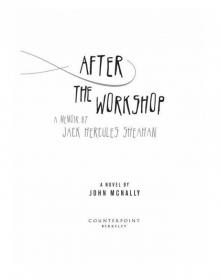
After the Workshop, page 7


S. S. Pitzer was a famous writer who had, after writing twelve critically acclaimed books in twelve years, disappeared after his last novel, Winter’s Ghosts, became his first New York Times best seller. I had escorted him ten years ago, shortly after I had taken this job; Winter’s Ghosts had just come out in paperback. Once the tour was over, he disappeared. Poof, and he was gone. Neither his agent nor his editor claimed to know where he was, and although his estranged wife hadn’t seen him either, she had told the press that she still received monthly checks drawn from a secret account in the Bahamas. The odds of S. S. Pitzer calling me in the middle of the night were at best one-in-ten-thousand, and I almost hung up, but there was something about the tenor of the man’s voice that made me stay on the line to hear him out.
“S. S. Pitzer, huh? Nice try,” I said.
“I’m at the bus station,” he said. “I know this is an imposition, but I was wondering if you could come get me.”
“The bus station? In Iowa City?” I didn’t believe him, and I almost said so, but then he told me something that only he could have known.
“I still remember the first sentence of your novel,” he said.
The only person I had ever shown any of my novel to was S. S. Pitzer. We’d gone drinking after his reading, and we’d ended up at my apartment, listening to old Tom Waits CDs while polishing off whatever had been hiding in my cupboards. In a moment of weakness, I told him what my novel was about. To my surprise, S. S. wanted me to read the first chapter aloud to him. I turned off the stereo. Reclining on my couch, S. S. Pitzer had listened to me with his eyes closed, as though he were hearing music. When I finished, he opened his eyes and said, “It’s brilliant, Jack. This is going to put you on the map in a big way.” And when I told him to quit fucking with me, he said, “No, no. That first line . . . Good God, man. You’ve got what it takes. You do.” Naturally, I was flying. If S. S. Pitzer thought it was brilliant, it had to be! When I drove him back to the airport the next day, he signed my copy of Winter’s Ghosts, “For Jack, To Whom the Gods of Literature Have Whispered. Your faithful reader and loyal friend, S. S. Pitzer.”
“Would you like me to recite it to you?” he asked me now.
“No, no,” I said. “I’ll come get you.”
“Please hurry, though,” he said. “There’s no heat in here.”
I had to dig my car out of the snow and then spend a good fifteen minutes backing up and pulling forward to rock it out of the drift that had built up along the sides, but the tires eventually found traction and rocketed me into the street.
Pitzer’s words, all those years ago, should have given me the courage to finish my novel, but instead they’d had the opposite effect. He had planted a poisonous seed inside my head, and with each new word I added to the manuscript, the seed bloomed until all that remained were expectations that I could never meet. I had tried to make every sentence as brilliant as the first, but at the end of a long day’s work, all I was left with were wooden paragraphs and lifeless scenes. The plot eventually petered out as well. No matter how many times I sat at my kitchen table and pored over the manuscript’s pages, I couldn’t revive it. The novel had flatlined.
And so I boxed it up and never wrote another word. Over the years, I had come to loathe S. S. Pitzer, even though I knew in my heart of hearts that I alone was really to blame. Still, I was secretly glad that he had quit writing books.
A Greyhound bus idled as plumes of exhaust rolled like fog past the station’s windows. I saw S. S. Pitzer standing inside the bus station alongside a few homeless men I recognized from around town. In his early sixties, Pitzer still had a thick mane of white hair. Wearing a tweed suit and a long wool overcoat, as though he were heading cheerily to a university production of Othello, he was the only living person I knew for whom the word dandy still applied. I honked my horn, and Pitzer, holding his overcoat closed, stepped out of the station. When he opened my passenger-side door, enough snow blew inside to chill my bones.
“The buttons popped off somewhere between St. George, Utah, and Lincoln, Nebraska,” he said. “It’s good to see you again, Jack. You wouldn’t believe the trip here. I started out in L.A., and the weather just got worse and worse, state by state. The earlier drivers, why, they’d pull over and wait for the storm to subside, but this last driver, my God, he wouldn’t stop. We couldn’t see ten feet ahead of us, none of us, but the driver kept pushing ahead. It was as though he were possessed.” He looked over at me and said, “You must be tired, old friend. We can chat more about this in the morning.” He said nothing about the awful sound my mufflerless car was making, and for that I was grateful.
“So, what brings you to town?” I asked. Once I’d thrown the question out there, I could feel the air around us shift ever so slightly, but it was too late: I couldn’t retract it.
“Oh, just passing through, son,” he said. “Just passing through.”
“And where am I taking you?” I asked.
“The thing is,” he said, “I didn’t book a room. I was wondering—hoping, really—that I might could rent your sofa. Is it available? If it’s an inconvenience, please let me know and I’ll get to work on other accommodations.”
“No, no, it’s fine,” I said.
“Are you sure?” he asked, but before I could answer, he said, “Thank you, Jack. I owe you. I most sincerely do.”
PART THREE
Everywhere I go, I’m asked if the universities stifle writers.
My opinion is that they don’t stifle enough of them.
—FLANNERY O’CONNOR
15
I HAD LONG BELIEVED that I’d been let into the Workshop due to a clerical error, or because the outgoing director wanted to screw with the incoming director by admitting some of the worst applicants in the Workshop’s long and illustrious history. The short story I had submitted was one that I had written for my undergraduate workshop, a story about Manny Grouse, a retired optometrist with failing eyesight who considers suicide until he sees a billboard advertising the annual optometrist’s convention at a local lodge. Manny goes to the convention with the hope of seeing a few old friends for the last time, but he recognizes nobody inside the old, dimly lit building with its paneled walls and flooring of cracked asbestos tiles. The keynote speaker, a man twenty years Manny’s senior and with a white beard and large old wire-frame glasses from the 1970s, talks not of new developments in optometry but rather of health, happiness, and prosperity; he talks of peace of mind; he talks of being as enthusiastic about the success of others as you would be of your own success. “Remember,” he intones, “that if you give adequate time to the improvement of yourself, you will have no time to criticize others!” Manny takes these words to heart, and, noticing several folding tables at the back of the hall, behind which men and women are offering opportunities to volunteer in the neighborhood, Manny wanders over to find out more. Childless and widowed, he signs up to help out an inner-city baseball team; he also writes a check for $500 so that the community center can purchase new equipment for the kids. On his way out, the keynote speaker stops Manny and introduces himself. “We haven’t seen you here before,” the man says, and Manny, as though kneeling inside a confessional and staring into the dark scrim at the priest’s obfuscated head, admits that it’s been awhile. Nodding, the old man smiles, puts a hand on Manny’s shoulder, and says, “Welcome back to the Optimists’, my friend.” Manny, confused, thanks the old man, then walks outside and into the dark parking lot, but before getting into his car, he turns toward the dingy trailer sign parked next to the road. Beneath the blinking arrow, against a yellow background, are the words: WELCOME OPTI-MISTS’ CLUB! Manny, unsure if what he’s reading is what’s actually on the sign, walks across the gravel lot and reads the letters, one by one, and then looks up into the sky, sees the constellation Cassiopeia, the vain queen who boasted of her unrivaled beauty, and begins to weep in gratitude for his spared life.
It wasn’t a good story. In fact, it was a pretty bad one. Any reader with even a passing knowledge of fiction writing could have pointed out the ridiculous plot contrivance. It was an overly clever story in which my presence hovered obtrusively. The plot’s saving grace was that I had been inspired by the early, ironic short stories of Chekhov rather than the gimmicky work of O. Henry, but I had also lifted, for the story’s finale, a little bit of James Joyce’s “Araby” and a dash of John Cheever’s “The Swimmer.” I hadn’t been aware of any of this as I wrote it, but when I started boning up on the classics after graduation before heading to Iowa, re-reading my Intro to Lit anthology from cover to cover, I saw with no small amount of horror what I had done. That no one who’d read my application pointed this out to me, and that the renowned Iowa Writers’ Workshop had actually accepted me on the basis of an overly ironic short story with not-so-subtle allusions to two stories that had appeared in nearly every short-story anthology published in the last thirty years, pretty much cemented my suspicions that my acceptance had been either an accident or a practical joke. To my credit, the story was full of strong imagery, and there was a precision to the language that naturally pulled the reader into Manny’s world even as my plot worked to push the reader out. If my admission into the Workshop hadn’t been an accident or a joke, it was because someone saw something in the story that transcended all that smacked of amateurishness. I had applied to Iowa on a whim. I never really expected to get accepted.
Which was why I felt compelled to work as hard as possible to become the best writer I could. I was fueled by guilt. I didn’t want anyone reading my stories for workshop wondering why I had been let in; I certainly didn’t want anyone going back to my application, reading my sample story, and saying, “What the fuck is this?” I was protecting both myself and the reputation of the Workshop. Even so, the entire time that I was there, I felt the distinct possibility that I might be called into the office of the Workshop coordinator, a woman named Leslie Buttons who had survived the reigns of four previous Workshop directors, and told to pack my bags, that the error had been caught, and that the only solution was for me to leave town as soon as possible. This, I supposed, was why I had become friends with the director himself, a writer named Gordon Grimes. I needed protection from the inside, a bulletproof vest, and Gordon Grimes was the only person who could provide that for me.
Grimes was in his early fifties when I met him, though he had a boyish face and a thatch of hair that hung perpetually over his forehead, making him look more like a rakish teenage boy in search of trouble than a professor of creative writing. He’d published only one book, twenty-two years before becoming director of the Workshop, an autobiographical novel about growing up in Hollywood and being forced by his mentally unstable stage mother to audition for bit roles in motion pictures. That book alone, though its sales were modest at best, garnered enough critical attention for him to parlay its success into a series of prestigious jobs. A few weeks before meeting him, shortly after I finished reading his memoir, I had actually seen one of his movies on TBS, a patriotic film of World War II, typical of the period, called The Tinseltown Chronicles: Gordon Grimes, eight years old and wearing overalls and a floppy hat, the same style of hat Jackie Coogan wears in Chaplin’s The Kid, selling newspapers on the corner of Hollywood and Vine and yelling as loud as he can, “Extra! Extra! Read all about it! Japs bomb Pearl Harbor! U.S. goes to war! Extra! Extra!” During a six-year period, Gordon Grimes appeared in thirty-two feature movies, but he was never in more than a single scene, and his only other talking role, besides The Tinseltown Chronicles, was in his final movie, a low-budget science fiction serial titled Little Green Men Conquer Earth! In that scene, Gordon shouts, “Look, Mommy. The Little Green Men are here!” In the next shot, using their laser guns, the Little Green Men bloodlessly annihilate the house in which both mother and son live, appropriately concluding Gordon Grimes’s career, such as it was, as a child actor.
By the time I had met Gordon Grimes, the year he’d taken over as the Workshop’s director, he was on the brink of renewing his old drinking problem, a problem, we were all to learn later, that had once reached epic proportions, but in those first few weeks in town he stuck to nursing imported beer and, in a futile attempt to quit smoking, chewed the living shit out of one stick of gum after the other. I happened to come across him, before the semester began, sidled up to the bar in the Miss Q. I was still exploring Iowa City, having just arrived from a state college in northern Michigan, where it wasn’t uncommon for hunters to get drunk and accidentally shoot each other, and where an overzealous bouncer had recently been jailed for choking a patron to death. Iowa City, by comparison, had seemed like a real university town, where you found students reading books like Gravity’s Rainbow or The Electric Kool-aid Acid Test in bars in the middle of a sunny afternoon, or you heard someone using the word postmodern or hegemony in passing. You saw the torches of intellectual pursuit flickering in the students’ eyes, rather than the rheumy fog of a hangover or near-overdose.
“Mr. Grimes?” I said, approaching him cautiously, as if he were a cornered possum. I was unsure how he would react, and, to be honest, he scared the daylights out of me.
After I had explained who I was, he motioned dramatically to the barstool next to him and said, “Sit, sit!” His accent was a curious blend of northeast prep school and W. C. Fields. That first night, he ordered me to read the entire nineteenth century.
“What books in particular?” I asked, and he looked back at me, astonished.
“All of them, of course!” he replied. “Dickens. Flaubert. The Russians. Read all the Russians.” He picked up a book of matches, turned it over in his fingers, and said, “The nineteenth century. That’s all you’ll ever need.”
“What about the twentieth century?” I asked.
“Yeah; sure,” he said, waving his hand dismissively. “Of course you need to read your contemporaries. Hemingway and Faulkner, too. And Joyce . . . but only early Joyce. The first two books. He got worse the older he got.”
This was news to me: My Irish lit professor had spent an entire semester illuminating the genius of Ulysses and Finnegans Wake as opposed to what he had called Joyce’s juvenilia, Dubliners and A Portrait of the Artist as a Young Man. Grimes’s words cheered me immensely, since I secretly preferred the earlier stuff. This was the first time I saw how differently writers and literature professors viewed the written word, and I wanted to hug Gordon Grimes for confirming what I had lately been suspecting—that a story with a beating heart was infinitely better (and more noble) than a story that made its reader scratch her head.
“What about Finnegans Wake?” I asked him.
“Crap,” he said, depositing the tooth-gray nugget of spent gum in the ashtray. He unwrapped a new stick and popped it into his mouth. I expected him to say more about Finnegans Wake, but he didn’t.
Gordon Grimes was notoriously rough in workshop. One time he held up a particularly bad story with the tips of his forefinger and thumb, and asked, “What smells like shit in here?” Another time, he spent an hour berating a student who had misspelled the word fluorescent, which also happened to be the story’s title. “Don’t you own a dictionary?” he asked. “Imagine Faulkner misspelling ‘sanctuary,’ for Christ’s sake. Imagine Hemingway not taking the time to look up the proper spelling of Kilimanjaro.” On yet another occasion, he spent the entire four hours of workshop reading aloud, sentence by sentence, a story that he most likely hadn’t read before coming to class. He now painstakingly questioned every choice made by the author, a young woman named Betsy McKay. “Why is there a semicolon here? Why is the relationship between this sentence and that one so important that it requires a semicolon? Can anyone explain this to me? Oh, and why the paragraph break here? Can anyone show me where the transition is? If the reader starts thinking that your choices are random, well, then, you’re through. You’re done! The reader is going to toss your precious work into the fireplace. Who wants to read a story in which the author hasn’t questioned every word, every comma, every break in paragraph?” Not even the sound of Betsy weeping moved Gordon to stop the assault. Only after Betsy, unable to take any more, left the room did Gordon, broken from his own trance, finally look up. His bloodshot eyes searched the room for his victim. We were well into the fourth hour of the interrogation. Without acknowledging Betsy’s abrupt departure, Gordon said, “Okay, then. I guess that’s all for today.”
Gordon’s were workshops of either tough love or masochistic persecution, depending upon the quality of light in which you viewed it. But Gordon liked me, and, more importantly, he liked my fiction. Most nights, we ended up at the Foxhead at about the same time and wrote our names on the chalkboard for the pool table.
“Sheahan!” he often yelled. “Are you sure you want to make that shot? The side pockets are the hard pockets!” Or else, in an attempt to throw me off my game, he would yell, “Are you sure that’s the English you want to put on the ball? Think about it before you shoot!”
Once, when he accidentally separated an otherwise tight-knit group of solids while leaning over to shoot another solid, Gordon raised up, smiled at the new, more promising configuration of pool balls, and said, “Hey, whaddya know?” as if the balls had separated of their own volition. By then, he was back to drinking whiskey and smoking. Groups of workshop students surrounded him—he had a guru’s following—and he would make offhand comments about how this writer or that one was whoring himself by working in Hollywood or writing thrillers under pseudonyms. “I’m not saying it’s wrong,” he added. “Everyone whores himself every now and then.” But you could tell that he did think it was wrong, even though he himself had spent considerable time doing hackwork.
I occasionally sat with the group, but mostly I remained in a booth across from everyone, alone, separating myself from all the bootlickers, even though I knew deep down that I too was one. I focused on the pool table instead, on whatever game was being played, ignoring the whoops of my classmates each time Gordon Grimes insulted one of his contemporaries or even, after a long night of drinking, one of our own classmates.