

The Wide, Carnivorous Sky and Other Monstrous Geographies, page 1


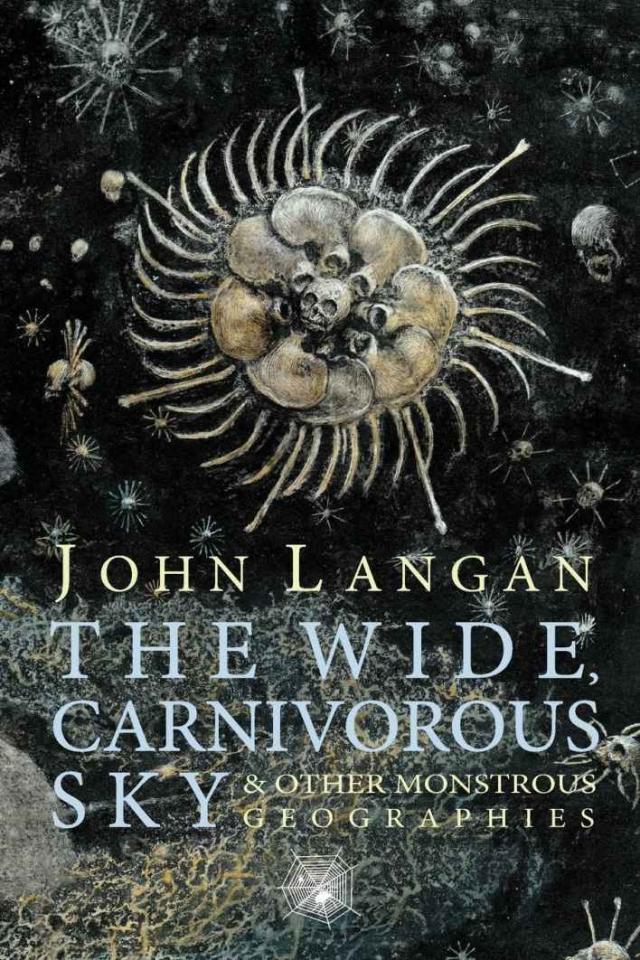
The Wide, Carnivorous Sky
HIPPOCAMPUS PRESS LIBRARY OF FICTION
Edith Miniter, Dead Houses and Other Works (2008)
Jonathan Thomas, Midnight Call and Other Stories (2008)
———, Tempting Providence and Other Stories (2010)
Ramsey Campbell, Inconsequential Tales (2008)
Joseph Pulver, Blood Will Have Its Season (2009)
———, Sin and Ashes (2011)
———, Portraits of Ruin (2012)
Michael Aronovitz, Seven Deadly Pleasures (2009)
Donald R. Burleson, Wait for the Thunder (2010)
W. H. Pugmire, Uncommon Places: A Collection of Exquisites (2012)
Peter Cannon, Forever Azathoth: Parodies and Pastiches (2012)
Alan Gullette, Intimations of Unreality (2012)
Richard A. Lupoff, Dreams (2012)
———, Visions (2012)
Richard Gavin, At Fear’s Altar (2012)
Jason V Brock, Simulacrum and Other Possible Realities (2013)
The Wide, Carnivorous Sky
and Other Monstrous Geographies
John Langan
Hippocampus Press
New York
Copyright © 2013 by Hippocampus Press
Works by John Langan © 2013 by John Langan
“Reading Langan” © 2013 by Jeffrey Ford
“Note Found in a Glenfiddich Bottle” © 2013 by Laird Barron
Published by Hippocampus Press
P.O. Box 641, New York, NY 10156.
http://www.hippocampuspress.com
All rights reserved.
No part of this work may be reproduced in any form or by any means without the written permission of the publisher.
Cover art © 2013 by Santiago Caruso (www.santiagocaruso.com.ar).
Hippocampus Press logo designed by Anastasia Damianakos.
First Electronic Edition, 2013
Kindle Edition: 978-1-61498-071-1
EPUB Edition: 978-1-61498-072-8
For Fiona
Understand Death? Sure. That was when the monsters got you.
—Stephen King, ’Salem’s Lot
Contents
Introduction: Reading Langan, by Jeffrey Ford
Kids
How the Day Runs Down
Technicolor
The Wide, Carnivorous Sky
City of the Dog
The Shallows
The Revel
June, 1987. Hitchhiking. Mr. Norris.
Mother of Stone
Story Notes
Afterword: Note Found in a Glenfiddich Bottle, by Laird Barron
Acknowledgments
Introduction: Reading Langan
In recent years, the horror genre has given rise to a number of exceptionally talented short story writers—Caitlín R. Kiernan, Laird Barron, Joe Hill, Brian Evenson, M. Rickert, Gary A. Braunbeck, Kaaron Warren, Glen Hirshberg, Ekaterina Sedia, to name only a few. These are incredibly adept stylists, and yet they never forget to deliver the chills both physical and metaphysical. The work of each of them is idiosyncratic. It would be a disservice to try to corral them together under the banner of some movement. John Langan is most certainly an important voice in this bumper crop of creators. His excellent fiction simultaneously honors and violates traditions in the genre, giving rise to mutations that stalk off in new directions.
Langan’s short fiction might, at first, seem daunting, because it’s rarely short. The guy is in no hurry. He writes long and he gives good weight on the detail. It doesn’t take many pages after entering one of these stories, though, to understand why. In adopting a concern for Gravity and Time (two key ingredients of the Gothic) in his work, Langan is able to create fictional effects you can’t get with the brief or minimal. The pacing of his stories and the manipulation of the passage of time, its effects on the characters, its warping of the plot, are ingenious and seem organic. Years often pass as these stories unfold, or there are sudden leaps in time, or the sequence of events is subtly rearranged. As in the world of physics, the rate of Time is influenced by Gravity, and through the varying weight of the description in these stories Langan directs this magic, sometimes to hallucinatory effect. When I speak of the weight of description, I don’t mean a cluttering of sentences. The read is always smooth and the flow of language carries you. Instead, I’m talking about the quality of description, its ability to convince the reader of the physical nature of the world of the story. This is important because Langan’s horror is vitally physical as well as psychological and philosophical. For a good example in this collection, I’d point to the opening paragraphs of “City of the Dog.”
Although the influence of the Gothic and of Poe in particular are evident everywhere in these stories, I wouldn’t say that Langan is so much working in a tradition as through it. He is garnering fictional effects from it and employing them in new ways, but he is also busy dissecting that tradition. If you notice, many of these stories have an analytical aspect and some take the obvious form of anatomies. Langan is a scholar of fantastic fiction and a professor, a fact he openly embraces in his stories. What better voice or persona for a fascinating, creepy, cockeyed lecture on “The Masque of the Red Death” or a disquisition on the werewolf story? He is pinning up traditional tropes of the genre and taking a scalpel to them. The point isn’t simply to analyze—this is not a research project—but to dig down to the core of these old monsters and change them. “How the Day Runs Down,” a zombie story that first appeared in the John Joseph Adams anthology The Living Dead, is a good example: it is a zombie story structured around Thornton Wilder’s iconic play Our Town. Langan uses the classic horror trope to dissect the classic American dream/nightmare and vice versa. The fiction that results from the process, a mutation, is brimming with original energy.
The most interesting aspect of the stories in this collection, though, comes through the characters and the drama. Langan gives us a chance to get to know the characters—you get a feeling of lives being lived—and become immersed in their realities. He is great at conveying character through dialogue or monologue. The gravity of the description pulls you toward its center. And the way things transpire seems always immediate, even in the past tense, as if these stories are being discovered as they are written. Langan is an explorer, and he has got the courage to follow the story where it takes him. There is an organic feel to the fiction, the unpredictability of journeys and visions, which makes the real realer and the weirdness weirder. This and all the various aspects of Langan’s fiction I’ve mentioned to this point come across as totally unpremeditated on his part. There is a unity to these stories that strikes me as having less to do with calculation and more some kind of fictional intuition, but that too could be art.
Ultimately, what awaits you in this collection are gravity and time, weird stories, supernatural and unsettling, physical horror, madness, monsters, hallucination, philosophical haunting, mutation at the core. And all of this, all of it, in glorious Technicolor.
—JEFFREY FORD
The Wide, Carnivorous Sky
Kids
These were not his students. For one thing, he’d never taught kids this young: the oldest couldn’t be more than six or seven, and the majority of the group crowding through his classroom door looked nearer four or five. For another thing, these children were beyond dirty, they were filthy: hair matted, skin thick with dirt, clothes a motley of stains. Not to mention the smell they brought with them: the pungence of garbage bags heaped high on the sidewalks outside cheap restaurants. For a moment, he was possessed by the conviction, by the absolute certainty, that he had stepped into a novel—Oliver Twist, perhaps, the Artful Dodger and his crew come calling, or possibly Maggie: A Girl of the Streets, the denizens of Crane’s Manhattan paying a visit—which his mind quickly corrected: I haven’t stepped into the novel; the novel’s stepped into me. The sensation gave him an odd vertigo; he reached out a hand to his desk to steady himself. Behind the six- or seven-year-old, the children shuffled into the room en masse. Finding his voice, he said, “Can I help you?” and was surprised to hear the quaver in his words.
The children stopped where they were, the expressions on their faces those of small animals suddenly discovered by a predator. The possibility that this was some kind of strange joke, one of the seniors playing freak-out the hardass English teacher, flashed through his mind, only to be rejected as paranoia. Anyway, there was too much about the scene in front of him that didn't make joke-sense. It wasn’t as if he were teaching Dickens right now—as if he ever taught Dickens, or Crane, for that matter. That he could recall, he’d never made mention of any phobias involving groups of small, dirty children, either. He stepped around the desk, closer to the kids. “Are you guys okay?” The children’s eyes tracked him as he drew closer to them, bent over slightly as he said, “Are you lost? Were you on your way someplace?” Maybe a student organization was doing something with kids from one of the more run-down sections of Worcester, having them to lunch or something. Although, Jesus, if that were the case, you’d think the kids’ parents could have done a little more to clean them up. Not that they had to be wearing dresses and suits, but still . . . He looked at the children’s eyes looking at him. How dark they all were, that dark brown that can seem indistinguishable from black. Strange to find a group of kids this size all with the exact same eye color. “ Tell you what: why don’t you come with me, and we’ll see if we can’t find out where you’re supposed to be.” He started to walk past them, toward the door.
He didn’t see which one tripped him, was on the floor so quickly that it took a moment for his brain to register what had happened. “What . . .” He was all right, but he’d come this far away from braining himself on one of the students’ desks. Probably an accident. “Hey,” he said as he went to turn over.
The pain in his calf was sharp and burning. He shouted and swung his hand back without thinking. It connected with a child’s head with a loud smack, rolled the kid off and away from him. Shouldn’t have done that, he thought as he tried to stand. But OW, the little punk bit me, look at that, he bit right through the leg of my pants. It was true: the brown fabric was torn, along with the skin beneath. Blood was literally running out of the wound, tickling down his leg, damping his sock. What the hell? “All right,” he said.
He wasn’t all the way to his feet when the children broke over him. This time his head did connect with the corner of a desk. There was a flare of white light and then a gap, a moment when the world went far away. It returned on a wave of pain. His legs, his arms, his side—all on fire with, with . . . Oh Christ, they’re biting me! Good Lord, the little—they’re biting me!
They were. Looking at their mouths smeared with red, you might have thought they were playing at clowns, applying their mothers’ lipstick with children’s enthusiastic spasms. But one of them was licking her lips; another was chewing, for the love of God; a third was jerking his head back the way you do when you’re trying to alley-oop a piece of food from your lip into your mouth. They were eating him. He could feel their teeth ripping pieces of him away. He tried to flail his arms, kick his legs, roll one way or the other, but they had him pinned to the classroom floor. His shirt, pants—what hadn’t been torn away—were sticking to him with his own blood. He tried to raise his head, to see what was being done to him, but all he could make out were small heads whose thick hair was slick with blood, with his blood. They pushed and shoved one another, jostling for the best places at the dinner table he had become.
No sound, he thought as consciousness spiraled down the drainpipe. They weren’t talking, laughing, crying, making any of the sounds a group of children might make. There was only the noise of eating, flesh tearing, teeth clicking, lips smacking together.
How the Day Runs Down
(The stage dark with the almost-blue light of the late, late night, when you’ve been up well past the third ranks of late-night talk shows, into the land of the infomercial, the late show movies whose soundtrack is out of sync with its characters’ mouths and which may break for commercial without regard for the action on the screen, the re-broadcast of the news you couldn’t bear to watch the first time. It is possible—just—to discern rows of smallish, rectangular shapes running across the stage, as well as the bulk of a more substantial, though irregular, shape to the rear. The sky is dark: no moon, no stars.
(When the STAGE MANAGER snaps on his flashlight—a large one whose bright beam he sweeps back and forth over the audience once, twice, three times—the effect of the sudden light, the twirl of shadows around the theater, is emphasized by brushes rushing over drums, which give the sound of leaves, and a rainstick, which conjures the image of bones clicking against one another more than it does rain.
(Having surveyed the audience to his apparent satisfaction, the Stage Manager trains his light closer to home. This allows the audience to see the rows of tombstones that stretch the width of the stage, two deep in most places, three in a couple. Even from his quick inspection of them, it is clear that these are old tombstones, most of them chipped and worn almost smooth. The Stage Manager spares a moment for the gnarled shape behind the tombstones, a squat willow, before positioning the flashlight on the ground to his left, bottom down, so that its white light draws a cone in the air. He settles himself down beside it, his back leaning for and finding a tombstone, his legs gradually crossing in front of him.
(It has to be said, even with the light shining right beside him, the Stage Manager is not easy to see. A reasonable guess would locate him somewhere in his late forties, but estimates a decade to either side would not be unreasonable. His eyes are deep set, sheltered under heavy brows and the bill of the worn baseball cap on his head. His nose is thick and may have been broken in some distant confrontation; the shadows from the light spilling across his face make it difficult to decide if his broad upper lip sports a mustache, although his solid chin is clear of any hair. His ethnicity is uncertain; he could put in an appearance at most audience members’ family reunions as a cousin twice-removed and not look out of place. He is dressed warmly, for late fall, in a bomber jacket, flannel shirt, jeans, and heavy boots.)
Stage Manager: Zombies. As with most things in life, the reality, when compared to the high-tech, Hollywood gloss of the movies, comes as something of a surprise. For one thing, there’s the smell, a stench that combines all the worst elements of raw sewage and rotted meat, together with the faint tang of formaldehyde. Folks used to think that last was from the funeral homes—whatever they’d used to pickle dear Aunt Myrtle—but as it turned out, this wasn’t the case. It’s just part of the smell they bring with them. Some people—scientists, doctors—have speculated that it’s the particular odor of whatever is causing the dead to rise up and stagger around; to which speculations I gather there are objections from other scientists and doctors. But you don’t have to understand the chemistry of it to know that it’s theirs.
For another thing, when it comes to zombies, no one anticipated how persistent the damned things would be. You shoot them in the chest, they keep on coming. You shoot them in the leg—hell, you blow their leg clean off with your shotgun at point-blank range—they fall on their side, flop around for a minute or two, then figure out how to get themselves on their front so they can pull themselves forward with their hands, while they push with their remaining leg. And all the time, the leg you shot off is twitching like mad, as if, if it had a few more nerve cells at its disposal, it would find a way to continue after you itself. There is shooting in the head—it’s true, that works, destroy enough brain matter and they drop—but do you have any idea what it’s like to try to hit a moving target, even a slow-moving one, in the head at any kind of distance? Especially if you aren’t using a state-of-the-art sniper rifle, but the snub-nosed .38 you bought ten years ago when the house next door was burglarized and haven’t given a thought to since—and the face you’re aiming at belongs to your pastor, who just last Saturday was exhorting the members of your diminished congregation not to lose hope, the Lord was testing you.
(From high over the Stage Manager’s head, a spotlight snaps on, illuminating OWEN TREZZA standing in the center aisle about three-quarters of the way to the stage. He’s facing the back of the theater. At a guess, he’s in his mid-thirties, his brown hair standing out in odd directions the way it does when you’ve slept on it and not washed it for several days running, his glasses duct-taped on the right side, his cheeks and chin full of stubble going to beard. The denim jacket he’s wearing is stained with dirt, grass, and what it would be nice to think of as oil, as are his jeans. The green sweatshirt under his jacket is, if not clean, at least not marred by any obvious discolorations, although whatever logo it boasted has flaked away to a few scattered flecks of white. In his outstretched right hand, he holds a revolver with an abbreviated barrel that wavers noticeably as he points it at something outside the spotlight’s reach.)
Owen: Oh, Jesus. Oh, sweet Jesus. Stop. Stop right there! Pastor Parks? Please—don’t come any closer. Pastor? It’s Owen, Owen Trezza. Please—can you please stay where you are? I don’t want to— You really need to stay there. We just have to make sure—Jesus. Please. Owen Trezza—I attend the ten o’clock service. With my wife, Kathy. We sit on the left side of the church—our left, a couple pews from the front. Pastor Parks? Can you please stop? I know you’re probably in shock, but—please, if you don’t stop, I’m going to have to shoot. It’s Owen. My wife’s expecting our first child. She has red hair. Will you stop? Will you just stop? Goddamnit, Pastor, I will shoot! I don’t want to, but you’re giving me no choice. Please! I don’t want to have to pull this trigger, but if you don’t stay where you are, I’ll have to. Don’t make me do this. For Christ’s sake, won’t you stop? I have a child on the way. I don’t want to have to shoot you.


