Lightspeed Magazine, Issue 51, page 5
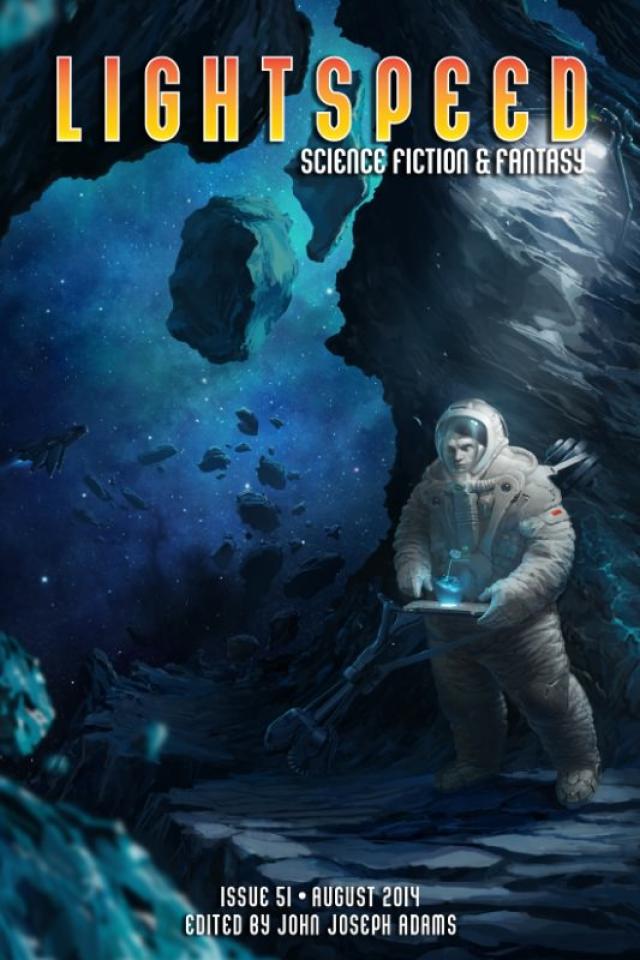


There’s only ruined flesh beneath your fingers. Your skin tingles as the spaceman’s blood moves into every fingerprint; it’s not red, it’s not blue, it’s not even ghastly green. It’s no color, but it feels like hot ice burning your fingerprints away. You wipe the blood down the matte material of his spacesuit and stare at your fingers. The prints are gone, your skin as smooth as the skin that runs the length of your forearm. Oh, shi—
Sorry, sorry, he says. Other pocket, other pocket!
There is another pocket, but you don’t dare look in it. You press a hand over his apparent wound and the pocket both and you can feel something moving inside. You have never touched a pregnant woman—Aunt Fran told you how presumptuous that was—but you imagine it would feel like this, something alive moving just beneath the skin, just beneath the sky—the sky moving just beneath the skin—
If only you had a box, you think, and you watch the threat slither past outside the bush once again. Stupid aliens, why are they always so stupid, and humans so clev—
But even as you think this, the branches of the bush part, and oh, they’ve found you. They have found you and will eat you while you’re still alive unless you and the spaceman vanish the way your hammock did. But you don’t vanish.
The aliens haul you out of the bushes and they are the worst thing you have ever seen. They are the image of every pet you ever loved, mashed into one terrible thing that should never have lived. They haul you and the spaceman to the edge of the bayou and the stench and bugs are nearly enough to knock you unconscious. You almost wish for that, because it would be better than looking into your puppy’s eyes in that alien face, but all you can do is look.
The spaceman has no gizmo that will save you or him or anyone. This, you tell the aliens, is clearly a misunderstanding. You ask them if they are lost and they stare at you.
You can’t know where they got the images of your pets—there’s dogs and cats and even a gulping fish face goes by as they look at you—but you think if they knew well enough to get those faces, they know everything there is to know about you and earth and life, but mostly, they should know that everything that lives also dies. Every face they assume as their own is dead and gone and so very dead, skin long since rotted away, burned away, chewed away, and you see the flicker of the grave upon them then. If you know death, they should know death, and they do. Wet, dissolving death.
The aliens come apart in a flood. They have no form but for that which you give them; they come apart in sticky rivers of ejaculate that whiten the edge of the bayou; they avalanche down the dirt and into the water, where they are nothing but an oily sheen. An alligator passes through, slicing the slick neatly in two.
You stare at the spaceman, who stares back at you with his dime-eyes, and you have no actual idea what has just happened, only that he smiles at you, and you smile at him and say goddamn it you owe me a hammock. And possibly also Orion, he mutters before the world snaps again and you—
You are sitting in the night-dark yard, telescope aimed at the endless glories and wonders of the night sky, bare feet curled into grass that should have been mowed a week ago. The night is too damn hot, but there should be a comet, a comet crossing through Orion’s belt, but you can’t find Orion’s belt, which is impossible, but also rather happening. You pull back from the lens, to scan the night sky and it’s just not there. It’s summer, you tell yourself, so there shouldn’t be an Orion at all, but it’s more than that.
There’s a hole in the sky where the stars used to be; there’s a stretch of black that is like looking into a pocket that is like looking into a crevasse that just keeps going and going until it stops in a shine that looks like a smile of dimes turned on their sides and you think oh, spaceman, what the hell did you do, what did you do, and when can you do it again, because sometimes these glories and wonders are just too impossible to take, and you want to bundle every single star and paper heart into a pocket, seal it up, and never look at them again. If only, you think, you had a box, a pocket, a spaceman. But the night is warm and quiet around you, your hammock and aunt have dissolved, and you do not.
© 2014 by E. Catherine Tobler.
ABOUT THE AUTHOR
E. Catherine Tobler is a Sturgeon Award finalist and the senior editor at Shimmer Magazine. Among others, her fiction has appeared in Clarkesworld, Lady Churchill’s Rosebud Wristlet, and Beneath Ceaseless Skies. Her first novel is now available. Follow her on Twitter @ECthetwit or her website, ecatherine.com.
To learn more about the author and this story, read the Author Spotlight.
Traveller’s Rest
David I. Masson
It was an apocalyptic sector. Out of the red-black curtain of the forward sight-barrier, which at this distance from the Frontier shut down a mere twenty metres north, came every sort of meteoric horror: fission and fusion explosions, chemical detonations, a super-hail of projectiles of all sizes and basic velocities, sprays of nerve-paralysants and thalamic dopes. The impact devices burst on the barren rock of the slopes or the concrete of the forward stations, some of which were disintegrated or eviscerated every other minute. The surviving installations kept up an equally intense and nearly vertical fire of rockets and shells. Here and there, a protectivized figure could be seen “sprinting” up, down, or along the slopes on its mechanical “walker,” like a frantic ant from an anthill attacked by flamethrowers. Some of the visible oncoming trajectories could be seen snaking overhead into the indigo gloom of the rear sight-curtain, perhaps fifty metres south, which met the steep-falling rock surface forty-odd metres below the observer’s eye. The whole scene was as if bathed in a gigantic, straight rainbow. East and west, as far as the eye could see, perhaps some forty miles in this clear mountain air despite the debris of explosion (but cut off to the west by a spur from the range), the visibility-corridor witnessed a continual onslaught and counter-onslaught of devices. The visible pandemonium was shut in by the sight-barriers’ titanic canyon-walls of black, reaching the slim pale strip of horizon-spanning light at some immense height. The audibility-corridor was vastly wider than that of sight; the many-pitched din, even through left ear in helm, was considerable.
“Computersent, must be,” said H’s transceiver into his right ear. No sigil preceded this statement, but H knew the tones of B, his next-up, who in any case could be seen a metre away saying it, in the large concrete bubble whence they watched, using a plaspex window and an infrared northviewer with a range of some hundreds of metres forward. His next-up had been in the bunker for three minutes, apparently overchecking, probably for an appreciation to two-up who might be in station VV now.
“Else how can they get minute-ly impacts here, you mean?” said H.
“Well, of course it could be longrange low-frequency—we don’t really know how Time works over There.”
“But if the conceleration runs asymptotically to the Frontier, as it should if Their Time works in mirror-image, would anything ever have got over?”
“Doesn’t have to, far’s I can see—maybe it steepens a lot, then just falls back at the same angle the other Side,” said B’s voice; “anyway, I didn’t come to talk science: I’ve news for you, if we hold out the next few seconds here: You’re Relieved.”
H felt a black inner sight-barrier beginning to engulf him, and a roaring in his ears swallowed up the noise of the bombardment. He bent double as his knees began to buckle, and regained full consciousness. He could see his replacement now, an uncertain-looking figure in protsuit (like everybody else up here) at the far side of the bunker.
“XN 3, what orders then?” he said crisply, his pulse accelerating.
“XN 2: pick em-kit now, repeat now, rocket 3333 to VV, present tag”—holding out a luminous orange label printed with a few coarse black characters—“and proceed as ordered thence.”
H stuck up his right thumb from his fist held sideways at elbow length, in salute. It was no situation for facial gestures or unnecessary speech. “XN 3, yes, em-kit, 3333 rocket, tag” (he had taken it in his left glove) “and VV orders; parting!”
He missed B’s nod as he skimmed on soles to the exit, grabbed a small bundle hanging (one of fifteen) from the fourth hook along, slid down the greasy slide underground ten metres to a fuel-cell-lit cavern, pressed a luminous button in the wall, watched a lit symbol passing a series of marks, jumped into the low “car” as it ground round the corner, and curled up foetuswise. His weight having set off the cardoor mechanism, the car shut, slipped down and (its clamps setting on H’s body) roared off down the chute.
Twenty-five seconds after his “parting” word, H uncurled at the forward receiver cell of station VV nearly half a mile downslope. He crawled out as the rocket ground off again, walked ten steps onward in this larger version of his northward habitat, saluted thumb-up and presented his tag to two-up (recognised from helm-tint and helm-sign), saying simultaneously, “XN 3 rep, Relieved.”
“XN 1 to XN 3: Take this” (holding out a similar orange tag plucked from his pocket) “and take mag-lev train down, in—70 seconds. By the way, ever seen a prehis?”
“No, sir.”
“Spot through here, then; look like pteros but more primitive.”
The infrared telescopic viewer looking northwest passed through the forward sight-barrier which due north was about forty metres away here; well upslope, yet still well clear of the dark infrared-radiation barrier could be seen, soundlessly screaming and yammering, two scaly animals about the size of large dogs, but with two legs and heavy wings, flopping around a hump or boulder on the rock. They might have been hit on their way along, and could hardly have had any business on that barren spot, H thought.
“Thanks; odd,” he said. Eleven seconds of the seventy had gone. He pulled out a squirter-cup from the wall and took a drink from the machine, through his helm. Seventeen seconds gone, fifty-three to go.
“XN 1 to XN 3: How are things up there?”
Naturally a report was called for: XN 2 might never return, and communication up-time and down-time was nearly impossible at these latitudes over more than a few metres.
“XN 3. Things have been hotting up all day; I’m afraid a burst through may be attempted in the next hour or so—only my guess, of course. But I’ve never seen anything like it all this time up here. I suppose you’ll have noticed it in VV too?”
“XN 1, thanks for report,” was all the answer he got. But he could hear for himself that the blitz was much more intense than any he had known at this level either.
Only twenty-seven seconds remained. He saluted and strode off across the bunker with his em-kit and the new tag. He showed the tag to the guard, who stamped it and pointed wordlessly down a corridor. H ran down this, arriving many metres down the far end at a little gallery. An underslung, railguided vehicle with slide-doors opening into cubicles glided quietly alongside. A gallery-guard waved as H and two others waiting opened doors whose indicators were unlit, the doors slid to, and H found himself gently clamped in on a back-tilted seat as the mag-lev train accelerated downhill. After ten seconds it stopped at the next checkhalt; a panel in the cubicle ceiling lit up to state “diversion, left,” presumably because the direct route had been destroyed. The train now appeared to accelerate, but more gently, swung away to left (as H could feel), and stopped at two more checkhalts before swinging back to right and finally decelerating, coming to rest and opening some 480 seconds after its start, by Had’s personal chronograph, instead of the 200 he had expected.
At this point daylight could again be seen. From the top bunker where XN 2 had discharged him, Had had now gone some ten miles south and nearly three thousand metres down, not counting detours. The forward sight-barrier here was hidden by a shoulder of mountain covered in giant lichen, but the southern barrier was evident as a violet-black fog-wall a quarter of a mile off. Lichens and some sort of grass-like vegetation covered much of the neighbouring landscape, a series of hollows and ravines. Noise of war was still audible, mingled with that of a storm, but nearby crashes were not frequent and comparatively little damage could be seen. The sky overhead was turbulent. Some very odd-looking animals, perhaps between a lizard and a stoat in general appearance, were swarming up and down a tree-fern near by. Six men in all got out of the mag-lev train, besides Had. Two and three marched off in two groups down a track eastward. One (not one of those who had got in at VV) stayed with Had.
“I’m going down to the Great Valley; haven’t seen it for twenty days; everything’ll be changed. Are you sent far?” said the other man’s voice in Had’s right ear through the transceiver.
“I—I—I’m Relieved,” tried Had uncertainly.
“Well I’m … disintegrated!” was all the other man could manage. Then, after a minute, “Where will you go?”
“Set up a business way south, I think. Heat is what suits me, heat and vegetation. I have a few techniques I could put to good use in management of one sort or another. I’m sorry—I never meant to plume it over you with this—but you did ask me.”
“That’s all right. You certainly must have Luck, though. I never met a man who was Relieved. Make good use of it, won’t you. It helps to make the Game worthwhile, up here—I mean, to have met a man who is joining all those others we’re supposed to be protecting—it makes them real to us in a way.”
“Very fine of you to take it that way,” said Had.
“No—I mean it. Otherwise we’d wonder if there was any people to hold the Front for.”
“Well, if there weren’t, how’d the techniques have developed for holding on up here?” put in Had.
“Some of the Teccols I remember in the Great Valley might have developed enough techniques for that.”
“Yes, but think of all the pure science you need to work up the techniques from; I doubt if that could have been studied inside the Valley Teccols.”
“Possibly not—that’s a bit beyond me,” said the other’s voice a trifle huffily, and they stood on in silence till the next cable-car came up and round at the foot of the station. Had let the man get in it—he felt he owed him that—and a minute later (five seconds only, up in his first bunker, he suddenly thought ironically and parenthetically) the next car appeared. He swung himself in just as a very queer-looking purple bird with a long bare neck alighted on the stoat-lizards’ tree-fern. The cable-car sped down above the ravines and hollows, the violet southern curtain backing still more swiftly away from it. As the time-gradient became less steep, his brain began to function better and a sense of well-being and meaningfulness grew in him. The car’s speed slackened.
Had was glad he still wore his protsuit when a couple of chemical explosions burst close to the cable line, presumably by chance, only fifty metres below him. He was even more glad of it when flying material from a third broke the cable itself well downslope and the emergency cable stopped him at the next pylon. He slid down the pylon’s lift and spoke with his transceiver close to the telephone at the foot. He was told to make west two miles to the next cable-car line. His interlocutor, he supposed, must be speaking from an exchange more or less on the same latitude as that of his pylon, since communication even here was still almost impossible north-south except at ranges of some metres. Even so, there was a squeaky sound about the other voice and its speech came out clipped and rapid. He supposed his own voice would sound gruff and drawled to the other.
Using his “walker,” he picked his way across ravines and gullies, steering by compass and watching the sight-barriers and the Doppler tint-equator ahead for yawing. “All very well for that man to talk about Teccols,” he thought, “but he must realise that no civilization could have evolved from anywhere as far north as the Great Valley: it’s far too young to have even evolved Men by itself—at least at this end; I’m not sure how far south the eastern end goes.”
The journey was not without its hazards: There were several nearby explosions, and what looked like a suspicious artificial miasma, easily overlooked, lay in two hollows which he decided to go round. Moreover, an enraged giant bear-sloth came at him in a mauve shrub-thicket and had to be eliminated with his quickgun. But to one who had just come down from that mountain-hell all this seemed like a pleasant stroll.
Finally he came upon the line of pylons and pressed the telephone button at the foot of the nearest, after checking that its latitude-number was nearly right. The same voice, a little less outlandish and rapid, told him a car would arrive in three-quarters of a minute and would be arranged to stop at his pylon; if it did not, he was to press the emergency button nearby. Despite his “walker,” nearly an hour had gone by since he set out by it. Perhaps ninety minutes had passed since he first left the top bunker—well over a minute and a half of their time there.
The car came and stopped, he scrambled up and in, and this time the journey passed without incident, except for occasional sudden squalls and the passage of flocks of nervous crows, until the car arrived at its terminus, a squat tower on the heathy slopes. The car below was coming up, and a man in it called through his transceiver as they crept past each other, “First of a bunch!” Sure enough, the terminus interior was filled with some twenty men all equipped—almost enough to have warranted sending them up by polyheli, thought Hadol, rather than wait for cars at long intervals. They looked excited and not at all cast down, but Hadol refrained from giving away his future. He passed on to the ratchet-car way and found himself one of a group of men more curious about the landscape than about their fellows. A deep reddish curtain of indeterminate thickness absorbed the shoulders of the heights about a quarter-mile northward, and the bluish fog terminated the view over the valley at nearly half a mile southward, but between the two the latitudinal zone was tolerably clear and devoid of obvious signs of war. Forests of pine and lower down of oak and ash covered the slopes, until finally these disappeared in the steepening edge of the Great Valley, whose meadows could however be glimpsed past the bluff. Swirling cloud-shadows played over the ground, skirts and tassels of rain and hail swept across it, and there was the occasional flash and rumble of a storm. Deer could be seen briefly here and there, and dense clouds of gnats danced above the trees.