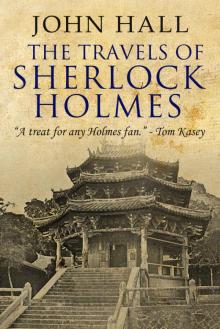
The Travels of Sherlock Holmes, page 16


‘Nothing, thank you.’
‘Then we shall say good night, and au revoir, if that is indeed appropriate.’
We took our leave, stepped over the still sleeping Dervish, and returned to our quarters, passing the old watchman, who was also sound asleep, as we did so.
I was all for making good our escape at dawn next day, but Sigerson pointed out that it would have looked most suspicious, and the pursuit would undoubtedly be raised at once. Furthermore, by remaining, we should give Igorov a better start on any pursuit.
A messenger arrived at breakfast, to say that the Khalifa would be there late that afternoon, and would be gracious enough to honour the mayor with his company.
There ensued some frantic preparations, for it was unwise to displease the Khalifa, and I was delighted that these preparations involved our being turned out of our room, for I had little taste for sleeping under the same roof as the madman who ruled the Sudan.
The mayor did not exactly turn us out into the street, but billeted us on one of his near neighbours, a dignified enough old gentleman, who looked frightened to death at the prospect of being associated with three fanatics such as ourselves. Selim had some talk with him, though, and did much to reassure him, after which Sigerson had a long chat about conditions generally, the results of which he intended, he told me later, to transmit to the authorities in London.
Evening came, and with it the Khalifa and his retinue. We were more or less obliged to go along and do him homage, and it was one of the more distasteful tasks that have come my way. He was not an imposing figure, a little below average height, with the mark of Cain writ as clearly upon his brow as any cut-throat I have ever encountered. His evil little eyes darted up and down us in a most insolent fashion – had one of my native servants dared regard me in such a way, I should have thrashed him on the spot, but we could do nothing save fawn upon the wretch, and tell our tale.
Selim did most of the talking, and the Khalifa nodded as he listened, smirking offensively at the worst tales of treachery and shabbiness.
I was pleased when the hour for dinner arrived, and we, not being invited to the high table, so to speak, could make good our escape, after promising to be on hand early next day to witness the encounter between Igorov and the Khalifa.
We talked to some of the Khalifa’s bodyguard, and gained some information as to the disposition, strength and mor-ale of the Sudanese forces, of which information Sigerson again took careful note.
Next day, we marched at the head of the great procession to the old palace. I noticed that many of the common people hesitated about going too near, but the Khalifa, secure with his guards about him, marched into the ruins, and up to the rough shelter.
His disappointment at finding Igorov gone was evident, and had it not been for the fact that the Russian’s companion was clearly afflicted of Allah, I do not think his life would have been worth much.
‘Word of your magnificence’s arrival has reached this rascal,’ said the old Emir, ‘and he has fled, rather than face your vengeance. A clear proof of his guilt.’
‘H’mm.’ The Khalifa stared at the Dervish who had travelled with Igorov. ‘I suppose you are truly mad, my brother, and not just pretending? I imagine it would be pointless putting you to the torture to discover the where-abouts of your creature?’
The Dervish scratched his head, and smiled foolishly at him.
‘H’mm,’ said the Khalifa again, the indecision patent in his eyes. Then his brow cleared, and he called out, ‘Where is the fellow who came to me with the great news that a saint had arrived in Khartoum, and preached a holy war? Let him be brought forward, that I may reward him properly.’
It transpired, however, that the man concerned had taken no thought for any reward, but gone quietly about his business elsewhere, and the Khalifa cursed him bitterly.
At a break in the flow, Sigerson approached the wretch and said quietly, ‘It would be unwise to consider any invasion of Egypt just at the moment, your highness.’
‘Indeed? And why so? Stay, let us have some privacy here,’ and the Khalifa vented some of his anger by telling his guards to clear the crowds away, which they did in a most ungentle fashion. ‘Now, speak.’
‘The British are cunning devils,’ said Sigerson. ‘They would wish you to invade Egypt, for they have vast armies waiting in ambush. Indeed, I am not sure that this spy who has fled your wrath was not an agent of the British, sent here as part of the plot.’
‘I see.’ The Khalifa’s eyes narrowed. ‘You are sure of this?’
‘Highness,’ the Emir put in, ‘these men have worked for you against the British in Egypt for many years. They are my own men, true and trusted.’
‘Indeed. And so what would you advise?’
‘Do nothing,’ Sigerson told him. ‘Do not attract the attention of the British devils, for they would like nothing better than to have an excuse to avenge Gordon.’
The Khalifa looked around the blackened ruins with some unease. ‘I think you are right. I shall return to Omdurman, and linger secure there – for, if aught should befall me, how could my people thrive?’
‘Just so,’ said Sigerson.
‘We did not catch this fellow,’ said the Khalifa, ‘but you did well to warn me nonetheless. Do you return to Egypt, to continue the good work?’
‘If it please you,’ Sigerson told him.
‘It does, it does. Take some good horses,’ he waved a hand magnanimously about him, ‘and say that I shall pay any price, if the seller comes to see me in Omdurman. And so, farewell.’ And off he went, followed by his entourage.
‘What think you to his guards?’ Sigerson asked me.
‘Not much. They may have taken Gordon by surprise – the garrison here was not a large one – but I cannot think they would last long against a determined force.’
‘So I think. If this wretch does not cause any trouble for a time, I think it will be easy enough to re-take the Sudan, and avenge Gordon. I shall inform London to that effect.’
I may add that I believe that ‘Sigerson’ did just that, and that the invasion and conquest of the Sudan a few years later was the direct consequence of his report.
We now took our leave of the old Emir, and he gave us guides and an escort to the border with Egypt. Incidentally, I heard from Selim later that the Emir decamped at the first hint of the British invasion, and might be seen in Mecca, showing the more gullible pilgrims some of the sights in return for a few coppers. I cannot honestly say that I was sorry at the news, doubtless the old rogue richly deserved hanging twice over, but he was likeable enough.
At the border, we parted with our escort, and rode on alone until we encountered a patrol of British cavalry. To say that they were surprised to encounter us there at that time, and that for a while they treated our story with some caution, is to understate the matter. But I gave them my best parade ground manner, and we eventually convinced them.
A week later, we were in Cairo, and there my story must end.
Chapter Seventeen - The journals of Dr John H Watson. A postscript
‘Dyce’s account ended rather abruptly,’ I said.
Holmes took his gaze from the ceiling, and stared at me. ‘It was something of an abrupt end to an interesting series of adventures,’ he said. ‘Dyce returned to his regiment, Selim to his embassy, and I to my old friends in London. My work was done, after all.’
‘And the stay in France?’ I asked.
‘Oh, that was real enough. I travelled from Alexandria to Marseilles, fully intending to make my way to one of the Channel ports, and start looking at the news from England, to see when best to make my entrance. But I met a man with whom I had some acquaintance, and he told me that the director of the new chemical laboratory needed someone to conduct some research into the coal-tar derivatives. I was in no particular hurry, and I have always found the atmosphere of France soothing, so I stayed.’
‘And returned when the work there was done?’
Holmes laughed. ‘I bumped into Le Villard – you may have some recollection of him? He was there on some case, and we got talking, as you may suppose. It was he who informed me that Sylvius was no longer in London, that he had in fact been observed making a villainous progress through France, on his way to Algeria.’
‘Ah, to shoot lions, no doubt?’
‘No doubt. Sylvius, you will not need reminding, was one of my most dangerous enemies at that time. He and Moran had stood their trial, but because of my being out of London – or perhaps for a more sinister reason – they had walked free, and whilst they were together in London, they presented an undoubted danger to me. Now only Moran remained, so I decided to return to England without delay. I made my way to Calais, stopping only to have a wax bust made – I had already worked out my scheme to trap Moran, you see. I confess that I was a little apprehensive lest the Customs authorities examine my baggage.’
‘How so?’ I asked.
‘Well, if they found I had a wax bust of myself, it would increase that entirely unjustified reputation for egocentricity which, thanks to your rather sensational accounts, I have laboured under for many years.’
‘I suppose so. Did they examine your bags?’ I asked with a sudden access of hope.
‘No, I am pleased to say. Anyway, I was actually in Calais when news of Adair’s death reached me. I knew at once that Moran was the murderer, and took the first boat. The rest you know.’
‘Yes.’ I looked around the old place. ‘This really is like old times, Holmes. I take it that you are now involved in some work on behalf of the government? And that young Wiggins – Mr Wiggins, that is to say – is working with you?’
Holmes nodded. ‘He is a good fellow, if a little lacking in imagination.’ He stretched luxuriously, and sighed. ‘Still, he is only young, by comparison, as you say. And those eight children! My dear fellow, would you believe he has photographs of each of them, and insists on showing them to me at every opportunity?’ He shuddered, then looked at me with those piercing eyes of his. ‘And you, I take it, are doing some useful and congenial work of your own?’
‘Me? Oh – well, you know, Holmes, duty and all that. Stern taskmaster, and all the rest. One has to do what one can, and so forth.’ And I echoed his sigh.
‘I suppose so. Yes, Wiggins is a good fellow, but there are times when one could wish for someone of one’s own age to talk to, someone possessed of one’s own Bohemianism of disposition, someone who knows one’s mental processes as well as oneself –’
‘Holmes!’
‘Well?’
‘A thought has just occurred to me!’
‘Indeed?’
‘Indeed, Holmes. And if you would be so kind as to touch the bell, I shall expound it to you over a little supper.’
If you enjoyed The Travels of Sherlock Holmes check out Endeavour Press’s other books here: Endeavour Press - the UK’s leading independent publisher of digital books.
For weekly updates on our free and discounted eBooks sign up to our newsletter.
Follow us on Twitter and Goodreads.
Author’s Note
There is a relatively small, but highly dedicated, band of enthusiasts which persists in regarding Mr Sherlock Holmes and Dr John H Watson as real men. Members of this band delight in controversy, in formulating their own theories and picking holes in those of other enthusiasts. For these people, one of the most puzzling conundrums in the Holmesian canon – which is full of puzzling conundrums – is the mysterious absence of Holmes from England between 1891, when he was popularly supposed to have died at Reichenbach, and 1894, when he reappeared in the case of ‘The Empty House’. Just before Holmes ‘died’ in 1891, Dr Watson remarked that ‘There was something very strange in all this’ – and how right he was!
To begin with, we must recall that Holmes had just concluded his investigations into the Moriarty gang, investigations which would result in a massive police action against the gang in a couple of days. Why on earth should Holmes choose to leave England at that crucial juncture? The only explanation I personally can think of is the one suggested in ‘The Final Problem’ and repeated here, namely that Holmes knew that he must stay alive to testify, or the whole massive police operation might well be thrown away; but even that is far from satisfactory.
Then again, why should Holmes simply disappear from view for almost four years? Particularly when his absence seems to have caused the failure of the case against Colonel Moran, and perhaps other highly-placed members of Moriarty’s gang. Several explanations have been advanced, for instance that Holmes suffered some sort of nervous breakdown, or that after defeating Moriarty he was engaged on a diplomatic mission on behalf of his brother Mycroft. And again, although all these have some appeal, none is entirely convincing.
It would surely have had to be something major which kept Holmes away from England for so long, something unusual which took him to Tibet, Persia, etc.? I do not know if the theory that Moriarty survived at Reichenbach is particularly original – and it almost certainly is not – but I had not thought of it; it was suggested to me by Ian Wilkes, who read an earlier version of this tale, and to whom I extend my thanks.
Thanks are also due to David Stuart Davies, for his help and encouragement; and of course to Martin Breese who has so kindly published the book!
John Hall, The Travels of Sherlock Holmes