

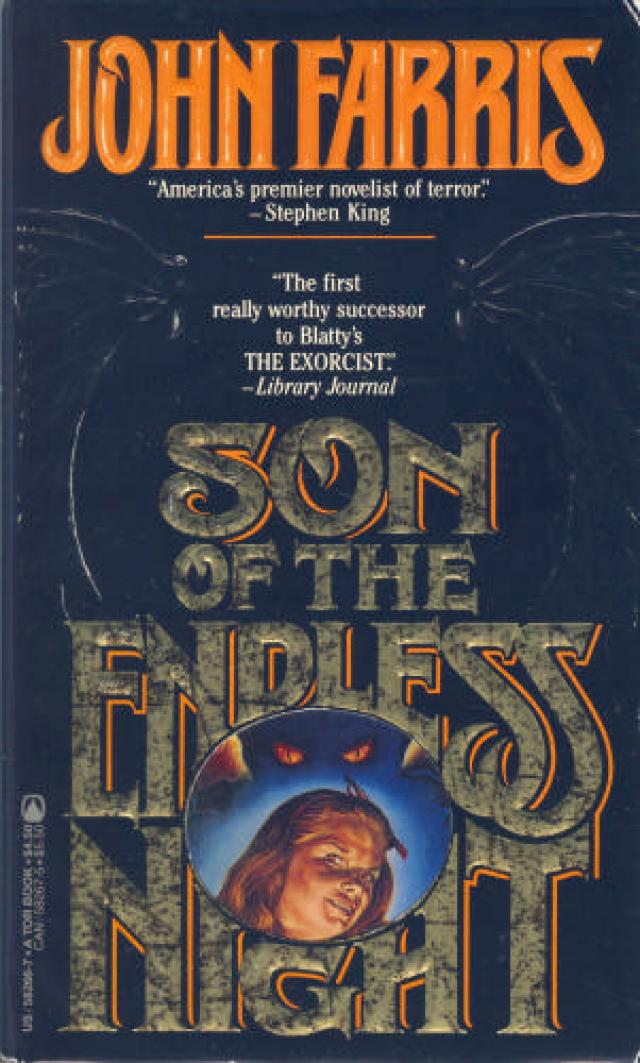
Son of the Endless Night, page 21


Halfway to the gate at the top of the knoll he made himself stop and take a long look at the Courdewaye house.
He couldn't stop shivering. His hands were freezing, his throat was raw from cold.
Now, he thought, prepared to be stern with himself, what actually happened? How much of it was nerves, and how much real?
He fished in a side pocket of his storm coat and felt the crumpled Polaroid photo there. So that was real. And he didn't have to take another look to remember what the camera had recorded.
There were two children in the photo he had taken from the former playroom. A boy and a girl— or at least she appeared to be a girl. Her hair was longer, she was more delicately shaped. But when a child is abused, perhaps only a few weeks from death by starvation, that child tends to appear on the delicate side. The children were eight, maybe ten years of age, and each wore white pajama bottoms, or— Conor had another thought— the kind of simple white cotton trousers everyone seemed to be wearing in those parts of rural Mexico which he and Gina had passed through on their honeymoon. That made sense, because he remembered the kids also were wearing sandals. Above the waist they looked skeletal: prominent ribcages and pale drained faces. Their sunken eyes seemed utterly exhausted, bereft of light, like the faces one saw in the photos of the Nazi death camp survivors. They were sitting down, looking directly into the camera, and they were joined together, quasi-Siamese style, by a length of frayed rope knotted at their throats.
All this was bad enough, God knows, the horror of their situation, the tortured emptiness of expression. But there was more in the photograph that made it uniquely chilling and awful, details that, combined with others Conor had seen, smelled, and sensed in the Courdewaye house, completed a tapestry of evil. The woman's hand, for instance. Placed in a proprietary way atop the boy's head, fingers not digging in exactly, but gripping the shorn bony round head as if she were about to pluck it and cast it into the shimmering sea in the distant background, a sea the precise blue-green color of the stone in the silver ring so prominent on one of her fingers.
Conor had seen that same ring on the hand that held the riding crop in the portrait in the den.
The thickness of red wine in his throat: the vapors turned to gasoline.
For God's sake Conor don't drink!
The cartoon animals on the wall. His fall down the stairs. The aches and bruises he now felt. What was real and what was not? Bambi. He choked on laughter. So he'd gone a little berserk, let himself be frightened. By what or whom he didn't know. He was sure of only one thing: He didn't have much of an imagination, no, not nearly enough to dream up something as revolting and despicable as the yoked children— and the gasoline can that was just visible between the long shadows of cacti in the background of the Polaroid photograph.
With his eyes still on the house, which was in deeper shadow now as the afternoon faded into dusk, Conor took the photo from his pocket and straightened it out. He looked at it with reluctance and loathing and nearly fainted.
It was all still there: the woman's hand, the terrace near the sea in that distant sunny place. The shadows. The implicit evil.
Only now there were three children instead of two.
They were his children. Hillary. Dean. Charley-chuck.
With a strangled cry of profanity, Conor dropped the photo and began smashing it into the snow with the heel of his boot.
The sun was setting behind his back, momentarily lighting up every window down below: a brazen, formidable glow. His eyes were blinded again, he couldn't look any longer.
Now whom could he tell, whom could he bring, whom could he convince as he himself was convinced that Rich was right about this house, about the evil that had lain in wait for him there?
Shaking, distraught, Conor reached down to retrieve the photo.
The image had faded nearly to nothingness. Only a pale blur of color remained, about where the woman's hand had been.
Conor ripped the stiff white square into several pieces, and scattered them.
He wondered what he would find, what would be waiting for him this time if he dared go back into the house.
But he knew he would never go back into the Courdewaye house. No power was sufficient to compel him to do so.
He would have to find another means to help his brother.
Helpless, devastatingly alone, Conor turned away.
39
Officer Michael O'Donnell, of the Casterbridge Police Department, received the call about the body by the railroad tracks south of Hungerford Avenue at eight twenty-three P.M. He'd been on his way to take his meal break at the New Daisy Diner on Route 9. Disgruntled by the timing of the call, he turned on the blue lights, swung his car around, and proceeded to the scene.
The temperature in the Berkshire Hills of western Massachusetts was near zero, with the wind chill factor bringing it to 28 below. Hungerford Avenue was an industrial eyesore little visited at night. The street was asphalt patching over century-old cobblestones, sectioned by railroad spur lines. On the north side of the street were factory outlets, old Quonset huts and vacant lots enclosed by rusted chain link fencing. South of the main line, the roadbed of which was in such poor shape that the daily freights could make only twenty-five miles an hour through this part of town, there was an embankment and a creek, an unimportant tributary of the Queetoosuc River. Ten inches of snow lay everywhere, with a surface glaze as hard and brilliant as ceramic tile.
Near the Sixth Street crossing he was flagged by two men wearing parkas and ski masks, which were almost obligatory in this weather. Still, he didn't like not having faces to look at. O'Donnell slowed half a block away, unbuttoned the strap over his Police Special and considered calling for backup. Instead he flashed the side-mounted spot on them, and on a jacked-up truck with a front tire off. He used the loudspeaker.
"Hands where I can see them," he ordered the two men, his voice echoing metallically from the walls on his right. They obeyed.
O'Donnell got out of the patrol car, gun in hand at his side, cocked and locked, flashlight with the long steel barrel in the other hand, and walked toward the two men.
"Hey, Mike," one of them said. "Is that you?"
"Right."
"I'm Jack Surrey. This is my brother-in-law Pete Contardi from Woonsocket."
O'Donnell holstered the revolver. He knew Surrey from the Knights of Pythias.
"Don't blame you for being cautious," Contardi said. The air between the three of them was filled by a thick luminous cloud of breath. O'Donnell's exposed nose was tingling.
"What happened to you guys?" he asked, looking at the truck.
"Flat," Surrey told him. "No spare. I figured Angelo's Gulf down on Brookman was still open and I could bum a tire from him. Started walking east along the tracks and that's when I noticed it."
"You found a body?"
"What it is, I think. Better have a look."
O'Donnell went with the two men toward Fifth Street, which was a dead-end at the tracks. About fifty yards from the crossing where they had left the truck Contardi directed the policeman to shine his light down the slope; his own flashlight's beam was weaker. The beam from the six-cell torch was reflected from the solid ice of the creek bed and from bushes half-submerged in sculpted drifts of polished snow. Irregular, reddish black droppings were splattered on the hard surface of the embankment from the edge of the tracks to the creek bank.
Something curiously out of place was sprawled in among the bare thickets. Like a big shapeless meal sack. But the longer O'Donnell looked, the more it resembled human remains in a camel's hair topcoat. Nothing human was visible in the light they cast upon it: no legs or feet or arms. No head. Nevertheless there were bumps and bulges within the material that suggested human form.
O'Donnell crushed the hardpacked snow with the heel of a boot, making steps to get him down there; otherwise he'd slide on his ass like a greased pig twenty feet to the ice of the creek. He asked Jack Surrey to have a look along the tracks on down toward Fifth Street. Then he descended slowly, digging in at the heels, swaying to keep his balance, a gloved hand shielding his face to keep the wind that had risen from biting his exposed skin. Contardi followed him.
"Those spots on the snow look like blood."
"Could be," the policeman grunted, trying to save his breath. They reached the bottom. It was a camel's hair coat, all right, and there was a good reason why no feet or legs were visible. They'd been chopped off.
O'Donnell looked up at the tracks. The freights fairly crawled through here, a blind man could get out of the way of one. But this poor bastard hadn't made it. O'Donnell parted stiff branches and isolated the head of the victim in the beam of light. Battered, misshapen head, the bones jumbled with swollen brain tissue under the nearly bald pate. A mass of brain like a hemorrhoid protruded from one ear cavity. His own mother might not recognize him. But both arms were still joined to the body. He was wearing suede gloves that were almost new. Not someone you'd expect to find in this neighborhood. One hand clutched a brown bag full of— O'Donnell reached down and prodded with a gloved finger— broken glass. Despite his stuffy nose he smelled the fumes given off through a tear in the paper. Scotch whiskey.
The policeman straightened and constructed a rough scenario. At some time during the last three hours, since darkness had set in, the deceased had left one of the three bars along Hungerford Avenue and, carrying a large bottle of whiskey with him in the sack, had attempted to cross the railroad tracks. It was not a good place to cross, so probably he was unfamiliar with the area. All right. A passing train had struck and killed him. How he could have been so intoxicated as to miss the approach of the train, while not so drunk he could still walk, was a mystery O'Donnell had no desire to figure out. Or maybe he was just a happy lush with a thing for trains, liked to get right up close and admire them as they rumbled by. Got too close this time, had one swig too many from the paper bag and keeled over under the wheels. Not much blood. Too cold, and from the appearance of his head he had died instantly.
There was always a third possibility. Suicide. O'Donnell had seen the bodies of people who had taken their lives in stranger ways than this. The simple act of stringing oneself up probably took a hell of a lot of guts and determination; more, he imagined, than plunging half stoned under a moving train.
Oh, well. Someone had to be notified he wouldn't be coming home.
O'Donnell was lucky; he uncovered the victim's wallet on his first try, probing the inside pocket of a tweed jacket. He flipped the wallet open to the driver's license.
"Somebody local?" Contardi inquired.
"Nope. Vermont. Chadbury, Vermont. Must be a car around here someplace, belongs to him."
"Hey!" Jack Surrey called down from the railroad tracks. They both looked at him, shifting the angles of their flashlights. He was holding, by the bend of the knee, a rigid length of leg, still neatly dressed, the black leather mold shoe in place. "What do I do with this?"
"Just put it down there," O'Donnell said disgustedly. "And don't handle any more loose parts you happen to find."
40
Conor Devon parked his grimy Lincoln in the driveway beside the kitchen door and went into his house. Dinner was over; he'd told them not to wait for him. He smelled lasagna, slightly scorched. On the winterized back porch they used as a rumpus room the television was on, although it was a school night and TV was forbidden between six thirty and eight thirty, homework hours. The immortal Archie Bunker, secure in rerun heaven, was ranting at his son-in-law.
"Gina?"
"Here," she said wanly, from the porch.
He walked through the kitchen and found her on the tartan plaid sofa with her legs, encased in red leg warmers, propped up on the coffee table. Like every other casual piece of furniture in the house the table was constructed of slabs of rock maple, neo-Colonial in style, glossily finished and sturdy enough to be considered childproof. Gina's head was sideways on a pillow in an attitude of dejection, her eyes on the TV. She had a wine glass in one hand, some watered-down Chianti in the glass. Conor was startled, and a little concerned; Gina almost never flaked out this way, at least not before eleven at night.
"Hi, honey." He sat down beside her. She smiled, a slow sad curving of her mouth, and slid her head from the pillow to the beefy crook of his arm.
"Thought you'd never get here."
"How are the kids?"
"They're in their rooms. I had to separate them after supper, they were driving me crazy with their squabbling. It's just nerves, I guess. All the stories about the murder in the Globe, and on TV. No way they can avoid it. And it's their uncle Rich. They're so uptight, I don't think it would be any worse for them if you and I were getting a divorce. You know the way Hillary is when she's depressed."
Conor nodded. Hillary was the family melancholic, after his side of the family. Even before puberty she was subject to disconsolate spells that had them worried. He would see her lying abed for no good reason at unlikely times of the day, her face a study in bleakness just this side of torment, twining her long hair around her fingers like a spent princess.
"Just keep Hillary busy, that's what she needs. I'll talk to the kids in a few minutes; I need to unwind."
"Fix you a drink? The lasagna was good and I saved some, but the oven temperature was too high— I don't know how that happened— and it's sort of ruined. I'm sorry." She wiped at an eye with the back of one hand. Her mascara had been rubbed into the little creases beside the eye; it looked like a tire tread. "There's still some Sunday roast, if you want a sandwich."
"I, I don't know— sure. I'll eat something. Just a glass of ale, though, skip the hard stuff."
Gina drank the rest of her Chianti and got up. Her hair needed combing; in the unflattering light that flickered from the TV screen her face seemed puffy. Gina saw him looking too long at her and, hunching her shoulders self-critically, explained, "I got my friend, and I just haven't much felt like making an effort today. But I'll make myself pretty for you later."
He murmured something reassuring. "Love you," Gina murmured back, and went into the kitchen. Charley-chuck, who was eight and a half but the size of a twelve-year-old, came soundlessly onto the porch, carrying a pet gerbil in one commodious pocket of his sweat jacket. Conor had no affection for the ratlike animals, but they couldn't have a dog or cat in the household because both he and Gina were allergic to the dander. The gerbils and hamsters, ordinarily confined to two tiers of lucite cages in the boys' room, had been a compromise to satisfy the children's hunger for something furry to love.
"Hi, Dad." The boy came close enough to kiss him, then retreated, one hand stroking the gerbil's darting head.
"Hi. Who have you got there?"
"Pandora. She hasn't been feeling too good. I got an eighty-nine in math today."
"That's terrific. My math scores for four years didn't add up that high." He looked more closely at a big adhesive square on the boy's brindled cheek. "How did you get that— hockey?"
"This kid on the Rangers was high-sticking. But we beat 'em six-zip."
"When do you play again?"
"Friday, at five-thirty."
"Afternoon, I hope."
"No, morning."
Conor groaned, and rubbed his son's red head. "I'll do my best to be there."
"Are you going to be home for a while?"
"I think so. Two or three days anyway."
Gina came back with a foaming glass of Bass ale for Conor. She looked sharply at their son.
"Hey, ten minutes to eight already, did I hear the bath running?"
"No," the boy said, with a shadowy stubbornness. "I wanted to talk to Dad."
Conor said placatingly, "Go on and take your bath. I'll be up soon."
When they were alone, Gina sat on the edge of the low coffee table in front of him, knees almost touching the tops of his shins, her tilted oval face stylized in satiny shadow like a religious carving; downcast madonna, woodenly worshipful, hair lightened to a withering incandescence by the backlighting of the TV: the worm in her wood, presentiment of bitter old age, death: he felt his heart aging in his chest.
She said, "I saw that lawyer on the six o'clock news."
"Adam Kurland."
"He's young. He's awfully young. Smooth. He looks as if he doesn't like getting his hair mussed, you know what I mean? Wouldn't Rich be better off with someone like F. Lee Bailey?"
Conor considered the publicized face, front-page for years. Jet pilot barrister, his foxy battle stripes, the huckster knowingness. Conor cringed. "How could we afford Lee Bailey? Besides, Adam and Rich got along. It's hard to tell, but I think Rich trusts him. That's important."
"So— " She made a small gesture of resignation with her hands. "You and Rich have made up your minds already. How is Rich acting now?"
"Well— he's better. He's on tranquilizers. He had some lunch today, hasn't shown much interest in food lately."
"Not acting crazy?"
"What's crazy? Rich looks and behaves like someone who is very disturbed and has to be sedated. He sits and smokes, not calm, just immobilized; the opposite effect, half the time, is motion, constant motion. He walks around the room, very self-absorbed, but a little frantic, like a mouse trundling through a maze. When you talk to him you can't be sure he's listening. His most coherent remarks are about things that happened to him five, ten years ago. Then he's very animated, fast-talking. He goes on about his mother as if she were still alive. How's mother taking it? Once he opened and started picking through Adam's briefcase. Every piece of paper. He'd look at each one and then put it back. His face was so dreary. It was as if he— he had misplaced his citizenship in the human race. Even though watching him is so awful, tears my guts out, Adam says I still have to be alert to the possibility that some of it is put-on."
Gina, having slowly assimilated hearsay evidence of Rich's disorientation, if not dementia, found this sudden contradiction— or accusation— hard to deal with.


