Gods in Londinium, page 1
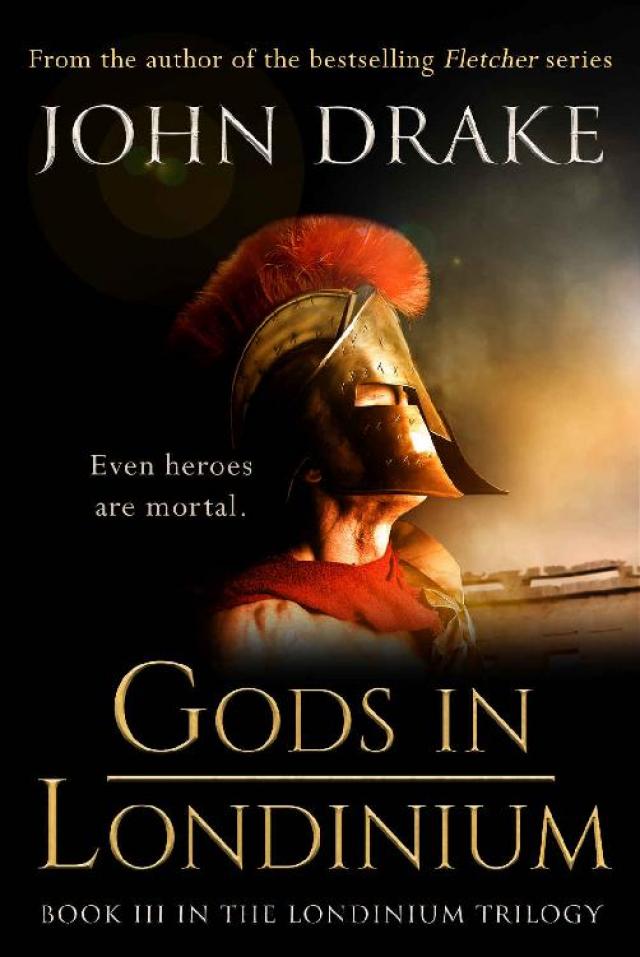


GODS IN LONDINIUM
John Drake
First published by Lume Books in 2022
Copyright © John Drake 2022
The right of John Drake to be identified as the author of this work has been asserted by them in accordance with the Copyright, Design and Patents Act, 1988.
All rights reserved. No part of this publication may be reproduced, stored in a retrieval system, or transmitted in photocopying, recording or otherwise, without the prior permission of the copyright owner.
Dedicated to the valiant Ukrainian nation,
led by the heroic Volodymyr Zelenskyy.
Table of Contents
CHAPTER 1
CHAPTER 2
CHAPTER 3
CHAPTER 4
CHAPTER 5
CHAPTER 6
CHAPTER 7
CHAPTER 8
CHAPTER 9
CHAPTER 10
CHAPTER 11
CHAPTER 12
CHAPTER 13
CHAPTER 14
CHAPTER 15
CHAPTER 16
CHAPTER 17
CHAPTER 18
CHAPTER 19
CHAPTER 20
CHAPTER 21
CHAPTER 22
CHAPTER 23
CHAPTER 24
CHAPTER 25
EPILOGUE
AFTERWORD
CHAPTER 1
My dreams are always bad, and this one is even worse. I am on a beach, some miles from my city of Apollonis, and the monster – the Chimera – is mounted on a platform facing the sea. The Chimera is a machine. It is Greek engineering perverted, and – worst of all – it is my machine, since I designed it. It is my creation and it is a weapon of war.
It is a war machine, but no sort of artillery that warfare would recognise, because it has a furnace and a hot stench and men standing by to work it, while shaking in terror. Only two things are certain about the Chimera: it is the product of science, not magic, and it is wildly uncertain in operation. It is dreadful to the enemy, but likely to kill every man of its own crew.
So, I am wearing protective clothes: a robe and hood with boots and leggings, all of wool, since wool is slow to burn. All the crew are in wool, but I am the commanding officer, with more protection.
My junior officer comes forward with a shield. It is a Roman shield, the scutum militaris, a half-cylinder of laminated wood that is large, light and strong, and one of the few devices that the Romans invented all by themselves without a Greek to show them how. And they invented it very well, because even we – the men of Apollonis – voted to adopt the Roman shield in battle.
“Honoured sir,” says the young man, “please take the shield.”
“No,” I say, “I will not take protection that the men cannot.” I look at the crew. They cannot hide behind shields while working the machine, so they are terrified, and they are here only because they are criminals excused the death sentence for this duty. Once, the Chimera crews had been volunteers. But not anymore. Not now.
So I look round. Only soldiers are present. All the people have been kept away from this secret place. The young officer speaks again.
“Honoured sir,” he says, “I must give you the shield. I am commanded by high authority.”
I sigh. I take the shield. He bows low.
“Now get back,” I say. “Get away from here.”
“Will you not retreat yourself, honoured sir?”
“No. My duty is here.”
He runs off. I ground the shield according to drill. I kneel behind it to take most protection, and prepare to duck low at the slightest need. Then I shout to the crew and they reply.
“Furnace man ready?”
“Ready!”
“Safety valve clear?”
“Clear!”
“Hose men ready?”
“Ready!”
“Torch man ready?”
“Ready!”
“Shoot!”
But then comes the explosion, which throws the crewmen burning and shrieking and only my shield saves me. Perhaps a valve stuck: who knows?
The dream shifts.
I am in the senate chamber of the city of Apollonis. Everything is white marble. A dome rises above me. The sun shines through the illuminating circular opening – the oculus – in the peak of the dome. One hundred senators sit in formal robes. Grey hair, white beards, dignity, soft echoes of conversation in the great stony hall. We are the governing body of Apollonite democracy. We sit in semi-circular ranks, each man in the marble chair incised with his name, rank and clan.
The speaker of the house lifts his voice and every man stares at me.
“I call upon Ikaros!” he says, “Ikaros, son of Cleon! Ikaros: grandson of Philippos of the Clan of the Horse! Ikaros: co-opted to the command of the Chimera!”
I stand. I go forward to the speaking place. I am given tongue by Apollo. My words flow with passion.
“The Chimera brings shame upon our city, our clans, and our gods! No man will work it willingly, it is disgrace to compel the unwilling, and even when it works, it inflicts such wounds upon the enemy as are beyond all civilised usages of war!”
“AYE!” say the senators in a united growl.
I continue. “If the Romans come, and if we must fight, then let us fight like men! Let us fight with honour, so that those who come after us may be proud!”
“AYE!”
I go on and on. Not one word is said against me. At last I sit down.
The speaker nods. “I congratulate Ikaros son of Cleon for his chosen words,” he says.
The senators agree. “AYE!”
The speaker of the house continues. “The motion put before us by Ikaros son of Cleon, is that all works on Chimera shall cease, while it, and all records of its design, shall be destroyed.”
“AYE!”
“All present will now stand, who wish to support the motion!”
A rustle and rumble as every senator stands.
Then, all of them are coming to me, in smiles and congratulation.
The dream shifts again.
Two years have passed.
Apollonis is burning. Fires roar, smoke rises, even as the Romans come over the walls from the great ramp built by their engineers. The long siege is ending in victory for Rome. Our men are stabbed by Roman swords, while the noblest of our women are dying by their own hands rather than be defiled or enslaved.
I am in my house. I am on my knees. My armour is hacked and dented, my helmet is thrown off, my sword hangs useless in its scabbard. I am holding my wife and children in my arms. They are dead and I am soaked in their blood. I am in agony because I know very well … I know without the slightest doubt … I know to the deep of my soul … that had I not spoken against the Chimera, and had we used it against the Romans, then our city would not have fallen, and my loved ones would still be alive.
CHAPTER 2
But why was I suffering nightmares? Why nightmares in a comfortable bed in Roman Londinium, where I was living in safety and luxury? Some explanation is needed.
Londinium was in Britannia, at the extreme reach of Roman power, and Britannia was strange and violent, and could not be trusted with any shade of self-government. So it was an imperial province, directly owned by the emperor, ruled by a governor, and held by three legions plus auxiliaries and cavalry: the biggest army of occupation in the entire empire. So, what did the Romans want of this strange and violent province?
Britannia was valuable in terms of produce: gold, silver, lead, pearls and corn. Also, local manufacture delivered a range of goods, including even the technically complex Roman army shield. Thus the province attracted entrepreneurs from across the empire, provided they were bold enough to take the risk of ferocious native uprisings. There was indeed great wealth in Britannia. But the real reason the Romans took it and held it was as a message to their rivals outside the empire – whether German savage or Parthian sage – that Rome could conquer any one, or any thing, that Rome chose. So the Germans, Parthians and others must make no hostile move against Rome, for fear that Rome will visit them with ten thousand pairs of boots, all tramping in perfect step.
So much for Britannia. What of myself? I was a Greek from the lost city of Apollonis: a tall man with a little of grey in my beard. I was pleasing to women and accustomed to the signs of their appreciation: a half-smile, then downcast eyes and a raised hand patting the hair in place. Also, I was a slave, but what kind of slave? Because – like everything else in the Roman world – slaves were ranked from high to low as defined by their cost. As the Romans say, servus pretium scit: the slave knows his price.
At the bottom were those condemned to the mines: criminal brutes, who were worked to death in a few years. Next came field slaves, worth more than pigs but less than horses. Then house slaves, who were valued according to skill: maids, footmen, cooks or even major domos of high price. Higher still came craftsmen: smiths, potters, carpenters, even locksmiths and jewellers and the like, who were semi-independent of their owners and might become so wealthy as to buy their freedom. At the top were the exotics: beautiful boys and girls whose prices were measured in millions, also educated Greeks recognised by the Romans as being superior in knowledge.
I was one of this latter group, having been captured when the Romans destroyed Apollonis. Beyond even that, there were other slaves of truly colossal value, as I shall explain later. But all slaves, of whatever kind, were property and not people. They were possessions, with no more legal rights than a mongrel dog or a pric eless Chinese vase.
In my own city I had been a senator, an engineer and a surgeon. I was an officer of cavalry too, in wartime. So I was valued for these things, and for other skills that were my blessing and my curse. Thus everyone says that I am a very clever man. I suppose that I am, but I see no cleverness in myself: only the ability to make deductions, based on evidence, that seem obvious to me, even if obscure to others. Or perhaps I am too modest? Perhaps I am better at understanding evidence? How should I know?
The outstanding result of my supposed cleverness is my ability to know what men and women are thinking, and to tell truth from lies. The world calls this mind-reading, and the world is united in believing that I do it by magic. But I do not. In conversation I note facial expressions, posture and manner, and make judgement based on facts. Everyone does this to some degree, since everyone knows a smile from a frown, and everyone guesses that a man who picks up broken glass is thinking of cut fingers. So I insist that I do not work magic.
Conversely, my capacity to observe and make swift judgment is so greatly above that of everyone else, that perhaps I am indeed magic? How should I know, by hell, damnation and misery? Only the gods know. So I despair of explanation, and you the reader must decide for yourself.
Meanwhile, I have not explained why my gift is a curse. It is a curse because sometimes I look into the minds of those whom I respect, and like, or even love, and I do not like what I see, and disillusion is a great pain. That is probably why I drink.
CHAPTER 3
Enough of my dreams, except to say that they were not messages from the gods, as is generally supposed. My dreams were caused by my sense of guilt for the loss of my family, and almost anything reminded me of that, even if I did something good.
I was in the great harbour of Londinium, just downstream of the bridge on a cold day under a grey Britannic sky. It was a two-cloak day, a thick puttees day, and I shivered and longed for the warmth of the Mediterranean. I was there with Morganus, first javelin of the Twentieth Legion: the senior of the legion’s sixty centurions. We made a good pair, he and I. He personified the military might of Rome, and the Roman law that stood behind it, while I was a tall Greek, with the beard which Romans thought to be a sign of intellect. They especially thought that of a Greek, because Romans were nervous of Greek intellect and they were entirely correct to be nervous of mine, especially given my trick of ‘mind-reading’.
I was therefore accorded special status. I had been purchased for the empire as an imperial slave, owned by the emperor himself. I thus became one of those very clever foreign slaves – mostly Greeks and Jews – who ran the imperial civil service. Who else would do it, after all? Romans are not clever enough to run their empire. Or perhaps I display Greek prejudice?
But I was a slave none the less, with Morganus standing in loco Imperatoris: in place of the emperor, as the Romans say. Thus I was obliged to live in his house and he was my owner in the emperor’s name. If he had not been Morganus, that would have been humiliation for a man who had been a senator. But he was indeed Morganus, he was my dear friend, and his wife and daughters – in their gracious kindness – treated me as one their own. Therefore, despite all the troubles of my life – and one very great trouble in particular – thanks to Morganus and his family, my world was not entirely without sunshine and I bless them for it in Apollo’s name.
And so to Morganus himself. I am tall but he is taller, especially when wearing the helmet of a first javelin with its transverse crest of swan feathers. The legions called him the big man, both for his height and the fact that he was a veteran of forty years’ service, having joined up at fifteen and won every decoration that the Roman army had to give. His titles in full were Leionius Morganus Fortis Victrix: First Javelin, Hero of the Roman Army, Father of the Legion and Chief Priest of the Legion.
As regards the last title, note that a Roman chief priest is not a holy mystic rolling in the ecstasies of faith. He is an administrator, who maintains smooth relations with the gods in exactly the same way as the official in charge of aqueducts maintains a smooth flow of water. This is so because Romans see the gods as creatures like themselves, who deliver good fortune in return for ritual and sacrifice in a business-like exchange. That is the Roman way, and it works for them. After all, they rule the world, so the gods must be on their side. Even a Greek knows that.
So, there we stood on one of the main wharves of the port of Londinium, surrounded by ships large and small: some coming to anchor, some casting off, and all the busy noise of a sea port. I do love a sea port for the life-force of it: bold mariners, insolent dockers, arrogant merchants, and the arguing and calling, and the creak of ropes in blocks as cranes of all kinds heave goods out of the ships.
There we stood: the mind-reading Greek, too clever for his own good, the great and loyal soldier, and all that turbulent company took care not to bump or jostle us. They took care not just because of the formidable appearance of Morganus, but for the four huge Roman soldiers who stood like iron statues behind him. They were his bodyguard, found from the biggest men in the Twentieth Legion. They went with him everywhere – even to the latrine – and were as much a part of his equipment as the sword at his side or the boots on his feet. They were his insurance – and mine – that he could go anywhere in Britannia without watching his back in fear of dagger, and in those days in Britannia, that was useful.
It was also practical, since the Roman Empire had taken special note of the combination of Morganus and me. It did so because while Romans cannot invent anything, they are swift to grab any useful thing that they find by chance. Thus, the governor of Britannia was using myself and Morganus as detective agents in matters of high crime and politics. The governor did this because unlike my own city of Apollonis, the Romans had no police force: not even officers patrolling the streets to prevent crime, let alone detective inquisitors who investigated crime once committed.
But today we were not investigating crime or politics. We were in the port for other reasons.
“Ah!” said Morganus, “Here they come!”
A group of men shoved through the crowded dock. Shouts and complaints rose up all round, especially from the seamen who give no respect to any landman whatsoever. But the newcomers pushed, shoved and came forward. There was quite a company of them, with big slaves on the outside to clear the way for their masters – six well-dressed citizens – while a clump of superior slaves followed behind, clutching documents. But the dockyard folk grinned and yelled at the anxious looks on the citizens’ faces as they approached Morganus.
“Been caught out?” said someone. “Had your hand in the strong-box?”
“Oooooooo!” said the crowd.
“Dirty buggers!” said someone else.
“Guilt written all over ’em!”
Then, the citizens and slaves stopped and bowed to Morganus. Or at least they did so eventually, but first there was an oddity that I had become used to on these occasions, because by normal Roman etiquette the citizens should have addressed Morganus and ignored me. They should have ignored me because I was a slave. Nobody greets a horse before its master, and it was the same with a slave. But Morganus was Morganus, and all Londinium knew that he was followed around by the magic Greek who read minds: the Greek who was dangerously clever. So, while the slaves entirely avoided looking at me, out of superstition, the citizens dithered and chewed their lips and glanced at each other, then gave a full bow to Morganus, and then a hesitant, awkward nod to me. It was amusing. I managed not to smile.
Then one of them spoke. “Honoured and illustrious Spear of the Twentieth,” he said to Morganus with a glance at me, “I’m Grannix Calindo of Gaul and I’m the harbour master.”
We nodded. We knew Grannix from previous investigations.
Grannix spoke on, introducing those he thought important enough to name. “These here, are Strabo, my assistant harbour master, and Secundus Ilyricus the shipmaster, and Timon the merchant who’s buying the stuff, and his chief accountant, and all the clerks, and all the documents, all correct and legal, and in good order!”
“Yes!” said Strabo.