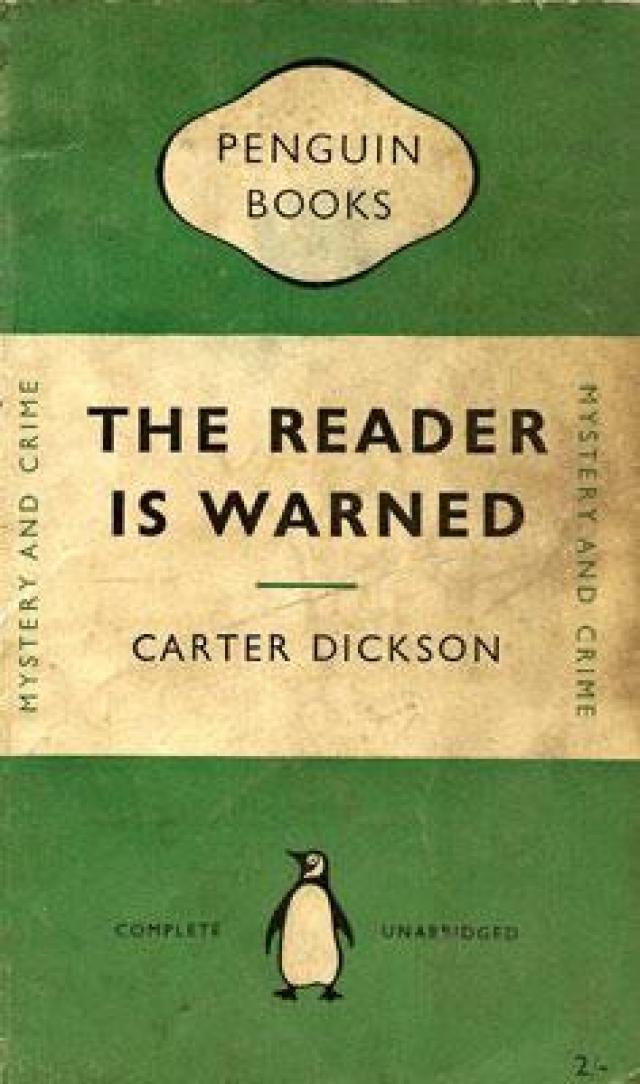
The Reader Is Warned shm-9, page 20
part #9 of Sir Henry Merrivale Series


'Heavenly! Absolutely heavenly!'
'I imagine it was.'
'Oh, it was. I met the nicest - but never mind that. You know what I want to hear. All about P-e-n-n-i-k. Hilary, you've become positively famous; all these terrible things in the papers; I can't think what's come over us. And you there in the middle of it all, all the thrilling things and everything. And that's not all. Pennik! They say he'd do anything for you; they say he adores you; positively dotes on you.'
'I suppose he does, rather.'
'Stella Erskine saw you both at Borononi's last night. Stella said she saw him lean over and kiss your hand in public. Well, I mean. Aren't you thrilled? I should be. Like being taken out by Hitler or Mussolini; only more so, if you know what I mean. Hilary, people positively run after me when they know I'm related to you. But you will tell me first, won't you? You will tell me all about it?'
'You shall hear all about it, Cynthia dear. I promise you that.'
Cynthia wriggled with pleasure.
'That's my Hilary. Now come over here and sit down, do. I can't wait to hear about it. Is he nice? Has he - you know what I mean, dear? Yet, I mean? They say it's a real grande passion, like those French kings who tear about in the stories and whoop it up so.' Her forehead clouded, though not seriously. She half laughed. 'Stella says I'd better be careful. She says she heard that Pennik said I wasn't fit to live, because I took your father's money from you or something like that. How absurd! Isn't it, dear? But don't stand there like that, please. Take off your things. And what on earth is that you've got under your arm ?'
'A little present for you.'
Cynthia's eyes opened, and she flushed with pleasure. 'For me? Oh, Hilary, how nice of you. And that reminds me. I brought you something from the Riviera too; it isn't much, but it was the best watch they had in the shop, and it's got diamond movements or something, whatever that means. There now, I've gone and told you what it was, but never mind. What's in yours? What is it? Let me open it.'
'You'll know in just a minute, Cynthia dear,' said Hilary.
Eluding the other's hands, she put down the parcel on the ledge of the white marble mantelpiece. Smiling, she took off her hat and shook back her rich brown hair.
'Hilary! Is anything wrong? You're trembling!'
'Nothing at all, Cynthia dear. - May I use your bathroom for a moment?'
'Of course,' said Cynthia, smiling at her rather archly. Though Hilary kept her own mechanical smile in the dimness of the room, she gave her companion back a long, curious look; and Sanders's heart turned cold inside him. Then, picking up her handbag with a swift movement, Hilary strode with the same swift movements across to the bathroom. She went in and closed the door.
Sanders could hear somebody's watch ticking. He did not think; he did not dare think. Once he had taken a step forward, as though to interrupt, but H.M.'s hand fell with a crushing grip on his shoulder.
Cynthia Keen hummed a little to herself; looked at herself in a mirror with her head on one side; turned round slowly, examining herself; laughed a little with excitement; lighted a cigarette from a box on a little table beside the wing chair; and put the cigarette out again immediately. She was evidently so avid to hear the details that she could not stand still. Then the bathroom door opened; and the atmosphere of that over-decorated room changed as palpably as though a cold current of air had been turned into it.
Yet it would be difficult to say just how or why the atmosphere had changed. The dim electric candles were burning near Hilary's face, one on either side of the bathroom door just behind her. They threw slanting shadows. They showed that Hilary's colour was perhaps a little higher, and that she was breathing perhaps a little faster; nothing more. She kept her pleasant, poised, rather heavy look. Keeping both hands behind her, she used one of them to push the door shut.
Hilary took a step forward. Cynthia half laughed.
'Darling', what on earth is the matter? I never saw such an absolute juggins! Is anything wrong?'
Hilary took another step forward, her hands still behind her back.
'Hilary!'
'No, really,' said Hilary, breaking the tension by speaking in her quiet, pleasant voice. 'There's nothing wrong with me, Cynthia dear. Only -'
She had nearly reached the chair. By this time, even outside the window they could smell faintly the new odour in that overheated room: the odour of chloroform. Cynthia must have smelled it, too, or must have caught another sort of atmosphere which surrounded Hilary; for she turned in such a way that her face was repeated in several mirrors, and all the faces were white. Nor did Hilary raise her voice in speaking: it was only the contrast between the quiet tones and the meaning of what she said.
'Only I'm going to kill you as I killed Mina Constable,' said Hilary - and flung herself on the other woman.
She spoke almost too soon.
Sanders could have told her that to administer chloroform to a fighting patient is not so easy as the layman supposes. The face-cloth, which she had saturated with it, almost slipped out of her hand; and Cynthia Keen was on the edge of being able to scream, for they saw her teeth before her head was buried in the crook of Hilary's arm. Both were carried over out of sight into the deep chair. Only the flapping, panting noises beat against the back of the chair and shook it partly round. It was a full minute before Cynthia's legs, the feet in white satin mules, ceased to kick and presently fell.
Hilary got up and backed away.
She was bent forward almost double so that the sides of her hair had fallen over her face, and she was breathing hard: Her blue eyes were blank, yet at the same time intensely watchful; they roamed into corners, they were poised as though every nerve were listening, they probed even the silence.
Then she examined herself. One of her stockings had laddered. She automatically put her finger to her lips, moistened it, and ran it along the edge of the stocking before she straightened up. Slowing down her panting breaths, pushing back her hair, she went to look at her now pale face in the mirror over the mantelpiece. Yet she never 'left off that strung-up watchfulness, turning round and round as she moved, round and round, as though wondering if something would surprise her in a corner. The silence felt too heavy; there was not even a clock.
As though remembering, she ran and turned the key in the lock of the door. Then, hastily, she broke the string of the brown-paper parcel on the mantelpiece. It seemed to contain a large box of stiff cardboard, which in turn contained several articles. First she took out several lengths of very heavy but soft-looking black plaited cord, evidently the cord of a dressing-gown cut into pieces. Next she took a pair of rubber gloves, and rolled them expertly on her hands.
Half carrying, half dragging the unconscious woman, her face suddenly snowing red and ugly with a grimace over Cynthia's lace-covered shoulder, Hilary supported her to the bed. She rolled her on to the bed, into the darkness under that muffling fall of brocaded canopy-curtains.
For the first time Hilary spoke aloud.
'I shall have to undress you, Cynthia dear,' she said. 'People have to be undressed before they can die in the way the other two died. After you're undressed, we will just tie you up with these, which are soft and won't leave bruises on you. Then' - she raced back to the mantelpiece, returning with a handkerchief and several strips of sticking-plaster -'we'll put this in your mouth and fasten it with the plaster to finish the gag. I want you to be fully awake when you die.'
Hilary sprang up and round again, her eyes searching,
The fine lightness and grace of her movements, like that of a dancer, was in contrast to the expression of her eyes. Those eyes moved towards the windows, hesitated and moved back. On the bed the other woman uttered a faint moan.
'Yes, you will be coming round in a moment,' said Hilary quickly. 'That must be seen to.'
Two minutes later she pulled up the bed coverlet over the stirring and muttering woman, who now could not move her arms or legs.
'Cynthia. Can you hear me?
'If I dared. I wonder if I dare take that gag out. If I dared.
'Cynthia!'
Inside the canopy showed only a blob of darkness, which Hilary's arm shook. Then Hilary herself seemed to wake up. Across the room there was a fat, squat-legged cabinet of gilt and lacquer-work, its front painted with a pastoral scene of Watteau shepherds and shepherdesses. It held, ingeniously concealed, a radio. Hilary clicked the switch, but no answering light showed against the glass inside. She hurriedly examined the base-plug, which was connected; again she clicked the dead switch back and forth.
'Cynthia, why won't this radio work ?'
There was no reply.
Hilary went over to the bed and spoke in a tone of quiet reasonableness. 'You see, I have got to hear Pennik speaking, poor lamb. He is going to announce your death, and I want to know when to kill you. Teleforce isn't much good unless I give it a little help unknown to him. As the dear chief inspector once truly said, Pennik couldn't kill an ant with a fly-swatter - though he quite sincerely thinks he can; and it's gone to his head.'
She bent closer.
'You would be surprised at the trouble I had persuading him to kill you. He was so set on making an example of Jack Sanders instead; and how he ranted and swaggered and threw his weight about! I had it all nicely arranged, too, before Dr Sanders butted in and challenged him. Then 1 had to go to work all over again. But I managed to persuade him (if you know what I mean, Cynthia? And of course you do) to choose you instead. He keeps telling me that he would give me the sun and moon to wear, if he were king; so he could hardly fail to agree to a modest little request like killing you.'
Hilary laughed a little. Her enormous vitality, her warm and living aliveness of personality, flooded up into it. But that mood changed very quickly. Her feet planted wide apart, her hands on her hips, she again bent forward like a mother over a cradle.
'So you wanted to hear all about it, Cynthia? You wanted to hear all about Pennik, and what he does, and who he is? You shall hear it: I promised you. To put it vulgarly, you thought I had picked a nice soft spot for myself, didn't you? You shall hear how soft it is. Do you know who Pennik is? Do you know what he is?'
She reached into the darkness of the bed. There was a tearing sound; she plucked away several strips of sucking-plaster, and extricated the handkerchief from Cynthia Keen's mouth. She threw the handkerchief on the floor.
'Do you, Cynthia?'
The whimper from the bed was still unintelligible.
'He is an East African mulatto,' said Hilary. 'His father was a white hunter of good family, or so he says. His mother was a Matabele savage. His grandfather was a Bantu fetish-man, or witch-doctor; and he was brought up in a Matabele hut until he was eight years old.'
Outside the window, several persons looked at each other.
As an arrow strikes dead to the centre of the target, as by the sound of the bat the cleanness of the hit can be told, so the essendal rightness of those words came back. They stirred dozens of memories. They made dozens of pictures. They created an image of Pennik, fitting together all the contradictions at once.
'You've seen him in public,' said Hilary. 'Look at his mouth, and his nose, and his jaw. Look at the shape of his head and body. Above everything look at the little blue half-moons at the base of his fingernails. You can't be mistaken, even when you see how he acts. He keeps a dreadful restraint on himself. He doesn't even drink. And yet he's a misfit. In his soul he's three-quarters cultured gentleman and one part superstitious savage; but watch, over and over and over again, the tail wagging the dog. That's the nice soft spot I've picked for myself. Cynthia darling: the black boy.'
Hilary was never still. She moved away from the bed. Now her cheeks were more deeply flushed; and she shivered. Back and forth she went, with little short steps.
'Anyway he was, and is, very intelligent. You can't deny that. They saw that when he was a boy; and an English priest and a German doctor took over his education. They took him away from the fetish-man, and sold the fetish-man's ivory so that he wasn't swindled, and got enough money to keep the boy-wonder for life. But I wish the fetish-man grandfather hadn't got into his skin so much. He did; and I have to stand it - for a little while, at least. The fetish-man taught him too much. I wish he hadn't seen the fetish-man mumbling spells in a hut, and striking down somebody a hundred miles away. He believes in it. He saw it work. All the rest of his life he's been trying to explain it scientifically. He's been at the science of the mind, the science of the mind, the science of the mind: thinking there was a great power somewhere; thinking he could put a scientific net round it and define its terms and mark it out and use it. He's got a power. I don't deny it, in its way. But it's not that.
'And then something snaps in his head sometimes, and he reverts to type. I don't mind that in the least, because it's given little Hilary what she wants; or it will, when I've watched you die. He reverted to type last Friday night, at the Constables', when we couldn't keep the conversation off a certain subject.
'You must hear about that. We were sitting in the conservatory, Sam Constable and Mina Constable and Dr Sanders and Larry Chase and myself, and not understanding what was under the surface. I wish I had understood it then. But I didn't. Nobody did. That smoothed-faced gentleman, perfect gentleman, Samuel Hobart Constable, had already been baiting Pennik until he couldn't stand much more of it. Then dear Dr Sanders set the real ball rolling by saying, "We will pass over the question of whether you could kill a man by thinking about him, like a Bantu witch-doctor."
'Pennik himself had already made a slip by using a "savage" as an illustration in an argument, and correcting himself quickly. But after that we couldn't keep off the subject. Chefs' caps came into the talk; and Mr Constable said, with that oh-so-nice-sneer of his, that Pennik would look well in a chef's cap. Mina Constable asked whether Dumas didn't once cook a dinner for the gourmets of France; and Dumas, as you probably don't know, was an octoroon. Samuel Hobart finished it by saying, "If I can dress for dinner among a lot of damned niggers, I can dress for dinner in my own house." And the light went out in my little mulatto's brain. He said Samuel Hobart would die. '
'And he would have died, if a Bantu spell could have killed him. That's what Pennik put on him over the salad-bowl. That's what scared that woman-servant and her son so much that they ran away from the house. That's why Pennik gets to a state of frothing at the mouth. That's why he came to me first, and attempted that highly inartistic seduction before dinner - really, Cynthia, dear, I hope most of your own clients are better - and told me hp would kill Samuel Hobart as a sacrifice to me, and said he would strew rubies at my feet; and, in short, my dear, for the moment at least, he really did frighten little Hilary out of her wits. I was terribly impressed. For Samuel Hobart did die, just as Pennik said he would. But the amusing part of the whole thing is that Pennik had nothing to do with it. The little Matabele boy is quite harmless, if you know how to manage him. All the same, he was a nice cover for me when I killed Mina Constable. I killed Mina so that she shouldn't blab the real truth about Sam's death, and then I could go on and do the real work - that is, attending to you - still under cover of Pennik's mysterious powers. Pennik's mysterious rubbish 1
'I know exactly what I'm doing, angel. I know that I'm in for some awkward suspicions and some awkward questions. But I'm used to that. I rather like dealing with men in that way. The point is that, no matter how much they suspect or think they suspect, they'll never be able to prove anything. Even if they do burst Pennik's bubble they'll still suspect him, and I shall be sitting most dainty and pretty (as usual) because I've got a really noble alibi for the death of Samuel Hobart Constable.'
Whereupon Hilary Keen made the mistake she could perhaps not help making. She lost her head. She had started talking, and she could not stop.
Her face was pink; she went so far as to do a small dance-step on the carpet, very gracefully and rather grotesquely; yet it revealed the inside of a mind as much as her words.
'I'm tired of playing things safe and sound, when people like you can get all they want just for the whistling. I made up my mind I was going to see you in your grave just as soon as I heard the real truth about how Samuel Hobart Constable died.
'I didn't kill him, Cynthia - did I tell you that? No, no. Up to the day after he died my thoughts were as innocent and pure as they ever have been. Otherwise I shouldn't have been so free about admitting to Dr Sanders that I wanted to see you dead. I heard the truth about Samuel Hobart's death because for two nights afterwards I slept in the same room with Mina; and Mina, as everybody knows, talks in her sleep. First I fitted together one bit of it; and then I fitted together another bit of it; and then I saw how I could use Pennik to cover me like a sheet in getting at you.
'In law, you could say that Samuel Hobart's death was an accident. It was, in mechanics; but it wasn't really an accident. Pennik was responsible for it. If Pennik hadn't said what he did, and done what he did, and prophesied death at Fourways before eight o'clock, Samuel Hobart would be alive and strutting at this time. It was bound to happen. If I had only listened to that conversation beforehand I could have seen it coming at us like an express-train. People 'all acted according to their natures, each as he had to; and Samuel Hobart's fat little carcase got the benefit of it. I got the benefit of the rest of it. Now you'll see how he died, because you're going to die like that too.'
Hilary made a little curtsey - as Sanders remembered, he had seen her do once before, on the stairway at Fourways. He also knew the expression of her face - he saw it under die mosaic dome in the dining-room, her colour up and her eyes glittering, when she took leave of him a few hours before the death of Mina Constable.
She ran over to the mantelpiece, taking a skip or two like a schoolgirl. She put her hand into the cardboard box.
'If the radio won't work,' she said practically, 'it won't work. And that's that. I've got oceans of time, anyway, before the announcement. I want you to pay close attention, ; Cynthia. It's the loveliest little way of killing people I've heard of. And needs no knowledge, or heaven knows I couldn't have managed it. Chief Inspector Masters said another thing that was as true as gospel. I sneaked up to listen to what they were saying at the door, before they put me on the train I didn't take; and he said, "Something as wild as wind and yet as domestic as cheese. Something you could do in your own home with two thimbles and a tablet of soap." And that was quite right. Soap! Soap! That reminds me. You'll have to wait a minute!'