Right Away Monday, page 37


Time enough to move to the capital city and hunker down in a scuzzy basement apartment with no windows and a nice, quiet family living above who are likely traumatized to this day. Writing away the nights—naive, angst-ridden rants and lyrics and twisted poetry just a few bloodstains short of a prolonged suicide note. Checking in with a psychotic probation officer every Friday morning. Sleeping pills. Beer. Tattoos. Port wine because Jack Kerouac says so. Black, black coffee and Drum tobacco. Girlfriend leaves and Hynes gives chase, manages to make a nasty situation ten times worse.
Back downstairs, alone with the cat. Gets a poem published! Bob Dylan. Roddy Doyle. Irvine Welsh. No heroin in St. John’s. University. “Mature” student. English classes—T. S. Eliot, Philip Larkin, Steinbeck, Layton, Plath, Heaney—the usual fixings. Drinking hot brandy from a coffee cup in the back of the classroom and trying to figure a way under the professor’s skirt. Failing, failing. Friends falling by the wayside.
Downtown! A bar called the Spur. The last of the bona fide drinking holes. Gone now, never coming back. Drinking some more. Nick Cave. Springsteen. Dodging the landlord. Caught stealing a Snickers bar at Wal-Mart. Three days in jail. Serving one-third of his sentence and then trying to walk the straight and narrow. Writing a play. Still failing out of school. Detox. Rehab.
Answers an ad in the paper for a job in Dublin. Gets the job, miraculously. Sent to Dublin for six months to “explore career options.” Wanders the country looking for work with the IRA. Makes an arse of it all. Solidifies his alcoholism.
Back to St. John’s with a haircut and new clothes. Back to the Spur. Things is all changed around. There’s an air of excess. The new millennium breeds panic. Get it in you as quick as ever you can. “Why dont you try bartending, Hynes? You’re here every night anyhow.” Becomes overnight sensation as the angriest bartender in St. John’s. Rakes in the cash and beer tokens. Weed and wraps of blow in his tip jar. Meets a new girl, loses his mind. Detox, auditioning, writing, no more band. Has another go at his play. Spiralling, stumbling, staggering the streets. Hits the pavement at seven in the morning, comes to in the back of an ambulance with a tourniquet on his arm. Lots of blood. Two weeks on a short, short leash. Goes back out into the world and doesnt drink anymore for a long, long time. Head starts to clear up a little.
“Becomes overnight sensation as the angriest bartender in St. John’s.”
Goes back to that play. It keeps getting bigger and bigger until he finally has to admit it’s a book. Finds himself on camera now and again. Tries whole-grain bread for the first time. Eats an avocado. Spends time in the bush in Northern Ontario, treeplanting, while his girlfriend’s belly is swelling with a baby boy. Comes home and hunkers down to be a dad.
Beautiful child born in the fall of that year, changes everything. Finally gets that play produced, called The Devil You Dont Know. Co-written with S. White, starring Hynes and White together. The play is a smash hit, by St. John’s standards. Down to the Dirt, the unpublished novel the play is adapted from, wins the Percy Janes First Novel Award. Killick Press publishes the book a year later. Everything changes again. Another year later, HarperCollins reissues the novel in Canada. French and Serbian translations follow. A U.S. edition. Down to the Dirt is nominated for the International IMPAC Dublin Literary Award. Hynes wants that hundred thousand Euros. He wants to go back to Dublin a published author and a happy, sober dad. He doesnt make the shortlist.
“Spends time in the bush in Northern Ontario, treeplanting, while his girlfriend’s belly is swelling with a baby boy.”
Gets a good job performing and writing on a CBC television show called Hatching, Matching and Dispatching. Works on another play. Starts writing another novel. Chelsea Hotel in New York, typically. Cant find no heroin there either. Down to the Dirt becomes a movie script. Hynes finds new accommodations in St. John’s, by himself, but shares his son, of course. Writing, writing. Book, play. Buys a vintage motorcycle. Finds an old abandoned house around the bay and starts fixing it up. Heads off to Los Angeles and wanders Venice Beach. Cant find no heroin there either.
Back to St. John’s. Launches audio book in Brooklyn. Gives worst reading of his life in Boston. Almost dies from mystery virus. Virus renders him deaf for a couple of weeks. While deaf, he cuts up hot peppers and rubs his eyes afterwards. Goes blind. Crawling around on the floor and shouting to his son to come help him get to the sink. Son thinks it’s hilarious that Dad is both deaf and blind. Later that night Hynes takes a shower and gets the hot pepper on his balls too. It burns. Sometimes it surprises him that he’s smart enough to write books.
Finally goes back to Ireland with a whole gang of Newfoundland writers and musicians. Tours the southeast. Lands in Dublin like a madman and completely discredits himself all over again. Same old Hynes, worse now that he’s got a book out.
Second novel comes out in May 2007. Called Right Away Monday. New play, Say Nothing Saw Wood, hits the stage a week later. About the murder of an old woman by a seventeen-year-old boy. Based on a true story. Sold-out run in St. John’s. Hynes begins to turn it into a novel. Down to the Dirt, the movie, is shot in the summer of 2007. Hynes plays the lead. Wicked, intense, very challenging. Back and forth between St. John’s and Toronto. Waiting, waiting for something big to fall from the sky.
“Sometimes it surprises him that he’s smart enough to write books.”
Writer-in-residence at the Drake Hotel in Toronto for a while. No one lines up to get his autograph. Goes out to auditions and pitches TV ideas. A few bites. Grows weary of the concept of a ladder, realizes that you’re only as good as the last time you worked. That you have to keep on going for the rest of your natural life. That you might stop to catch your breath but you cant actually stop to breathe.
Nothing falls from the sky. It seems there’s no commercial appeal in killing a poisoned cat or beating off into a bottle of shampoo. Most people want to talk about the weather. We are all alone.
Starts in on another novel. Teaches creative writing to the inmates at Her Majesty’s Penitentiary in St. John’s. Starts working on a screenplay. Applies for grants. Tries to be a good dad. Tries to take it all a day at a time. Sits down to write an extended bio in the third person, as if someone who knows him really well wrote it, and not him.
In Conversation with Joel Thomas Hynes
Can you tell us about your formative years and how they shaped your creative imagination? Was reading and writing a big part of your world growing up?
I was very much an outsider as a child. I wanted to be involved in dangerous activities, and I was up for more imaginative adventures than, say, getting a ball game underway. I liked setting things on fire and going places I wasn’t supposed to go. I didn’t have much time for competitive sports, even though I was marginally involved in softball and hockey for years. I’d say the only sport I put any real value in was, and is, cross-country running, and that’s a very solitary, masochistic activity, which suits me fine. But where I come from, hockey players are hailed as community heroes, no matter if they happen to be illiterate, bullying narcissists. And if you don’t excel at sports, then you’re pretty much useless. I think that’s the way with a lot of Canadian towns. There certainly wasn’t any room for creative thought or artistic expression. And, of course, when you’re really young, you don’t have any way of knowing that you’re an artist or a writer. So you just think you’re useless or fucked up somehow. There’s something wrong with you if you don’t care about the Stanley Cup. So with me being a rather rambunctious individual, I just found ways to rebel and satisfy my interests.
“As a child, I wanted to be involved in dangerous activities.
My father was a voracious reader and I always strove for his approval, so from a young age, I found a lot of comfort in books.
It never really occurred to me that I could write until I was in my early teens. I discovered The Doors, typically, and thought I was Jim Morrison for a while. And through The Doors I got on to Bob Dylan and Jack Ker-ouac, and then Steinbeck and Hemingway and all those crazies.
My mother is a closet-case songwriter and spent her entire life playing the piano. My uncle is the renowned songwriter Ron Hynes, and so I felt I was close to creativity somehow. Ron would put out an album every couple of years, and he’d be all over the TV and the papers. He was quite famous on the Southern Shore, and I remember finding some sort of indirect inspiration from all that, a feeling that it was possible.
“I always feel like I am moving forward when I write.”
So I started writing poetry. Flat out. Three or four full poems a day. Perfect rhyme schemes. Teenage stuff. Then I moved on to journal writing, and fictionalizing my journals. I started a band and we played the bars. We were all hungry and young and naive, and we had fun. I was reading all the while.
I guess I’ve been writing since I was a child—stories and essays and poetry and lyrics—and I’ve always identified with books and writers. So I am a writer, and always was, long before I was ever published.
Writing offers me control. I always feel like I am moving forward when I write.
Many of your characters, but particularly Keith Kavanagh and Clayton Reid, have a propensity toward self-obliteration. Yet they don’t seem to take death too seriously; rather, they get a thrill out of courting self-destructiveness. In fact, one of Clayton’s favourite toasts is “There’s always suicide.” Can you talk a little about that?
I’ve never taken death too seriously. I have an egotism that lets me believe I’m immune to it, or that my own death will be timely and poetic. Or that it can’t happen to me. Or that I’m not one of the ones who actually will contract lung cancer from smoking. Or that AIDS is something that happens to someone else. Or that I can become involved with certain drugs and can pull out whenever I like, no trouble. That I am different. It’s stupid, I know, and maybe it’s a sort of defence mechanism. Maybe it just means I’m a bit of a nutbar. But I have a suspicion that a lot of people think that way. The truth is, I’ve had a few close calls and lived to tell the tale, and I feel like I’ve been spared for a good reason, like if I didn’t check out that night ten years ago with all those downers packed into my system, I won’t kick it on my way to the grocery store tomorrow either. And that attitude helps me run red lights and give lip to big guys downtown.
“I have an egotism that lets me believe I’m immune to death, or that my own death will be timely and poetic.
But seriously, once when I was seventeen, I was kicked out of a club on the Southern Shore because I was practically legless. I walked a small ways down the road toward home and collapsed in the woods in the snow. That night it rained a little and then warmed up for a while before it got really cold again. When I woke up the next morning, my hair was frozen into the ice—I had really long hair back then—and I had to yank hard to get out of it. I didn’t die, and I always think I defied physical reality by living. And something else in me believes I was being watched over and kept here for a reason.
What are you working on now?
These days I’m working on a number of different projects, some personal and some commissioned. I’m writing a screenplay a new stageplay, and I’m developing a new novel. I also teach creative writing at Her Majesty’s Penitentiary in St. John’s, where I’m helping the inmates create an anthology of their work. I’ve always got a lot of things going at one given time, even though half the time I feel like I’ve got nothing going on at all.
“I’ve always got a lot of things going at one given time, even though half the time I feel like I’ve got nothing going on at all.”
The novel I’m working on is called Say Nothing Saw Wood. It’s based on the true story of a murder that happened in my hometown in 1971. A teenager killed an old woman after she woke up to find him robbing her home. She had known him all his life and looked out for him from the time he was a small child. The story is basically an exploration of a life gone horribly wrong, how one split-second decision can change the course of so many lives. It’s a look at how we are remembered, how we would like to be perceived and received by the world, and whether or not we can ever truly rise above the stigma of the worst thing we’ve ever done.
About the book
Joel Thomas Hynes on Writing
By the time I finished writing my first novel, I’d pretty much taught myself how to write a novel. So I was ready to try it for real. That sounds kind of self-deprecating, but it’s actually not so far from the truth. Who can teach you to write a novel? I dont think anyone can. The only way to learn is by sitting down and having a go at it and letting yourself get it wrong, opening yourself up to criticism and advice, submitting your work to publishers and journals, swallowing the rejection letters, elbowing your way onto the reading circuit, crying and chain smoking your hair out. That’s what I did. But I suppose it does help to be a little prepared as well. It’d be kinda hard to write a novel if you hadnt ever read one. You gotta read a lot of books, read the way other writers tell their stories. I tend to latch on to particular writers and then hunt down everything they’ve written and look for the commonalities that bridge their work. I will read until they disappoint me, and then I’ll start on someone new.
“When I’m not writing, then it’s the last goddamn thing I want to do.”
Books have always carried me through. Reading is the one thing I do always, no matter what state my life is in. Whereas writing, on the other hand, comes only when I’m completely backed into a corner. Because when I’m not writing, then it’s the last goddamn thing I want to do. I know I should be writing, but I just dont want to. But the longer I’m away from it, the more unravelled it seems my life becomes. I get restless and dark and I push people away. I take to the bed. I might take a drinking fit. I drive faster on the highway. I might start writing poems. I have even started jogging. And then comes the moment when I realize what an absolute arse I’ve been for the past weeks or months, and I own up to what I am and what I need to be doing, make up my mind to start in writing on a certain date…and the cloud lifts.
I’ve often thought about this restlessness, about what makes people write or paint or sing or take pictures. I guess, at its most obvious, it’s the need to capture how you see the world, the need to convey an opinion, the need to express what is in your head and your heart—where you come from, what you feel. But where does the need originate? It comes from a crisis of communication. I think those with the creative bent are considerably more alienated individuals than more conventionally minded folks. It’s the artist’s twisted attempt to socialize. Writing is a way of announcing that we feel alone and that we dont want to feel alone anymore.
“Writing is a way of announcing that we feel alone and that we dont want to feel alone anymore.”
For me, when I write, I want to recreate how things went down. I want to reinvent what happened in my own terms. I want to alter the memories of those who might have brushed against me when I was not at my best. Put words in a character’s mouth that wouldnt necessarily come out in real life. Renegotiate the conditions of my history. And I like to toss a bit of fiction in there as well.
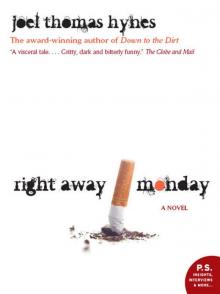
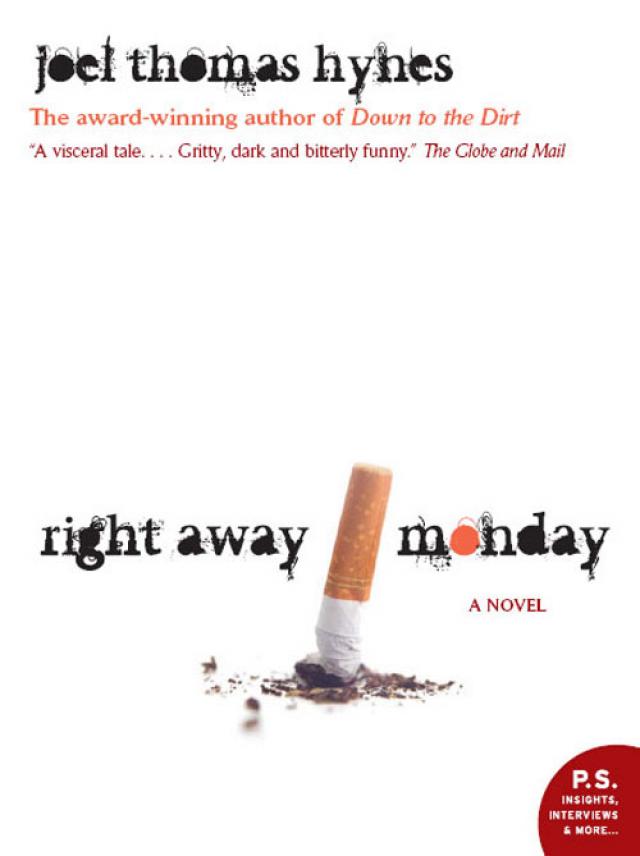
I started writing Right Away Monday before Down to the Dirt was published. The latter was signed with a publisher already, so I had no idea what to do with myself. All I knew was that I wanted to keep exploring roughly the same themes and types of characters as I had brushed against with my first book. I guess that’s always what the next book is—the attempt to get it right the next time around. That’s the constant state of dissatisfaction that all writers and artists endure. But imagine being satisfied. What a horribly flaccid idea. People come up to me and say how they loved this or that piece I wrote and how I must be delighted with it, and all I can think is how much I’d love to go back and rewrite it.
A big part of publishing your work is also learning to let it go, coming to terms with the fact that it no longer belongs to you but to the reader. That it’s going to be interpreted and misinterpreted or praised or shit on, and there’s nothing you can do or say because it no longer has anything to do with you. I remember seeing copies of my books on the shelves and freaking out because—for whatever personal reason or mood I was in—at that moment I didnt want anyone to read them. I wanted them back. It’s hard sometimes for me to be proud of work that is often perceived as being over-the-top angry or dark or destructive. Couple this with the notion that my work is largely autobiographical and it gets me feeling a little raw and naked.
“I remember seeing copies of my books on the shelves and freaking out because at that moment I didnt want anyone to read them.
But it’s difficult when complete strangers believe that you are one and the same as the characters you write about. We all know how dull and boring and uninspired real life is. Sure, there’s lots of sex and lots of ways to entertain yourself of a Friday night, and of course there are the ones you love, and there’s motorcycling and trouting and birthday parties and opening nights and travel and strange lands with stranger customs, but there’s fuck all to believe in anymore. Our beliefs are fuelled primarily through propaganda. We are told to recycle, compost, boycott, strike back, to not stand for it. We are told to subscribe, conned into believing we can make a difference when we know in our hearts that something else is more accurately true: that there is no God, there is no country, there is no one, big forever love, no soulmate, there are no miracles, no ghosts, no second coming, no one ever really wins the lottery, no one really gets their own TV show, there are no coincidences, you will never get that apology, your lover can never truly come back, nothing will ever really change out there, not for the better, not according to your own terms. Smoking in public is gone and it’s never coming back.